
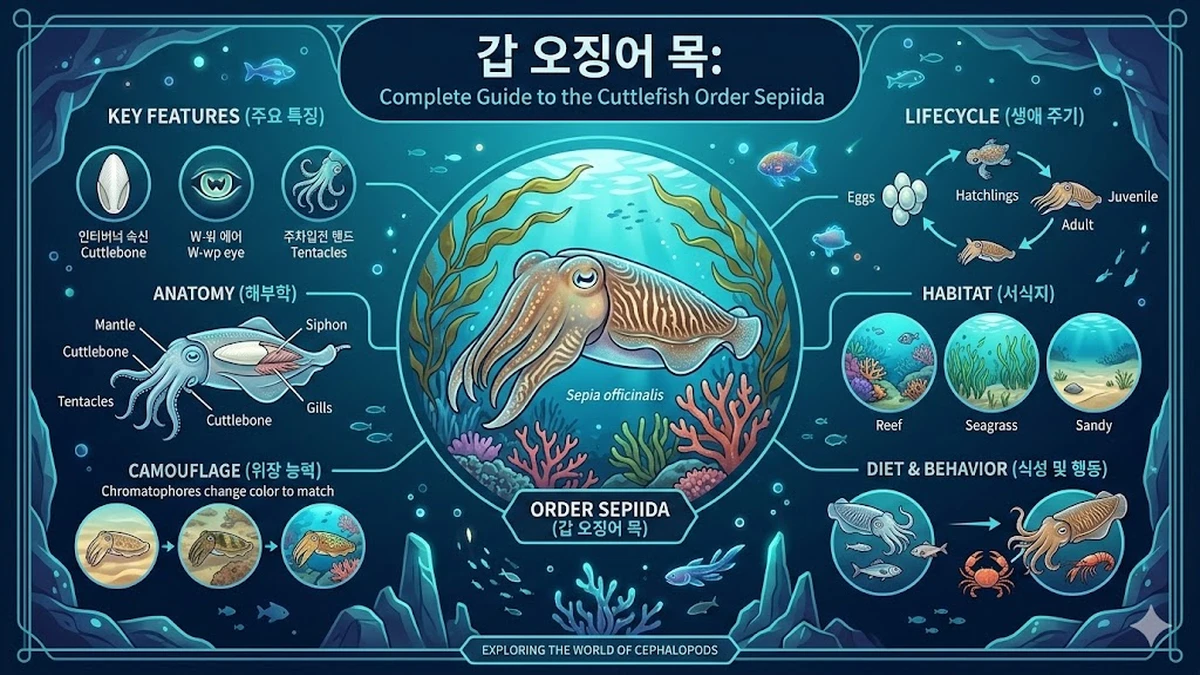
When people search for information about the cuttlefish order, they are usually seeking clarity about what distinguishes these animals from squid and octopus. Cuttlefish belong to the order Sepiida, a group of marine cephalopods defined by their internal shell, extraordinary camouflage abilities, and highly developed nervous systems. Found primarily in shallow temperate and tropical waters, they play critical ecological roles as both predators and prey. – 갑 오징어 목.
I begin with the simplest explanation: Sepiida is a taxonomic order within the class Cephalopoda, which also includes squid, octopus, and nautilus. What makes cuttlefish distinct is the cuttlebone, a porous internal structure that regulates buoyancy, and their unmatched capacity for rapid color change. According to Smithsonian Ocean, cuttlefish are often called “the chameleons of the sea” (Smithsonian Ocean, n.d.), a phrase that captures both their beauty and biological complexity.
But classification only scratches the surface. The story of Sepiida spans over 200 million years of evolution, from ancient marine environments to modern coral reefs. Their skin contains millions of chromatophores, allowing instant pattern shifts that rival any vertebrate display. Their eyes perceive polarized light, and their arms manipulate prey with calculated precision.
Understanding the order Sepiida means exploring anatomy, behavior, fisheries, history, and even art. What appears to be a modest mollusk is, in truth, one of the most sophisticated invertebrates in the ocean.
Taxonomy and Evolutionary Origins
The order Sepiida sits within the phylum Mollusca and class Cephalopoda. Unlike octopuses in the order Octopoda or squids in Teuthida, cuttlefish possess a calcified internal structure called the cuttlebone. Fossil records suggest that early coleoids, ancestors of modern cephalopods, emerged during the Mesozoic era.
The evolution of internal shells marked a dramatic shift. While nautiluses retained external shells, coleoids evolved reduced or internalized shells for improved mobility. The cuttlebone represents a buoyancy device, allowing cuttlefish to hover effortlessly above reefs and sandy bottoms. – 갑 오징어 목.
Marine biologist Roger Hanlon has described cephalopod camouflage as “the most versatile camouflage system known in nature” (Hanlon, 2007). That system likely evolved as a survival response in predator dense shallow waters.
Modern Sepiida includes over 120 recognized species, most concentrated in the Indo Pacific region. The common cuttlefish, Sepia officinalis, has become the model organism for laboratory research due to its manageable size and adaptable behavior.
Anatomical Distinctions
Cuttlefish share cephalopod traits such as eight arms and two specialized feeding tentacles. However, their anatomy includes unique features that distinguish them from other orders.
Key Anatomical Features of Sepiida
| Feature | Description | Functional Role |
|---|---|---|
| Cuttlebone | Internal, chambered calcium carbonate structure | Buoyancy control |
| Chromatophores | Pigment containing cells in skin | Rapid color change |
| Polarized Vision | W shaped pupils | Enhanced prey detection |
| Two Tentacles | Retractable feeding appendages | Swift prey capture |
The cuttlebone’s chambered design allows gas regulation. By adjusting pressure within chambers, the animal achieves neutral buoyancy. This structural adaptation enables near motionless hovering, critical for ambush predation.
The skin is layered with chromatophores, iridophores, and leucophores. These layers interact to produce dynamic patterns within milliseconds. National Geographic notes that cuttlefish can shift colors “in the blink of an eye” (National Geographic, n.d.), underscoring their neurological precision.
Read: Smartness Lab: A Complete Guide to Innovation, Intelligence, and Applied Knowledge
Camouflage and Communication
Few animals command as much scientific fascination as cuttlefish when it comes to skin patterning. Their camouflage is not merely defensive. It is communicative.
Chromatophores expand and contract through direct neural control. Unlike many animals that rely on hormonal signals, cuttlefish skin responds almost instantly to environmental cues. They can display disruptive patterns, uniform colors, or mimicry. – 갑 오징어 목.
Research has demonstrated that cuttlefish use body patterns during mating rituals and territorial disputes. A male may display bold zebra stripes to signal dominance. In some species, males perform a remarkable split display, presenting courtship colors toward a female while showing subdued patterns toward rival males.
Three main camouflage strategies have been documented:
- Background matching
- Disruptive coloration
- Masquerade mimicry
These strategies reveal cognitive sophistication. Cuttlefish evaluate spatial features of their environment before choosing a display.
Intelligence and Behavioral Complexity
Cuttlefish intelligence rivals that of many vertebrates. Laboratory studies show that they can learn from observation, navigate mazes, and remember past experiences.
Cephalopods possess the largest brain to body ratio among invertebrates. Their neural density supports rapid sensory processing and decision making. According to a review in Philosophical Transactions of the Royal Society B, cephalopods demonstrate advanced problem solving skills that parallel some vertebrates (Godfrey Smith, 2016).
In controlled experiments, cuttlefish have delayed gratification when offered preferred food rewards, a behavior often associated with higher cognition. Such studies suggest forward planning abilities. – 갑 오징어 목.
Marine ecologist Jennifer Mather has written that cephalopods show “complex behaviors and learning abilities” that challenge assumptions about invertebrate cognition (Mather, 2008). This growing body of evidence has even influenced animal welfare regulations in parts of Europe, where cephalopods are protected in research contexts.
Habitat and Global Distribution
Sepiida species inhabit coastal and continental shelf regions, particularly in warm waters of the Indo Pacific, Mediterranean, and eastern Atlantic. They prefer sandy substrates, coral reefs, and seagrass beds.
Major Geographic Regions of Sepiida
| Region | Representative Species | Notable Habitat |
|---|---|---|
| Mediterranean Sea | Sepia officinalis | Seagrass beds |
| Indo Pacific | Sepia latimanus | Coral reefs |
| Western Pacific | Metasepia pfefferi | Reef slopes |
| Eastern Atlantic | Sepia elegans | Sandy coastal zones |
Seasonal migrations occur in temperate zones. In the Mediterranean, cuttlefish move to shallow waters during spring spawning periods. Fisheries data from the Food and Agriculture Organization indicate that Mediterranean landings of Sepia officinalis have fluctuated significantly over recent decades due to environmental and fishing pressures (FAO, 2022).
Life Cycle and Reproduction
Cuttlefish are generally short lived, surviving one to two years. Reproduction is terminal, meaning adults typically die after spawning.
Males compete for access to females through visual displays and physical contests. Fertilization occurs internally. Females attach grape like clusters of eggs to seagrass or reef structures. – 갑 오징어 목.
Embryonic development lasts several weeks. Remarkably, embryos can perceive light and may respond to visual stimuli before hatching. Juveniles emerge fully formed and immediately capable of hunting.
Growth is rapid. Within months, juveniles reach maturity. Their life strategy emphasizes quick development, intense reproduction, and generational turnover.
Fisheries and Culinary Significance
Cuttlefish have long been harvested for food and ink. In Mediterranean and East Asian cuisines, they are prized for tender flesh and distinctive flavor.
Commercial fishing methods include trawling, traps, and hand lines. Global catch data from FAO show consistent demand, especially in southern Europe and Japan.
Cuttlebone has also been used historically as a calcium supplement for birds and as a polishing agent. – 갑 오징어 목.
However, overfishing poses concerns. Because cuttlefish populations fluctuate with environmental conditions, fisheries management requires careful monitoring.
Cultural History and Ink
Long before marine biology named the order Sepiida, artists knew cuttlefish through their ink. The pigment known as sepia was widely used in Renaissance drawing.
The word sepia itself derives from the Greek term for cuttlefish. Ink sacs once provided a natural brown pigment used in manuscripts and early photography.
In literature, cuttlefish have symbolized concealment and adaptability. Their ink defense mechanism became a metaphor for strategic retreat.
Climate Change and Emerging Research
Ocean warming and acidification pose potential threats to calcifying organisms. Because the cuttlebone contains calcium carbonate, researchers are examining how acidified waters affect buoyancy structures.
Preliminary studies suggest that some cephalopods may adapt more quickly than other marine invertebrates due to rapid growth rates. Still, shifting prey availability and habitat degradation present long term risks.
Scientists are also studying cuttlefish vision to inspire bio inspired technologies. Their ability to perceive polarized light has applications in imaging and robotics.
Expert Perspectives
Dr. Roger Hanlon, a senior scientist at the Marine Biological Laboratory, has emphasized that cuttlefish camouflage is not random but “controlled directly by the brain in real time” (Hanlon, 2007).
Marine ecologist Jennifer Mather argues that cephalopods should be considered behaviorally complex animals deserving ethical consideration (Mather, 2008). – 갑 오징어 목.
According to Smithsonian Ocean, cuttlefish are “masters of disguise,” a phrase reflecting decades of observational research (Smithsonian Ocean, n.d.).
These expert assessments reinforce the idea that Sepiida represents one of the most advanced invertebrate groups on Earth.
Takeaways
- Sepiida is the taxonomic order that defines all cuttlefish species.
- The cuttlebone provides buoyancy control unique among modern cephalopods.
- Rapid camouflage is neurologically controlled and multifunctional.
- Cuttlefish demonstrate learning and memory abilities uncommon in invertebrates.
- They inhabit coastal waters globally, especially in the Indo Pacific and Mediterranean.
- Fisheries rely on sustainable management due to fluctuating populations.
- Climate change may affect calcification and habitat stability.
Conclusion
Cuttlefish rarely headline marine documentaries in the way sharks or whales do, yet their biological sophistication rivals that of many celebrated species. As I reflect on the order Sepiida, what stands out most is its elegant balance between vulnerability and mastery. A soft bodied mollusk without an external shell has evolved one of the most refined camouflage systems in nature.
Its life cycle is brief but intense. Its intelligence challenges assumptions about invertebrate simplicity. Its ink has shaped art, and its flesh sustains communities. In coral reefs and seagrass beds, cuttlefish continue to perform silent displays of color and cognition.
Understanding Sepiida deepens our broader understanding of evolution itself. It reveals how pressure from predators, competition, and environment can sculpt extraordinary adaptations. Beneath the shifting patterns of their skin lies a story of innovation written across millions of years of ocean history. – 갑 오징어 목.
FAQs
What distinguishes cuttlefish from squid?
Cuttlefish possess an internal cuttlebone for buoyancy control, while squid have a flexible internal pen and typically longer bodies adapted for open water swimming.
How many species exist in the order Sepiida?
Scientists recognize over 120 species, primarily distributed in the Indo Pacific and Mediterranean regions.
Are cuttlefish intelligent?
Yes. Studies show learning, memory, and problem solving abilities comparable to some vertebrates.
Why is sepia ink historically significant?
Cuttlefish ink was used as a brown pigment in Renaissance art and early photography.
Do cuttlefish face conservation threats?
Overfishing and climate related habitat changes pose challenges in certain regions.