
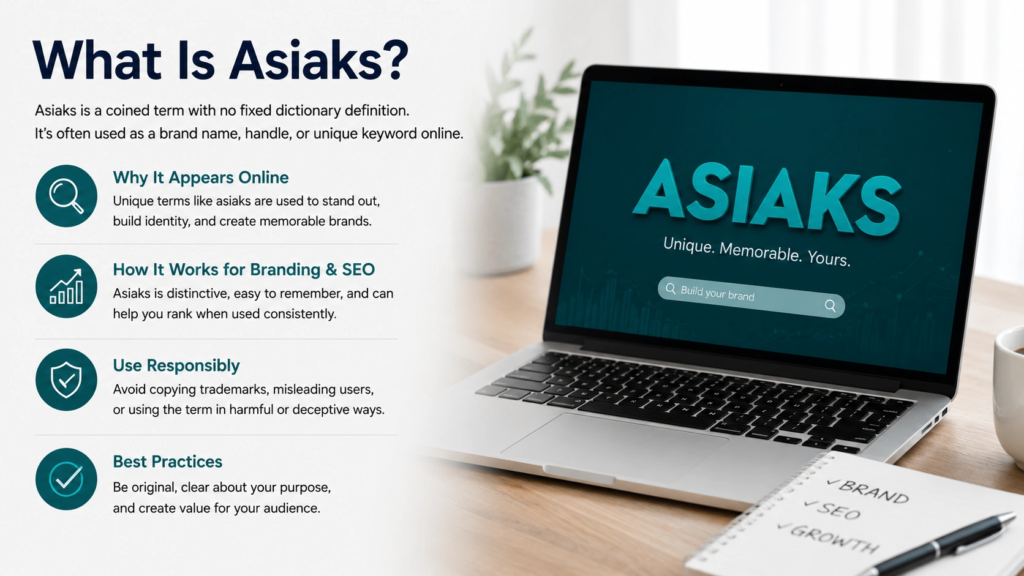
I see asiaks as the kind of word that makes readers pause because it looks familiar and unfamiliar at the same time. It sounds like it could be a brand, a regional word, a typing error, a business name, or a new digital concept. That uncertainty is exactly why it deserves a careful explanation. In my analysis, asiaks is best understood as an emerging coined term that appears across online branding, search behavior, business naming, and digital identity discussions. It does not have one universally accepted dictionary meaning, so the safest way to use it is to define the context clearly before building content, a brand, or a marketing strategy around it.
Key Takeaways About Asiaks
Asiaks is not a widely established dictionary word with one fixed meaning. It is better treated as an ambiguous online keyword that may refer to a coined brand name, a digital identity term, a business label, a possible spelling variation, or a search query created by user curiosity.
In my view, the most useful explanation is that asiaks works like a modern invented brand word. It can be shaped by context, repetition, audience understanding, domain use, and content quality. A coined word can become meaningful when a brand consistently attaches clear services, values, visuals, and trust signals to it.
Asiaks may also cause confusion because it resembles other terms. Some users may connect it with “Asia,” “asiakas,” or even “ASICS” because of spelling similarity. That does not mean those terms are the same. It means anyone using asiaks in content should be clear about what the word means in that exact setting.
For SEO, asiaks has both opportunity and risk. The opportunity is low competition and high curiosity. The risk is weak intent. If readers search the word and find vague content, they may leave quickly. A strong asiaks page should explain the term directly, compare possible meanings, and guide readers toward practical use.
For branding, asiaks could be useful if a business wants a distinctive, flexible, and memorable name. However, I would never recommend using it without checking domain availability, social handles, trademark databases, local meaning, pronunciation, and possible confusion with existing brands.
What Asiaks Means in Practical Terms
Asiaks means different things depending on where the reader finds it. In a branding article, it may mean an invented brand style keyword. In a business listing, it may be part of a company name. In a search engine, it may represent curiosity around an unfamiliar term. In language comparison, it may be discussed near similar looking words such as “asiakas,” which means customer or client in Finnish. In product search, it may even appear because someone typed a word similar to another brand by mistake.
I believe the most responsible definition is this: asiaks is an ambiguous coined term used mainly in digital contexts, branding discussions, search behavior, and possible business naming. It should not be treated as a universal cultural label, a verified platform, a guaranteed company name, or a proven technical term unless the source clearly defines it.
This distinction matters because many new online terms gain attention before they gain stable meaning. A word can appear in blog posts, social media handles, domain names, directories, and SEO pages long before it becomes a formal term. We can see this pattern across the internet. A unique word starts as a curiosity, then content creators explain it, businesses test it, and search engines begin associating it with the contexts where it appears most often.
A practical example helps. If a startup uses Asiaks as the name of a logistics software product, then the word means that brand in that setting. If a blogger writes about asiaks as a coined digital identity term, then the word means a naming concept in that article. If someone searches “asiaks shoes,” they may be trying to find something else entirely. The spelling alone does not solve the meaning. Context does.
Why Asiaks Is Confusing for Searchers
Asiaks is confusing because it has the structure of a brand name without the stability of a well-known brand. It is short, memorable, and unusual, but it does not immediately tell the reader what category it belongs to. That makes it useful for branding, yet difficult for search intent.
The first source of confusion is spelling. Asiaks resembles several other word patterns. It begins with “Asia,” which may suggest geography, trade, travel, culture, or global business. It also resembles “asiakas,” a Finnish word often translated as customer or client. It may also be confused with ASICS, the sportswear brand, because the letters and sound pattern are close enough for casual searchers to mix them up.
The second source of confusion is online repetition. When a term has no stable meaning, many websites may publish broad articles that repeat general explanations without proving what the word actually refers to. This can create visibility, but not always clarity. In my view, this is where responsible content has to slow down and say what is known, what is uncertain, and how readers can verify the meaning.
The third source of confusion is branding flexibility. A coined word can be used by different people for different purposes. That flexibility is useful for businesses, but it also means searchers need more context. A word like asiaks might be used for a digital agency, an export company, a tool, a community, a blog, or an online username. Without a source, location, industry, or official website, we cannot assume one meaning.
How Asiaks Fits Into Modern Digital Branding
Modern digital branding often favors distinctive words because common words are crowded. Many simple names are already taken as domain names, social handles, app names, trademarks, and search keywords. A coined word like asiaks gives a brand more room to define itself.
This is not a new idea. Many successful brands are built on invented, adapted, blended, or unusual words. The advantage is that the brand can own the meaning over time. The disadvantage is that the audience may not understand the name at first. That means the brand must work harder in the beginning.
In my view, asiaks has the main qualities of a brandable coined word. It is short. It is easy to scan. It has a modern sound. It does not lock the business into one narrow product category. It can be used in technology, trade, logistics, consulting, digital services, or content platforms. However, those strengths only matter if the brand attaches a clear promise to the name.
A useful quotation from the World Intellectual Property Organization explains why distinctiveness matters in branding:
“A trademark is a sign capable of distinguishing the goods or services of one enterprise from those of other enterprises.”
World Intellectual Property Organization
This quotation matters because it reminds us that a name is not just decoration. A good brand name helps people distinguish one source from another. If asiaks is used as a brand, its job is to become recognizable enough that people associate it with one clear provider, product, or idea.
Asiaks as a Coined Brand Name
A coined brand name is a word created or adapted for identity. It may not mean anything before the brand gives it meaning. That can be powerful because it lets the brand define the emotional and commercial space around the word.
Asiaks could work as a coined brand name because it is flexible. A company could attach it to a software platform, an import export service, a digital marketing agency, an online learning community, a data tool, or a content brand. The word does not force the company into one category the way names such as “Fast Logistics Hub” or “Blue Accounting Pro” would.
However, flexibility is not automatically strength. A vague name becomes valuable only when the business clarifies what it does. If the homepage says “Welcome to Asiaks” but does not explain the offer, readers may leave. A strong brand statement would be more specific: “Asiaks helps small exporters manage supplier documents, shipping updates, and buyer communication in one dashboard.” In that sentence, the coined name becomes attached to a concrete benefit.
From my perspective, the brand strategy should answer three questions immediately. What is Asiaks? Who is it for? Why should the reader care? Without those answers, the name remains a curiosity rather than an asset.
Asiaks and Domain Name Strategy
A coined word can be valuable online because it may be easier to secure as a domain than a common dictionary term. Domain names matter because they shape discoverability, trust, memory, and brand consistency.
ICANN explains the role of domain names in simple terms:
“The Domain Name System (DNS) helps you find your way around the Internet.”
ICANN
That quote is useful because it connects branding to internet infrastructure. A domain name is not just a label. It is how people reach the brand, remember it, type it, share it, and return to it. If asiaks is used as a brand, the domain should be short, clean, and consistent with the brand’s official spelling.
A practical example makes the point clear. Suppose two businesses want the same market. One uses a long domain with hyphens, extra words, and confusing spelling. The other uses a clean domain built around a distinctive term such as asiaks. The second business may be easier to remember, but only if users can spell the name after hearing it. That is why pronunciation and spelling tests matter.
A business should also check whether people accidentally search for similar names. If many users type “asics” when they mean “asiaks,” the brand may face confusion. If users hear the word and type “asiacs,” “asiak,” “asiaks,” or “asyaks,” the company may need a strategy for redirects, paid search protection, and clear brand repetition.
Asiaks Meaning by Context
The table below shows the most practical ways asiaks may appear online. I use this kind of comparison because the same word can lead to different reader expectations.
| Context | What Asiaks May Mean | What to Check First | Best Response |
|---|---|---|---|
| Digital branding | A coined or invented brand word | Brand purpose, logo, domain, audience | Define the name clearly and connect it to a specific offer |
| SEO content | A low competition keyword with curiosity value | Search intent, competing pages, related terms | Answer the meaning directly and avoid vague filler |
| Business naming | A company, product, tool, or service name | Official website, registration, country, industry | Verify the entity before describing it as real |
| Language comparison | A possible variation near “asiakas” | Intended language, translation source, spelling | Do not assume the words are identical |
| Product search | A possible typo or brand confusion | Similar terms such as ASICS or Asia based names | Help readers correct the query if needed |
| Social media identity | A username, handle, or community label | Platform profile, bio, activity, authenticity | Treat it as context based, not universal |
| Global trade branding | A name suggesting Asia or cross-border activity | Business model, location, services | Use clear category language to avoid confusion |
The main lesson from this table is that asiaks should always be explained before it is promoted. A reader should not have to guess whether the article is about a business, a keyword, a language variation, a brand name, or a typo.
SEO Potential of Asiaks
Asiaks has SEO potential because unusual keywords can be easier to rank for than crowded generic terms. However, low competition does not guarantee useful traffic. A keyword only matters when it connects to a real audience need.
In my analysis, asiaks has informational search intent first. Most users who search it likely want to know what it means. That means an effective page should open with a direct definition, explain why the term is confusing, list possible interpretations, and guide the reader toward the next step.
Google Search Central gives a useful standard for content strategy:
“People-first content means content that’s created primarily for people, and not to manipulate search engine rankings.”
Google Search Central
This quote matters because a keyword like asiaks can tempt publishers to create thin content just because the term is new or low competition. I believe that approach is risky. A better page should genuinely help the reader understand the term, verify claims, and use the word responsibly.
A strong SEO article about asiaks should include clear sections such as definition, possible meanings, branding use, domain considerations, trademark caution, confusion with similar words, examples, FAQs, and sources. It should not simply repeat “asiaks is important” in different words.
Search Intent Behind Asiaks
Search intent is the reason behind a search. With asiaks, the intent may not be stable because users may arrive from different motivations. Some may be curious. Some may have seen the word on a website. Some may be checking a business. Some may be searching for a similar word and typed it wrong.
The safest content strategy is to serve multiple likely intents without pretending certainty. A good page can say: “Asiaks may refer to a coined brand term, an online identity, or a context specific business name. Here is how to verify which meaning applies.” That kind of sentence respects the reader’s uncertainty.
A weak page would say: “Asiaks is the future of everything,” without evidence. Readers can sense when a page is stretching. Search engines are also built to evaluate whether content satisfies users. If readers leave because the article never answers the question, the page may not perform well over time.
How to Use Asiaks as a Brand Name
Using asiaks as a brand name requires more than liking the sound. I would treat it as a naming project with research, testing, legal review, and audience validation.
First, define the category. A name means little without a category. “Asiaks” could be a platform, agency, logistics provider, marketplace, newsletter, SaaS product, or community. The category gives the name direction.
Second, define the promise. The promise should explain what change the brand helps create. For example, “Asiaks simplifies supplier communication for small exporters” is clearer than “Asiaks is a modern solution.”
Third, check pronunciation. A name that looks good in text may fail in conversation. Ask whether people pronounce it as “ay-see-aks,” “ah-see-aks,” “asia-ks,” or something else. If the brand depends on word of mouth, pronunciation matters.
Fourth, check spelling recall. Say the name aloud and ask someone to write it down. If most people spell it incorrectly, the brand may need a tagline, phonetic support, or a different name.
Fifth, check domain and handle availability. A brand loses strength when the website, email, and social profiles all use different variations.
Sixth, check trademark risk. A distinctive word can still create legal problems if it is too close to an existing mark in the same field. Legal review is especially important before investing in logos, packaging, paid ads, or app development.
Practical Brand Positioning Examples for Asiaks
A realistic hypothetical example is a B2B export tool called Asiaks. The brand could position itself as a dashboard for small suppliers who need to manage invoices, shipping updates, buyer messages, and compliance documents. In that case, the name could suggest Asia connected trade without making a narrow claim.
Another hypothetical example is a digital branding agency called Asiaks Studio. The agency could specialize in naming, domain strategy, SEO foundations, and visual identity for startups. In that setting, the word becomes a symbol of modern naming and digital visibility.
A third hypothetical example is a content platform called Asiaks Journal. It could explain emerging online terms, business language, and search trends. Here, the name would work because the platform itself deals with language evolution.
These examples are not verified case studies. They are scenarios to show how the word can take meaning from context. The important point is that asiaks does not carry enough meaning alone. The surrounding brand system must do the work.
Step-by-Step Guide to Building a Brand Around Asiaks
A step-by-step process helps turn the keyword from a vague idea into a practical brand asset.
Step 1: Decide What Asiaks Will Stand For
Start by writing a one sentence definition. For example: “Asiaks is a digital platform that helps small exporters organize trade documents and customer communication.” This sentence should be simple enough for a stranger to understand.
If the sentence feels vague, the brand is not ready. A coined name needs extra clarity because readers cannot infer the offer from the word itself.
Step 2: Identify the Audience
A brand should know who it serves. Asiaks for exporters would speak differently from Asiaks for creators, students, designers, or software teams. Audience clarity affects tone, features, pricing, design, and content.
A useful exercise is to write a reader profile. “Our audience is small business owners who sell across borders and feel overwhelmed by scattered documents.” That is clearer than “everyone interested in business.”
Step 3: Check Similar Words and Competitors
Search for asiaks, similar spellings, and industry related names. Look for businesses, domains, apps, social handles, and trademarks. The goal is not only legal safety. It is also practical differentiation.
If search results are filled with confusing unrelated content, the brand may need stronger positioning. If similar names already exist in the same industry, the risk increases.
Step 4: Secure Digital Assets
A serious brand should try to secure a domain, social handles, branded email, and consistent profile names. If the exact match is not available, choose a clean variation that still looks official.
Avoid complicated forms such as too many hyphens, random numbers, or long add-ons. A coined word works best when it feels intentional.
Step 5: Create a Clear Brand Story
Explain why the name exists. The story should not be overdramatic. A simple statement works: “We chose Asiaks because we wanted a short, adaptable name for a tool built around clarity, connection, and cross-border workflows.”
A brand story should support trust, not replace the actual service. Readers still need features, benefits, proof, and support.
Step 6: Publish Helpful Content
Build content around real user questions. For example: what is Asiaks, how it works, who it helps, pricing, use cases, FAQs, security, support, and comparisons. Content should reduce uncertainty, not create more mystery.
Step 7: Monitor Search Behavior
Once the brand is live, track how people search for it. Do they spell it correctly? Do they search for “asiaks login,” “asiaks app,” “asiaks meaning,” or “asiaks review”? These searches reveal what the audience needs next.
Asiaks Brand Launch Checklist
The table below turns the naming process into a practical checklist. I recommend using it before investing in a logo, website, product launch, or campaign.
| Task | Why It Matters | How to Check It | Risk if Ignored |
| Define the meaning | A coined name needs explanation | Write a one sentence brand definition | Readers do not understand the offer |
| Choose the category | Names become clearer inside a market | Identify industry, product type, and audience | The brand feels vague |
| Test pronunciation | Spoken recall affects referrals | Ask people to say the name after reading it | Users mispronounce or avoid saying it |
| Test spelling recall | Search and word of mouth depend on spelling | Say the name aloud and ask people to write it | Users land on wrong websites |
| Check domain availability | A clean domain builds trust | Search domain registrars and ICANN lookup tools | Brand assets become fragmented |
| Check social handles | Consistency helps recognition | Search major platforms | Impersonation or confusion increases |
| Search trademarks | Legal conflict can be costly | Search relevant trademark databases and consult counsel | Rebrand risk after launch |
| Review cultural meaning | Global words can carry hidden associations | Check language and regional usage | Brand sounds awkward or inappropriate |
| Build content plan | The name must gain meaning over time | Map pages, FAQs, guides, and product pages | Searchers find vague or thin content |
| Monitor queries | User behavior reveals confusion | Review analytics and search console data | Brand misses real audience questions |
The most important takeaway is that asiaks can be useful only when it is managed deliberately. A unique word is a starting point, not a complete brand strategy.
Common Mistakes People Make With Asiaks
The first mistake is claiming that asiaks has one fixed meaning without proof. Since the term is still ambiguous, writers should not present one interpretation as universal unless they are discussing a specific brand or source.
The second mistake is confusing asiaks with similar words. Similar spelling does not equal identical meaning. If the intended word is ASICS, Asia, Asiatic, or asiakas, the content should say that clearly. A good article helps readers correct confusion rather than exploiting it.
The third mistake is using the word as a label for people or cultures without evidence. Because the word begins with “Asia,” some writers may be tempted to stretch it into a broad cultural term. I would avoid that unless a real community uses it that way and the context is verified. Broad labels can become inaccurate or disrespectful when they are invented casually.
The fourth mistake is building thin SEO content. A low competition keyword can attract publishers who write vague articles with little substance. That may get indexed, but it does not build trust. A reader searching “asiaks meaning” needs a direct answer, not a long cloud of unsupported claims.
The fifth mistake is skipping legal checks. Even invented words can conflict with existing marks. Before using asiaks commercially, a business should investigate trademark risk in relevant countries and categories.
The sixth mistake is failing to define the offer. A name does not sell by itself. If Asiaks is a software product, the website must show features, use cases, pricing, support, and proof. If it is a content brand, it must show editorial purpose and expertise.
Asiaks as an SEO Keyword
Asiaks can be treated as an SEO keyword, but I would build content around meaning and clarification rather than hype. The keyword likely attracts readers who are asking basic questions: What is asiaks? Is it a brand? Is it a typo? Can I use it as a name? Does it mean something in another language?
A strong SEO page should answer the question in the first paragraph. It should then explain possible meanings, compare similar terms, and give practical verification steps. This structure helps both readers and search engines understand the page.
The keyword should appear naturally. Repeating asiaks in every sentence would make the article awkward. A better approach is to use close variations such as “the term,” “the keyword,” “the coined name,” “this brand style word,” and “the search query.”
In my view, the page should also include a section about uncertainty. That may feel unusual in SEO writing, but it builds trust. Saying “this term does not have one verified universal meaning” is more honest than pretending certainty.
How to Write a Helpful Page About Asiaks
A helpful page about asiaks should begin with clarity. The first sentence should define the term in the most practical way. Then the page should explain why the term is confusing and how the reader can verify meaning.
The page should include examples. For instance, a user may have seen Asiaks as a brand name on a business card. Another user may have seen it in a blog title. A third user may have typed it while searching for a sports shoe brand. These people need different answers, so the article should not assume one intent.
The page should include a comparison table. Tables help readers process ambiguity faster. A table can show possible meanings, signs to look for, and next actions.
The page should include cautions. If using the word commercially, check trademarks. If using it in content, define it. If searching for a company, verify official sources. If comparing it with a language term, use reliable dictionaries.
The page should include FAQs because ambiguous terms create follow-up questions. Readers want quick answers about meaning, legitimacy, pronunciation, SEO value, and brand use.
Expert Recommendations for Using Asiaks Responsibly
My first recommendation is to define asiaks every time it appears in a serious context. Do not assume the reader knows what it means. A short definition prevents confusion and makes the content more useful.
My second recommendation is to avoid exaggeration. A coined word can be promising, but it is not automatically a movement, platform, culture, or business opportunity. Use evidence based language. Say “may refer to,” “can be used as,” or “appears in,” when certainty is limited.
My third recommendation is to verify before buying, investing, or registering anything. If someone claims Asiaks is a company, check the official website, business registration, reviews, contact details, and domain history. If someone claims it is a platform for earning money, look for independent evidence before sharing personal information.
My fourth recommendation is to keep SEO human. A keyword should serve the reader. The best asiaks content will answer real confusion, not simply chase traffic.
My fifth recommendation is to think long term if using asiaks as a brand. A brand name grows through consistent experience. The word will mean what users repeatedly experience: clarity, confusion, trust, poor service, innovation, or something else. The name opens the door, but behavior builds the reputation.
Risks and Opportunities of Asiaks
Asiaks has a clear opportunity: it is distinctive. Distinctive words can stand out in search results, domains, logos, and conversations. They can be easier to own in the mind of a niche audience if the brand acts consistently.
The risk is uncertainty. If a word is too unfamiliar, people may not know what to do with it. They may misspell it, mispronounce it, distrust it, or confuse it with another term. That is why the supporting brand system matters so much.
Another opportunity is international neutrality. A coined word may travel across regions more easily than a highly local phrase. However, this must be checked. A word that seems neutral in one language may sound odd or carry unintended meaning in another.
Another risk is imitation or low quality content. Once a keyword starts appearing online, many websites may publish similar articles. A brand using the term should create official pages that clearly define its own identity so search results do not become dominated by vague third-party explanations.
Conclusion
Asiaks is best understood as an emerging coined term with flexible meaning in branding, SEO, business naming, and digital identity. I believe its value comes from its distinctiveness, but that same distinctiveness creates responsibility. If we use asiaks as a brand name, we should define it clearly, test pronunciation, check domain and trademark availability, and build a consistent message around it. If we write about asiaks as a keyword, we should answer the reader’s real question rather than filling space with vague claims. The central practical lesson is simple: a coined word becomes useful only when context gives it meaning. My recommended next action is to decide why you are using the term, then verify the surrounding facts before publishing, registering, investing, or promoting anything connected with it.
Frequently Asked Questions
What Does Asiaks Mean?
Asiaks most often means an ambiguous coined online term that may be used for branding, digital identity, SEO content, or a context specific business name. It does not currently have one universally accepted dictionary meaning. I would define it based on where it appears. If it appears on a company website, check that company’s official description. If it appears in an article, check whether the writer is discussing branding, language, or search behavior.
Is Asiaks a Real Word?
Asiaks is not a widely established standard word in the way common dictionary terms are. It appears more like a coined or constructed term used in online content and possible brand naming. That does not make it useless. Many brand names begin as invented words. However, it does mean we should avoid claiming a fixed meaning unless a specific source, company, or context defines it clearly.
Is Asiaks the Same as ASICS?
Asiaks is not the same as ASICS. ASICS is a known sportswear and footwear brand, while asiaks appears as a different spelling and a much more ambiguous keyword. Some searches may happen because users mistype or misremember a similar looking word. If the topic is shoes or sportswear, the reader should confirm the official spelling before buying products or trusting search results.
Can I Use Asiaks as a Brand Name?
You may be able to use asiaks as a brand name, but you should check availability and risk first. I would search domains, social handles, business registries, and trademark databases in the countries and industries where the brand will operate. A coined name can be powerful, but only when it is legally safe, easy to spell, easy to explain, and clearly connected to a real offer.
Why Is Asiaks Appearing in SEO Articles?
Asiaks appears in SEO articles because unusual keywords often attract curiosity and may have low competition. Publishers may create content around such terms to answer search demand or capture early visibility. The problem is that low competition does not always mean high value. A useful article should explain the uncertainty around asiaks, compare possible meanings, and help readers verify the correct context.
How Should a Website Explain Asiaks?
A website should explain asiaks directly in the first few sentences. The best approach is to say what the term means on that specific website, who it serves, and what action the reader can take next. For example, “Asiaks is our project management platform for small export teams” is much better than “Asiaks is the future of digital transformation.” Clear language builds trust faster than vague branding language.
Is Asiaks Good for Digital Branding?
Asiaks can be good for digital branding if the business wants a distinctive and flexible name. Its strength is that it is short and uncommon. Its weakness is that people may not understand it immediately. I would use it only with a strong tagline, clear homepage copy, consistent visual identity, and careful checks for pronunciation, spelling, domain availability, and trademark conflicts.
What Should I Check Before Trusting an Asiaks Website?
Before trusting an Asiaks website, check the official domain, company information, contact details, privacy policy, reviews, business registration if relevant, and whether the claims are realistic. Be especially careful if the site asks for money, personal data, login credentials, or investment. Because the term is ambiguous, verification matters more than appearance. A professional logo alone does not prove legitimacy.
Sources and References
World Intellectual Property Organization, trademark basics.
Google Search Central, creating helpful, reliable, people-first content.
ICANN, about domain names and the Domain Name System.
Current online articles and search results discussing asiaks as an ambiguous coined term, brand style keyword, and context dependent search query.
Finnish language references for the separate word “asiakas,” where relevant for comparison.
Disclaimer
This article is for educational and informational purposes only. It does not provide legal advice, trademark clearance, investment advice, business verification, or professional SEO guarantees. Before using asiaks as a commercial name, product title, domain, platform, or brand identity, consult qualified legal, branding, and technical professionals and verify all claims through official sources.