
I see vīķi as one of the most practical plant groups for anyone interested in farming, forage, soil fertility, pollinator support, and sustainable crop rotations. The word may look simple, but it opens the door to a wider group of leguminous plants in the Vicia genus. These plants can climb, scramble, fix nitrogen, feed livestock, cover bare soil, and fit into both traditional and modern agricultural systems. In my view, the real value of vīķi comes from understanding them not as one single plant, but as a useful group of related species with different roles in fields, gardens, meadows, and cover crop plans.
Key Takeaways About Vīķi
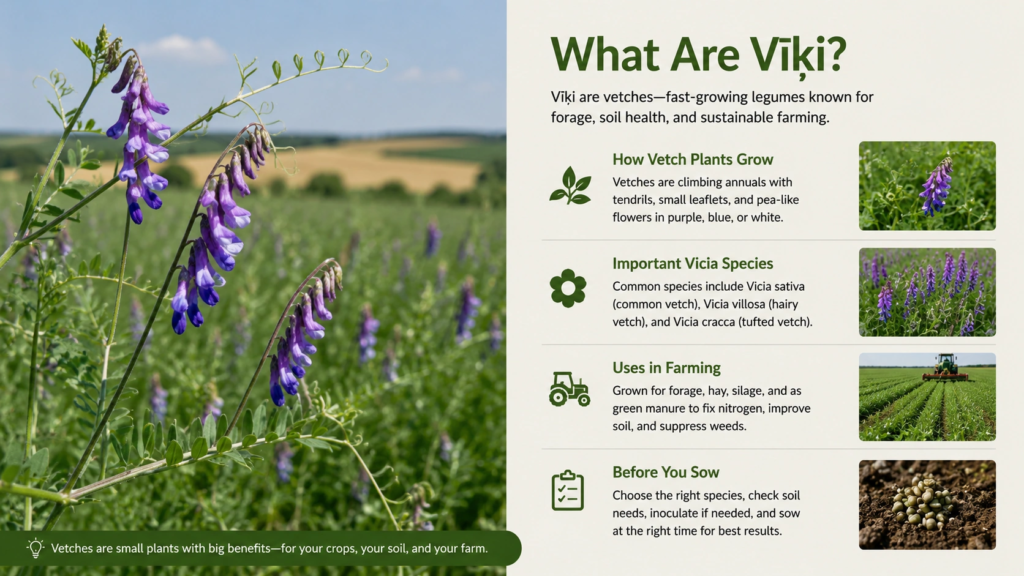
Vīķi are vetch plants, generally connected with the Vicia genus in the legume family. They may be annual or perennial, and many have climbing or scrambling stems, tendrils, compound leaves, pea like flowers, and seed pods.
The most important agricultural forms include sējas vīķi, often linked with common vetch or Vicia sativa, and winter or hairy vetch types such as Vicia villosa. Other wild or semi wild vetches may appear in meadows, field edges, hedges, woodland margins, and uncultivated ground.
Farmers and gardeners value vīķi because they can supply forage, support livestock feeding systems, add organic matter, protect soil, and contribute nitrogen through their relationship with nitrogen fixing bacteria. They are especially useful when grown as part of crop rotations or mixed cover crops.
Vīķi are useful, but they require good management. Some types can become weedy if allowed to set seed, and some seeds may contain anti nutritional compounds that make proper feed planning important. In my analysis, the right species, sowing time, termination method, and end use should always be chosen before planting.
For readers who want a simple practical rule, I would say this: use vīķi with a clear purpose. Grow them for forage, green manure, soil cover, nitrogen contribution, or biodiversity support, but do not sow them casually without knowing how and when they will be managed.
What Vīķi Are and Why the Name Matters
Vīķi is the Latvian word commonly used for vetches, plants in or closely connected with the Vicia genus. These plants belong to the legume family, also known as Fabaceae. Legumes are important in agriculture because many of them form relationships with root bacteria that help convert atmospheric nitrogen into forms plants can use. This does not mean every vetch crop automatically solves every soil fertility problem, but it explains why farmers have valued these plants for a long time.
A useful Latvian definition from Tezaurs describes vīķi as leguminous plants that may be annual or perennial and have climbing or less often upright stems.
“Viengadīgi vai daudzgadīgi tauriņziežu dzimtas pākšaugi.”
Tezaurs, Mūsdienu latviešu valodas vārdnīca
This short definition matters because it places vīķi clearly in the legume family and reminds us that the word can refer to more than one species. Some vetches are cultivated crops. Others are wild plants. Some are grown for livestock feed. Others are useful mainly for soil cover, nitrogen, flowers, or habitat value.
In everyday use, people may say vīķi when they mean common vetch, winter vetch, hairy vetch, field vetch, or another Vicia species. That is why I think botanical names are important. A farmer ordering seed should not rely on a common name alone. A seed bag, field guide, or agronomic plan should identify the exact species or mixture.
How Vīķi Fit Into the Vicia Genus
The Vicia genus includes many species, and not all of them are used in the same way. Some species are major agricultural legumes. Some are forage crops. Some are wild plants that add diversity to natural and semi natural habitats. Some may behave as weeds in certain cropping systems if they appear where they are not wanted.
Vīķi often share several visible traits. The leaves are usually compound, meaning they contain several leaflets. Many species have tendrils that help the plant climb or scramble through surrounding vegetation. The flowers are pea like and may be violet, purple, pink, white, yellowish, or blue toned depending on the species. The fruit is a pod containing seeds.
From my perspective, the climbing habit is one of the most important practical traits. Vīķi often perform better when supported by another plant, especially a cereal such as oats, rye, triticale, barley, or wheat. The cereal gives structure, while the vetch adds legume value. This is why vetch cereal mixtures are common in forage and cover crop systems.
Common Types of Vīķi and Their Uses
Different vetch species serve different purposes. Some are better for forage, some for cover cropping, some for wildlife value, and some for soil improvement. The table below compares the forms that readers are most likely to encounter in agricultural or plant identification contexts.
| Latvian or Common Name | Likely Botanical Name | Main Use | Growth Habit | Practical Note |
|---|---|---|---|---|
| Sējas vīķi or common vetch | Vicia sativa | Forage, green manure, rotation crop, livestock feed | Annual, scrambling or climbing | Often used with cereals because stems need support |
| Ziemas vīķi or hairy vetch | Vicia villosa | Winter cover crop, nitrogen contribution, erosion control | Annual or winter annual, climbing | Strong cover crop, but must be managed before seed set |
| Vanagu vīķi or tufted vetch | Vicia cracca | Wild habitat, pollinators, field edges | Perennial climbing plant | Useful for biodiversity, not always desired in crops |
| Žogu vīķi or bush vetch | Vicia sepium | Wild plant, hedgerows, meadows, woodland edges | Perennial scrambling plant | Often seen in less intensive habitats |
| Meža vīķi or wood vetch | Vicia sylvatica | Wild plant, woodland margins, natural vegetation | Perennial climbing plant | More relevant to ecology than field production |
| Pannonijas vīķi | Vicia pannonica | Forage and cover crop in some regions | Annual or winter annual | Can suit specific climates and mixed sowings |
| Lauka pupa or broad bean | Vicia faba | Food, feed, rotation crop | Upright annual legume | Related genus member, but usually discussed separately as bean crop |
The main takeaway is that vīķi should not be treated as one identical crop. A farmer planning forage should think differently from a botanist identifying wild plants or a gardener choosing a cover crop. The name is useful, but the species determines the best management.
Why Vīķi Matter in Agriculture
Vīķi matter because they can connect several agricultural goals at once. They can produce biomass, contribute feed, protect soil from erosion, add organic matter, support soil biology, improve crop rotations, and reduce dependence on synthetic nitrogen when managed well.
Feedipedia gives a concise description of common vetch:
“The common vetch (Vicia sativa L.) is an annual scrambling and climbing legume.”
Feedipedia
That description is useful because it captures both identity and growth habit. Common vetch is a legume, but it is also a scrambling plant. In practice, that means it may lodge or tangle if grown alone, especially under lush conditions. A cereal companion can help keep it upright and make harvest easier.
Vīķi are especially attractive in mixed farming systems where livestock and cropping are linked. A field can produce a vetch cereal forage, feed animals, return manure to the land, and support the next crop through improved soil cover and organic matter. That circular relationship is one reason legumes have remained important in agriculture.
Vīķi as Forage
Vīķi can be grown as fresh forage, hay, silage, or part of a mixed forage stand. Common vetch is often used with oats or other cereals because the cereal supports the vetch and balances the forage. The vetch adds protein potential, while the cereal adds bulk, fiber, and standability.
A realistic example is a small livestock farm that needs spring forage before summer pasture is fully productive. The farmer might sow common vetch with oats. The oats provide structure and biomass, while the vetch improves feed quality and contributes legume value. The mix can be cut at a stage that balances yield and quality.
The exact feeding value depends on species, growth stage, seed proportion, weather, harvest method, and storage quality. I would never recommend using vīķi in animal diets without considering livestock type and feed formulation. Ruminants may use vetch forage differently from pigs, poultry, horses, or other animals.
Vīķi as Green Manure
Green manure means a crop grown mainly to improve the soil rather than to be harvested as a saleable product. Vīķi can work well in this role because they produce biomass and contribute nitrogen through legume symbiosis.
For example, a vegetable grower might sow vīķi after an early harvested crop and terminate it before planting a heavy feeding crop the next season. The vetch protects the soil surface, reduces bare ground, and later releases nutrients as residues decompose. The exact nitrogen release depends on growth stage, biomass, weather, soil biology, and termination timing.
In my view, green manure use is one of the clearest reasons to value vīķi. It shifts the question from “What can this field produce today?” to “How can this field stay productive over several seasons?”
Vīķi as Cover Crops
Cover crops are planted to cover and protect soil, often between cash crops. Vīķi are common cover crop candidates because they can reduce erosion, add residue, compete with weeds, and contribute nitrogen.
Hairy vetch is especially well known as a cover crop in many regions. NRCS describes it as a legume cover crop that can provide an excellent nitrogen source.
“Hairy Vetch (Vicia villosa) is a legume cover crop that can provide an excellent nitrogen source.”
USDA Natural Resources Conservation Service
I interpret that statement as a management opportunity, not a guarantee. Nitrogen contribution depends on the stand, inoculation, climate, termination time, and following crop. A thin, poorly established stand will not perform like a dense, well nodulated stand.
How Vīķi Improve Soil Health
Vīķi can improve soil health through living roots, residue production, nitrogen fixation, soil cover, and biological activity. The roots help feed soil organisms. The foliage protects the surface from rain impact. The residue can increase organic matter over time when used in a thoughtful rotation.
Nitrogen Fixation and Root Nodules
Legumes such as vīķi can form root nodules with rhizobia bacteria. These bacteria help fix atmospheric nitrogen. The plant benefits from access to nitrogen, and the soil system may benefit later when roots, leaves, and stems break down.
This process is powerful, but it should not be romanticized. Nitrogen fixation depends on the right bacteria, adequate soil pH, moisture, phosphorus, sulfur, and general plant health. If the proper rhizobia are not present, inoculation may be needed. If the crop is stressed, nodulation may be weak.
A practical example helps. Two fields are sown with hairy vetch. One field has seed inoculated with the right rhizobia and receives enough moisture for establishment. The other field is sown late into dry soil with no inoculation history. The first field is more likely to create a strong nitrogen fixing stand. The second may produce uneven growth and limited benefit.
Soil Cover and Erosion Reduction
Bare soil is vulnerable. Rain can seal the surface, wind can move particles, and weeds can establish quickly. Vīķi can cover soil and reduce exposure. When grown with a cereal, the cover is often more complete because the cereal grows upright while the vetch fills lower and climbing spaces.
For sloping fields, soil cover can be especially important. Even if the vetch crop is not harvested, its living canopy and residue can reduce erosion risk. In my view, this is one of the strongest arguments for cover crops in general: they keep the land working even when no cash crop is present.
Organic Matter and Soil Biology
When vīķi residues decompose, they feed soil organisms. Earthworms, fungi, bacteria, and other organisms interact with plant residues in complex ways. Over time, regular cover cropping and residue return can support better aggregation, water infiltration, and nutrient cycling.
Vetch residues are generally richer in nitrogen than cereal residues. This means they can break down more quickly. That can be useful when the next crop needs nutrients, but it can also mean the soil surface loses cover faster than with a high carbon grass residue. This is why mixtures often work well. The cereal provides longer lasting structure, and the vetch provides nitrogen rich material.
How to Grow Vīķi Step by Step
Growing vīķi well requires a clear goal, correct species, suitable sowing time, good seedbed preparation, and planned termination. I would not begin by asking only “How much seed should I sow?” I would first ask “What do I want this crop to do?”
Step 1: Choose the Purpose Before Choosing the Seed
The purpose may be forage, hay, silage, grazing, green manure, winter cover, pollinator support, or soil improvement. Each purpose points toward a different species and management plan.
If the goal is livestock forage, common vetch with oats may be practical. If the goal is winter soil cover and nitrogen before maize or vegetables, hairy vetch may be considered. If the goal is wildflower value, native or locally appropriate Vicia species may matter more than agricultural cultivars.
Step 2: Match the Species to the Climate and Season
Some vīķi are better suited to spring sowing, while others are used as winter annuals. Local climate matters. Winter hardiness, frost tolerance, drought tolerance, rainfall pattern, soil drainage, and heat all affect performance.
A grower in a mild winter region may establish a winter vetch cover crop that grows through cool months. A grower in a colder region may need an earlier sowing date so plants establish before winter, or may choose a spring grown option instead.
Step 3: Prepare a Firm and Clean Seedbed
Vīķi need good seed to soil contact. A firm seedbed helps germination and establishment. Excessive clods, deep placement, surface compaction, or competition from established weeds can reduce stand quality.
Seedbed preparation depends on the system. In conventional tillage, the goal may be a fine, firm seedbed. In no till systems, residue management, drill settings, and moisture become more important.
Step 4: Use the Correct Inoculant When Needed
If the field has not recently grown compatible legumes, inoculation may improve nodulation. The seed supplier or local extension guidance should identify the correct rhizobia group. Inoculant should be handled carefully because living bacteria can be damaged by heat, sunlight, drying, or expired storage.
In practical terms, inoculation is a low cost detail that can make a big difference. A vetch crop without nodules may grow, but it may not deliver the nitrogen benefit expected from a legume.
Step 5: Sow at the Right Depth and Rate
Seed rate and depth depend on species, seed size, mixture, climate, and planting purpose. Vīķi are often sown deeper than tiny seeded legumes but should not be buried so deeply that emergence is weak. When mixed with cereals, the ratio should reflect whether the goal is more legume, more biomass, more support, or more weed suppression.
A simple example is a forage mix where too little cereal causes the vetch to lodge, while too much cereal suppresses the vetch. The right balance depends on harvest timing and desired feed quality.
Step 6: Manage Weeds, Moisture, and Establishment
A dense stand is the best defense against many problems. Early competition from weeds can reduce vetch performance. Moisture stress after sowing can delay emergence. Waterlogging can harm roots and nodulation.
I would monitor the crop during establishment rather than waiting until the planned harvest or termination date. Early gaps, pest damage, or poor nodulation can change the management plan.
Step 7: Terminate or Harvest at the Right Stage
The best harvest or termination stage depends on the goal. For forage quality, earlier cutting may improve feed value, while later cutting may increase biomass. For cover cropping, termination before seed set is often important to prevent volunteers. For green manure, timing affects nitrogen release and residue persistence.
A grower who waits too long may get more biomass but also more seed production, woodier stems, and management problems. A grower who terminates too early may lose potential nitrogen and cover benefits. Timing is the central decision.
Practical Uses of Vīķi in Farm and Garden Systems
Vīķi can fit into many systems, but they work best when paired with a specific job. I think of them as flexible tools rather than automatic solutions.
Vīķi in Crop Rotations
In crop rotations, vīķi can break cereal dominated patterns, add legume diversity, and prepare the field for a following crop. A vetch cover before maize, vegetables, or other nitrogen demanding crops can be useful when managed correctly.
However, rotation planning should also consider disease cycles, weed risk, herbicide carryover, and seed bank issues. A vetch that is helpful in one rotation may be inconvenient in another if volunteers appear in the next crop.
Vīķi in Livestock Systems
In livestock systems, vetch forage can add protein and diversity. It can be grazed, cut fresh, made into hay, or ensiled in suitable mixtures. The best method depends on livestock type and local feeding practice.
I would be careful with seed heavy material, anti nutritional concerns, and feed transitions. Any unfamiliar forage should be introduced thoughtfully and balanced with the rest of the ration.
Vīķi in Small Gardens
Gardeners can use vīķi as a cover crop in empty beds. A small plot may not produce enough forage to matter, but it can still protect soil and add organic matter. The key is termination. A gardener should cut or incorporate the vetch before it becomes hard to manage or sets seed.
A practical garden scenario is an empty vegetable bed after early potatoes. The gardener sows a vetch and oat mix, lets it cover the soil, then cuts it before flowering or at early flowering depending on the next crop plan. The residue can be composted, used as mulch, or incorporated according to the garden system.
Benefits and Limitations of Vīķi
The table below compares the main benefits and risks. I include both because vīķi are valuable, but only when managed with realistic expectations.
| Benefit or Limitation | What It Means in Practice | Best Use Case | Management Response |
| Nitrogen contribution | Vīķi can fix nitrogen when well nodulated | Cover crops before demanding crops | Inoculate when needed and allow enough growth |
| Forage value | Vetch can improve protein content in mixtures | Livestock farms with cereal legume forage | Harvest at the right stage and balance rations |
| Soil cover | Living plants reduce bare ground exposure | Winter or off season fields | Establish early enough for canopy development |
| Weed suppression | Dense growth can compete with weeds | Mixed cover crop stands | Use good seed rates and avoid thin stands |
| Pollinator support | Flowers can attract insects | Biodiversity margins and low intensity areas | Let some plants flower where appropriate |
| Lodging risk | Stems can sprawl without support | Pure vetch stands or lush growth | Mix with cereals or structural companion crops |
| Volunteer risk | Seed set can create future weed pressure | Poorly terminated cover crops | Terminate before mature seed formation |
| Feed caution | Seeds or certain uses may require care | Animal diets involving grain or seed | Use feed guidance and avoid assumptions |
| Slow establishment in some seasons | Early growth may be uneven | Late sowing or dry seedbeds | Sow at proper timing with good moisture |
| Species confusion | Common names may hide important differences | Seed buying and plant identification | Use botanical names and local advice |
The most important message from this table is that vīķi are neither perfect nor risky by default. They are management dependent. Good planning turns them into a useful crop. Poor timing can turn them into a problem.
Common Mistakes People Make With Vīķi
The first mistake is using the word vīķi without identifying the species. A wild vetch in a meadow, common vetch in a forage mix, and hairy vetch in a cover crop plan are not managed in the same way. Common names are helpful for conversation, but botanical names are better for decisions.
The second mistake is sowing vīķi without a termination plan. This is especially important for cover crops. A grower should know when the crop will be cut, grazed, rolled, incorporated, sprayed, or otherwise ended. Waiting until the plant sets mature seed can create volunteer issues.
The third mistake is expecting nitrogen benefits from a weak stand. A legume must grow well to contribute meaningfully. Poor establishment, missing rhizobia, waterlogging, drought, or severe weed competition can reduce the benefit.
The fourth mistake is growing vīķi alone when a mixture would work better. Because many vetches climb or scramble, cereals often make excellent companions. A mix can improve stand structure, biomass, harvestability, and soil cover.
The fifth mistake is using vetch seed or forage without feed knowledge. Livestock feeding should consider animal species, growth stage, total ration, seed content, and local guidance. I would not treat any legume as automatically safe or ideal in every feeding situation.
The sixth mistake is assuming cover crop advice transfers across climates. A recommendation from a warm region may not fit a cold region. A practice that works on sandy soil may fail on heavy wet clay. Local adaptation matters.
Expert Recommendations for Growing Vīķi Successfully
My first recommendation is to choose vīķi according to purpose. If the goal is forage, think about yield, quality, harvest method, and companion cereal. If the goal is green manure, think about biomass, nitrogen, termination timing, and following crop. If the goal is biodiversity, think about flowering, habitat, and local species suitability.
My second recommendation is to use mixtures when structure matters. A vetch cereal mixture is often easier to manage than a pure vetch stand. Oats, rye, triticale, barley, or wheat can support the vetch and create more balanced biomass.
My third recommendation is to check nodulation. Dig a few plants carefully and look for nodules on the roots. Healthy active nodules often show pinkish color inside. Poor nodulation may signal inoculation, soil, or management problems.
My fourth recommendation is to terminate before seed becomes a problem. This is especially important in vegetable gardens, conservation agriculture, and fields where volunteers would interfere with the next crop.
My fifth recommendation is to use local agronomic guidance. Seed rates, sowing dates, winter survival, inoculants, and termination methods vary by region. A general guide can explain principles, but local advice makes the plan practical.
My sixth recommendation is to treat vīķi as part of a system. Their best benefits appear when rotations, livestock, soil cover, residue management, and nutrient planning work together.
How Vīķi Compare With Other Legume Cover Crops
Vīķi are not the only legume option. Clover, peas, beans, alfalfa, lupins, and other legumes may compete for the same role in a rotation. The best choice depends on climate, soil, season, livestock needs, equipment, and following crop.
Compared with clover, vīķi may produce strong biomass in annual systems and can work well in cereal mixtures. Compared with field peas, some vetches may climb more and have different winter survival. Compared with alfalfa, vīķi are usually more useful as annual or short term crops rather than long term perennial forage stands.
I would not say vīķi are always better. I would say they are particularly useful when the farm needs a flexible annual legume with forage or cover crop value. They also fit well where a cereal companion is already part of the plan.
Vīķi in Biodiversity and Pollinator Support
Vīķi are not only farm tools. Wild Vicia species can support insects, add flowers to field margins, and contribute to plant diversity. Their pea like flowers may attract bees and other pollinators. Their climbing growth can weave through grasses and shrubs, creating layered vegetation.
In agricultural landscapes, field margins and less disturbed areas can host wild vetches. These plants may be valuable, but they also require context. A vetch that is welcome in a meadow may be unwanted inside a seed crop. Biodiversity management is not only about adding plants. It is about placing the right plants in the right places.
A practical example is a farm that keeps a flowering margin beside a field. Wild vīķi in that margin may support insects and visual diversity. The farmer may still control volunteer vetch inside the crop. These two decisions can coexist because the location and purpose differ.
Vīķi and Sustainable Farming
Vīķi fit strongly into sustainable farming because they help reduce bare soil periods, add biological nitrogen, and increase diversity. A rotation that includes legumes can be more resilient than one built only around repeated cereal crops.
The Crop Trust summarizes common vetch value clearly:
“The common vetch (Vicia sativa L.) provides palatable forage.”
Crop Trust
That simple statement points to one part of the sustainability story: vīķi can feed animals while also serving crop rotation and soil functions. When a crop has more than one benefit, it can become easier to justify in a real farm plan.
Sustainability, however, requires measurement. A grower should ask whether vīķi improved soil cover, reduced purchased nitrogen, supported yield, improved forage supply, or reduced erosion risk. Without observation, a cover crop becomes an idea rather than a proven practice on that farm.
Vīķi for Home Gardeners and Smallholders
Home gardeners may use vīķi differently from farmers. The goal may be soil cover, compost material, pollinator flowers, or learning about legumes. A smallholder may also cut vetch cereal mixtures for rabbits, goats, sheep, or other animals, but feed safety and species suitability should always be checked.
For gardens, I would keep management simple. Sow vīķi in an empty bed, keep the stand from becoming too weedy, cut before mature seed, and use the residue responsibly. If the next crop needs a clean seedbed, terminate early enough for residues to break down. If the goal is mulch, cut and lay stems on the surface.
A small garden example: after harvesting onions in late summer, a gardener sows a vetch and oat mix. The bed stays covered through the cool season. Before planting tomatoes, the gardener cuts the cover crop and lets residue wilt. This approach protects soil and adds organic material without leaving the bed bare.
Safety, Feed, and Weed Considerations
Vīķi are useful feed plants, but they are not automatically suitable in every form for every animal. Seeds of some vetch species may contain anti nutritional compounds, and the suitability of forage depends on animal species, growth stage, diet balance, and management. A livestock nutritionist or local agricultural adviser should be consulted when using significant amounts in feed.
Weed risk also deserves attention. Vīķi can reseed if allowed to mature. In some systems, volunteers may be manageable. In others, they may contaminate grain or interfere with crop quality. Seed production should be controlled when the vetch is not intended to persist.
The safest approach is to use certified seed, select suitable species, plan termination, and avoid casual wild seed collection. Wild collected seed may contain other species, weed seeds, or uncertain genetics.
Conclusion
Vīķi are valuable because they combine several practical functions in one plant group: forage, soil cover, green manure, nitrogen contribution, rotation diversity, and habitat value. I believe the central lesson is that vīķi work best when we manage them with a specific purpose rather than treating them as a general miracle crop. The same plant that improves soil in one system can become a volunteer problem in another if timing is poor. The same forage that helps a livestock farm may need careful ration planning before it is fed widely. My advice is to begin with the end goal, then choose the right Vicia species, sowing date, companion crop, inoculation plan, and termination method. When we give vīķi that level of attention, they can become one of the most useful legumes in a practical, soil conscious growing system.
Frequently Asked Questions
What Are Vīķi?
Vīķi are vetches, usually plants in the Vicia genus within the legume family. They may be annual or perennial and often have climbing or scrambling stems, tendrils, compound leaves, pea like flowers, and pods. In agriculture, vīķi are commonly grown for forage, green manure, cover cropping, and soil improvement. In nature, related wild species may appear in meadows, hedges, woodland edges, and field margins.
Are Vīķi the Same as Common Vetch?
Vīķi can include common vetch, but the word is broader than one species. Common vetch is usually Vicia sativa, known in Latvian as sējas vīķi. Other vīķi may include hairy vetch, tufted vetch, bush vetch, wood vetch, and several additional Vicia species. For farming or seed buying, I would always check the botanical name because different species need different management.
Why Do Farmers Grow Vīķi?
Farmers grow vīķi because they can provide forage, cover soil, contribute nitrogen, support crop rotations, and add organic matter. They are often grown with cereals such as oats or rye because the cereal supports the climbing vetch stems. In my view, vīķi are most valuable when they serve more than one purpose, such as feeding livestock while also improving soil conditions for the following crop.
Can Vīķi Fix Nitrogen?
Yes, vīķi can fix nitrogen when they form effective root nodules with compatible rhizobia bacteria. The amount of nitrogen depends on species, growth, nodulation, soil conditions, moisture, and termination timing. If a field has not grown compatible legumes before, seed inoculation may be useful. A strong, healthy stand is much more likely to provide meaningful nitrogen benefits than a thin or stressed crop.
Are Vīķi Good Cover Crops?
Yes, vīķi can be good cover crops, especially when the goal is soil cover, nitrogen contribution, erosion reduction, or green manure. Hairy vetch is a well known winter cover crop in many regions. Common vetch can also be used, often in mixtures. The key is management. Cover crop vīķi should usually be terminated before mature seed forms unless reseeding is intended.
Can Livestock Eat Vīķi?
Livestock can eat some vīķi as forage, hay, silage, or part of a mixed ration, but feeding should be managed carefully. Suitability depends on the species, growth stage, seed content, animal type, and total diet. Ruminants may use vetch forage well in many systems, but seeds and anti nutritional factors require attention. I would use local feed guidance before relying heavily on vīķi.
Should Vīķi Be Grown Alone or in a Mixture?
Vīķi often perform better in mixtures, especially with cereals. Because many vetches scramble or climb, a companion crop such as oats, rye, barley, triticale, or wheat can provide support and improve harvestability. A mixture can also balance nitrogen rich legume residue with more carbon rich grass residue. Pure stands may work in some cases, but they can lodge more easily.
When Should Vīķi Be Terminated?
Vīķi should usually be terminated according to the goal and before mature seed becomes a problem. For forage, harvest timing balances yield and quality. For cover crops, termination before seed set reduces volunteer risk. For green manure, termination timing affects nitrogen release and residue breakdown. I would plan termination before sowing because waiting too long can make management harder.
Sources and References
Tezaurs, Mūsdienu latviešu valodas vārdnīca, vīķi definition.
Tezaurs, Vicia terminology and Latvian species names.
Feedipedia, Common vetch or Vicia sativa livestock feed reference.
USDA Natural Resources Conservation Service, Hairy Vetch Cover Crop Fact Sheet.
Crop Trust, Vetch crop wild relatives and common vetch uses.
PubMed indexed review literature on common vetch as animal feed.
EuroPlusMed PlantBase, Vicia sativa regional plant name references.
Disclaimer
This article is for educational and informational purposes only. It does not replace local agronomic advice, livestock nutrition guidance, seed certification information, or legal requirements for seed use and land management. Before planting vīķi commercially, feeding them to animals, or using them in regulated cropping systems, consult qualified agricultural advisers, seed suppliers, veterinarians, or local extension resources.