
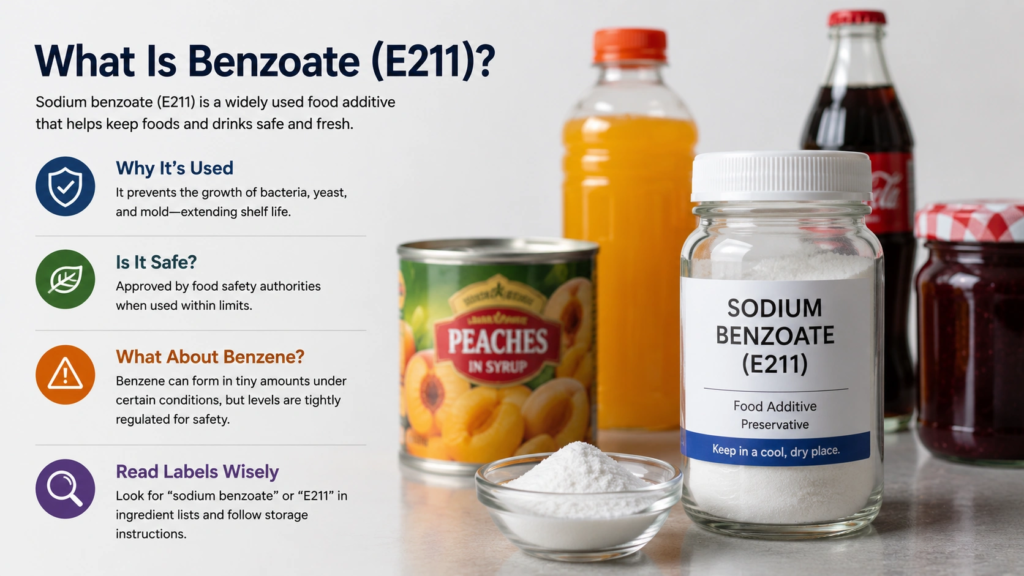
I see benzoate E211 as one of those food label ingredients that can easily worry people because it sounds technical, chemical, and unfamiliar. In everyday terms, E211 is sodium benzoate, a preservative used to help protect certain foods and drinks from spoilage caused by yeasts, moulds, and some bacteria. It appears most often in acidic products such as soft drinks, fruit drinks, sauces, pickles, jams, condiments, and similar foods where preservation is important for shelf life and safety.
Key Takeaways About Benzoate E211
Benzoate E211 is sodium benzoate, the sodium salt of benzoic acid. It is used as a preservative in food and drinks, especially acidic products where it works most effectively.
The main purpose of E211 is not to add flavour, colour, sweetness, or nutrition. Its job is preservation. It helps slow the growth of yeasts, moulds, and some bacteria that could spoil food before the consumer opens it.
Regulators have evaluated sodium benzoate and related benzoates. In the European food safety context, benzoates are assessed with an acceptable daily intake expressed as benzoic acid. International bodies may use different ADI values because scientific committees can apply different evaluation methods.
The most discussed safety issue around benzoate E211 is benzene formation in certain beverages when benzoate salts are combined with vitamin C or erythorbic acid under conditions such as heat and light. This does not mean every product containing E211 contains benzene. It means some formulations need careful control.
Some research has examined mixtures of artificial colours and sodium benzoate in relation to children’s hyperactivity. In my view, that evidence should be described carefully because the studies involved mixtures, not sodium benzoate alone in ordinary food use.
For consumers, the practical approach is simple: read labels, understand what E211 does, avoid exaggerated fear, and reduce frequent intake of highly processed drinks and snacks if they make up a large part of the diet.
What Benzoate E211 Means on a Food Label
Benzoate E211 means sodium benzoate. The “E” number system is used in Europe and many other markets to identify approved food additives. E211 is one member of the benzoate preservative group. Related preservatives include E210, which is benzoic acid, E212, which is potassium benzoate, and E213, which is calcium benzoate.
In practical label reading, a product may say “sodium benzoate,” “preservative: sodium benzoate,” “preservative E211,” or “E211.” These labels refer to the same additive. I believe this is worth making clear because many people assume the E number version is more suspicious than the ingredient name. In reality, the E number is simply a code.
Sodium benzoate is especially common in acidic foods and beverages because the preservative action depends strongly on pH. In acidic conditions, benzoate is more likely to exist as benzoic acid, which is the form that interferes with microbial growth. This is why E211 is more useful in products such as fizzy drinks, fruit based drinks, pickles, sauces, and salad dressings than in neutral foods.
A realistic example is a bottle of fruit flavoured drink. The manufacturer wants the drink to remain stable during distribution, storage, and sale. Because the drink is acidic, a preservative such as sodium benzoate may help prevent spoilage organisms from growing. Without preservation, the product might require refrigeration, shorter shelf life, pasteurisation, different packaging, or another preservation method.
Why Food Manufacturers Use Benzoate E211
Food manufacturers use benzoate E211 because it is effective, relatively inexpensive, well studied, and compatible with many acidic products. It helps maintain shelf life, reduce spoilage, and protect product quality during storage and transportation.
From my perspective, the preservative should be judged by function. E211 is not added because it sounds attractive to consumers. It is added because the product formulation needs microbial control. A sauce that sits on a shelf for months, a drink shipped through warm conditions, or a jar of pickled vegetables sold at room temperature all need some strategy to control spoilage.
Preservation can be achieved in many ways. Heat treatment, refrigeration, acidity, salt, sugar, dehydration, packaging, fermentation, pasteurisation, and preservatives can all play roles. Sodium benzoate is one option within this wider food safety system. It is not always necessary, and it is not always the best choice, but it can be practical in specific products.
A useful way to think about E211 is to ask what would replace it. A manufacturer could use potassium sorbate, pasteurise more aggressively, lower pH further, use refrigeration, change packaging, shorten shelf life, or reformulate the product. Each option has trade offs in flavour, cost, safety, texture, energy use, waste, and consumer convenience.
How Sodium Benzoate Works as a Preservative
Sodium benzoate works mainly by becoming benzoic acid in acidic foods. Benzoic acid can enter microbial cells and disturb their internal conditions, making it harder for yeasts, moulds, and some bacteria to grow. This effect is strongest at lower pH, which explains why E211 is commonly linked with acidic products.
I think this is one of the most important details for readers because it explains why E211 is not used randomly in every food. It has a working environment. A preservative that works well in an acidic drink may not perform the same way in a neutral soup, fresh meat, or bread.
Benzoate E211 in Acidic Drinks
Soft drinks and fruit drinks are common places to find E211. These products often contain acids such as citric acid, phosphoric acid, or fruit acids, which create the acidic conditions where benzoate works.
A practical example is a carbonated fruit flavoured beverage sold at room temperature. The product may contain sugar or sweeteners, flavour compounds, acids, and water. Without microbial control, yeasts could ferment sugars, create gas, change flavour, or spoil the drink. E211 helps reduce that risk when used within approved limits.
Benzoate E211 in Sauces and Condiments
Sauces and condiments often sit in cupboards or refrigerators for long periods after opening. Products such as ketchup, chilli sauce, soy based sauces, salad dressings, and pickled condiments may use preservatives to help maintain quality.
This does not mean every sauce needs E211. Some rely on vinegar, salt, sugar, heat treatment, or refrigeration. However, sodium benzoate can be part of the preservation system when the formula and regulations allow it.
Benzoate E211 in Pickles and Acidified Foods
Pickled foods often rely on acidity and salt. In some products, E211 may be added to strengthen preservation. The same principle applies: low pH helps benzoate work.
In my view, the consumer question should not be “Is the ingredient name scary?” but “How often do I eat this product, and does it fit into my overall diet?” A small amount of preserved condiment is different from drinking several preserved soft drinks every day.
Common Foods and Drinks That May Contain Benzoate E211
The table below shows where benzoate E211 is most commonly found and why it may be used. Exact use depends on country, regulation, product type, and manufacturer formulation.
| Product Type | Why E211 May Be Used | Typical Preservation Challenge | Practical Label Tip |
|---|---|---|---|
| Carbonated soft drinks | Helps control yeast and mould growth | Sugary or flavoured acidic liquid stored at room temperature | Check for “sodium benzoate” or “E211” near the end of the ingredient list |
| Fruit drinks and juice drinks | Helps extend shelf life after processing | Fruit acids, sugars, and flavour compounds can support spoilage organisms | Look for benzoate plus vitamin C if concerned about benzene risk |
| Pickles and relishes | Supports acid based preservation | Opened jars may be stored for weeks | Compare brands if you prefer preservative free options |
| Sauces and condiments | Helps maintain quality over long storage | Repeated opening exposes product to air and microbes | Small serving sizes usually mean low intake |
| Salad dressings | Helps protect acidic oil and water mixtures | Emulsions can separate and spoil | Refrigeration instructions still matter |
| Jams and fruit preparations | Helps prevent yeast and mould growth | Sugar and fruit create a spoilage risk when opened | Low sugar products may need stronger preservation |
| Olives and brined vegetables | Supports brine based preservation | Brine, acidity, and storage conditions vary | Follow storage instructions after opening |
| Some medicines or syrups | Preservative in liquid formulations | Repeated dosing can introduce contamination | Do not change medicine use without professional advice |
| Some cosmetics and personal care products | Preserves water based products | Microbes can grow in water containing formulas | Food safety rules and cosmetic rules are separate |
The main takeaway is that E211 is most common in acidic, shelf stable, water containing products. It is less about one specific food and more about the preservation needs of a product category.
Safety Assessments and Acceptable Daily Intake
Safety discussions around benzoate E211 often mention ADI, which stands for acceptable daily intake. ADI is an estimate of the amount of a substance that can be consumed daily over a lifetime without appreciable health risk, based on available scientific evidence and safety factors.
EFSA’s re-evaluation of benzoic acid and benzoates includes a key safety conclusion:
“The Panel derived an acceptable daily intake (ADI) of 5 mg/kg bw per day.”
European Food Safety Authority
I interpret this as a risk assessment benchmark, not as a target to consume. An ADI is not a recommended daily amount. It is a safety reference used by regulators and risk assessors to evaluate exposure.
JECFA, the Joint FAO and WHO Expert Committee on Food Additives, has also evaluated benzoates and related compounds. Its more recent group ADI differs from EFSA’s value. This can confuse readers, but it does not automatically mean one body is careless and another is strict. Different committees may use different data sets, assumptions, adjustment factors, and grouping methods.
For consumers, the practical lesson is not to calculate every milligram in a panic. It is to understand that safety is assessed against body weight, total exposure, and frequency. A small child who drinks large amounts of preserved beverages may have a different exposure pattern from an adult who occasionally uses a preserved condiment.
How to Think About Benzoate E211 Exposure
Exposure depends on concentration, serving size, frequency, body weight, and the number of foods containing benzoates in a person’s diet. The same product can represent a different exposure for different people.
A simple hypothetical example helps. If a child and an adult drink the same bottle of preserved soft drink, the child receives more additive per kilogram of body weight because the child weighs less. If the child drinks preserved beverages daily, exposure increases. If the adult uses one teaspoon of preserved sauce occasionally, exposure is much smaller.
This does not mean parents need to fear every label. It means the diet pattern matters. I would focus more on reducing frequent intake of sugary or highly processed beverages than on worrying about a tiny amount of E211 in an occasional condiment.
Benzoate E211, Vitamin C, and Benzene Risk
The most serious public discussion around benzoate E211 involves benzene formation in beverages. Benzene is a known carcinogen, so even low level formation deserves attention. The concern is not that sodium benzoate itself is benzene. The concern is that under certain conditions, benzoate salts can react in products containing ascorbic acid, also known as vitamin C, or erythorbic acid.
The FDA explains the issue clearly:
“Benzene can form at very low levels (ppb level) in some beverages that contain both benzoate salts and ascorbic acid.”
U.S. Food and Drug Administration
This quote matters because it keeps the risk specific. The issue is not every food with E211. It is mainly certain beverages with benzoate salts and vitamin C or similar compounds, especially when exposed to heat and light.
A realistic example is a fruit flavoured drink containing sodium benzoate and added vitamin C. If that drink is stored in a hot warehouse, left in direct sunlight, or kept for a long time under poor conditions, benzene formation may be more likely. Manufacturers can reduce the risk through formulation choices, ingredient controls, packaging, storage instructions, testing, and avoiding risky combinations.
In my view, this is where consumers and manufacturers have different responsibilities. Consumers can avoid leaving drinks in hot cars or direct sunlight. Manufacturers must design safe formulations and verify that their products remain within safety expectations under realistic storage conditions.
Benzoate E211 and Children’s Behaviour
Another common question is whether benzoate E211 affects children’s behaviour. The concern became widely discussed after research on mixtures of certain artificial colours and sodium benzoate. These studies did not prove that sodium benzoate alone causes hyperactivity in every child. They examined mixtures, and the interpretation has remained cautious.
EFSA described the evidence from the Southampton study in careful language:
“This study provided limited evidence that the mixtures of additives tested had a small effect on the activity and attention of some children.”
European Food Safety Authority
I believe that wording is important. It says “limited evidence,” “mixtures,” “small effect,” and “some children.” Those qualifiers matter. They prevent us from turning a complex study into a simple claim that E211 alone causes hyperactivity.
For parents, the practical approach is observation and balance. If a child seems sensitive to certain processed drinks or brightly coloured foods, it may be reasonable to discuss an elimination approach with a healthcare professional. However, I would not recommend making a child’s diet more restrictive than necessary without guidance, especially if there are nutritional concerns.
It is also worth noting that reducing highly processed drinks and sweets can improve diet quality for reasons beyond additives. Less sugar, fewer empty calories, and more whole foods are often beneficial regardless of the E211 question.
Benefits and Concerns of Benzoate E211
The table below compares the practical benefits and concerns of benzoate E211. I include both sides because a fair article should not turn a preservative into either a villain or a miracle.
| Topic | Potential Benefit | Possible Concern | Practical Response |
| Shelf life | Helps products last longer | May encourage reliance on highly processed foods | Use preserved foods as part of a balanced diet |
| Food safety | Helps control spoilage organisms | Does not replace hygiene or proper storage | Follow storage instructions after opening |
| Cost | Helps keep shelf stable products affordable | Cheap preservation may support low quality formulations | Compare ingredients and nutrition labels |
| Acidic drinks | Useful against yeasts and moulds | Benzene risk if combined with vitamin C under poor conditions | Avoid heat and sunlight exposure, choose reputable brands |
| Children’s diets | Preserves some drinks and sauces | Behaviour concerns have been studied in additive mixtures | Reduce frequent intake of highly processed drinks if concerned |
| Allergy like reactions | Most people tolerate approved uses | Sensitive individuals may report symptoms | Discuss suspected reactions with a clinician |
| Label clarity | E number identifies the additive | E numbers can look alarming to consumers | Learn the name and function of the additive |
| Waste reduction | Longer shelf life can reduce spoilage | Long shelf life can hide poor diet patterns | Focus on overall food quality |
| Regulation | Additive use is controlled by food law | Regulations vary by country | Check local rules for specific products |
The key takeaway is that benzoate E211 has a clear technological purpose, but its best use depends on responsible formulation, lawful limits, proper storage, and sensible consumption patterns.
Step-by-Step Guide to Reading a Label With Benzoate E211
A label can tell us more than whether a food contains E211. It can show product type, serving size, sugar level, acidity clues, other preservatives, colour additives, vitamin C, and storage instructions.
Step 1: Find the Ingredient Name
Look for “sodium benzoate,” “E211,” or “preservative E211.” The ingredient list usually appears in descending order by weight, although additives may appear near the end because they are used in small amounts.
If the label says E210, E212, or E213, those are related benzoate preservatives, but they are not exactly the same additive as E211.
Step 2: Check the Product Category
Ask what kind of product it is. A soft drink, pickle, jam, sauce, and medicine syrup all use preservatives for different reasons. Product category helps explain why the additive is present.
A preserved chilli sauce used in tiny amounts is not the same exposure pattern as a large bottle of soft drink consumed daily.
Step 3: Look for Vitamin C or Ascorbic Acid
If the product is a beverage and contains both sodium benzoate and ascorbic acid, vitamin C, or erythorbic acid, the benzene discussion becomes more relevant. That does not prove the product is unsafe, but it is a formulation that manufacturers need to control carefully.
As a consumer, I would store such drinks away from heat and light and avoid products that appear poorly stored, damaged, or expired.
Step 4: Review Sugar, Calories, and Overall Nutrition
Sometimes the additive is not the biggest nutritional issue. A drink may contain E211, but the larger concern may be high sugar intake or frequent replacement of water, milk, or whole foods.
In my view, label reading should not stop at preservatives. Look at serving size, sugars, salt, calories, and how often the food appears in the diet.
Step 5: Check Storage Instructions
Preservatives help, but they do not make a product invincible. “Refrigerate after opening,” “consume within a certain number of days,” or “store in a cool dry place” should be followed.
If a preserved product smells odd, fizzes unexpectedly, changes colour, grows mould, or has a swollen package, it should not be consumed.
Step 6: Compare Alternatives
If you prefer to avoid E211, compare brands. Some products use potassium sorbate, pasteurisation, refrigeration, vinegar, salt, sugar, or no preservative. Each option has trade offs.
A preservative free sauce may need refrigeration and may spoil faster. A refrigerated juice may cost more and have a shorter shelf life. A fermented product may have a different flavour. Choice depends on priorities.
Common Mistakes People Make About Benzoate E211
The first mistake is assuming that anything with an E number is automatically harmful. E numbers are identification codes for approved additives. Some are colours, some are preservatives, some are antioxidants, some are acids, and some are substances that sound familiar under another name.
The second mistake is assuming “natural” always means safer. Benzoic acid occurs naturally in some foods, including certain berries, but that does not mean every natural product is automatically safer than every regulated additive. Safety depends on dose, exposure, formulation, and individual circumstances.
The third mistake is ignoring total diet. A person may worry about E211 in a small amount of sauce while drinking several sugary beverages a day. In that case, the broader diet pattern may deserve more attention than one additive line.
The fourth mistake is treating benzene risk as if every E211 product has the same problem. The benzene issue is most relevant to certain beverages containing benzoate salts and vitamin C or related compounds, especially with heat and light exposure.
The fifth mistake is making strong claims about children’s behaviour from evidence that studied mixtures. The research is worth discussing, but it does not prove that sodium benzoate alone has the same effect in every child.
The sixth mistake is assuming preservative free always means better. Preservative free foods can be excellent, but they may also spoil faster or require stricter cold storage. Food safety still matters.
Expert Recommendations for Consumers
My first recommendation is to understand the function of benzoate E211 before judging it. It is a preservative, not a flavour enhancer or a hidden stimulant. Its job is microbial control in suitable products.
My second recommendation is to focus on frequency. Occasional intake from condiments or preserved foods is very different from daily high consumption of preserved soft drinks. The dose and pattern matter more than the ingredient’s presence alone.
My third recommendation is to be more cautious with beverages that combine sodium benzoate and added vitamin C. Buy from reputable brands, avoid expired products, and do not store drinks in hot cars, direct sunlight, or warm places for long periods.
My fourth recommendation is to watch children’s overall intake of brightly coloured and highly processed foods. If behaviour concerns appear linked to specific products, discuss a careful trial reduction with a healthcare professional rather than guessing.
My fifth recommendation is to compare labels rather than panic. Many product categories offer alternatives. Some have no benzoates, some use different preservatives, and some rely on refrigeration or pasteurisation.
My sixth recommendation is to report unusual reactions. If someone experiences repeated symptoms after consuming products with E211, a clinician or allergy specialist can help evaluate whether the additive, another ingredient, or a separate condition may be involved.
Expert Recommendations for Food Businesses
Businesses using benzoate E211 should treat it as part of a controlled preservation system, not as a casual ingredient. The first responsibility is legal compliance. Maximum permitted levels, food categories, labelling requirements, and formulation rules vary by jurisdiction.
The second responsibility is product safety. If a beverage contains benzoate and vitamin C, the company should assess benzene formation risk under realistic storage conditions. That may include formula adjustment, packaging control, light protection, chelating agents where allowed, storage guidance, and testing.
The third responsibility is clear labelling. Consumers should not have to guess whether a product contains sodium benzoate. Ingredient lists should be accurate, compliant, and easy to read.
The fourth responsibility is quality control. Preservatives work within limits. Poor hygiene, contaminated raw materials, incorrect pH, wrong dosing, and bad storage can still create problems.
The fifth responsibility is honest marketing. A product should not frighten consumers about competitors’ preservatives while using similar preservation strategies under different names. I believe transparent explanation builds more trust than fear based marketing.
Benzoate E211 Compared With Other Preservation Options
Benzoate E211 is only one preservation option. To understand it fairly, we should compare it with alternatives.
| Preservation Method | How It Works | Where It Fits Best | Main Advantage | Main Limitation |
| Sodium benzoate, E211 | Controls yeasts, moulds, and some bacteria in acidic foods | Soft drinks, sauces, pickles, acidic products | Effective at low pH and widely used | Benzene risk must be managed in some vitamin C beverages |
| Potassium sorbate, E202 | Inhibits moulds and yeasts | Cheese, drinks, bakery, sauces, dried fruit | Often used where yeast and mould control is needed | Not ideal for every formula |
| Benzoic acid, E210 | Direct acid form of benzoate preservation | Acidic foods and beverages | Strong preservative effect at low pH | Solubility and formulation may limit use |
| Pasteurisation | Uses heat to reduce microorganisms | Juices, sauces, dairy, packaged drinks | Can reduce need for chemical preservatives | May affect flavour, nutrients, packaging, and energy use |
| Refrigeration | Slows microbial growth | Fresh juices, sauces, ready foods | Supports fresher formulations | Requires cold chain and shorter shelf life |
| Fermentation | Uses beneficial microbes and acidity | Yogurt, pickles, kimchi, sauerkraut | Can create flavour and preservation together | Requires careful process control |
| High sugar or salt | Reduces water availability for microbes | Jams, cured foods, syrups, brines | Traditional and effective in some foods | May raise sugar or sodium intake |
| Aseptic packaging | Sterile processing and packaging | Drinks, soups, sauces | Long shelf life without some preservatives | Requires specialised equipment |
The main message is that every preservation method has trade offs. E211 is not the only tool, but it can be a useful one when the product type, pH, regulation, and safety controls fit.
How Much Benzoate E211 Is Too Much?
The answer depends on body weight, total diet, product concentrations, and local regulatory limits. ADI values are designed for long term exposure assessment, not for casual meal by meal judgement.
A simplified example can make the idea clearer. A 20 kg child has a lower body weight than a 70 kg adult, so the same amount of sodium benzoate represents a higher mg per kg exposure for the child. If that child consumes several preserved drinks daily, exposure may become more relevant. If the adult uses a preserved condiment occasionally, exposure is likely much lower.
I would not advise readers to calculate every product unless there is a special reason, such as a medical concern, professional risk assessment, or very high intake pattern. For ordinary consumers, the easier and more useful step is to reduce frequent consumption of highly processed drinks and choose a varied diet.
Benzoate E211 and Sensitive Individuals
Most people tolerate permitted uses of sodium benzoate, but some individuals report sensitivity like reactions. These may include skin symptoms, respiratory symptoms, headaches, digestive discomfort, or behaviour concerns. Such reports do not prove that E211 is the cause in every case, because foods contain many ingredients and symptoms can have many triggers.
In my view, suspected sensitivity should be handled methodically. Keep a food and symptom diary. Note the product, serving size, timing, other foods, medications, stress, sleep, and symptoms. Then discuss the pattern with a healthcare professional. Randomly eliminating many foods can make the diet less balanced and may not identify the true cause.
People with asthma, chronic urticaria, multiple food sensitivities, or complex medical histories should be especially careful about self diagnosis. A qualified clinician can help separate additive sensitivity from allergy, intolerance, reflux, migraine triggers, anxiety, infections, or unrelated conditions.
Practical Ways to Reduce Benzoate E211 Intake
Reducing E211 intake is possible without becoming extreme. The first step is to identify the main sources in your diet. For many people, preserved soft drinks, fruit drinks, sauces, and condiments are more relevant than occasional small items.
Choose water, plain sparkling water, milk, unsweetened tea, or fresh homemade drinks more often if preserved beverages are a daily habit. Compare sauces and condiments because some brands use benzoates and others do not. Buy smaller jars if preservative free products spoil before you finish them.
Cook more meals from basic ingredients when practical. Fresh vegetables, grains, legumes, eggs, fish, meat, plain dairy, nuts, seeds, and fruit usually do not need E211 in the form people worry about. However, I would avoid turning this into a purity test. Preserved foods can be useful, affordable, and safe when used sensibly.
A realistic household example is a family that drinks fruit flavoured soft drinks daily and uses preserved sauces often. Instead of banning everything overnight, they could replace weekday soft drinks with water or homemade lemon water, keep sauces as occasional condiments, and choose preservative free options where storage and budget allow. That lowers exposure without creating unnecessary stress.
Benzoate E211 in Cosmetics and Medicines
Sodium benzoate can also appear outside food, including in some medicines, syrups, oral care products, cosmetics, and personal care items. Its role is usually preservation. Water based products can support microbial growth, so preservatives help maintain safety and stability.
Food additive rules are not the same as medicine or cosmetic rules. A substance can be used in different product categories under different regulations, concentrations, and purposes. I would not use food label logic to judge a medicine without consulting a pharmacist or doctor.
For example, a child’s medicine syrup may contain sodium benzoate as a preservative. If the medicine is prescribed or recommended, do not stop it simply because the ingredient name appears on the label. Ask a healthcare professional if there is a specific concern.
My Balanced View on Benzoate E211
I do not think benzoate E211 should be treated as automatically dangerous simply because it has an E number. It has a clear preservative function, and food safety authorities have evaluated it. At the same time, I do not think consumers should ignore context. Formulation, dose, storage, diet pattern, age, body weight, and sensitivity all matter.
The most sensible position sits between fear and indifference. E211 can be acceptable in regulated use, especially in small amounts and suitable foods. Still, a diet built heavily around preserved soft drinks and highly processed products is not ideal, even if each additive is within legal limits.
From my perspective, the best consumer action is not panic. It is pattern awareness. Know where E211 appears, reduce unnecessary frequent sources, store beverages properly, and choose more whole or minimally processed foods when possible.
Conclusion
Benzoate E211 is sodium benzoate, a food preservative used mainly in acidic foods and drinks to help control spoilage. I believe the central practical lesson is that E211 should be understood through context, not fear. It has been assessed by food safety authorities, it has a clear technological purpose, and it can help products remain stable. Still, certain concerns deserve attention, especially benzene formation in some beverages that combine benzoate salts with vitamin C under heat and light exposure. The research on children’s behaviour also needs careful wording because it involved mixtures of additives rather than sodium benzoate alone. My recommended next step is to read labels calmly, identify your main sources of E211, store drinks properly, and focus on the wider quality of your diet. If you consume preserved soft drinks every day, reducing those products is more useful than worrying about an occasional spoonful of preserved sauce.
Frequently Asked Questions
What Is Benzoate E211?
Benzoate E211 is sodium benzoate, a food preservative used to slow the growth of yeasts, moulds, and some bacteria. It is most effective in acidic foods and drinks, which is why it often appears in soft drinks, fruit drinks, sauces, pickles, condiments, and similar products. On labels, it may appear as sodium benzoate, preservative E211, or simply E211.
Is Benzoate E211 Safe?
Benzoate E211 is considered safe for approved food uses when it stays within regulatory limits and total dietary exposure remains within safety benchmarks. Food safety authorities have assessed sodium benzoate and related benzoates. However, safety depends on dose, body weight, frequency, product type, and formulation. I would not treat E211 as a nutrient or something to seek out, but occasional exposure from regulated foods is different from heavy daily intake.
Why Is E211 Used in Drinks?
E211 is used in drinks because acidic beverages can be vulnerable to spoilage by yeasts and moulds, especially when stored at room temperature. Sodium benzoate helps preserve product quality and shelf life. It is most useful in acidic drinks such as carbonated soft drinks and fruit flavoured beverages. Manufacturers must control formulation carefully, especially if the drink also contains vitamin C.
Can Benzoate E211 Form Benzene?
Benzoate E211 can be involved in benzene formation in some beverages when benzoate salts are combined with ascorbic acid, also known as vitamin C, or erythorbic acid. Heat, light, metals, and storage conditions can increase the risk. This does not mean every product containing E211 contains benzene. It means certain beverage formulas require careful manufacturing control, testing, and proper storage.
Should Children Avoid Benzoate E211?
Children do not necessarily need to avoid all foods with benzoate E211, but their exposure deserves more attention because they have lower body weight and may consume sweet drinks frequently. Research on hyperactivity involved mixtures of artificial colours and sodium benzoate, so it should not be interpreted as proof against E211 alone. If parents notice a pattern, they should discuss dietary changes with a healthcare professional.
Is Sodium Benzoate the Same as Benzoic Acid?
Sodium benzoate is not exactly the same as benzoic acid, but they are closely related. Sodium benzoate is the sodium salt of benzoic acid. In acidic foods, sodium benzoate can exist in a form that acts like benzoic acid, which is important for preservative activity. This relationship is why safety assessments often discuss benzoic acid and benzoates together.
How Can I Avoid Benzoate E211?
You can avoid or reduce benzoate E211 by reading ingredient labels and choosing products without sodium benzoate or E211. Start with soft drinks, fruit drinks, sauces, pickles, and condiments, because these are common sources. Choose fresh foods, homemade drinks, refrigerated products, or brands using other preservation systems when practical. I would focus first on products you consume often.
Is E211 Natural or Artificial?
E211 itself is a manufactured food additive, but benzoic acid occurs naturally in some foods such as certain berries. This distinction can be confusing. Natural occurrence does not automatically mean unlimited safety, and manufactured use does not automatically mean danger. The important factors are dose, formulation, exposure, and regulatory control.
Sources and References
European Food Safety Authority, Scientific Opinion on the re-evaluation of benzoic acid E210, sodium benzoate E211, potassium benzoate E212, and calcium benzoate E213 as food additives.
U.S. Food and Drug Administration, Questions and Answers on the Occurrence of Benzene in Soft Drinks and Other Beverages.
UK Food Standards Agency, Approved Additives and E Numbers.
JECFA, WHO food additives database entries for sodium benzoate and benzoates.
European Food Safety Authority, evaluation of the Southampton study on food additives and child behaviour.
University of Southampton, public summary of the study on food additives and hyperactivity in children.
NHS and Food Standards Agency public guidance on food colours and hyperactivity.
Disclaimer
This article is for educational and informational purposes only. It does not provide medical advice, allergy diagnosis, nutrition treatment, food manufacturing compliance advice, or legal interpretation of food additive regulations. If you suspect sensitivity to benzoate E211, have concerns about a child’s behaviour, manage a medical condition, or formulate commercial foods and drinks, consult qualified healthcare, nutrition, toxicology, regulatory, or food safety professionals.