
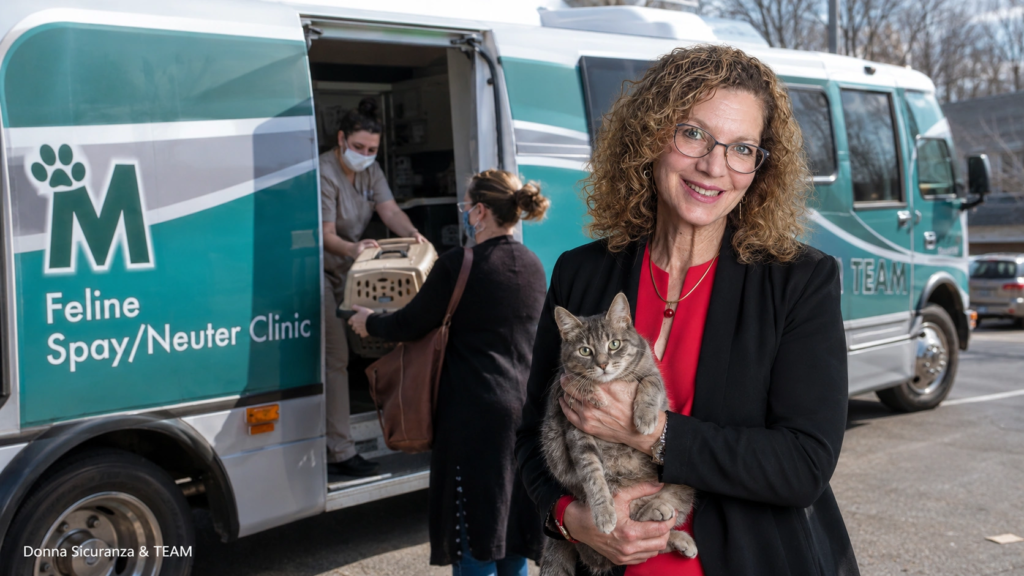
I approach donna sicuranza as a public-interest profile, not as a gossip topic or a private biography. The strongest verified public record connects Donna Sicuranza, also listed by TEAM as Donna Sicuranza Marconi, with Tait’s Every Animal Matters, a Connecticut nonprofit known for the TEAM Mobile Feline Spay/Neuter Clinic. The official TEAM staff page lists Donna Sicuranza Marconi as Executive Director, and the same site says TEAM veterinarians have sterilized and vaccinated more than 225,000 cats since 1997. That gives us a useful and responsible frame for the article: her public relevance comes from nonprofit leadership, affordable feline care, and long-term work around cat overpopulation in Connecticut.
Key Takeaways About Donna Sicuranza
Donna Sicuranza is best understood through her public role with Tait’s Every Animal Matters, often called TEAM. The organization’s own materials identify Donna Sicuranza Marconi as Executive Director, while nonprofit data sources also connect Donna Sicuranza with leadership roles at the Westbrook, Connecticut organization.
TEAM’s work is practical rather than symbolic. Its mobile feline clinic travels through Connecticut communities and provides spay, neuter, vaccination, and related services for cats, including domestic and feral cats. The official TEAM site says any Connecticut cat, domestic or feral, is welcome on the mobile clinic.
The organization’s public history places the mobile clinic’s planning in 1996 under John A. Caltabiano, DVM, and executive director Donna Sicuranza, with the clinic hitting the road on March 1, 1997. TEAM’s own history page describes it as Connecticut’s first and only mobile spay/neuter clinic for cats.
In my view, the most important lesson from Donna Sicuranza’s public profile is that animal welfare leadership often depends on prevention, access, logistics, communication, and donor trust. It is not only about dramatic rescue stories. It is also about making routine care reachable before unwanted litters, illness, and shelter strain increase. The ASPCA has similarly explained that preventing unwanted litters can reduce shelter intake and create more space for adoptions.
Who Donna Sicuranza Is in Public Context
Donna Sicuranza is publicly associated with Tait’s Every Animal Matters, a nonprofit organization based in Westbrook, Connecticut. The organization’s official “Meet The Team” page lists “Donna Sicuranza Marconi” as Executive Director, while Cause IQ lists “Donna Sicuranza” as President and Executive Director and also lists “Donna Sicuranza Marconi” as Executive Director in its personnel section. Because public records use both forms, I treat Donna Sicuranza and Donna Sicuranza Marconi as connected public references to the same organizational leadership context, while staying focused on verifiable professional information.
I believe this distinction matters because a search for a person’s name can easily become invasive or inaccurate. In this case, the reliable public information does not support a private-life article. It supports a professional profile about nonprofit work, community veterinary access, and the way a focused animal welfare program can operate for decades. We can discuss leadership, mission, services, public statements, and nonprofit context without inventing personal details.
From my perspective, that restraint makes the article more useful. Readers searching for Donna Sicuranza likely want to know who she is, what organization she represents, what TEAM does, and why the name appears in connection with Connecticut cat welfare. The answer is not a celebrity-style biography. It is a profile of a public-facing nonprofit leader whose work is tied to mobile feline spay, neuter, and vaccination services.
Why Donna Sicuranza Is Linked to Tait’s Every Animal Matters
Tait’s Every Animal Matters is the public organization most closely tied to Donna Sicuranza’s name. Cause IQ identifies the organization as a 501(c)(3) animal protection and welfare nonprofit in Westbrook, Connecticut, formed in 1993, with the mission description focused on spaying or neutering as many cats as possible before they reproduce. Cause IQ also lists the organization’s EIN as 06-1364861 and shows its general address as PO Box 591, Westbrook, CT 06498.
The organization’s public identity is highly focused. It does not appear to present itself as a broad veterinary hospital, a shelter, or a celebrity charity. Instead, its materials point to a specific service model: affordable, accessible feline spay, neuter, vaccination, and related basic care. In my analysis, that kind of focus is one reason the organization has a clear public story. It chose a defined problem, feline overpopulation, and built a mobile model around it.
Public Profile Snapshot
| Area | Verified Public Context | Why It Matters |
|---|---|---|
| Public name | Donna Sicuranza, also listed as Donna Sicuranza Marconi | Public sources use both forms in relation to TEAM leadership |
| Main public role | Executive Director at Tait’s Every Animal Matters | This is the central verified reason her name appears in animal welfare searches |
| Organization location | Westbrook, Connecticut | TEAM is rooted in Connecticut service delivery |
| Organization type | 501(c)(3) animal welfare nonprofit | This explains the donation-supported public service model |
| Core service | Mobile feline spay, neuter, vaccination, and related care | The work targets prevention and access |
| Public impact marker | More than 225,000 cats sterilized and vaccinated since 1997, according to TEAM | This gives readers a scale for the organization’s long-running work |
The most important takeaway from this table is that Donna Sicuranza’s public relevance is institutional and service-based. We can see a consistent connection between her name, TEAM leadership, Connecticut, and feline welfare access.
Donna Sicuranza and the TEAM Mobile Feline Spay Neuter Clinic
The TEAM Mobile Feline Spay/Neuter Clinic is the heart of Donna Sicuranza’s public profile. TEAM’s history page says that in 1996, plans for the clinic took shape under John A. Caltabiano, DVM, then TEAM president, and executive director Donna Sicuranza. The same page says the mobile clinic began operating on March 1, 1997, and describes it as the first and only clinic of its kind in Connecticut.
In practical terms, the model is simple but demanding. Instead of expecting every cat caretaker to travel to a fixed clinic or pay traditional veterinary pricing, TEAM brings a mobile clinic into communities. That kind of service model requires scheduling, equipment, staff coordination, surgical protocols, donor support, public communication, and community trust. From my perspective, the operational difficulty is easy to underestimate because the public sees the appointment, not the system behind it.
A TEAM newsletter from 2019 adds useful context. It says the clinic was established in 1997 by the late John Caltabiano, DVM, and TEAM Executive Director Donna Sicuranza to make spay and neuter services more affordable and accessible to cat caretakers. The newsletter also described the early clinic as a 22-foot vehicle with limited room and later noted that the veterinary staff could spay or neuter 35 cats in custom-built vehicles.
One short quotation from Donna Sicuranza captures the practical reality of the work:
“The cats don’t get here by themselves.”
Donna Sicuranza, TEAMWORKS newsletter
I read that quote as more than a logistical comment. It points to the human network behind animal welfare: caretakers, donors, office staff, veterinary professionals, mechanics, volunteers, and people willing to make appointments and transport cats. In my view, prevention works only when the system is accessible enough for ordinary people to use.
Why Donna Sicuranza’s Work Matters for Connecticut Cat Welfare
Donna Sicuranza’s public work matters because feline overpopulation is not solved by concern alone. It needs access to surgery, vaccination, education, and repeatable systems. TEAM’s official materials say the organization regularly travels to many communities statewide and welcomes Connecticut cats, whether domestic or feral.
We can understand the value through a realistic scenario. Imagine a retired person in Connecticut caring for two indoor cats and feeding a few outdoor neighborhood cats. Traditional veterinary costs may feel out of reach, especially if several cats need surgery and vaccines. Without an affordable option, one unspayed female cat can become the start of repeated litters. A mobile clinic does not solve every animal welfare problem, but it gives that caretaker a concrete next step.
The ASPCA has explained the broader shelter value of prevention clearly: preventing unwanted litters can reduce shelter intake and create more space and opportunities for pets to be adopted. That aligns with the logic behind TEAM’s service model.
In my view, this is where Donna Sicuranza’s profile becomes more meaningful than a standard biography. Her public work is connected to a service that helps owners, feral cat caretakers, rescue volunteers, local shelters, and communities. The benefit is not limited to a single surgery. Each completed surgery can prevent future litters, reduce pressure on shelters, and improve the health outlook for individual cats.
What TEAM Services Include for Connecticut Cat Caretakers
The official TEAM services page currently lists spay or neuter surgery at $245 and says it includes vaccinations for rabies, distemper, and upper/lower respiratory infection, along with a nail trim and ear mite treatment if needed. The page also lists additional fees, including Convenia at $20 and hernia repair at $50, plus other services and supplies such as a kitten package, ParaMonthly Plus, Profender topical dewormer, and ear mite treatment. Because fees can change, I would treat these figures as source-page information to verify before booking.
| Service or Item | Listed Detail | Practical Meaning for Readers |
|---|---|---|
| Spay or neuter surgery | Listed at $245 | Core surgery for preventing reproduction |
| Included vaccinations | Rabies, distemper, upper/lower respiratory infection | Adds preventive health value to the appointment |
| Nail trim | Included with surgery package | Useful basic care during the same visit |
| Ear mite treatment | Included if needed in the package | Helps address a common cat health issue |
| Convenia | Listed additional fee of $20 | May be used if the veterinarian determines it is needed |
| Hernia repair | Listed additional fee of $50 | Applies only when the veterinarian determines the condition requires attention |
| Kitten package | Listed at $50 for kittens 10 to 16 weeks | Supports early preventive care before surgery age or timing |
| ParaMonthly Plus | Listed at $10 | Flea and tick treatment added to a veterinary service |
The biggest takeaway is that TEAM’s service model combines sterilization with preventive care. I would not describe it as a replacement for a full-service veterinary relationship, but it can be a highly practical access point for cat caretakers who need affordable, focused help.
Step-by-Step Guide to Using the TEAM Model Responsibly
The first step is to confirm eligibility and location. TEAM’s site says services and supplies are available for Connecticut residents only, and its “Meet The Team” page says any Connecticut cat, domestic or feral, is welcome on the mobile clinic. That means a reader should first confirm that the cat and caretaker fit the program’s current service requirements.
The second step is to call the organization rather than assume availability. TEAM’s services page tells readers to call 1-888-FOR-TEAM for schedule, information, and appointments. I believe this is important because mobile clinic schedules, community stops, surgery capacity, and waiting times can change.
The third step is to prepare the cat properly. A domestic cat should be transported securely, while a feral cat may require coordination with trap-neuter-return practices. The goal is not merely to show up. The goal is to protect the cat, the staff, and other animals during transport and handling.
The fourth step is to ask what is included and what might cost extra. Based on the service page, the core package includes several items, but additional treatments may be determined by the veterinarian. Asking ahead reduces confusion and helps caretakers plan responsibly.
The fifth step is to follow aftercare instructions. Surgery is only one part of the process. A cat also needs safe recovery space, monitoring, and appropriate follow-up if anything seems wrong. In my view, aftercare is where responsible ownership and humane community cat care become visible.
Practical Examples of How the Work Can Help
Consider a hypothetical family that adopts a young cat from a neighbor. They want to do the right thing, but the cost of a traditional appointment delays the decision. If they use a mobile clinic appointment, the cat can be sterilized and vaccinated before an accidental litter happens. That is prevention in its clearest form.
Now consider a hypothetical community cat caretaker who feeds several outdoor cats behind a small business. Without spay and neuter access, the colony may grow every kitten season. With access to a mobile clinic, the caretaker can trap, transport, sterilize, vaccinate, and return cats more systematically. That does not make the work easy, but it makes humane action more realistic.
A third scenario involves shelters and rescue groups. When more cats arrive already sterilized or fewer kittens are born into unmanaged conditions, rescue capacity can stretch further. The ASPCA’s broader spay and neuter discussion supports this logic by connecting unwanted-litter prevention with reduced shelter intake and improved adoption opportunity.
From my perspective, these examples show why Donna Sicuranza’s public work deserves attention. It is not only about one organization’s numbers. It is about a prevention model that gives ordinary people a way to act before a problem becomes larger, more expensive, and more painful.
Public Statements That Show the Mission Behind the Work
A 2021 Patch interview provides one of the clearest public windows into Donna Sicuranza’s view of the clinic. Patch reported that the mobile clinic had been on Connecticut roads for more than two decades, bringing affordable spay, neuter, and vaccination services to cats statewide. The article also reported that more than 200,000 cats had been spayed or neutered and vaccinated aboard the clinic since 1997.
One brief quote shows how Sicuranza described the work:
“It really is amazing.”
Donna Sicuranza, quoted by Patch
That short statement matters because it frames the work as emotionally durable. We can reasonably assume that decades of nonprofit veterinary logistics include stress, demand, limited resources, and public pressure. Yet the quote presents the work as rewarding for cats, owners, and staff, which is consistent with a mission-led organization.
Patch also quoted Sicuranza explaining the importance of keeping fees low through donations:
“Spaying and neutering is the most important service that can be offered.”
Donna Sicuranza, quoted by Patch
I believe this quote gets to the center of the article. In animal welfare, prevention rarely feels as dramatic as rescue, but it may be more powerful over time. A single surgery can prevent repeated cycles of unwanted litters, overcrowding, and avoidable suffering.
Common Misconceptions About Donna Sicuranza and TEAM
One common misconception is that Donna Sicuranza should be covered like a celebrity. I do not think the verified record supports that. Her public relevance is not rooted in entertainment, scandal, or personal branding. It is rooted in nonprofit animal welfare leadership.
Another misconception is that a mobile spay and neuter clinic is “less real” than a traditional veterinary facility. Patch reported that Sicuranza addressed this kind of concern by emphasizing that the staff is professional and experienced. TEAM’s own materials also describe a veterinary staff, a medical director, and long-running mobile clinic operations.
A third misconception is that low-cost services eliminate the need for regular veterinary care. I would not make that leap. TEAM’s model is focused, and the official services page lists specific services and supplies. A cat with chronic illness, injury, dental disease, advanced diagnostics needs, or emergency symptoms may still need a full-service veterinarian or emergency hospital.
The fourth misconception is that spay and neuter work only helps shelters. In reality, it helps owners, outdoor cat caretakers, neighbors, local governments, rescue groups, veterinary partners, and cats themselves. The benefit is distributed across the community.
Research-Based Recommendations for Cat Owners and Caretakers
For cat owners, my first recommendation is to treat spay and neuter planning as early preventive care, not as an optional task to handle someday. Humane World for Animals notes that owned cats should be altered before they are 5 months old, based on its summary of general recommendations.
For community cat caretakers, I recommend planning in batches only when it is safe and manageable. It may be tempting to trap many cats at once, but transportation, appointment capacity, weather, recovery space, and stress levels all matter. A responsible plan is better than a rushed plan.
For donors, I recommend looking beyond emotional appeals and asking whether a program has a measurable service model. TEAM’s public materials point to decades of work and more than 225,000 cats served since 1997, which gives donors a concrete way to understand the scale of the mission.
A useful outside perspective comes from the ASPCA’s Dr. Carolyn Brown, who connected each surgery to larger animal welfare outcomes:
“Every surgery prevents the birth of puppies or kittens.”
Dr. Carolyn Brown, ASPCA
I include that quote because it explains why a profile of Donna Sicuranza naturally becomes a discussion of prevention. The work is not abstract. It changes future intake, future costs, future suffering, and future caretaker decisions.
Risks, Limits, and Better Responses for Cat Care Decisions
Every animal welfare service model has limits. I think readers are better served when those limits are named clearly. Mobile clinics can be powerful, but they are not magic. They work best when caretakers prepare well, communicate honestly, and understand what the service does and does not include.
| Situation | Possible Risk | Better Response |
|---|---|---|
| Waiting too long to spay a young cat | Accidental pregnancy or repeated heat cycles | Schedule early and ask the clinic about age and weight requirements |
| Bringing a sick cat without disclosure | Surgery may be unsafe or delayed | Tell the clinic about symptoms before the appointment |
| Assuming all services are included | Unexpected fees or unmet expectations | Review the current service list and ask about add-ons |
| Transporting a cat in an unsafe carrier | Escape, injury, or stress | Use secure carriers or approved traps for feral cats |
| Treating mobile care as full-service care | Chronic issues may go undiagnosed | Keep a relationship with a full-service veterinarian when possible |
| Ignoring aftercare | Complications may be missed | Follow recovery instructions and seek help if warning signs appear |
The main lesson from this table is that access and responsibility must work together. TEAM can provide an important service, but the caretaker still has to prepare, transport, monitor, and follow through.
How Donna Sicuranza’s Work Fits Into Nonprofit Leadership
Donna Sicuranza’s public record shows the kind of leadership that often receives less attention than it deserves. A small nonprofit leader has to communicate with donors, manage public trust, support staff, respond to demand, keep services understandable, and stay mission-focused. We can see this in TEAM’s public materials, which combine service information, staff listings, donation appeals, appointment instructions, and community-facing explanations.
ProPublica’s Nonprofit Explorer gives another angle. Its extracted Form 990 data shows TEAM’s revenues, expenses, net assets, and compensation figures across multiple fiscal years. For fiscal year ending September 2023, ProPublica lists revenue of $489,192, expenses of $681,137, and net assets of $787,912. Those figures remind us that nonprofit service delivery is also financial management.
In my view, that financial context matters because low-cost services still have real costs. Vehicles, fuel, equipment, supplies, staff, insurance, medicine, maintenance, compliance, and administration do not disappear because a mission is charitable. A leader in this setting must balance compassion with sustainability.
Cause IQ’s listing also says the organization treated 2,720 animals in the fiscal year shown on its page. That figure helps readers understand that the work is ongoing and operational, not merely historical.
Why Prevention Is Often the Strongest Animal Welfare Strategy
Prevention can look quiet, but I believe it is one of the strongest forms of animal welfare. A rescued kitten is visible. A prevented litter is invisible. That invisibility can make prevention less emotionally dramatic, but not less important.
TEAM’s model is built around the idea that spaying or neutering cats before reproduction reduces future suffering. Cause IQ’s description of TEAM states that the organization aims to spay or neuter as many cats as possible before they reproduce, while making the services affordable and accessible to the state’s cat caretakers.
Humane World for Animals adds a health dimension, noting that altered pets have reduced risk of certain cancers and that intact female cats and dogs have greater chances of developing pyometra and cancers of the reproductive system. It also says neutering male pets eliminates their risk of testicular cancer and benign prostatic hyperplasia.
From my perspective, the prevention argument has three layers. The first layer is individual health. The second is population control. The third is community capacity. When fewer unwanted kittens are born, shelters and rescues can use limited resources more effectively. That is the practical reason Donna Sicuranza’s work with TEAM deserves a focused public profile.
Conclusion
I believe Donna Sicuranza’s public story is best understood through service, not spectacle. The verified record connects donna sicuranza with Tait’s Every Animal Matters and the TEAM Mobile Feline Spay/Neuter Clinic, a Connecticut model built around affordable, accessible feline care. What stands out to me is the steady nature of the work. More than two decades of mobile clinic operations require more than compassion. They require planning, credibility, fundraising, staff commitment, and a clear understanding of what cat caretakers actually need.
The practical lesson is straightforward: animal welfare improves when prevention becomes accessible. A spay or neuter appointment may seem routine, but at community scale it can reduce unwanted litters, ease shelter pressure, and help owners act responsibly before problems multiply. For readers, the next action is to treat feline sterilization and vaccination as early planning, not delayed crisis management. For Connecticut residents, that means checking TEAM’s current schedule, fees, and appointment requirements directly before making decisions.
Frequently Asked Questions
Who Is Donna Sicuranza?
Donna Sicuranza is publicly associated with Tait’s Every Animal Matters, also known as TEAM, a Connecticut nonprofit focused on feline spay, neuter, vaccination, and related care. The official TEAM website lists Donna Sicuranza Marconi as Executive Director, while nonprofit data sources connect Donna Sicuranza with leadership roles at the same organization. The most responsible public profile focuses on her animal welfare work rather than unsupported personal details.
Why Is Donna Sicuranza Connected to TEAM?
Donna Sicuranza is connected to TEAM because public sources identify her in executive leadership connected with Tait’s Every Animal Matters. TEAM’s history page says plans for the mobile clinic took shape in 1996 under John A. Caltabiano, DVM, and executive director Donna Sicuranza. That history places her at the center of the organization’s long-running mobile feline spay and neuter model in Connecticut.
What Does Tait’s Every Animal Matters Do?
Tait’s Every Animal Matters provides mobile feline spay, neuter, vaccination, and related services for Connecticut cats. Its official site says TEAM veterinarians have sterilized and vaccinated more than 225,000 cats since 1997 and that domestic and feral Connecticut cats are welcome on the mobile clinic. This makes the organization especially relevant to owners, rescue volunteers, and community cat caretakers.
Is Donna Sicuranza a Veterinarian?
I did not find verified public information showing that Donna Sicuranza is a veterinarian. The public sources identify her through executive and administrative leadership. TEAM’s official staff page lists Art Heller, DVM, as Medical Director and lists veterinary technicians separately, while Donna Sicuranza Marconi appears under administrative staff as Executive Director.
How Many Cats Has TEAM Helped?
TEAM’s official staff page says its veterinarians have sterilized and vaccinated more than 225,000 cats since 1997. A 2021 TEAM history page gave an earlier figure of more than 206,000 cats, while a 2019 newsletter celebrated the completion of the 200,000th sterilization surgery. These figures show a long-running increase over time.
Why Does Donna Sicuranza’s Work Matter?
Donna Sicuranza’s work matters because it is tied to a prevention-focused animal welfare model. Affordable spay and neuter access can help reduce unwanted litters, support healthier cats, and ease pressure on shelters and rescues. In my view, this is the kind of practical animal welfare leadership that deserves attention because it solves problems before they become larger crises.
Sources or References
Official TEAM staff page and service information for Tait’s Every Animal Matters.
TEAM history page about Connecticut’s mobile feline spay/neuter clinic.
TEAMWORKS Summer 2019 newsletter.
Patch interview and report on the TEAM Mobile Feline Spay/Neuter Clinic.
Cause IQ and ProPublica nonprofit data for Vernon Tait All Animal Adoption Preservation Team.
ASPCA and Humane World for Animals resources on spay and neuter context.
Editorial brief supplied for this article.
Disclaimer
This article is based on publicly available information from organizational pages, nonprofit data sources, and cited reporting. It does not claim private biographical details, personal relationships, medical credentials, or personal history that could not be verified from reliable public sources. Service prices, schedules, eligibility rules, and appointment details may change, so readers should contact TEAM or any relevant veterinary provider directly before making care decisions.