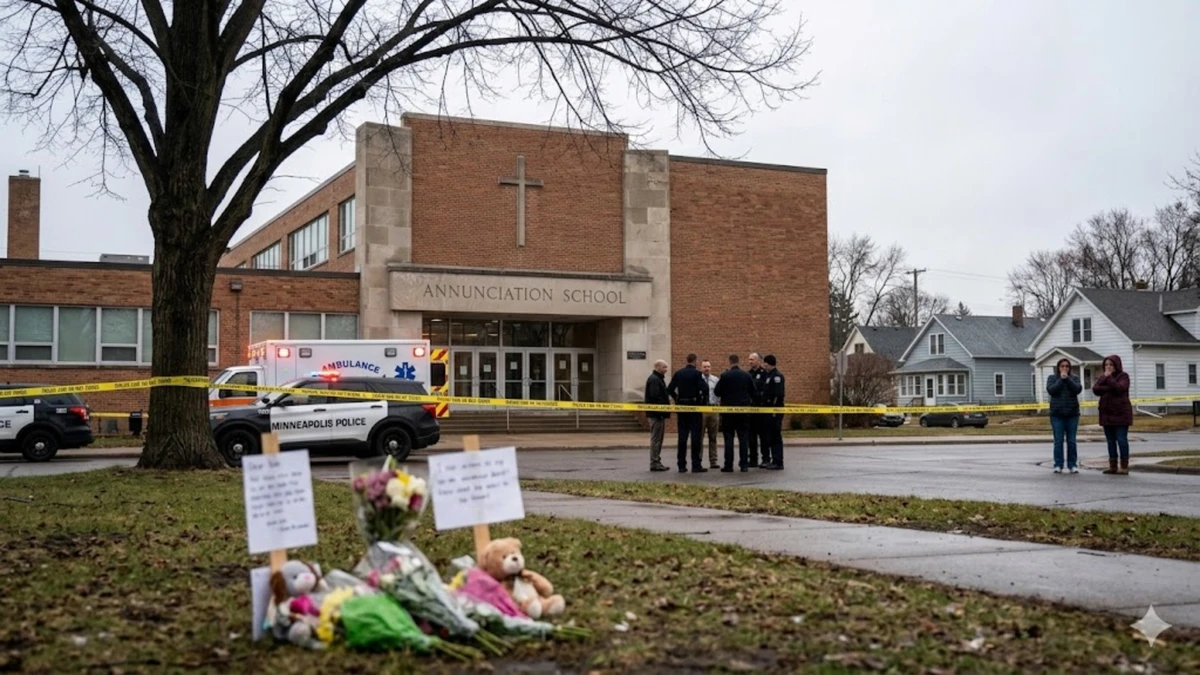
The Annunciation School shooting refers to the deadly attack that took place on Aug. 27, 2025, at Annunciation Catholic School and its adjoining church in Minneapolis, Minnesota. During an all-school Mass early that morning, a gunman opened fire through stained-glass windows, killing two children and injuring at least 17 others, most of them students. The suspect later died by suicide. Authorities secured the scene within minutes, but the impact of the attack rippled far beyond that morning.
I remember watching the first alerts appear on my phone, brief headlines that quickly grew into a steady stream of grim details. A school Mass. Children under pews. Parents racing toward sirens. What unfolded inside the church lasted only minutes, but for families and survivors, the memory has stretched into an enduring trauma.
The Annunciation tragedy immediately joined a painful list of American school shootings. It forced Minneapolis residents to confront questions about safety in sacred and educational spaces. It also reignited a national debate about gun laws, mental health resources and the vulnerability of children in environments meant to protect them. As investigations moved forward and vigils filled the church grounds, the community struggled to process what had happened and what must change to prevent it from happening again.
The Morning of the Shooting
On the morning of Aug. 27, students and staff gathered for an all-school Mass during the first week of classes. Shortly after 8:15 a.m., gunfire shattered the stillness inside Annunciation Catholic Church. According to authorities, the shooter fired multiple rounds through stained-glass windows before moving toward other parts of the property.
Witnesses initially described confusion. Some thought the noise was construction or fireworks. Realization came quickly. Teachers shouted instructions. Students dropped to the floor. Older children attempted to shield younger classmates. The shooting lasted approximately two minutes before the gunman died by suicide in a parking area behind the church.
Emergency calls began around 8:27 a.m. Minneapolis police officers entered the building to render aid and secure the premises. Paramedics transported the wounded to nearby hospitals. By 9 a.m., authorities declared there was no ongoing threat. Law enforcement agencies at the city, state and federal levels assisted in the investigation.
Read: OpenSkyNews: A Modern Voice in Digital Journalism
The Victims
Two children were killed in the attack: 8-year-old Fletcher Merkel and 10-year-old Harper Moyski. Their names were spoken at vigils, printed on memorial programs and written in chalk on sidewalks near the church. The grief was immediate and visible.
At least 17 others were injured, including 14 children. Some sustained critical wounds. Families described frantic moments inside emergency rooms and hospital corridors. Community fundraisers were organized to help cover medical expenses and funeral costs.
One survivor, eighth-grader Lydia Kaiser, later spoke publicly about being shot and undergoing multiple surgeries. Her words carried a quiet urgency. She described fear, pain and determination. In the weeks that followed, she called on lawmakers to strengthen gun safety measures. Her testimony became part of a broader advocacy effort tied to the tragedy.
The names and faces of the children transformed statistics into lived loss. For classmates, empty desks served as daily reminders of what happened that morning.
The Shooter and Investigation
Authorities identified the gunman as 23-year-old Robin Westman, a Minnesota resident. Law enforcement officials reported that he legally purchased the firearms used in the attack. Investigators executed search warrants at multiple locations connected to him.
Officials stated that Westman had exhibited signs of mental health struggles and appeared to have an interest in prior mass shootings. Materials recovered during the investigation included writings and digital content referencing violence. However, authorities did not immediately release a definitive motive.
The FBI assisted local investigators and examined whether the attack could qualify as domestic terrorism or a hate crime targeting a Catholic institution. As with many such cases, determining motive required careful analysis of evidence, communications and background history.
While the shooter’s life ended that morning, the investigation continued for months. Law enforcement officials emphasized the importance of transparency and thoroughness to provide answers for families and the public.
Emergency Response and Heroism
First responders described a chaotic and emotionally wrenching scene. Officers entered through shattered glass and overturned pews to reach victims. Paramedics triaged children and adults amid debris and broken windows.
Teachers and staff were credited with taking swift action. Some used their bodies as shields. Others directed students toward safer areas. Parents who heard gunshots rushed toward the church, confronting fear with instinctive urgency.
A family reunification center was established to help connect parents with children. Counselors and clergy were dispatched to provide immediate support. Hospitals mobilized trauma teams prepared for pediatric emergencies.
In the aftermath, local officials praised the coordinated response among police, firefighters and medical personnel. While the violence could not be undone, the rapid arrival of emergency services likely prevented additional fatalities.
Community Grief and Solidarity
Within hours of the shooting, the church lawn filled with flowers, candles and handwritten notes. Neighbors gathered in silence. Some knelt in prayer. Others simply stood together.
Mayor Kim Norton and city leaders addressed the public, offering condolences and affirming a commitment to safety. Faith leaders organized interdenominational services. The Minnesota governor visited the site and met with families.
The grief extended beyond the parish. Schools across Minneapolis held moments of silence. Parents discussed safety plans with their children. Social workers and psychologists were brought into classrooms to provide trauma-informed care.
Community forums followed in the weeks after. Residents spoke about fear, resilience and responsibility. For many, the shooting represented not only personal tragedy but a civic challenge.
National Reaction and Policy Debate
The Annunciation School shooting reignited debate over gun policy in the United States. Lawmakers at both state and federal levels addressed questions about background checks, safe storage laws and access to high-powered firearms.
Supporters of stricter regulations argued that legally purchased weapons had once again been used in a mass shooting. Opponents cautioned against legislative overreach and emphasized mental health interventions.
Faith leaders across the country spoke about violence in sacred spaces. Advocacy groups highlighted the frequency of school shootings and called for comprehensive reform.
Survivor voices added emotional weight to policy discussions. Lydia Kaiser’s appeal for protection from gun violence resonated widely. Her story became a rallying point for those pushing for legislative change.
While debate intensified, consensus remained elusive. The tragedy underscored enduring divisions in national discourse.
School Shootings in Broader Context
The Annunciation attack fits within a troubling pattern of violence targeting educational institutions. Since 1999, numerous school shootings have shaken communities across the United States.
Researchers note that prevention efforts often include multiple strategies: strengthened security infrastructure, threat assessment protocols, expanded mental health services and firearm regulation.
Comparative data shows that the United States experiences higher rates of gun violence than many other developed nations. Advocates for reform cite these disparities as evidence of systemic challenges.
Educators increasingly conduct active-shooter drills and review emergency plans. Yet critics argue that preparedness measures alone cannot substitute for prevention.
The Annunciation tragedy renewed scrutiny of these approaches, prompting renewed calls for coordinated solutions.
Comparative Overview
| Element | Annunciation School Shooting | Typical U.S. School Shooting Trends |
|---|---|---|
| Date | Aug. 27, 2025 | Recurring incidents since 1999 |
| Fatalities | 2 children | Varies by incident |
| Injuries | 17+ | Often multiple victims |
| Shooter Outcome | Suicide | Frequently suicide or arrest |
| Location Type | Catholic school and church | Public and private schools |
| Policy Area | Proposed Response | Ongoing Debate |
|---|---|---|
| Background Checks | Universal checks | Federal legislation discussions |
| Safe Storage | Mandated firearm storage | State-level adoption varies |
| Mental Health | Expanded counseling access | Funding and infrastructure challenges |
| School Security | Increased training and resources | Balancing safety and environment |
These comparisons illustrate both the specific details of the Annunciation tragedy and the recurring patterns seen nationwide.
Expert Perspectives
Dr. Laura Martinez, a violence prevention researcher, says effective solutions require “integrated approaches that address firearm access, early intervention and community resilience.”
Education analyst Mark Rivers notes that “schools must balance creating welcoming environments with implementing necessary safety measures.”
Child psychologist Dr. Nina Shah emphasizes the need for sustained support. “Trauma does not resolve quickly. Students and families require long-term counseling and stability,” she says.
These assessments reflect the complexity of addressing school violence beyond immediate response.
Takeaways
- The Annunciation School shooting occurred on Aug. 27, 2025, during morning Mass in Minneapolis.
- Two children were killed and at least 17 others were injured.
- The shooter legally obtained firearms and died by suicide at the scene.
- Emergency responders acted quickly, likely limiting additional casualties.
- The tragedy prompted national debate over gun laws and school safety.
- Community healing efforts continue alongside legal and policy discussions.
Conclusion
The Annunciation School shooting stands as a somber reminder of the vulnerability of children in spaces meant for worship and learning. A brief burst of gunfire transformed a morning of prayer into enduring grief.
I think about the families who left home that morning expecting an ordinary school day. Their lives shifted irreversibly in a matter of minutes. Memorials, policy debates and investigative findings cannot restore what was lost, but they form part of a broader reckoning.
The community of Minneapolis continues to mourn and rebuild. The nation continues to argue and search for solutions. In the space between grief and policy, survivors carry memories and voices that demand attention.
Whether the Annunciation tragedy becomes another entry in a long list or a catalyst for change remains uncertain. What is certain is the lasting imprint it has left on those who lived through it.
FAQs
What happened at Annunciation Catholic School?
A gunman opened fire during an all-school Mass on Aug. 27, 2025, killing two children and injuring at least 17 others.
How did the shooter obtain the weapons?
Authorities reported the firearms were legally purchased prior to the attack.
How did first responders react?
Police and paramedics arrived within minutes, secured the scene and transported victims to hospitals.
What has been the community response?
Residents held vigils, memorial services and public forums focused on healing and prevention.
Has the shooting affected policy discussions?
Yes. The tragedy renewed national debate over gun regulations, school safety and mental health resources.