
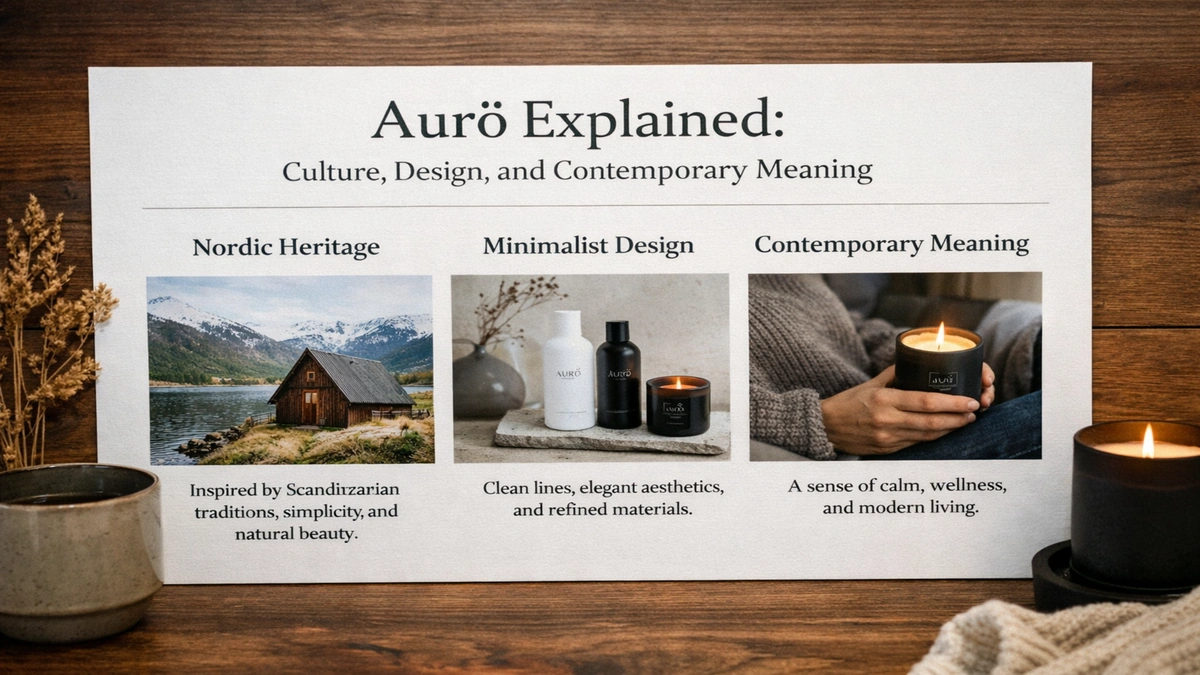
I first encountered Aurö not as a definition, but as a mood. It appeared in conversations about calm interiors, in academic emails announcing workshops, and in digital spaces where people seemed to be searching for something slower and more deliberate. In the first moments of encountering the word, most readers are not asking for an etymology. They want to know what Aurö stands for, why it keeps surfacing, and whether it points to something real or merely fashionable.
Aurö has no single, authoritative meaning. Instead, it functions as a shared symbol across several domains. In lifestyle and design, it signals restraint, softness, and intentional choices. In academic circles, it names a formal network devoted to environmental and resource economics. Online, it has become shorthand for thoughtful creativity and resistance to excess. The unifying thread is not the spelling or sound of the word, but the values it carries. Aurö suggests care, balance, and a refusal to rush.
In a culture dominated by speed, metrics, and constant stimulation, concepts like Aurö gain traction because they offer an alternative. They give language to feelings many already have but struggle to articulate. This article explores Aurö as a cultural idea rather than a dictionary entry. It traces how the term moves between disciplines, how its meanings overlap, and why its ambiguity may be its greatest strength.
Read: Craigslist Buffalo NY: Housing, Jobs and Local Life
Aurö as a Constructed Cultural Concept
Aurö is best understood as a constructed term, intentionally open to interpretation. It was not inherited from a single language or tradition, and it does not belong to folklore or classical philosophy. Its power comes from suggestion rather than definition. The umlaut adds a visual and sonic softness, often associated with Nordic or Central European aesthetics, while the base of the word echoes ideas of aura, atmosphere, and value.
Because Aurö is not fixed, it adapts easily. Designers can apply it to spaces. Researchers can use it as an institutional label. Digital creators can adopt it as an identity marker. Each usage reshapes the term slightly, yet none fully claims ownership. This flexibility reflects a broader trend in modern culture, where meaning is often negotiated rather than prescribed.
Unlike buzzwords that rise and fall with trends, Aurö operates quietly. It is rarely shouted. It appears in thoughtful contexts, often alongside discussions of quality, sustainability, and care. That restraint is part of its appeal. Aurö does not promise transformation. It suggests alignment.
Design and the Aurö Aesthetic
In design and lifestyle culture, Aurö is closely associated with calm environments and intentional living. An Aurö-inspired interior does not aim to impress through scale or novelty. It seeks to settle the nervous system. Colors are muted. Materials are tactile and natural. Light is indirect and forgiving.
This approach aligns with a broader shift away from maximalism and visual overload. As homes increasingly double as workplaces and refuges, people gravitate toward spaces that reduce friction rather than add stimulation. Aurö functions here as a guiding principle rather than a style guide. It asks how a space feels before asking how it looks.
Designers who reference Aurö often speak about subtraction. What can be removed without loss. What objects genuinely earn their place. The result is not emptiness but coherence. Every element has a role, and nothing competes for attention.
Common Elements in Aurö-Inspired Design
| Aspect | Typical Characteristics |
|---|---|
| Color | Soft neutrals, earth tones, low contrast |
| Materials | Wood, linen, clay, stone |
| Light | Natural, diffused, warm |
| Form | Simple lines, gentle curves |
| Atmosphere | Quiet, grounded, uncluttered |
These choices are not about trend alignment. They reflect a philosophy of care and longevity, both environmental and emotional.
Aurö and Intentional Living
Beyond physical spaces, Aurö has become shorthand for a way of living. This interpretation emphasizes deliberate routines, mindful consumption, and a slower relationship with time. It does not reject technology or ambition, but it questions excess.
People drawn to Aurö-style living often speak about boundaries. Limiting digital noise. Choosing fewer commitments. Designing days with breathing room. In this sense, Aurö overlaps with ideas like slow living and mindfulness, but it remains distinct because it is less prescriptive. There is no list of rules, only a general orientation toward balance.
This flexibility allows Aurö to resonate across cultures and age groups. A young professional might interpret it as digital restraint. A family might see it as calmer domestic rhythms. A designer might frame it as ethical material choices. The common ground is intention.
Read: FloArena Wrestling: Revolutionizing the World of Wrestling
Aurö in Academic and Professional Contexts
Aurö also exists as a formal acronym in academic life. In German-speaking economics circles, AURÖ refers to a committee focused on environmental and resource economics. It functions as a professional network that supports early-career researchers through workshops and scholarly exchange.
In this setting, Aurö represents rigor rather than relaxation. Yet the connection is not accidental. Environmental and resource economics is concerned with balance, limits, and long-term thinking. The academic Aurö is about sustainability in the most literal sense: how societies allocate scarce resources without undermining future stability.
The annual Aurö workshops provide structured spaces for doctoral candidates and postdoctoral researchers to present work, receive feedback, and build professional relationships. These gatherings emphasize depth over spectacle. They prioritize conversation, critique, and community.
Lifestyle and Academic Meanings Compared
| Dimension | Lifestyle Aurö | Academic Aurö |
|---|---|---|
| Core Focus | Calm and intentional living | Environmental economics |
| Primary Audience | Designers, individuals | Researchers, scholars |
| Key Values | Balance, simplicity | Sustainability, rigor |
| Output | Spaces, routines, content | Workshops, research |
Despite their differences, both uses reflect a shared concern with thoughtful engagement and long-term perspective.
Digital Culture and the Aurö Signal
In digital spaces, Aurö has become a subtle signal rather than a mass trend. It appears in bios, captions, and community labels, often without explanation. For those who recognize it, Aurö implies discernment. It suggests content created with care rather than speed.
This usage reflects growing fatigue with algorithmic intensity. As platforms reward constant output, some creators choose to slow down. Aurö functions as a quiet marker of that choice. It does not guarantee quality, but it signals an aspiration toward it.
Unlike viral hashtags, Aurö does not spread through spectacle. It circulates through affinity. People who use it often share similar values around craft, ethics, and attention. In that sense, Aurö helps form micro-communities within vast digital ecosystems.
Sustainability links many interpretations of Aurö. In design, it appears through durable materials and timeless aesthetics. In lifestyle discourse, it shows up as reduced consumption and mindful habits. In academia, it anchors research into environmental limits and policy.
What unites these strands is a resistance to short-term thinking. Aurö consistently points toward choices that endure. This does not mean austerity or denial. It means selecting what lasts, emotionally and materially.
Experts in sustainable design often emphasize that calm environments encourage care. People are more likely to maintain and value spaces that feel balanced. In economics, sustainability requires similar emotional discipline. Long-term policies demand patience and restraint.
Aurö, in this sense, acts as a cultural bridge between feeling and structure. It connects personal experience with systemic thinking.
Expert Perspectives on Aurö
Cultural theorists have noted that modern concepts often emerge not from institutions but from shared unease. Aurö fits this pattern. It gives form to diffuse concerns about overload, fragmentation, and loss of meaning.
Design professionals describe Aurö as a response to visual noise. They argue that restraint is not minimalism for its own sake, but a way to restore focus. Environmental economists, meanwhile, frame the academic Aurö as essential infrastructure for addressing climate and resource challenges.
Digital culture analysts observe that terms like Aurö gain power precisely because they are not optimized for algorithms. Their ambiguity resists commodification, at least initially. This resistance makes them attractive to communities seeking authenticity.
Why Ambiguity Works
One of Aurö’s defining features is its refusal to settle. It remains slightly out of reach, which allows people to project their own priorities onto it. In a world saturated with labels and categories, that openness feels refreshing.
Ambiguity can be frustrating, but it can also be generative. Aurö invites interpretation rather than compliance. It encourages people to ask what balance means in their own lives and work.
This quality may explain why Aurö appears in such different contexts without collapsing into confusion. Each usage reinforces the others by sharing an underlying ethic of care.
Takeaways
- Aurö is a modern, constructed concept with multiple valid meanings.
- In design, it emphasizes calm, material honesty, and restraint.
- In lifestyle culture, it reflects intentional living and mindful choices.
- In academia, it names a serious network focused on environmental economics.
- In digital spaces, it signals thoughtful creation over constant output.
- Its ambiguity allows it to adapt without losing coherence.
Conclusion
Aurö does not ask to be defined once and for all. It asks to be lived, practiced, and interpreted. That may be why it resonates across such different fields. Whether encountered in a quiet room, a research workshop, or a digital profile, Aurö carries the same underlying suggestion: slow down, choose carefully, and think beyond the immediate moment.
In an era marked by acceleration, Aurö offers a counterpoint. It does not promise escape from complexity, but it encourages a more humane relationship with it. By valuing balance, sustainability, and intention, Aurö reflects a cultural shift that is still unfolding.
The word may change. Its uses may expand or contract. But the impulse behind it seems durable. As long as people continue to seek clarity in crowded systems, ideas like Aurö will find new ways to surface.
FAQs
Is Aurö a real word?
Aurö is a constructed term rather than a traditional dictionary word, shaped by contemporary cultural and professional use.
Does Aurö have one official meaning?
No. Its meaning depends on context, ranging from lifestyle philosophy to academic organization.
Why is Aurö popular in design culture?
Because it captures ideas of calm, restraint, and material honesty that resonate with modern living needs.
Is Aurö connected to sustainability?
Yes. Many interpretations of Aurö emphasize long-term thinking, reduced excess, and environmental responsibility.
Can Aurö be used in branding or identity?
It often is, especially by individuals and projects that value subtlety, intention, and thoughtful expression.