
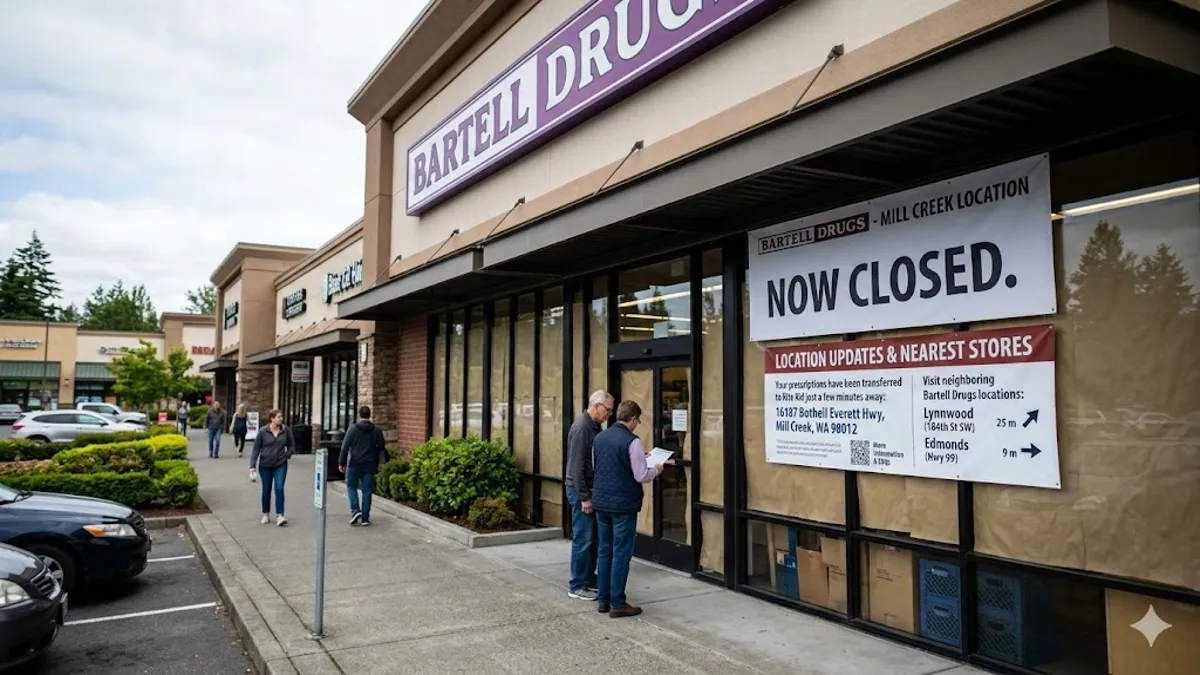
I remember the familiar rhythm of a neighborhood pharmacy: prescriptions filled while neighbors exchanged greetings, shelves stocked with both medicine and small-town convenience. In Mill Creek, Washington, that rhythm ended in September 2025, when Bartell Drugs permanently closed its location on Mill Creek Boulevard. For residents searching what happened to Bartell Drugs in Mill Creek, the answer is direct: the store shut down as part of broader closures tied to Rite Aid’s financial struggles and bankruptcy restructuring.
But the closure is more than a single storefront going dark. It marks the end of a long-standing presence tied to a 135-year-old regional brand. Bartell Drugs, once family-owned and deeply rooted in the Pacific Northwest, had already undergone significant transformation after its acquisition by Rite Aid in 2020. When Rite Aid entered bankruptcy again in 2025, the remaining Bartell locations, including Mill Creek, were swept into a wave of closures.
Today, residents must travel to nearby Everett or Lynnwood for pharmacy services once available within minutes. The change is logistical, but also emotional. It reflects a larger story unfolding across the United States: the slow disappearance of neighborhood pharmacies and the consolidation of healthcare retail into fewer, larger players.
A Local Institution with Deep Roots
Bartell Drugs began as a family-owned business in Seattle in 1890, growing steadily into one of the Pacific Northwest’s most recognizable pharmacy chains. For generations, it was more than a place to pick up prescriptions. It was a community hub, known for personalized service and local engagement.
The Mill Creek location, situated at 15520 Mill Creek Boulevard, embodied this tradition. Residents relied on it not only for medications but for vaccinations, household essentials, and quick consultations with pharmacists who often knew their customers by name.
This local identity distinguished Bartell from national chains. Even as competitors expanded aggressively, Bartell maintained a reputation for community-centered care. That identity began to shift in 2020 when Rite Aid acquired the company for $95 million, ending family ownership.
“Regional pharmacy chains often carry a level of trust that national chains struggle to replicate,” says Dr. Jane Sarasohn-Kahn, a health economist. “When they disappear, communities feel that loss beyond convenience.”
The Mill Creek closure, therefore, represents not just a business decision but the fading of a longstanding regional institution.
Read: What Are Tumbons? A Practical Guide from Experience
The Corporate Shift: From Family-Owned to Consolidated Retail
The acquisition of Bartell Drugs by Rite Aid marked a turning point. Rite Aid, itself a national pharmacy chain facing mounting financial pressure, sought to expand its footprint in the Pacific Northwest through the purchase.
Initially, the move appeared strategic. Bartell’s strong regional brand complemented Rite Aid’s scale. However, the challenges facing retail pharmacies soon became apparent. Declining reimbursement rates from insurers, increased competition from online pharmacies, and rising operational costs strained profitability.
By 2023, Rite Aid filed for Chapter 11 bankruptcy, signaling deeper structural issues. Store closures began to ripple through its network, including several locations in and around Mill Creek.
The second bankruptcy filing in 2025 accelerated these closures. Bartell locations were gradually phased out, with some sold to competitors and others shuttered entirely. The Mill Creek store was among the final closures, marking the end of the brand’s physical presence in the area.
“Pharmacy chains are caught between shrinking margins and growing expectations,” explains retail analyst Neil Saunders. “It’s a difficult business model to sustain without scale or innovation.”
Timeline of Key Events Leading to Closure
| Year | Event | Impact |
|---|---|---|
| 2020 | Rite Aid acquires Bartell Drugs | Ends family ownership |
| 2023 | First Rite Aid bankruptcy | Initial closures begin |
| Early 2025 | Stores sold to competitors like CVS | Brand fragmentation |
| Sept 2025 | Final Bartell closures, including Mill Creek | End of local presence |
This timeline illustrates how quickly the landscape changed. What began as an acquisition evolved into a complete transformation of the brand within five years.
The Immediate Impact on Mill Creek Residents
The closure of the Mill Creek Bartell Drugs created a noticeable gap in local healthcare access. Residents who once relied on a nearby pharmacy now face longer travel times and fewer options.
For many, particularly older adults or those with chronic conditions, convenience is not a luxury but a necessity. The loss of a local pharmacy can complicate medication adherence and reduce access to professional guidance.
Nearby locations in Everett and Lynnwood have absorbed some of the demand. These include stores on Seattle Hill Road, Silver Lake, and Lake Serene, all within a few miles of central Mill Creek.
Nearest Operational Pharmacy Options
| Store | Address | Distance | Key Services |
|---|---|---|---|
| Seattle Hill Road | 5006 132nd St SE, Everett | ~2.9 miles | 24-hour pharmacy |
| Lake Serene | 3625 148th St SW, Lynnwood | ~3 miles | 24-hour service |
| Silver Lake | 11020 19th Ave SE, Everett | ~4–5 miles | Drive-thru, delivery |
| Alderwood | 2518 196th St SW, Lynnwood | ~5 miles | Curbside pickup |
While these alternatives provide continuity, they lack the immediacy and familiarity of a neighborhood store.
“Access to pharmacies is a public health issue,” says Dr. Michael Barnett of the Harvard T.H. Chan School of Public Health. “When stores close, especially in suburban or rural areas, patients can face real barriers to care.”
The Broader Collapse of Rite Aid
The closure of Bartell Drugs in Mill Creek cannot be understood in isolation. It is part of the broader decline of Rite Aid, once one of the largest pharmacy chains in the United States.
Rite Aid has struggled for years with declining sales, increased debt, and legal challenges related to opioid litigation. Its business model, heavily dependent on retail pharmacy operations, faced mounting pressure from multiple directions.
Online competitors, including Amazon Pharmacy, have introduced new pricing models and delivery options. At the same time, insurance reimbursement rates have tightened, reducing margins on prescription drugs.
The company’s second bankruptcy filing in 2025 marked a critical point. Asset sales, store closures, and restructuring efforts reshaped its operations, leaving fewer locations and a diminished footprint.
“Retail pharmacy is undergoing a structural reset,” says Lisa Gill, a healthcare analyst at J.P. Morgan. “The traditional model is being challenged on every front.”
Changing Consumer Behavior in Healthcare Retail
The decline of neighborhood pharmacies is also tied to shifting consumer behavior. Patients increasingly prioritize convenience, cost, and digital access when choosing healthcare services.
Online prescription services allow users to order medications from home, often at lower prices. Telehealth platforms reduce the need for in-person consultations, further diminishing foot traffic to physical pharmacies.
These changes have altered the economics of brick-and-mortar stores. Without consistent in-store purchases, pharmacies struggle to maintain profitability.
At the same time, large chains have diversified into health clinics and expanded services, attempting to adapt to new demands. Smaller or regional chains, however, often lack the resources to compete at this scale.
The closure of Bartell Drugs in Mill Creek reflects this broader shift. It is not simply a failure of one company, but a sign of changing expectations in healthcare delivery.
Community Response and Emotional Impact
For many residents, the closure of Bartell Drugs was not just an inconvenience but a loss of community identity. Local pharmacies often serve as informal gathering spaces, where relationships develop over time.
Customers recall pharmacists who offered advice beyond prescriptions, staff who recognized familiar faces, and a sense of continuity in a rapidly changing world.
“When a local pharmacy closes, it’s like losing a piece of the neighborhood,” says urban sociologist Ray Oldenburg, known for his concept of “third places.” “These spaces contribute to social cohesion in subtle but important ways.”
In Mill Creek, the absence of Bartell Drugs has left a noticeable void. While nearby stores provide essential services, they cannot replicate the unique role the local branch once played.
The Future of Local Pharmacies
The story of Bartell Drugs in Mill Creek raises broader questions about the future of local pharmacies. Can independent or regional chains survive in an increasingly consolidated market?
Some experts believe innovation is key. Pharmacies that expand into clinical services, personalized care, and digital integration may find new opportunities for growth.
Others argue that policy changes are needed. Adjustments to reimbursement models and support for community pharmacies could help sustain local access.
“Pharmacies are critical infrastructure in healthcare,” says Dr. Aaron Kesselheim of Harvard Medical School. “Ensuring their viability should be a priority.”
The path forward remains uncertain, but the closure of Bartell Drugs highlights the urgency of these questions.
Takeaways
- Bartell Drugs in Mill Creek permanently closed in September 2025
- The closure was driven by Rite Aid’s bankruptcy and financial struggles
- Nearby pharmacies in Everett and Lynnwood now serve local residents
- The loss reflects broader trends in retail pharmacy consolidation
- Changing consumer behavior is reshaping healthcare access
- Community identity is deeply affected by the disappearance of local stores
Conclusion
I think about what remains after a neighborhood pharmacy closes. The building may stand, eventually repurposed or replaced, but the relationships it housed are harder to reconstruct. In Mill Creek, Bartell Drugs was more than a retailer. It was a constant in the daily lives of residents.
Its closure reflects forces far larger than a single community: corporate consolidation, economic pressure, and the evolution of healthcare delivery. Yet the impact is felt locally, in longer drives, fewer familiar faces, and the quiet absence of a trusted institution.
As the retail pharmacy landscape continues to change, the story of Bartell Drugs in Mill Creek serves as a reminder. Convenience and efficiency may define the future, but community remains an essential, if often overlooked, part of healthcare.
FAQs
Why did Bartell Drugs in Mill Creek close?
It closed in September 2025 due to Rite Aid’s bankruptcy and restructuring, which led to widespread store closures.
Are there any Bartell Drugs locations left in Mill Creek?
No, there are no remaining Bartell Drugs or Rite Aid stores in Mill Creek.
Where can residents go for pharmacy services now?
Nearby options include locations in Everett and Lynnwood, such as Seattle Hill Road and Lake Serene stores.
Did Rite Aid own Bartell Drugs?
Yes, Rite Aid acquired Bartell Drugs in 2020 for $95 million.
How far are the nearest pharmacies from Mill Creek?
The closest locations are approximately 2.9 to 5 miles away, depending on the store.