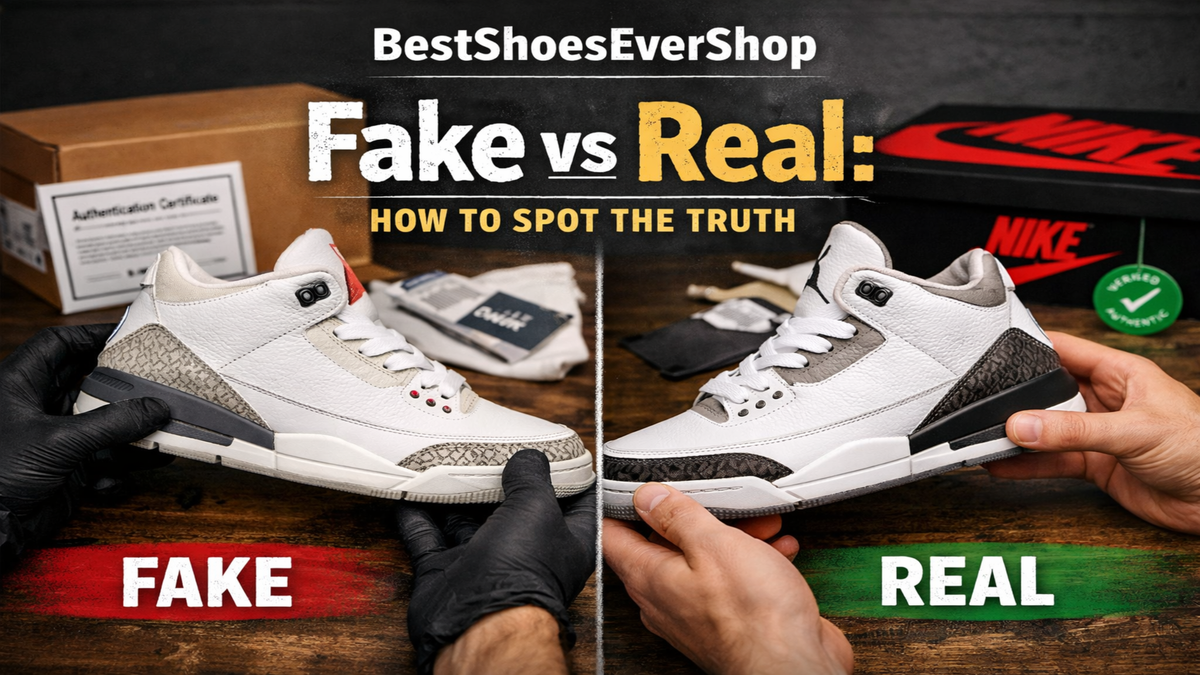
I began researching BestShoesEverShop fake vs real because the same question appears repeatedly across sneaker forums, Reddit threads, and consumer complaint boards: Is BestShoesEverShop legitimate, or is it another counterfeit sneaker store? Within minutes of digging through reviews and industry reports, the answer becomes more nuanced than a simple yes or no.
Shoppers searching for this term are typically trying to determine whether the website selling branded footwear is trustworthy. The most reliable way to evaluate a site like BestShoesEverShop is to examine several signals: product pricing, brand authorization, payment security, website transparency, and customer feedback. Authentic retailers almost always have verified relationships with brands like Nike or Adidas, while counterfeit stores often lack clear company information, sell shoes far below market value, or disappear after payment.
The problem is hardly unique to a single website. The global counterfeit footwear market is enormous. According to the Organisation for Economic Co-operation and Development (OECD), counterfeit goods represented 3.3 percent of global trade as of 2019, with fashion items and footwear among the most frequently copied products (OECD, 2021). The rise of independent e-commerce sites has made the problem harder for consumers to navigate.
Understanding whether BestShoesEverShop is real or fake therefore requires stepping back and looking at the broader system: the booming sneaker economy, the global counterfeit industry, and the digital marketplaces where the two collide.
The Modern Sneaker Economy and the Rise of Online Stores
The global sneaker industry has grown into a massive economic ecosystem over the past two decades. Athletic footwear brands generate billions in annual revenue, fueled by sports culture, fashion trends, and resale markets.
Nike alone reported $51.2 billion in revenue for fiscal year 2023, with footwear representing the majority of its business (Nike, 2023). Meanwhile, the resale market for rare sneakers has transformed into a global industry valued at several billion dollars.
This growth has created enormous incentives for counterfeiters. Fake sneakers now circulate through independent websites, social media marketplaces, and peer-to-peer platforms.
Websites like BestShoesEverShop often appear within this landscape as third-party retailers claiming to sell discounted branded shoes. Some are legitimate independent shops sourcing from wholesalers or liquidation channels. Others sell counterfeit products manufactured to resemble authentic designs.
Sneaker authentication expert Josh Luber, co-founder of the resale platform StockX, once explained the issue succinctly:
“The sneaker market grew so quickly that counterfeiters followed the demand. Consumers now have to be far more careful about where they buy.” (Luber, cited in Bloomberg, 2019)
This context explains why searches like “BestShoesEverShop fake vs real” have become increasingly common.
What BestShoesEverShop Appears to Be
BestShoesEverShop is commonly referenced online as an e-commerce website selling branded sneakers at discounted prices. Stores with similar naming patterns often claim to carry products from brands such as Nike, Adidas, or New Balance.
However, determining authenticity requires verifying several factors:
- Whether the retailer is authorized by the brand
- Whether the pricing aligns with market averages
- Whether the website provides verifiable business information
- Whether independent consumer reviews confirm successful deliveries
Major brands maintain strict control over authorized sellers. For example, Nike’s distribution agreements typically restrict who can sell official products.
Retail analyst Matt Powell, formerly of NPD Group, has warned consumers about unauthorized online retailers:
“If the price is dramatically below market value, that’s the first red flag.” (Powell, 2022)
Websites selling shoes at 70 or 80 percent discounts frequently raise suspicion among sneaker buyers.
Warning Signs of Counterfeit Sneaker Websites
Shoppers investigating BestShoesEverShop often report encountering certain warning signals common to counterfeit websites.
These signs do not automatically confirm that a store is fake, but they strongly suggest caution.
Common Red Flags
| Warning Sign | Why It Matters | Risk Level |
|---|---|---|
| Prices far below retail value | Authentic brands rarely allow extreme discounts | High |
| No company address or phone number | Lack of transparency about the business | High |
| Only cryptocurrency or risky payment options | Reduced consumer protection | High |
| Poor grammar or duplicated product descriptions | Signs of automated or cloned websites | Medium |
| No verified brand partnerships | Unauthorized sellers may distribute counterfeits | Medium |
Consumer protection organizations frequently advise shoppers to check these indicators before purchasing.
The U.S. Federal Trade Commission warns that fake online stores often use aggressive discounts to lure buyers into impulse purchases (FTC, 2022).
Real vs Fake Sneaker Stores: A Comparison
Understanding the differences between legitimate and counterfeit retailers helps consumers evaluate websites like BestShoesEverShop.
| Feature | Legitimate Retailer | Suspicious Retailer |
|---|---|---|
| Brand authorization | Listed by official brands | No verification |
| Pricing | Slight discounts or seasonal sales | Extreme price drops |
| Payment options | Secure card payments, buyer protection | Crypto or direct transfers |
| Customer reviews | Verified purchases on multiple platforms | Sparse or suspicious reviews |
| Return policy | Clear return window and refund system | Vague or absent policies |
Sneaker authenticity platforms such as GOAT and StockX emerged largely because of these uncertainties in the online marketplace.
According to GOAT Group’s authentication team, thousands of counterfeit sneakers enter global circulation each year, many sold through independent websites (GOAT Group, 2022).
The Global Counterfeit Footwear Industry
The counterfeit fashion industry has expanded dramatically alongside e-commerce growth.
The OECD estimates that the global trade in counterfeit and pirated goods reached $464 billion annually, with footwear representing a major portion of seized items (OECD, 2021).
Counterfeit sneakers originate primarily from large manufacturing networks capable of replicating popular designs with surprising accuracy.
These products often mimic:
- Air Jordan releases
- Nike Dunk models
- Adidas Yeezy sneakers
- Limited-edition collaborations
Some counterfeit shoes are obvious fakes. Others are nearly indistinguishable without expert inspection.
Professor David Henard, a marketing researcher studying counterfeit consumption, notes:
“Many buyers are not intentionally purchasing fake goods. They simply believe they found a legitimate discount.” (Henard, 2018)
This confusion fuels ongoing consumer searches about suspicious online stores.
How Consumers Investigate Suspicious Websites
Before buying from any unfamiliar retailer, experienced sneaker buyers perform a series of checks.
The process often includes:
- Domain history analysis
- Review aggregation searches
- Brand authorization verification
- Image reverse searches for product photos
Digital security researcher Brian Krebs advises consumers to treat unfamiliar e-commerce websites with skepticism:
“Scam shopping sites often appear suddenly and vanish after collecting payments.” (Krebs, 2021)
These sites frequently reuse product photos and descriptions from legitimate retailers.
One of the simplest verification methods is checking whether the brand itself lists the retailer as an authorized partner.
Price Psychology and the Discount Trap
Extreme discounts are one of the most powerful tools counterfeit sellers use to attract customers.
Sneaker culture has created high demand for certain models, sometimes pushing resale prices far above retail. When shoppers see the same shoe advertised at half the expected price, the temptation can override caution.
Behavioral economists describe this effect as price anchoring, where consumers compare deals to the perceived market value rather than questioning legitimacy.
Research from Harvard Business School suggests consumers often rely on price signals when judging product authenticity (Mandel & Johnson, 2002).
This explains why counterfeit sellers frequently advertise dramatic “clearance sales.”
Why Counterfeit Sneaker Sites Keep Appearing
Even when authorities shut down fraudulent websites, new ones appear almost immediately.
The reason is structural. Creating an e-commerce site has become extraordinarily easy.
Platforms like Shopify, WordPress, and automated storefront builders allow new stores to launch in hours.
Cybersecurity researchers have documented networks of counterfeit sites that share identical templates, product images, and payment systems.
Many of these sites operate for only a few months before disappearing.
For consumers researching BestShoesEverShop, the key question is whether the site demonstrates long-term credibility or short-term opportunism.
The Role of Consumer Reviews
One of the most valuable tools for evaluating a retailer is independent review data.
Sites like Trustpilot, Reddit, and sneaker forums often contain firsthand reports from buyers.
However, review systems themselves can be manipulated. Some fraudulent stores post fake positive reviews to build credibility.
Consumer advocate Teresa Murray of the U.S. Public Interest Research Group warns:
“Fake reviews have become one of the biggest challenges in online shopping.” (Murray, 2021)
The safest approach is to look for patterns across multiple review platforms rather than relying on a single source.
Takeaways
- Websites selling discounted branded sneakers require careful verification before purchase.
- Counterfeit footwear represents a significant portion of global illicit trade.
- Extreme price discounts are often the most common warning sign of fraudulent retailers.
- Consumers should verify brand authorization and independent reviews before purchasing.
- Secure payment methods with buyer protection reduce financial risk.
- Independent sneaker authentication platforms emerged largely due to counterfeit concerns.
Conclusion
The question “BestShoesEverShop fake vs real” reflects a broader challenge facing modern online shoppers. The internet has made buying sneakers easier than ever, but it has also opened the door to counterfeit products, deceptive websites, and short-lived online stores.
Determining whether any individual retailer is legitimate requires careful evaluation of several factors: brand authorization, pricing patterns, payment security, and independent consumer feedback. No single indicator guarantees authenticity, but patterns of transparency and credibility often reveal the truth.
The sneaker industry’s explosive growth has created a marketplace where genuine retailers, gray-market sellers, and counterfeit operators sometimes appear side by side. For consumers, the safest strategy remains patience and verification.
A trusted retailer may not always offer the lowest price, but it provides something far more valuable: confidence that the product arriving at your door is exactly what you paid for.
Click Here For More Blog Posts!
FAQs
Is BestShoesEverShop a legitimate store?
Its legitimacy depends on whether it provides verifiable business information, authorized brand partnerships, and consistent customer reviews. Always verify these indicators before purchasing.
How can I tell if a sneaker website is fake?
Look for warning signs such as extremely low prices, missing company details, limited payment options, and lack of verified customer reviews.
Are counterfeit sneakers common online?
Yes. Counterfeit footwear is one of the most frequently seized product categories in global anti-counterfeiting efforts.
What is the safest place to buy authentic sneakers?
Authorized retailers, official brand websites, and verified resale platforms with authentication services offer the safest purchasing options.
Can counterfeit sneakers look identical to real ones?
Yes. Some high-quality counterfeits closely mimic authentic designs, which is why authentication services have become common in the resale market.
References
Federal Trade Commission. (2022). Online shopping scams and how to avoid them. https://consumer.ftc.gov
GOAT Group. (2022). Inside the sneaker authentication process. https://www.goat.com
Henard, D. (2018). Counterfeit products and consumer behavior. Journal of Marketing Research.
Krebs, B. (2021). Online shopping scams surge during e-commerce boom. https://krebsonsecurity.com
Mandel, N., & Johnson, E. (2002). When web pages influence choice. Journal of Consumer Research.
Nike. (2023). Nike FY2023 annual report. https://investors.nike.com
OECD. (2021). Global trade in counterfeit and pirated goods. https://www.oecd.org
Powell, M. (2022). Sneaker market trends analysis. NPD Group.
Bloomberg. (2019). The sneaker resale market explained. https://www.bloomberg.com