
I see the Cadillac VISTIQ as one of the clearest signs that three-row electric SUVs are moving beyond experimental products and becoming practical alternatives to traditional luxury family vehicles. It combines room for six or seven people with standard all-wheel drive, strong acceleration, more than 300 miles of EPA-estimated range in selected configurations, and many of Cadillac’s most advanced comfort and driver-assistance features.
The VISTIQ occupies an important position in Cadillac’s electric lineup. It is larger and more family-focused than the two-row LYRIQ but less expensive and easier to manage than the full-size ESCALADE IQ. That positioning gives it a specific purpose: provide Escalade-like presence, technology, and three-row versatility without requiring buyers to move into Cadillac’s largest or most expensive electric SUV.
In my analysis, the VISTIQ’s strongest qualities are not limited to its 615-horsepower output or rapid acceleration. Its real appeal comes from the way it combines performance with everyday usability. The cabin includes genuine third-row accommodation, substantial cargo flexibility, standard Super Cruise availability through an included service period, massaging front seats, a large integrated display, and charging hardware suitable for regular home use.
There are still important compromises to examine. The VISTIQ is heavy, its maximum DC charging rate trails the fastest 800-volt electric vehicles, cargo room behind the third row is limited, and the most desirable suspension and technology upgrades require a substantial jump to Premium Luxury. Real-world highway range can also be noticeably lower than the EPA estimate.
This guide explains what the Cadillac VISTIQ is, what each trim includes, how charging works, how much usable space it provides, and which version makes the most sense for different buyers. Prices and availability can change, so the figures below reflect publicly listed United States information available in June 2026.
Key Takeaways About the Cadillac VISTIQ
- The Cadillac VISTIQ is a midsize three-row luxury electric SUV positioned between the LYRIQ and ESCALADE IQ.
- Dual-motor all-wheel drive is standard across the lineup.
- Cadillac rates the powertrain at up to 615 horsepower and 650 pound-feet of torque in Velocity Max mode.
- Cadillac estimates a 0-to-60-mph time of 3.7 seconds, while independent testing has recorded 3.6 seconds.
- The 2026 model provides up to 305 miles of EPA-estimated range with the standard 11.5-kW onboard charger.
- Versions with the 19.2-kW onboard charging module carry a 300-mile EPA range estimate.
- Public DC fast charging peaks at 190 kW, with Cadillac claiming approximately 80 miles of added range in about 10 minutes under suitable conditions.
- The VISTIQ seats seven with a second-row bench or six with available captain’s chairs.
- Maximum cargo capacity is 80.2 cubic feet with both rear rows folded.
- Maximum towing capacity is rated at 5,000 pounds when properly equipped.
- Four 2026 trims are offered: Luxury, Sport, Premium Luxury, and Platinum.
- The 2027 model introduces a standard native J3400, commonly called NACS, charging port.
- Standard equipment includes a 33-inch Horizon Display, Super Cruise, a 23-speaker AKG audio system, five-zone climate control, and heated, ventilated, massaging front seats.
- In my view, the Luxury trim provides the strongest value, while Premium Luxury is the better choice for buyers who want the most meaningful ride, maneuverability, and driver-information upgrades.
What Is the Cadillac VISTIQ?
The Cadillac VISTIQ is a battery-electric, three-row luxury crossover built by General Motors. It entered production for the 2026 model year and is assembled at GM’s Spring Hill facility in Tennessee. Cadillac created it to fill the size and price gap between the LYRIQ and the much larger ESCALADE IQ. [2]
Calling the VISTIQ a midsize SUV can be slightly misleading because it is still a substantial vehicle. The 2026 model measures approximately 205.5 inches long, 79.7 inches wide with the mirrors folded, 71 inches high, and rides on a 122-inch wheelbase. It is more than 17 feet long and has a curb weight exceeding 6,300 pounds in common configurations. [3][7]
Those dimensions make it comparable in purpose to other large three-row electric crossovers, but its character is distinctly Cadillac. The exterior uses vertical lighting, an illuminated Black Crystal Shield front panel, a long roofline, and a formal profile. Inside, Cadillac combines large digital displays with textured trim, open-pore wood on selected models, ambient lighting, and a panoramic glass roof.
The VISTIQ is not simply a LYRIQ with two additional seats. Cadillac gives it a more powerful standard drivetrain, a larger body, more advanced rear-passenger climate controls, and an available air suspension with active rear steering. It also offers a proper choice between seven-passenger bench seating and a six-passenger layout with captain’s chairs.
From my perspective, the vehicle’s place in Cadillac’s range is easy to understand:
- OPTIQ is the compact entry point.
- LYRIQ is the stylish two-row midsize model.
- VISTIQ serves buyers who need three rows without moving to full-size proportions.
- ESCALADE IQ and ESCALADE IQL provide greater space, range, and flagship presence.
- CELESTIQ serves an entirely different ultra-luxury market.
The VISTIQ therefore targets families, executive-car buyers, luxury-SUV owners considering their first EV, and customers who want a premium electric vehicle capable of carrying more than five people.
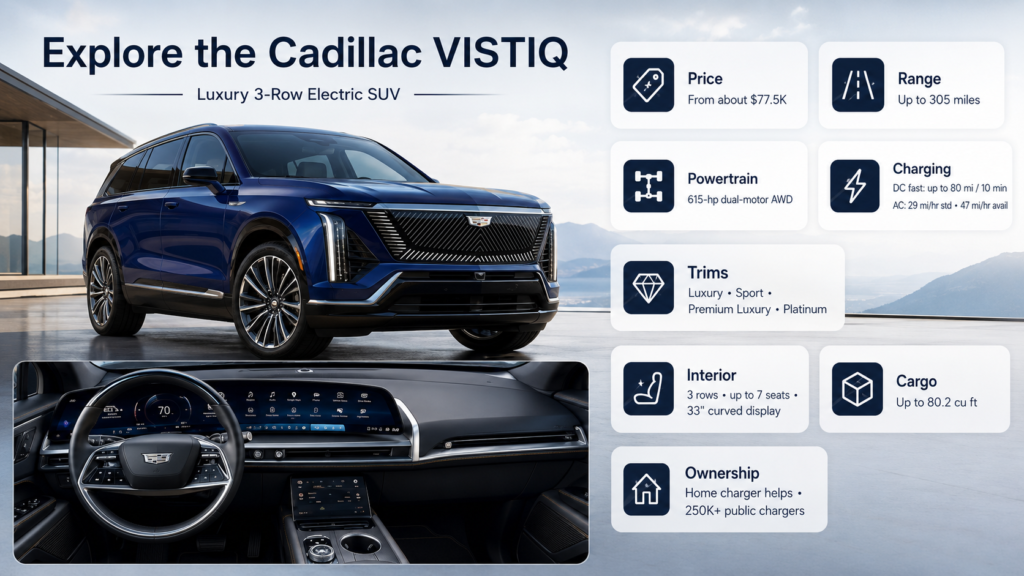
Cadillac VISTIQ Specifications and Dimensions
The following table collects the measurements and performance figures that matter most in daily ownership. Range, charging speed, acceleration, and towing performance can vary with equipment, temperature, vehicle load, wheel choice, road conditions, and driving style.
| Specification | 2026 Cadillac VISTIQ figure |
|---|---|
| Powertrain | Dual electric motors |
| Drivetrain | All-wheel drive |
| Maximum output | 615 hp in Velocity Max |
| Maximum torque | 650 lb-ft in Velocity Max |
| Cadillac-estimated 0-60 mph | 3.7 seconds |
| Independent tested 0-60 mph | 3.6 seconds |
| Battery rated energy | 102 kWh |
| Maximum EPA-estimated range | 305 miles |
| Range with 19.2-kW onboard charger | 300 miles |
| Maximum DC charging rate | 190 kW |
| Standard AC onboard charger | 11.5 kW |
| Available AC onboard charger | 19.2 kW |
| Maximum towing capacity | 5,000 pounds |
| Maximum seating | Seven |
| Length | 205.5 inches |
| Width with mirrors folded | 79.7 inches |
| Width with mirrors | 86.7 inches |
| Height | 71 inches |
| Wheelbase | 122 inches |
| Ground clearance | 7.2 inches |
| Front legroom | 43.1 inches |
| Second-row legroom | 40.1 inches |
| Third-row legroom | 30.6 inches |
| Cargo behind third row | 15.2 cubic feet |
| Cargo behind second row | 43 cubic feet |
| Maximum cargo volume | 80.2 cubic feet |
The main takeaway is that the VISTIQ combines sports-car acceleration with the footprint and mass of a large family SUV. That combination can feel impressive, but it also affects tire wear, energy consumption, braking distance, and the amount of space required for parking.
The 30.6 inches of third-row legroom should be sufficient for children and workable for many adults on shorter journeys. However, buyers expecting minivan-like third-row access or generous luggage space with every seat occupied should inspect the vehicle personally.
A hypothetical family example helps explain the cargo figures. Two adults and three children can fold one section of the third row to create more luggage space while keeping five usable seats. A group carrying six or seven occupants will have only 15.2 cubic feet behind the last row, so roof storage, careful packing, or a smaller luggage selection may be required for a long trip.
Cadillac VISTIQ Price and Trim Comparison
Cadillac lists the 2026 VISTIQ at base prices ranging from $77,395 to $96,495 before the current destination charge. Adding the listed $1,995 destination fee produces window-sticker starting prices from approximately $79,390 to $98,490 before options, taxes, registration, and dealer charges. [1][3][7]
The 2027 VISTIQ is also listed by Cadillac, starting at $77,500 before destination. Buyers should therefore confirm whether a dealer is quoting a 2026 or 2027 model and whether the advertised figure includes destination.
| 2026 trim | Base MSRP before destination | Starting price with $1,995 destination | Primary distinction |
| Luxury | $77,395 | $79,390 | Strong standard equipment and seven-passenger layout |
| Sport | $77,895 | $79,890 | Darker exterior styling and unique grille |
| Premium Luxury | $91,895 | $93,890 | Air suspension, rear steering, Night Vision, and head-up display |
| Platinum | $96,495 | $98,490 | Exclusive styling, Brembo brakes, and upgraded interior finishes |
The pricing structure reveals a major gap between the two entry models and Premium Luxury. Luxury and Sport differ primarily in design, while Premium Luxury introduces mechanical and technology upgrades that can noticeably change the driving experience.
Cadillac VISTIQ Luxury
Luxury is the value-focused VISTIQ, although “base model” does not accurately describe its equipment level. It includes dual-motor all-wheel drive, Super Cruise with an initial connected-service period, a 33-inch Horizon Display, a panoramic dual-pane roof, five-zone climate control, a 23-speaker AKG audio system, heated second-row outboard seats, and heated, ventilated, massaging front seats. [3]
Standard seven-passenger seating uses a second-row bench. Buyers can select captain’s chairs to reduce capacity to six and improve access to the third row. The faster 19.2-kW onboard AC charger is also available.
I believe Luxury is the most rational trim for buyers who want the VISTIQ’s core strengths. It delivers the same maximum power, similar range, the same display, and most of the major comfort features as the more expensive versions.
Cadillac VISTIQ Sport
Sport costs approximately $500 more than Luxury before destination. Its main changes are visual, including a unique grille treatment, darker exterior trim, gloss-black roof rails, body-color door handles, and different wheel finishes.
The mechanical foundation and cabin equipment remain closely aligned with Luxury. Sport makes sense when the buyer prefers a darker, less chrome-focused appearance but does not need the additional chassis systems fitted to Premium Luxury.
In my view, choosing between Luxury and Sport should be based almost entirely on design preference. The small price difference means neither represents a serious financial compromise compared with the other.
Cadillac VISTIQ Premium Luxury
Premium Luxury is where the VISTIQ changes most significantly. It adds Air Ride Adaptive Suspension, Active Rear Steering, standard second-row captain’s chairs, a 19.2-kW onboard charger, Night Vision, an augmented-reality head-up display, 22-inch wheels, a sueded microfiber headliner, and additional interior trim details. [3]
Air suspension can improve ride isolation and body control, while rear-wheel steering helps a long vehicle turn more tightly at low speeds and feel more stable during higher-speed lane changes. Those systems address two practical challenges created by the VISTIQ’s length and weight.
Premium Luxury is substantially more expensive than Luxury, but the additional money buys functional upgrades rather than cosmetic changes alone. I consider it the best choice for buyers who frequently drive in crowded urban areas, value a smoother ride, or want the full driver-information package.
Cadillac VISTIQ Platinum
Platinum combines equipment from Sport and Premium Luxury with distinctive front and rear fascias, body-color lower exterior elements, a black roof, Brembo brakes with black calipers, unique 22-inch wheels, exclusive quilted seating patterns, and open-pore Black Ash trim.
The Platinum is visually more individual than Premium Luxury, but it is not automatically the better technical value. Premium Luxury already contains the major suspension, steering, charging, and driver-assistance upgrades. Platinum primarily appeals to buyers who want the most exclusive appearance and interior treatment.
A buyer should compare both trims in person because wheel design, seat material, exterior color, and cabin trim may matter more at this price level than the difference in the equipment list.
Cadillac VISTIQ Range and Battery Performance
The 2026 Cadillac VISTIQ uses a 102-kWh battery and receives an EPA-estimated range of up to 305 miles when equipped with the standard 11.5-kW onboard charging module. Models fitted with the 19.2-kW onboard charger are rated at 300 miles. [2][3]
The five-mile difference is small and should not determine the purchase by itself. The more powerful onboard charger adds weight and electrical hardware but can substantially reduce AC charging time when connected to a compatible high-output home system.
EPA range is a standardised estimate, not a guarantee. Cold weather, high motorway speeds, large wheels, aggressive acceleration, elevation changes, towing, heavy passenger loads, and extensive cabin heating can reduce the distance achieved between charging stops.
Car and Driver recorded approximately 250 miles during its 75-mph highway range test. That result does not mean the 305-mile EPA figure is inaccurate. Highway testing at sustained speed places different demands on an EV than the mixed driving cycle used for the official estimate. [5]
For practical planning, I would treat 305 miles as the best-case reference and build a road-trip schedule around shorter intervals. Drivers commonly stop before the battery reaches zero and may leave a fast charger before reaching 100 percent because charging slows as the battery fills.
Consider a hypothetical 420-mile motorway trip. Starting at home with a full battery, the driver might stop after 210 to 240 miles, charge during a meal, and complete the remaining distance with a comfortable reserve. In winter, while towing, or when travelling into a headwind, an earlier stop would be sensible.
Daily use is considerably easier. Someone driving 40 miles per day could recover that energy in roughly 90 minutes using the standard 11.5-kW onboard charging system under favourable conditions. The vehicle would not need to be charged from empty every night.
How Fast Does the Cadillac VISTIQ Charge?
The VISTIQ supports three broad charging methods:
- Level 1 charging from a standard household outlet
- Level 2 AC charging at home or at a destination
- Public DC fast charging
Level 1 is too slow to serve as the main charging solution for most VISTIQ owners. It may add a small amount of range overnight but is better treated as an emergency or occasional option.
The standard 11.5-kW onboard charger can add up to approximately 29 miles of range per hour when the vehicle is connected to a sufficiently powerful Level 2 unit. The available 19.2-kW charger can add up to approximately 46.9 miles per hour under suitable conditions. [3]
Those figures describe the vehicle’s maximum AC capability, not what every home can supply. A 19.2-kW charging installation requires substantial electrical capacity, appropriate wiring, a compatible charger, and professional assessment. Many homes will need service upgrades before supporting that output.
For example, a household with a 7.7-kW charging unit will not receive 19.2 kW merely because the vehicle supports it. The charger, circuit, electrical service, and vehicle must all support the required power.
At a compatible DC fast charger, the 2026 VISTIQ can accept up to 190 kW. Cadillac says it can add as much as 80 miles of range in around 10 minutes under optimal conditions. Charging speed changes throughout the session and depends on battery temperature, charger output, battery state of charge, and environmental conditions. [3]
A maximum of 190 kW is respectable but not class-leading. Some rivals use 800-volt systems capable of higher peak speeds and shorter ideal charging stops. Peak power also tells only part of the story because the complete charging curve determines how long the vehicle maintains a high rate.
The 2027 VISTIQ uses a native J3400 charging port, commonly known as NACS, which improves direct compatibility with participating North American charging networks. Buyers comparing model years should inspect the charging-port specification and ask whether an adapter is included or required.
Performance, Handling, and Towing Ability
The VISTIQ uses two electric motors to provide standard all-wheel drive. In Velocity Max mode, Cadillac rates the system at 615 horsepower and 650 pound-feet of torque. Cadillac estimates a 3.7-second sprint from zero to 60 mph. [2][3]
Car and Driver recorded 3.6 seconds to 60 mph and a 12.1-second quarter mile at 114 mph. Those results place the VISTIQ among genuinely quick performance vehicles despite its three rows, large battery, and substantial weight. [5]
The immediate torque should make motorway merging and passing effortless. However, maximum acceleration is not the vehicle’s most important dynamic quality. A large luxury SUV must also remain composed over rough surfaces, predictable in corners, quiet at speed, and manageable in parking areas.
Luxury and Sport use a suspension with Continuous Damping Control. Premium Luxury and Platinum add Air Ride Adaptive Suspension and Active Rear Steering. Rear steering turns the rear wheels slightly in the opposite direction at low speeds to reduce the turning circle and in the same direction at higher speeds to improve stability.
Cadillac’s chief engineer described the intended balance in a statement that helps explain the engineering goal:
“Bold, yet refined, the VISTIQ provides a comfortable ride while handling like a much smaller vehicle.”
Jeff MacDonald, North American chief engineer for Cadillac VISTIQ [2]
The quotation highlights why rear steering matters. The VISTIQ cannot physically become smaller, but steering the rear wheels can reduce how large it feels from the driver’s seat.
Independent evaluations have generally praised the balance between ride comfort, power, and three-row utility. MotorWeek described it as Cadillac’s favourite electric SUV effort at the time of its review, while Car and Driver found its acceleration especially strong. [5][6]
The VISTIQ is rated to tow up to 5,000 pounds when properly equipped. That capacity can support selected small boats, utility trailers, or campers, but buyers must check the trailer’s loaded weight, tongue weight, hitch requirements, and local regulations.
Towing can reduce electric range significantly. The exact reduction depends on trailer shape, weight, speed, temperature, and terrain. A tall travel trailer creates more aerodynamic drag than a lower utility trailer of similar weight.
In my view, towing suitability should be evaluated by route rather than capacity alone. A vehicle may be capable of pulling a 4,000-pound trailer, but a journey through a region with limited pull-through chargers could still be inconvenient.
Interior Space and Three-Row Comfort
The Cadillac VISTIQ seats seven when equipped with a second-row bench and six when fitted with captain’s chairs. Premium Luxury and Platinum include captain’s chairs as standard, while Luxury and Sport can be configured with them. [3]
The front row provides 43.1 inches of legroom, the second row provides 40.1 inches, and the third row provides 30.6 inches. Headroom is listed at 40.9 inches in front, 38.9 inches in the second row, and 39.5 inches in the third. [3]
Those dimensions suggest that the third row is more than a token emergency seat, although passenger comfort will depend on height, seating position, and journey duration. Adults should test entry, knee room, foot space, and visibility before assuming the third row will work for regular long-distance travel.
Cadillac gives third-row passengers padded armrests, cupholders, device storage, USB charging, and glass above or beside them. These details make the area feel less like an afterthought.
The five-zone climate-control system is another unusual feature. Separate control areas allow the system to manage comfort across the cabin more precisely than a typical two-zone or three-zone arrangement.
Cargo space is 15.2 cubic feet behind the third row, 43 cubic feet when the third row is folded, and 80.2 cubic feet behind the first row. [3]
The 15.2-cubic-foot figure is the one families should examine most carefully. Maximum cargo capacity looks impressive in advertising, but buyers carrying six or seven passengers cannot fold all the rear seats.
A realistic hypothetical scenario involves two adults, three children, a stroller, and luggage for a weekend. The third row could remain partly folded, creating a workable balance between seating and cargo. A seven-person airport trip with large suitcases would be considerably more difficult.
The VISTIQ does not provide the same luggage flexibility as a minivan or extended-length full-size SUV. It instead offers a compromise between exterior manageability, passenger capacity, luxury, and load space.
Cabin Technology and Comfort Features
The dashboard is dominated by a curved 33-inch Horizon Display that integrates instrument information and infotainment functions. Google built-in compatibility provides access to navigation, voice functions, and supported applications without requiring a connected smartphone for every task. [3]
Cadillac also includes a 23-speaker AKG Studio audio system with available Dolby Atmos support. Unlike many luxury vehicles that reserve their premium sound system for expensive packages, the VISTIQ includes the AKG setup as a central part of the cabin experience.
Other notable standard or available features include:
- Heated, ventilated, and massaging front seats
- Heated second-row outboard seats
- A panoramic dual-pane glass roof
- A separate fixed-glass section above the third row
- Seven USB-C ports
- Two front wireless-phone charging pads
- 126-color ambient lighting
- Front and rear passenger command screens
- An augmented-reality head-up display on selected trims
- Night Vision on selected trims
- Five-zone climate control
- Power-folding third-row seats
The combination is impressive, but the quantity of digital controls deserves attention during a test drive. Buyers should check whether climate functions, seat settings, camera views, and frequently used menus are easy to reach while driving.
A large screen is not automatically better if common tasks require too many steps. I recommend spending at least 15 minutes using the infotainment system before signing a purchase agreement. Pair a phone, enter a destination, change audio sources, adjust climate settings, and activate the parking cameras.
Super Cruise and Driver-Assistance Technology
Super Cruise is standard on the VISTIQ with an initial three-year OnStar service period, according to Cadillac’s model information. The system permits hands-free driving on compatible roads when its operating conditions are satisfied. [2][3]
Hands-free does not mean self-driving. The driver must remain attentive, monitor the road, and be ready to take control. Cameras, mapped-road information, radar, and other sensors support the system, but responsibility remains with the driver.
The VISTIQ also includes or offers a broad set of driver-assistance technologies, including:
- Forward Collision Alert
- Enhanced Automatic Emergency Braking
- Blind Zone Steering Assist
- Lane Keep Assist with Lane Departure Warning
- Adaptive Cruise Control
- Rear Cross Traffic Braking
- Reverse Automatic Braking
- Side Bicyclist Alert
- Rear Pedestrian Alert
- HD Surround Vision
- Rear Camera Mirror
- Driver Attention Assist
- Automatic high beams
Premium Luxury and Platinum add access to Night Vision and an augmented-reality head-up display. Night Vision uses an infrared sensor to help identify certain pedestrians or large animals beyond the normal headlamp view.
These systems can reduce workload and provide useful warnings, but they have limitations. Dirty sensors, poor weather, faded lane markings, construction zones, unusual road layouts, and software conditions can affect performance.
In my view, the correct buying question is not whether the vehicle can “drive itself.” The better question is whether its assistance systems reduce fatigue without creating confusion or overconfidence.
Vehicle-to-Home Power Capability
The Cadillac VISTIQ supports bidirectional Vehicle-to-Home power capability when paired with the required GM Energy equipment and a properly configured home electrical system. In suitable installations, energy stored in the vehicle may be used to supply the home during a power interruption. [2]
The vehicle alone is not enough. Owners may require compatible charging hardware, an inverter, an isolation device, professional installation, permits, and utility approval.
A hypothetical example involves a home losing grid power during a storm. A properly installed bidirectional system could use energy from the VISTIQ battery to operate selected circuits or household loads. The amount of time available would depend on the battery’s charge level and the home’s electricity consumption.
This capability may be valuable in areas with frequent outages, but installation costs can be significant. Buyers should request a complete home-energy quotation rather than assuming bidirectional charging is included in the vehicle price.
Cadillac VISTIQ Exterior Design
Cadillac designed the VISTIQ to look formal and recognisable without copying the ESCALADE IQ directly. The upright front end, illuminated grille panel, vertical lighting, large wheels, and strong shoulder line give it a substantial road presence.
Luxury and Sport receive different front-panel patterns. Luxury uses a more tailored pinstripe treatment, while Sport introduces a darker, performance-inspired pattern.
The D-pillar has a widening sail-panel design influenced by earlier Cadillac models. A Mondrian-style pattern is integrated into the third-row glass area, creating visual detail while helping provide privacy.
Cadillac lead creative designer Zhou Fang summarised the intended character clearly:
“It’s confident, luxurious, elegant, all combined.”
Zhou Fang, Cadillac lead creative designer [4]
I believe the design succeeds because it does not attempt to make the VISTIQ look unusually futuristic simply because it is electric. The closed front panel and lighting reveal its EV identity, but the overall shape still communicates the formality associated with Cadillac.
Wheel choices range from 21 to 23 inches, depending on trim and options. Larger wheels can improve visual presence and steering response, but they may also increase tire cost, reduce ride comfort, and affect range.
Buyers should therefore treat wheel size as an ownership decision rather than a styling detail alone. A 23-inch tire may cost significantly more to replace than a 21-inch alternative and may be harder to source quickly.
Practical Cadillac VISTIQ Ownership Scenarios
Daily Commuting With Home Charging
A driver covering 35 to 50 miles per day should be able to replace the used energy easily through overnight Level 2 charging. The vehicle can remain within a comfortable battery range without being charged to 100 percent every night.
The main requirement is reliable access to a private charger. An electrician should inspect panel capacity, wiring distance, parking location, and local permit requirements before the vehicle is purchased.
Family Use With Occasional Third-Row Passengers
The seven-seat configuration can work well for families that need the third row periodically. Folding part or all of the last row creates considerably more cargo space for groceries, sports equipment, or strollers.
Captain’s chairs make third-row access easier but reduce total seating capacity. Families should decide whether the extra seat or the central walkway is more valuable.
Long-Distance Road Trips
The VISTIQ can cover long distances, but journey planning should account for real highway range rather than relying entirely on the EPA estimate. Charging stops should be selected based on charger reliability, nearby amenities, and the next available backup location.
A 190-kW peak rate is sufficient for practical travel, although stops may be longer than those required by the fastest-charging competitors.
Towing a Small Camper or Boat
The 5,000-pound maximum rating gives the VISTIQ useful towing potential. Buyers should still calculate the loaded trailer weight and expect shorter range.
Charging-station design may become a larger issue than battery capacity. Many locations require the trailer to be disconnected because chargers are placed beside standard parking spaces rather than in pull-through bays.
Apartment or Street-Parking Ownership
The VISTIQ is less convenient for drivers who cannot charge at home or at work. Public fast charging can support ownership, but it usually costs more and requires more planning than overnight residential charging.
A buyer who depends entirely on public infrastructure should map reliable charging sites near home, work, and regular travel routes before choosing any large EV.
How to Choose and Buy a Cadillac VISTIQ
1. Measure the Parking Space
Confirm garage length, door width, turning space, and charger location. The VISTIQ is 205.5 inches long and 86.7 inches wide with its mirrors extended.
A garage may technically fit the vehicle while leaving too little room to open the tailgate or walk around it comfortably.
2. Decide Between Six and Seven Seats
Choose the bench when maximum passenger capacity is essential. Select captain’s chairs when easier third-row access, passenger separation, and second-row comfort matter more.
3. Assess Home-Charging Capacity
Request an electrical evaluation before selecting the 19.2-kW onboard charger. A household unable to supply that power may gain little from the upgrade.
The standard 11.5-kW system is already more than sufficient for many overnight-charging routines.
4. Compare Luxury With Premium Luxury
These are the two trims I would examine first. Luxury provides most of the VISTIQ experience at the lowest price. Premium Luxury adds the air suspension, rear steering, faster onboard charger, Night Vision, head-up display, and captain’s chairs.
Sport and Platinum are more strongly influenced by styling preference.
5. Test the Third Row and Cargo Area
Bring the people and equipment normally carried. Install a child seat, place a stroller in the cargo area, test entry to the third row, and check luggage space with every seat raised.
Brochure capacity cannot replace a practical fit test.
6. Drive on Rough Roads and in Tight Spaces
A short route around a dealership may not reveal ride quality or maneuverability. Include broken pavement, a motorway section, a parking structure, and a tight turning area.
Comparing Luxury and Premium Luxury on the same route can reveal whether the air suspension and rear steering justify the price difference.
7. Request a Complete Out-the-Door Quote
The advertised base price may exclude destination, options, accessories, taxes, registration, documentation charges, and dealer adjustments.
Ask for a written figure showing every charge. Compare financing, leasing, insurance, and home-charger costs rather than focusing on the monthly vehicle payment alone.
8. Confirm the Model Year and Charging Port
A 2026 vehicle and a 2027 vehicle may have different charging-port arrangements. Verify whether the car uses CCS or a native J3400 port and whether any required adapter is included.
9. Review Connected-Service Costs
Super Cruise and other connected features may require a paid plan after the included period ends. Ask the dealer for current renewal pricing and confirm which functions remain available without a subscription.
10. Obtain an Insurance Quote
The VISTIQ’s performance, value, technology, and repair complexity can affect insurance costs. Request quotes using the specific trim and vehicle identification number when possible.
Common Cadillac VISTIQ Buying Mistakes
Assuming 305 Miles Is Guaranteed
EPA range is a standardised estimate. High speed, winter weather, towing, large wheels, and heavy loads can lower real-world distance.
Plan around expected conditions rather than the most favourable published number.
Buying the 19.2-kW Charger Without Checking the Home
The faster onboard charger only provides its full benefit when the property can supply the required power. Electrical upgrades may be expensive or impractical.
Ignoring Cargo Space Behind the Third Row
The maximum 80.2-cubic-foot figure requires both rear rows to be folded. With all seats raised, the available volume is 15.2 cubic feet.
Choosing Larger Wheels Without Pricing Tires
Large wheels can look impressive, but replacement tires may be expensive. They can also affect comfort and efficiency.
Treating Super Cruise as Autonomous Driving
Super Cruise is a driver-assistance system. The driver must remain attentive and responsible.
Forgetting the Destination Charge
The 2026 base prices listed by Cadillac do not always appear with destination included. Adding the current $1,995 charge changes the entry Luxury price from $77,395 to approximately $79,390.
Overlooking Subscription Renewals
The initial Super Cruise and connected-service period does not necessarily provide every service indefinitely. Long-term ownership costs should include likely subscription expenses.
Assuming Bidirectional Charging Works Without Additional Equipment
Vehicle-to-Home capability requires compatible hardware and a properly prepared property. It is not activated by connecting an ordinary home charger.
Which Cadillac VISTIQ Trim Should You Buy?
I believe the 2026 VISTIQ Luxury offers the best overall value. It includes the full 615-horsepower dual-motor drivetrain, up to 305 miles of range, Super Cruise, massaging front seats, the large display, premium audio, panoramic glass, and seven-passenger capacity.
Sport is the logical alternative for someone who dislikes bright exterior trim and prefers a darker design. The $500 difference is small enough that appearance can guide the decision.
Premium Luxury is the model I would recommend for buyers who prioritise ride quality and easy maneuverability. Air suspension and rear steering are meaningful upgrades on a vehicle of this size. The included captain’s chairs, faster AC charging, Night Vision, and head-up display further strengthen the package.
Platinum is the emotional choice. It adds exclusive visual details, Brembo brakes, and richer interior treatments, but its higher price is harder to justify through practical benefits alone.
The best choice can be summarised as follows:
- Choose Luxury for value and seven-seat versatility.
- Choose Sport for dark exterior styling at a small premium.
- Choose Premium Luxury for the best combination of technology, ride, and maneuverability.
- Choose Platinum for exclusivity, design, and top-level presentation.
Cadillac VISTIQ Advantages and Limitations
The VISTIQ offers several clear advantages:
- Rapid acceleration
- Standard dual-motor all-wheel drive
- More than 300 miles of rated range
- A usable third row
- Strong standard equipment
- Standard Super Cruise with an introductory service period
- High-quality audio and cabin technology
- Up to 5,000 pounds of towing capacity
- Available air suspension and rear steering
- Vehicle-to-Home capability with additional equipment
Its main limitations include:
- A high purchase price
- Limited cargo volume with all seats in use
- Considerable weight
- A DC charging peak below the fastest competitors
- Potentially expensive large-wheel tires
- Reduced highway range compared with the EPA estimate in independent testing
- Subscription costs after included connected-service periods
- Home-energy hardware costs for bidirectional operation
- No guarantee that every public charger will deliver the advertised peak rate
In my assessment, the strengths outweigh the weaknesses for buyers who have dependable home charging and regularly need a premium three-row vehicle. The calculation becomes less favourable for drivers who rarely use the third row, cannot install a home charger, or place maximum charging speed above cabin comfort.
How the 2026 and 2027 Cadillac VISTIQ Differ
The 2026 model established the VISTIQ line with four trims, dual-motor all-wheel drive, a 102-kWh battery, and up to 305 miles of EPA-estimated range.
Cadillac’s current site lists the 2027 VISTIQ from $77,500 before destination. The most practical update for many North American owners is the standard J3400 charging port, which is commonly referred to as NACS. [1]
The fundamental vehicle remains similar. Buyers comparing remaining 2026 inventory with a 2027 order should focus on:
- The final transaction price
- Available incentives
- Charging-port configuration
- Included adapters
- Equipment changes
- Connected-service terms
- Resale implications
- Delivery timing
A discounted 2026 model may be a stronger financial choice for a driver who is comfortable using an adapter. A 2027 model may be preferable for someone who regularly uses compatible NACS charging stations and wants the convenience of direct connection.
Conclusion
The Cadillac VISTIQ succeeds because it combines abilities that have often been separated in electric vehicles. It provides three usable seating rows, strong cargo flexibility, standard all-wheel drive, serious towing capacity, luxury equipment, and acceleration that would have been associated with a performance car only a few years ago.
I believe the most important buying lesson is to look beyond the headline figures. The 615-horsepower output is impressive, but home-charging access, third-row requirements, cargo needs, wheel size, subscription costs, and real highway range will have a greater effect on long-term satisfaction.
Luxury is the strongest value for most shoppers, while Premium Luxury delivers the most meaningful upgrades through its air suspension, rear steering, faster onboard charging, and advanced displays. Sport and Platinum make sense when design and visual distinction carry greater weight.
Before purchasing a Cadillac VISTIQ, measure the parking space, arrange an electrical assessment, test every seating row, and obtain a complete out-the-door quote. Those practical checks will reveal whether the VISTIQ is merely appealing in a showroom or genuinely suited to the way the household travels.
Frequently Asked Questions
How Much Does the Cadillac VISTIQ Cost?
The 2026 Cadillac VISTIQ starts at $77,395 before destination, taxes, registration, options, and dealer charges. Adding the listed $1,995 destination fee brings the starting Luxury price to approximately $79,390. Sport starts around $79,890 with destination, Premium Luxury around $93,890, and Platinum around $98,490. Cadillac lists the 2027 model from $77,500 before destination. Actual transaction prices vary by location, inventory, incentives, optional equipment, and dealer pricing.
What Is the Cadillac VISTIQ Range?
The 2026 Cadillac VISTIQ offers up to 305 miles of EPA-estimated range when equipped with the standard 11.5-kW onboard charging module. Models using the 19.2-kW onboard charger are rated at 300 miles. Actual range can be lower because of cold weather, motorway speed, large wheels, towing, elevation, passenger load, battery condition, and climate-control use. Independent 75-mph highway testing recorded approximately 250 miles, illustrating the difference between EPA mixed-driving estimates and sustained high-speed travel.
How Long Does the Cadillac VISTIQ Take to Charge?
Charging time depends on the charger and the battery’s starting level. The standard 11.5-kW AC system can add up to approximately 29 miles per hour, while the available 19.2-kW system can add up to 46.9 miles per hour when connected to suitable equipment. At a compatible public DC fast charger, Cadillac says the VISTIQ can add up to 80 miles in about 10 minutes under optimal conditions. Charging normally slows as the battery approaches full capacity.
Does the Cadillac VISTIQ Have Three Rows?
Yes, the Cadillac VISTIQ has three seating rows. Luxury and Sport normally seat seven with a second-row bench, while captain’s chairs are available to create a six-seat layout. Premium Luxury and Platinum include captain’s chairs as standard. Cadillac lists 30.6 inches of third-row legroom and 39.5 inches of third-row headroom. The space should work for children and many adults, although buyers should test access and comfort personally before relying on it for regular long journeys.
How Much Cargo Space Does the Cadillac VISTIQ Have?
The Cadillac VISTIQ provides 15.2 cubic feet of cargo volume behind the third row, 43 cubic feet behind the second row, and a maximum of 80.2 cubic feet when both rear rows are folded. The maximum figure is useful for furniture or large loads, but the 15.2-cubic-foot measurement is more relevant when carrying six or seven passengers. Families planning airport trips or long holidays should verify that their luggage fits with every required seat raised.
Is the Cadillac VISTIQ Fast?
Yes. Cadillac rates the VISTIQ at up to 615 horsepower and 650 pound-feet of torque in Velocity Max mode. The manufacturer estimates a 3.7-second time from zero to 60 mph, while independent testing has recorded 3.6 seconds. That performance is unusually strong for a three-row SUV weighing more than 6,000 pounds. Drivers should remember that repeated hard acceleration can increase electricity consumption and tire wear.
Can the Cadillac VISTIQ Tow a Trailer?
The Cadillac VISTIQ can tow up to 5,000 pounds when properly equipped. Buyers must account for the trailer’s loaded weight, tongue weight, passengers, cargo, hitch specification, and local regulations. Towing can substantially reduce electric range, especially with a tall or aerodynamically inefficient trailer. Charging may also require planning because many public stations do not provide pull-through spaces, forcing drivers to disconnect a trailer before using the charger.
Does the Cadillac VISTIQ Have Super Cruise?
Yes, Super Cruise is standard on the Cadillac VISTIQ with an initial connected-service period. It permits hands-free driving on compatible roads when operating conditions are satisfied. The system does not make the vehicle autonomous. Drivers must remain attentive, monitor traffic, and take control whenever requested. Buyers should also ask about subscription costs after the included service period ends because continued access to certain connected functions may require a paid plan.
Which Cadillac VISTIQ Trim Is Best?
Luxury is the best value for most buyers because it includes the full-power all-wheel-drive system, up to 305 miles of range, Super Cruise, massaging front seats, premium audio, panoramic glass, and the 33-inch display. Premium Luxury is the better choice for drivers who value air suspension, rear-wheel steering, faster home charging, Night Vision, captain’s chairs, and the augmented-reality head-up display. Sport primarily changes exterior styling, while Platinum focuses on exclusive design and interior finishes.
Does the Cadillac VISTIQ Support Tesla Superchargers?
Charging access depends on model year, adapter availability, station compatibility, software, and network policies. The 2027 VISTIQ uses a native J3400 charging port, commonly known as NACS. Buyers considering a 2026 model should confirm its connector type and whether an approved adapter is supplied or available. Not every Supercharger location supports every non-Tesla vehicle, so drivers should verify compatibility through the vehicle’s navigation system or an official charging-network application before travelling.
Can the Cadillac VISTIQ Power a House?
The VISTIQ supports Vehicle-to-Home bidirectional energy capability when combined with compatible GM Energy equipment and a properly configured house. The vehicle cannot power a home through an ordinary charger alone. Installation may require additional charging hardware, electrical isolation equipment, professional labour, permits, utility approval, and electrical-panel upgrades. Buyers interested in outage backup should obtain a full installation quotation before treating the feature as part of the vehicle’s value.
Is the Cadillac VISTIQ Worth Buying?
The Cadillac VISTIQ can be worth buying for households that need three rows, have dependable home charging, and value comfort, performance, and technology. Its strengths include standard all-wheel drive, strong range, rapid acceleration, a well-equipped cabin, and useful towing ability. It is less suitable for buyers who need maximum cargo space with seven passengers, depend entirely on public charging, or prioritise the fastest possible DC charging. A thorough test drive and home-charging assessment are essential.
Sources and References
- Cadillac, current VISTIQ model overview and pricing pages, accessed June 2026.
- Cadillac Newsroom, “Introducing the All-Electric 2026 Cadillac VISTIQ,” November 12, 2024.
- Cadillac, “2026 VISTIQ Luxury 3-Row Electric SUV,” specifications, trims, charging, dimensions, and consumer FAQ.
- General Motors News, “Form, Function, Flair: Design Highlights of the 2026 Cadillac VISTIQ,” December 9, 2024.
- Car and Driver, “2026 Cadillac VISTIQ Tested: A Promising Costar Is Born,” including instrumented testing and highway-range results.
- MotorWeek, “2026 Cadillac VISTIQ Road Test: Cadillac’s Best EV SUV.”
- Edmunds, 2026 Cadillac VISTIQ trim pricing, specifications, and dimensions.
Disclaimer
This article provides general automotive information based on manufacturer material and independent testing available in June 2026. Prices, destination charges, incentives, specifications, charging access, subscriptions, equipment, and availability may change. Range and charging results vary with temperature, speed, terrain, battery condition, vehicle load, towing, wheel choice, charger performance, and driving behaviour. Verify all details with Cadillac, the selling dealer, the charging-network operator, a licensed electrician, and the vehicle documentation before purchasing or installing charging equipment.