
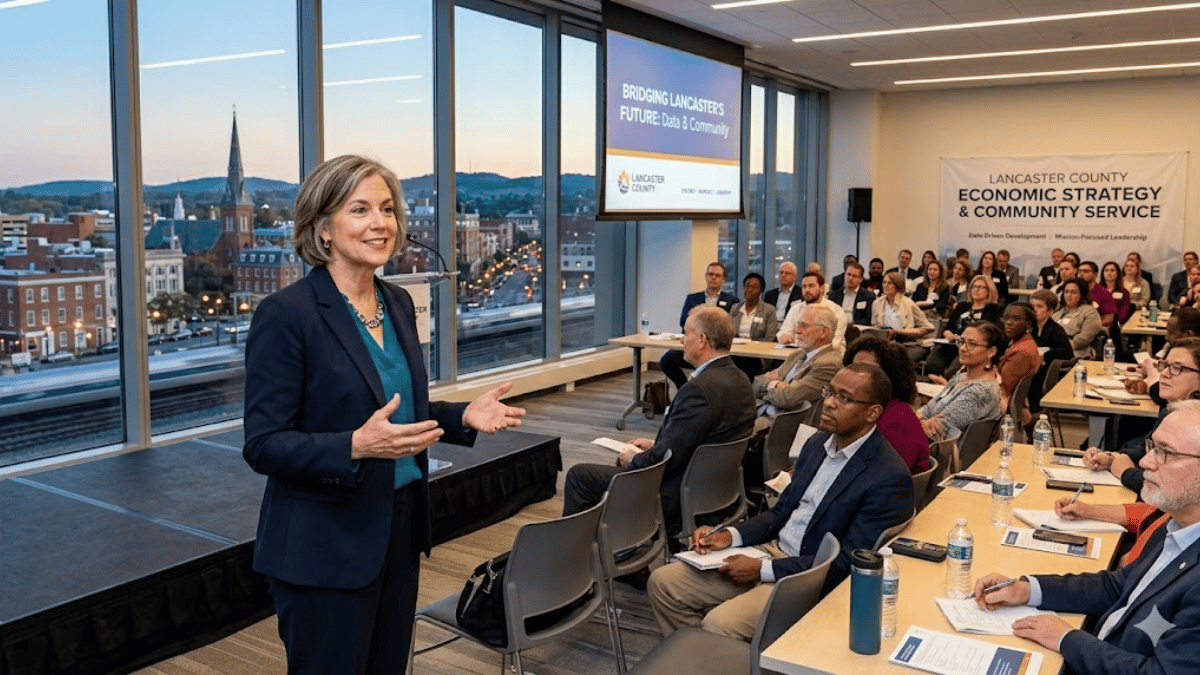
Lancaster County, Pennsylvania, is widely known for its agricultural heritage, resilient manufacturing base, and a civic culture that often blends tradition with pragmatic innovation. Over the past two decades, one of the figures working behind the scenes to shape that regional trajectory has been Cheryl Irwin-Bass, a communications strategist and nonprofit executive whose career bridges economic development, marketing, and mission-driven leadership. – cheryl irwin lancaster pa.
Irwin-Bass, who built much of her reputation as vice president and chief operating officer at the Lancaster Chamber of Commerce & Industry, has played a central role in several initiatives that helped redefine how the region measures prosperity and engages its workforce. Today she serves as Chief Mission & Culture Officer at SpiriTrust Lutheran, a Pennsylvania nonprofit providing senior care and health services, where her responsibilities span human resources, communications, philanthropy, and organizational culture.
Her work in Lancaster County illustrates a broader shift in how local leaders approach economic development. Instead of focusing solely on job counts or industrial expansion, Irwin-Bass helped champion a model that emphasizes data transparency, workforce diversity, and community engagement. – cheryl irwin lancaster pa.
Colleagues frequently describe her leadership style as collaborative and analytical. That approach was evident in the Prosperity Indicators Program, launched in 2011, which created benchmarks across education, health, economic performance, and community well-being. The initiative encouraged business leaders and policymakers to replace anecdotal decision-making with measurable data about the region’s progress.
In Lancaster, where civic leadership often blends public service with private enterprise, Irwin-Bass became a bridge between business strategy and social outcomes. Her career traces the evolution of a regional economy adapting to demographic change, globalization, and the growing importance of mission-driven institutions.
A Career Rooted in Communication and Public Engagement
Cheryl Irwin-Bass’s professional trajectory began with an academic foundation in communication, a discipline that would later shape her leadership approach in both corporate and nonprofit sectors. – cheryl irwin lancaster pa.
She earned a Bachelor of Science in Speech Communication with a minor in public relations from Millersville University of Pennsylvania. She later completed a Master of Science in Communication Studies from Shippensburg University, graduating with honors.
These academic experiences prepared her for work in organizational communication, an area that combines messaging strategy, leadership development, and public engagement. In economic development organizations such as chambers of commerce, communication plays a central role in aligning businesses, government agencies, and community stakeholders.
In 2003 she completed the Institute for Organizational Management (IOM) certification at Villanova University, a credential designed for chamber and nonprofit executives focused on leadership, governance, and financial strategy.
Experts in nonprofit leadership often emphasize the importance of communication backgrounds for executives guiding complex organizations.
“Effective nonprofit leadership depends on translating mission into shared understanding across staff, donors, and the community,” writes nonprofit management scholar Peter Drucker in his analysis of mission-driven organizations (Drucker, 1990).
For Irwin-Bass, communication was not simply a professional skill but a strategic lens. Throughout her career she used messaging, data visualization, and stakeholder engagement as tools to shape regional conversations about economic growth and social responsibility.
Read: Consultant Management System Guide for Modern Firms
The Lancaster Chamber Years
Irwin-Bass’s most visible public role began in the mid-2000s when she joined the Lancaster Chamber of Commerce & Industry, eventually becoming vice president and chief operating officer. – cheryl irwin lancaster pa.
The Lancaster Chamber, founded in the 19th century, functions as one of the region’s primary business advocacy organizations. It connects companies with policymakers, organizes research initiatives, and promotes regional competitiveness.
During Irwin-Bass’s tenure, which lasted roughly from 2006 to 2019, the chamber undertook several initiatives aimed at modernizing its strategy and expanding its influence beyond traditional networking functions.
One of the central goals was to transform the chamber into a hub for economic data and strategic planning rather than merely a membership association.
“Economic development increasingly depends on reliable data that helps communities understand where they are and where they’re going,” said economist Richard Florida in research on regional competitiveness (Florida, 2014).
Irwin-Bass and her colleagues attempted to bring that philosophy to Lancaster County by creating programs that gathered and analyzed regional indicators.
The chamber’s initiatives during this period included workforce studies, community engagement campaigns, and new membership models that broadened access for businesses of different sizes. – cheryl irwin lancaster pa.
Timeline of Key Leadership Milestones
| Year | Initiative or Role | Impact |
|---|---|---|
| 2006 | Joined Lancaster Chamber leadership | Began strategic transformation of programs |
| 2011 | Launch of Prosperity Indicators Program | Introduced data benchmarks for regional progress |
| 2016 | Immigrant Workforce Study presented | Highlighted economic contributions of foreign-born workers |
| 2017 | Open Investor membership model | Expanded access to chamber services |
| 2019 | Transition to marketing leadership role | Shifted to strategic communications sector |
Through these initiatives, Irwin-Bass helped reshape the chamber’s role as a strategic convener for Lancaster’s business community.
The Prosperity Indicators Program
Perhaps the most influential project associated with Irwin-Bass’s tenure at the chamber was the Prosperity Indicators Program.
Launched in 2011, the initiative introduced measurable benchmarks across several sectors affecting Lancaster County’s quality of life. The indicators included metrics related to education, health and safety, economic performance, environmental conditions, and community engagement.
Instead of relying on isolated statistics, the program compiled multiple indicators to create a comprehensive picture of regional well-being.
| Indicator Category | Examples of Metrics |
|---|---|
| Economic Engine | Job growth, unemployment rates, business creation |
| Education | Graduation rates, workforce training participation |
| Health & Safety | Access to healthcare, crime statistics |
| Community & Culture | Civic engagement, cultural participation |
| Physical Environment | Land use, environmental sustainability |
| Well-Being of People | Income trends, population diversity |
The idea was simple but ambitious: provide local leaders with a shared set of data points that could guide policy decisions. – cheryl irwin lancaster pa.
Irwin-Bass described the initiative as an effort to move beyond fragmented discussions about economic growth. According to program documents, the goal was to help stakeholders “focus resources and attention on areas where collective action could make the most impact.”
Urban policy experts often note that such indicator systems can help communities coordinate across sectors.
“Cities that track and publish social indicators create a foundation for collaborative decision-making,” writes urban studies scholar Mark Moffett (Moffett, 2016).
For Lancaster County, the program became a reference point for discussions about education investment, workforce development, and regional competitiveness.
Championing Local Business Through the “Think Local” Campaign
Beyond data analysis, Irwin-Bass also promoted initiatives aimed at strengthening the local business ecosystem.
One of the most visible campaigns during her chamber tenure was “Think Local,” which encouraged residents and companies to support Lancaster County businesses. – cheryl irwin lancaster pa.
The campaign was built around the idea that local spending generates economic multipliers. When residents purchase goods from nearby businesses, those businesses in turn support local suppliers, employees, and civic initiatives.
Events associated with the campaign included celebrations of long-standing regional companies, such as the centennial anniversary of the Lancaster-based dental manufacturer StarDental in 2011.
The messaging strategy highlighted Lancaster’s identity as a community where local entrepreneurship and family-owned companies remain central to the economy.
Economic development experts often emphasize that regional identity can be a powerful driver of economic resilience.
“Local loyalty and community identity are significant factors in sustaining small and mid-size enterprises,” notes economic geographer Edward Glaeser (Glaeser, 2011).
Through initiatives like “Think Local,” Irwin-Bass helped reinforce the narrative that Lancaster’s economic strength depended not only on attracting new investment but also on nurturing existing businesses.
Workforce Diversity and the Immigrant Workforce Study
Another milestone in Irwin-Bass’s chamber leadership came in 2016 when she presented findings from a study examining the role of immigrants in Lancaster County’s workforce.
The research highlighted how foreign-born workers were helping sustain manufacturing operations and other industries facing labor shortages.
According to the study’s findings, immigrant workers contributed to preserving more than 1,000 manufacturing jobs and generated millions in local tax revenue. – cheryl irwin lancaster pa.
The presentation was delivered during the chamber’s annual “State of the County” event, a forum where regional leaders review economic trends and policy priorities.
The study reflected a broader demographic shift occurring in many mid-sized American regions. As birth rates declined and younger workers migrated toward larger cities, employers increasingly relied on immigrant labor to fill essential roles.
Economists often describe immigration as a critical component of regional workforce sustainability.
“Immigration has historically supported economic growth by expanding the labor force and fostering entrepreneurship,” notes the National Academies of Sciences in its landmark report on immigration and economic growth (National Academies, 2017).
By highlighting these dynamics, Irwin-Bass helped spark conversations about inclusive workforce strategies in Lancaster County.
Rethinking the Chamber Membership Model
In 2017, the Lancaster Chamber implemented one of its most significant structural changes: a transition to an “Open Investor” membership model.
Traditionally, chambers of commerce relied on fixed membership dues, which could discourage small businesses or startups from joining.
The Open Investor model eliminated mandatory dues and replaced them with a flexible system that allowed businesses to contribute at varying levels.
The goal was to make chamber resources available to a broader segment of the business community.
Under the new model:
- Businesses could participate without a required fee.
- Organizations chose investment levels based on their capacity.
- Services and programs were accessible to all companies.
The approach reflected a larger trend in membership organizations shifting toward value-based engagement rather than mandatory fees.
Nonprofit strategist Beth Kanter has argued that such models encourage greater participation and innovation.
“Organizations that remove barriers to entry often unlock wider collaboration across sectors,” Kanter wrote in her research on nonprofit networks (Kanter & Fine, 2010).
For the Lancaster Chamber, the transition represented an effort to modernize its operations while expanding its reach across the regional economy.
Transition to Strategic Marketing Leadership
After more than a decade at the chamber, Irwin-Bass transitioned in 2019 to a role in the private sector.
She joined Scheffey Marketing & Communications, a Lancaster-based marketing firm, as strategic marketing director.
The move reflected her background in communication strategy and her experience coordinating complex messaging across business and nonprofit audiences.
In this position she worked with regional organizations on branding, public relations, and strategic messaging. – cheryl irwin lancaster pa.
The experience further expanded her perspective on how communication shapes economic development narratives.
Marketing experts often emphasize that regional economies depend not only on infrastructure and investment but also on storytelling.
“Communities compete for talent and investment through narratives that shape their identity,” writes marketing scholar Philip Kotler in research on place branding (Kotler & Gertner, 2002).
Irwin-Bass’s marketing leadership role allowed her to apply these principles while working with a variety of organizations across central Pennsylvania.
Leadership at SpiriTrust Lutheran
In recent years Irwin-Bass has taken on a new role at SpiriTrust Lutheran, a nonprofit organization providing senior living, home care, hospice, and community services throughout Pennsylvania.
As Chief Mission & Culture Officer, she is part of the organization’s executive leadership team.
Her responsibilities include oversight of human resources, communications and public relations, philanthropy programs, and compliance initiatives.
The role reflects a growing recognition that organizational culture and mission alignment are critical components of nonprofit performance.
Healthcare and senior services organizations in particular face complex challenges, including workforce shortages, regulatory requirements, and rapidly evolving demographic needs.
SpiriTrust Lutheran operates multiple life-plan communities and service programs across Pennsylvania, serving older adults and their families.
Irwin-Bass’s work focuses on aligning employee engagement, mission messaging, and philanthropic outreach with the organization’s long-term strategy.
Nonprofit leadership scholars frequently note that culture management has become an increasingly important executive responsibility.
“Culture is the operating system of an organization,” leadership expert Edgar Schein writes in his research on organizational behavior (Schein, 2017).
By integrating HR strategy, communication, and philanthropy, Irwin-Bass’s role reflects that integrated leadership model.
Community Engagement and Civic Leadership
Beyond her formal executive roles, Irwin-Bass has remained active in Lancaster County’s civic ecosystem.
She has participated in advisory panels addressing workforce development, regional economic planning, and nonprofit collaboration.
Her community engagement also includes involvement with organizations focused on senior services and aging populations, such as CARE, Ltd., which promotes retirement excellence initiatives.
Lancaster County has long been recognized for strong collaboration between businesses, nonprofits, and public institutions.
In such environments, civic leadership often emerges through networks rather than individual authority.
Irwin-Bass’s career illustrates how these networks function. By moving between economic development, marketing, and nonprofit leadership, she has connected multiple sectors of the regional community.
Local leaders often credit such cross-sector collaboration with helping Lancaster maintain economic stability even during national downturns.
The region’s economy combines agriculture, manufacturing, healthcare, and tourism, creating a diversified base that depends heavily on coordinated leadership.
The Lancaster Model of Regional Leadership
The trajectory of Cheryl Irwin-Bass’s career reflects broader trends in American regional development.
Mid-sized regions like Lancaster increasingly rely on collaborative leadership rather than centralized authority.
Economic development organizations, nonprofits, universities, and local governments often share responsibility for shaping long-term strategies.
Irwin-Bass’s initiatives illustrate several characteristics of this model:
- Data-driven policy frameworks
- Workforce inclusion strategies
- Cross-sector collaboration
- Mission-driven nonprofit leadership
These principles are becoming more common in regions seeking sustainable growth.
Urban policy researchers frequently describe this approach as “networked governance,” in which multiple institutions coordinate strategies to address economic and social challenges.
Lancaster County’s emphasis on partnerships between business and community organizations has allowed it to maintain relatively stable economic performance compared with many similarly sized regions.
While no single individual defines that system, leaders like Irwin-Bass play an important role in maintaining the relationships that make collaboration possible.
Key Takeaways
- Cheryl Irwin-Bass is a Lancaster-based executive known for leadership in economic development and nonprofit strategy.
- She served more than a decade as vice president and COO of the Lancaster Chamber of Commerce & Industry.
- The Prosperity Indicators Program introduced data-driven benchmarks for regional development in 2011.
- Her workforce research highlighted the economic importance of immigrant labor in Lancaster County.
- She helped modernize the chamber’s membership structure through the Open Investor model.
- Today she leads mission and culture initiatives at SpiriTrust Lutheran, a major Pennsylvania nonprofit.
Conclusion
Leadership in regional economies often unfolds quietly, far from the national spotlight that typically accompanies corporate or political figures. Cheryl Irwin-Bass’s career illustrates how influence can grow through collaboration, research, and sustained civic engagement.
In Lancaster County, her work helped shift conversations about economic development from simple growth metrics to broader indicators of community well-being. The Prosperity Indicators Program, workforce studies, and membership reforms she championed all reflect a belief that economic success depends on shared data, inclusive strategies, and strong local institutions.
Her transition into nonprofit leadership at SpiriTrust Lutheran represents another stage in that trajectory. In a sector where organizational culture and mission alignment increasingly determine effectiveness, her background in communication and strategic planning offers valuable perspective.
Lancaster County continues to evolve as demographic shifts and technological change reshape its economy. Yet the region’s ability to adapt has often depended on leaders willing to connect businesses, nonprofits, and community stakeholders.
Irwin-Bass’s career offers a case study in that collaborative style of leadership. Rather than pursuing visibility, she has focused on building systems that allow communities to measure progress, share responsibility, and pursue long-term prosperity.
FAQs
Who is Cheryl Irwin-Bass?
Cheryl Irwin-Bass is a business and nonprofit leader based in Lancaster, Pennsylvania. She is known for her leadership at the Lancaster Chamber of Commerce and her current role at SpiriTrust Lutheran.
What is the Prosperity Indicators Program?
The Prosperity Indicators Program is a regional initiative launched in 2011 to track economic and social benchmarks in Lancaster County, guiding community decision-making.
What role does she hold at SpiriTrust Lutheran?
She serves as Chief Mission & Culture Officer, overseeing human resources, communications, philanthropy, and compliance within the nonprofit organization.
What is the Open Investor membership model?
It is a flexible chamber membership structure introduced in 2017 that removed mandatory dues and allowed businesses to contribute at varying investment levels.
What is her educational background?
She holds a B.S. in Speech Communication from Millersville University, an M.S. in Communication Studies from Shippensburg University, and an IOM certification from Villanova University.