
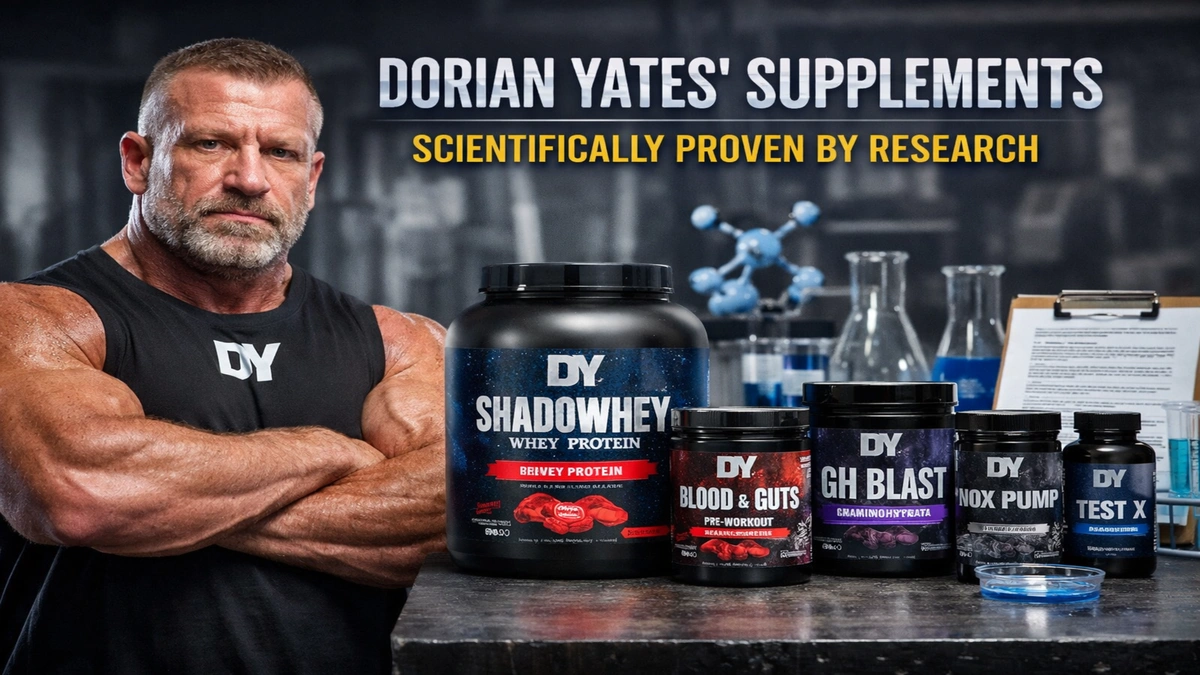
I have spent years watching how elite athletes shape public thinking about health, and few figures command as much respect in bodybuilding as Dorian Yates. A six-time Mr. Olympia winner, Yates built his legacy on intensity, discipline and a relentless approach to progress. In retirement, he has continued influencing the fitness world through his openness about supplementation. That raises a practical question for lifters and everyday readers alike: which of Dorian Yates’ supplements are scientifically proven, and which are still under debate? – Dorian Yates’ Supplements Scientifically Proven by Research.
The answer begins with distinction. Some supplements associated with Yates, such as creatine and whey protein, sit on decades of research and are widely recognized in sports nutrition. Others, including NMN and high-dose melatonin, exist in a more experimental or emerging category. Then there are foundational nutrients such as vitamin D3 and K2, which carry strong medical support but are often misunderstood in athletic contexts.
This article examines the core supplements publicly linked to Yates’ regimen and evaluates them through the lens of established scientific understanding. The goal is not endorsement or dismissal. It is clarity. For anyone seeking evidence rather than hype, separating proven performance tools from promising but preliminary compounds is essential.
The Foundation of Yates’ Supplement Approach
Dorian Yates built his physique in the 1990s during what many consider bodybuilding’s golden era of mass. His training style, known as “Blood and Guts,” emphasized high intensity and brief, brutal sessions. Supplementation in that era centered largely on protein powders, creatine and basic vitamins. Over time, Yates has expanded his stack to include compounds focused not only on muscle but also on longevity, recovery and overall health.
His commonly discussed supplements include whey protein, creatine monohydrate, vitamin D3 combined with K2, N-acetylcysteine, nicotinamide mononucleotide, melatonin and general multivitamins. Each of these falls into a distinct scientific category. Some are performance enhancers, some are recovery agents and others are metabolic or cellular support compounds.
The key question is not whether Yates takes them. The key question is whether scientific evidence supports their claimed benefits. – Dorian Yates’ Supplements Scientifically Proven by Research.
Read: Craigslist Buffalo NY: Housing, Jobs and Local Life
Creatine: The Gold Standard of Performance Supplements
Among all supplements associated with Yates, creatine stands out as the most thoroughly researched. Creatine monohydrate increases phosphocreatine stores in muscle tissue. This supports rapid regeneration of adenosine triphosphate, the primary energy molecule used during short bursts of high-intensity effort such as heavy lifting.
Numerous controlled studies have demonstrated that creatine supplementation, when combined with resistance training, improves strength, increases lean muscle mass and enhances repeated sprint performance. Its safety profile in healthy individuals is also well documented when taken in recommended doses. – Dorian Yates’ Supplements Scientifically Proven by Research.
What makes creatine unique is the consistency of results. While not every individual responds identically, the body of evidence supporting strength and hypertrophy outcomes is robust compared with nearly any other sports supplement.
For a bodybuilder like Yates, whose career revolved around maximal muscle recruitment and overload, creatine aligns cleanly with both physiology and science. It is one of the rare supplements that can be confidently described as scientifically proven for its intended purpose in resistance-trained individuals.
Whey Protein: Practical, Effective and Often Misunderstood
Protein intake remains central to muscle growth. Whey protein is a fast-digesting, high-quality protein source rich in essential amino acids, particularly leucine, which plays a critical role in stimulating muscle protein synthesis.
Scientific literature consistently shows that adequate daily protein intake supports muscle repair and growth. Supplementing with whey protein can help individuals reach recommended intake levels, especially those training intensely. Research indicates that muscle protein synthesis is stimulated most effectively when total daily protein is sufficient and distributed across meals. -Dorian Yates’ Supplements Scientifically Proven by Research.
However, it is important to clarify that whey protein itself is not magical. It does not build muscle independently of resistance training. Nor is it inherently superior to whole food protein sources when total intake is adequate. Its value lies in convenience, digestibility and precise dosing.
In Yates’ case, whey protein likely serves as a practical tool to meet high protein requirements without excessive caloric burden. Scientifically, protein supplementation is well supported when dietary intake would otherwise fall short.
Vitamin D3 and K2: Structural Health Beyond Muscle
Vitamin D deficiency is common worldwide. Vitamin D3 supports calcium absorption, immune regulation and muscle function. In individuals with low serum vitamin D levels, supplementation improves bone density and may reduce the risk of fractures.
Vitamin K2 plays a complementary role by assisting in directing calcium into bone tissue rather than soft tissues. The pairing of D3 and K2 is increasingly discussed in nutritional science because of this potential synergy.
While vitamin D3 supplementation is strongly supported in deficient populations, its effects in already sufficient individuals are less dramatic. The scientific consensus holds that correcting deficiency is beneficial, but megadosing beyond recommended levels does not necessarily enhance performance.
For aging athletes like Yates, maintaining bone density and musculoskeletal integrity becomes increasingly important. In this context, D3 and K2 supplementation aligns with preventive health rather than muscle hypertrophy. The science here is solid regarding deficiency correction, moderate regarding synergy claims and cautious about high-dose use without medical supervision. – Dorian Yates’ Supplements Scientifically Proven by Research.
N-Acetylcysteine: Antioxidant Support With Nuance
N-acetylcysteine, commonly known as NAC, is a precursor to glutathione, one of the body’s primary endogenous antioxidants. In clinical medicine, NAC is used to treat acetaminophen overdose and certain respiratory conditions.
From a physiological standpoint, boosting glutathione levels may reduce oxidative stress. Exercise generates reactive oxygen species, and moderate oxidative stress is a natural signal for adaptation. The question researchers have explored is whether antioxidant supplementation enhances or blunts training adaptation.
Findings are mixed. Some evidence suggests NAC may reduce markers of muscle fatigue in specific scenarios. Other research indicates that excessive antioxidant supplementation could theoretically interfere with beneficial training adaptations.
In short, NAC is scientifically established in medical contexts. Its role as a performance enhancer remains less clear. It may support recovery in certain conditions, but it is not classified as a proven muscle-building compound.
NMN: Emerging Longevity Science
Nicotinamide mononucleotide, or NMN, is a precursor to NAD+, a molecule involved in cellular energy metabolism and DNA repair. Interest in NMN has grown within longevity research circles.
Animal studies have shown promising effects related to metabolic function and aging pathways. Early human trials indicate that NMN can increase NAD+ levels in the bloodstream and may influence markers of metabolic health. However, long-term clinical outcomes in humans remain under investigation.
It is crucial to differentiate between biochemical plausibility and proven clinical benefit. Raising NAD+ levels does not automatically translate to extended lifespan or improved athletic performance.
For Yates, NMN likely represents an investment in healthy aging rather than muscle gain. Scientifically, NMN is best described as promising but not definitively proven in large-scale human trials.
Melatonin and Sleep Optimization
Melatonin regulates circadian rhythm and sleep cycles. Adequate sleep supports muscle recovery, hormonal balance and cognitive function. Research supports low-dose melatonin supplementation for short-term sleep regulation, particularly in cases of jet lag or circadian disruption.
Higher doses are sometimes used, but long-term high-dose effects are less well studied. Sleep optimization itself is unquestionably critical for recovery and performance. Whether megadoses of melatonin are necessary is another matter.
For athletes, improved sleep quality indirectly supports muscle growth and recovery. The scientific backing for melatonin as a sleep aid is moderate. Its direct impact on muscle mass is indirect and dependent on overall sleep improvement.
Cannabis Derivatives: Recovery and Inflammation
Cannabidiol, or CBD, and other cannabis derivatives have gained popularity for potential anti-inflammatory and relaxation effects. Early research suggests CBD may reduce anxiety and influence inflammatory pathways. However, high-quality evidence specific to athletic recovery is still developing.
Regulatory landscapes also vary by region. While anecdotal reports of improved relaxation and recovery are common, large controlled trials in elite athletic populations remain limited.
As a result, cannabis derivatives occupy a gray area. The science is evolving, and claims often outpace evidence.
Comparing the Evidence
Below is a structured comparison of key supplements associated with Yates and their relative scientific support.
| Supplement | Primary Purpose | Strength of Evidence |
|---|---|---|
| Creatine | Strength and muscle mass | Strong |
| Whey Protein | Muscle protein synthesis | Strong when intake insufficient |
| Vitamin D3 | Bone and immune support | Strong for deficiency |
| Vitamin K2 | Calcium regulation | Moderate |
| NAC | Antioxidant support | Strong medically, mixed athletically |
| NMN | Cellular energy and longevity | Emerging |
| Melatonin | Sleep regulation | Moderate |
Another way to view this is by distinguishing performance enhancers from health maintenance compounds.
| Category | Supplements |
|---|---|
| Proven Performance Support | Creatine, Whey Protein |
| Structural and Preventive Health | Vitamin D3, K2 |
| Experimental or Emerging | NMN |
| Conditional Recovery Support | NAC, Melatonin, CBD |
Expert Perspectives
Sports nutrition researchers consistently emphasize that creatine remains one of the most validated ergogenic aids available. Exercise physiologists also note that total protein intake across the day is more critical than any single protein supplement.
Researchers in aging science caution that while NAD+ precursors are exciting, human longevity data remain incomplete. These perspectives reinforce a central theme: context matters.
The Broader Lesson
Dorian Yates’ supplement regimen reflects a shift from pure performance toward holistic health. During his competitive years, muscle and strength dominated priorities. In retirement, cellular health, sleep and recovery appear more central.
The science supports some components strongly. Creatine and adequate protein intake are well grounded in research. Vitamin D3 supplementation is beneficial in deficiency states. Other compounds, such as NMN and high-dose antioxidant strategies, are still navigating the pathway from hypothesis to confirmed benefit.
The presence of a supplement in an elite athlete’s stack does not automatically confer scientific validation. It does, however, invite examination.
Takeaways
- Creatine is strongly supported for strength and muscle development.
- Whey protein is effective when total dietary protein is insufficient.
- Vitamin D3 is beneficial in deficiency and important for bone health.
- NAC has clear medical uses but mixed performance evidence.
- NMN is promising but not conclusively proven for longevity in humans.
- Sleep quality remains foundational, with melatonin playing a supportive role.
Conclusion
Dorian Yates built his legacy on intensity and discipline, and his supplement choices reflect both tradition and curiosity. Some of the compounds associated with his regimen rest on decades of evidence and remain pillars of sports nutrition. Others represent the frontier of metabolic and longevity research, where data are still accumulating.
For readers seeking guidance, the path forward is grounded in evidence-based hierarchy. Prioritize proven fundamentals such as adequate protein intake, structured training, sufficient sleep and, when appropriate, creatine supplementation. Address nutritional deficiencies with targeted nutrients under medical guidance. Approach emerging compounds with informed skepticism and an understanding of their experimental status.
Science evolves. What is speculative today may become standard tomorrow. Until then, clarity, moderation and evidence should remain the guiding principles for anyone navigating the complex world of supplementation.