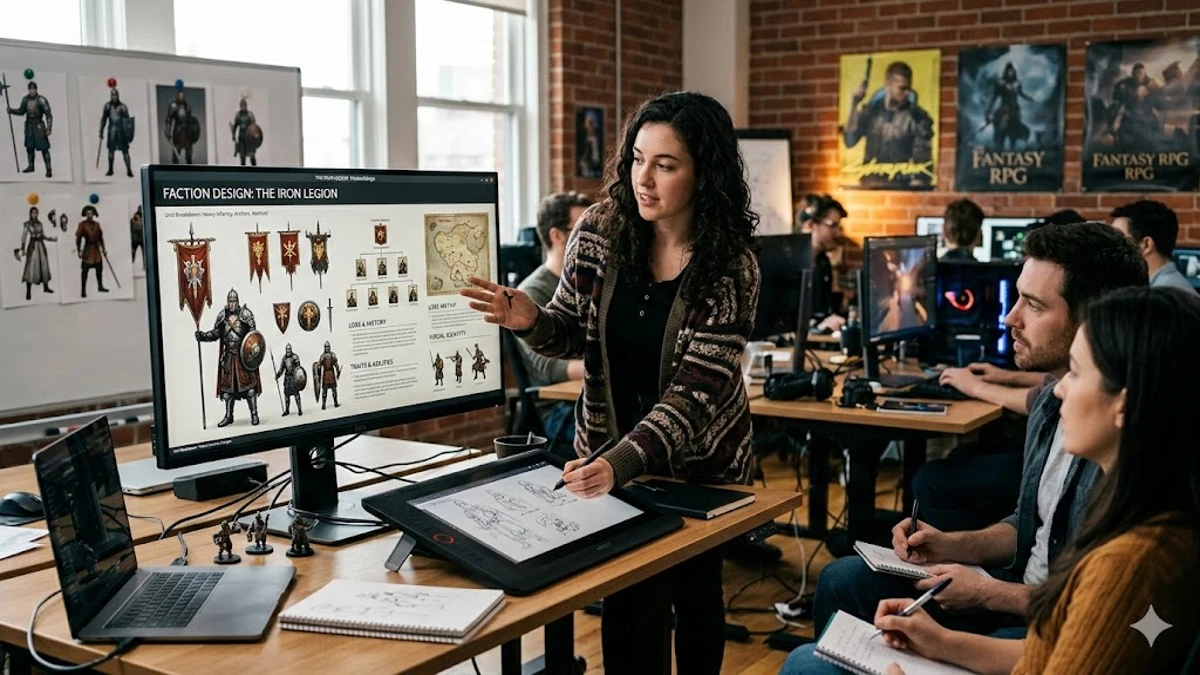
I have always been fascinated by the invisible architecture behind fictional worlds. When players enter a massive video game universe or readers explore an intricate fantasy story, they often encounter competing groups: guilds, empires, rebel movements, corporations, or tribes. The person responsible for shaping those identities is often called a faction designer. A faction designer develops the political, cultural, visual, and narrative structures of groups that populate a game or fictional universe. Their work determines how factions behave, how they clash with rivals, and how players interact with them.
Faction design has become a crucial part of modern game development and interactive storytelling. From massive multiplayer games to strategy titles and narrative adventures, factions help organize gameplay, provide motivations for conflict, and create memorable identities within fictional settings. Instead of designing characters alone, faction designers think in terms of entire societies.
The rise of expansive open-world games has increased the importance of faction design. Players no longer move through simple storylines but navigate complex ecosystems of groups competing for power. These factions often represent ideologies, cultural traditions, or moral perspectives, allowing players to align themselves with particular values.
Game developers now recognize that faction design sits at the intersection of narrative design, systems design, and world-building. A faction must feel believable within the fictional setting while also serving gameplay mechanics.
Understanding the work of a faction designer reveals how much thought goes into the rivalries, alliances, and identities that bring digital worlds to life.
What a Faction Designer Actually Does
When I speak with game developers about faction design, they often describe it as a blend of storytelling, sociology, and systems thinking. A faction designer constructs the structure of groups within a fictional universe.
The process typically begins with defining the faction’s core identity. Designers ask foundational questions: What does this group believe? What motivates its members? How does it interact with rivals?
These questions shape everything from visual aesthetics to gameplay mechanics. In strategy games, factions might possess unique units or abilities. In role-playing games, factions might control territories or offer quests.
Game design scholar Katie Salen notes that systems of conflict drive many interactive experiences. “Games create meaning through structured interactions between players and systems,” she writes in research on game design principles (Salen & Zimmerman, 2004).
Faction designers translate those interactions into narrative structures.
The role often overlaps with world-building teams, narrative designers, and art directors. Together, they ensure that each faction has a coherent identity.
The Rise of Factions in Modern Game Worlds
Factions have existed in games for decades, but their importance expanded dramatically in the 2000s as game worlds grew larger and more complex.
Early strategy games such as StarCraft and Command & Conquer introduced distinct factions with unique abilities and aesthetics. These differences created strategic variety while reinforcing narrative conflict.
Massively multiplayer online games pushed faction design even further. Titles like World of Warcraft structured entire player communities around competing factions.
The concept quickly spread across genres.
| Game Genre | Role of Factions | Example Function |
|---|---|---|
| Strategy games | Asymmetric gameplay mechanics | Unique units and technologies |
| RPGs | Narrative alliances and quests | Reputation systems |
| MMOs | Player identity groups | Large-scale faction wars |
| Sandbox games | Political world-building | Territory control |
Game historian Tristan Donovan argues that faction systems transformed how players experience digital worlds. “Distinct factions create emotional investment by giving players a sense of belonging,” he wrote in research on video game history (Donovan, 2010).
That emotional attachment remains one of the most powerful tools in interactive storytelling.
Narrative Foundations of Faction Design
Every compelling faction begins with a story. Designers rarely start with mechanics alone. Instead, they imagine a cultural identity.
A faction might represent an ancient civilization preserving tradition. Another might embody technological progress or revolutionary ideals.
These identities help players understand the world quickly. Instead of memorizing complex histories, players recognize the symbolic meaning of each faction.
Narrative designer Richard Rouse III has argued that storytelling in games must support player agency. “Interactive narrative allows players to explore stories rather than simply watch them unfold,” he writes in research on game narrative design (Rouse, 2005).
Faction design supports that exploration.
When players choose which faction to support, they participate directly in shaping the story.
Read: Map 2.0 Post Assessment Answers: Complete Guide to Understanding Results
The Psychology Behind Faction Identity
One reason factions work so well in games involves human psychology. People naturally form group identities.
Psychologist Henri Tajfel’s social identity theory explains how individuals categorize themselves into groups to create a sense of belonging. This phenomenon appears not only in politics or sports but also in fictional environments.
Game designers leverage this tendency intentionally.
When players join a faction, they begin to identify with its values and goals. Rival factions then become symbolic opponents.
| Psychological Factor | Effect in Games |
|---|---|
| Group identity | Players feel loyalty to factions |
| Rivalry | Conflict increases engagement |
| Shared goals | Cooperation among players |
| Symbolism | Visual identity reinforces belonging |
Game designer Jesse Schell explains that successful game systems often mirror real human behavior. “Games resonate when they reflect the motivations and emotions people already understand,” he writes in The Art of Game Design (Schell, 2019).
Faction systems capitalize on those motivations.
Visual Design and Symbolic Identity
Faction designers collaborate closely with artists to create distinctive visual identities.
Colors, architecture, clothing, and symbols all communicate faction values. A militaristic faction might feature rigid structures and sharp geometric designs. A nature-focused faction might use organic shapes and earth tones.
Visual design helps players identify factions instantly.
Consider how many iconic games use strong faction aesthetics. Players recognize rival groups immediately based on armor styles, banners, or architectural motifs.
These visual cues reinforce narrative themes.
Art director Scott Robertson notes that visual storytelling often communicates faster than dialogue. “Design language allows audiences to understand a world at a glance,” he explains in research on visual development.
For faction designers, this visual language becomes essential.
Mechanics That Differentiate Factions
While narrative identity matters, factions must also influence gameplay.
Designers often give factions unique abilities, technologies, or resources.
For example, one faction might specialize in defense while another focuses on mobility or economic expansion.
Balancing these mechanics requires careful design. If one faction becomes significantly stronger than others, the game loses strategic variety.
| Design Element | Purpose |
|---|---|
| Unique abilities | Encourage different strategies |
| Specialized units | Create tactical diversity |
| Territory control | Generate political conflict |
| Reputation systems | Influence narrative outcomes |
Balancing faction mechanics remains one of the most complex challenges in game design.
Developers often analyze large datasets from player behavior to adjust faction abilities over time.
Faction Design in Open-World Games
Open-world games have expanded faction design dramatically.
Instead of two opposing sides, these worlds often include multiple factions competing for influence.
Players navigate political landscapes where alliances shift and conflicts emerge dynamically.
Examples appear in games such as The Elder Scrolls series, where guilds, political groups, and secret societies shape the player’s journey.
These layered faction systems make worlds feel alive.
Players encounter different groups with conflicting agendas, forcing them to make choices that affect the story.
Open-world faction design often resembles political simulation more than traditional storytelling.
The Influence of Real-World History
Faction designers frequently draw inspiration from real historical conflicts.
Empires, revolutions, and ideological movements provide rich material for fictional factions.
History offers examples of how groups form identities, create symbols, and engage in conflict.
Military historian John Keegan once observed that human societies often define themselves through opposition to rivals. That dynamic translates easily into storytelling and game design.
By studying history, faction designers gain insight into how power structures evolve.
This research helps create factions that feel believable rather than arbitrary.
The Future of Faction Design
As games become more complex, faction design continues to evolve.
Artificial intelligence may soon allow factions to behave more dynamically, reacting to player actions in unpredictable ways.
Procedural storytelling systems could generate faction conflicts automatically, creating unique narratives for every player.
Game studios are also exploring moral complexity within factions. Instead of portraying groups as purely good or evil, designers increasingly present factions with competing but understandable goals.
This trend reflects broader shifts in storytelling toward ambiguity and nuance.
Future faction design may resemble political ecosystems rather than simple rivalries.
Takeaways
- A faction designer builds the identities and conflicts of groups within fictional worlds.
- Factions combine narrative, visual design, and gameplay mechanics.
- Psychological group identity makes factions emotionally engaging for players.
- Visual symbolism helps players recognize factions instantly.
- Balanced mechanics ensure each faction offers unique gameplay experiences.
- Historical and cultural influences shape believable faction identities.
Conclusion
When I step back and consider the role of faction designers, I realize how central their work has become to modern storytelling. The rival groups that populate games and fictional universes do far more than create conflict. They provide structure, identity, and meaning within complex worlds.
Faction design blends art and strategy. Designers must imagine cultures, beliefs, and political motivations while also ensuring that gameplay remains balanced and engaging. Each faction becomes a miniature society with its own symbols, traditions, and ambitions.
As interactive worlds grow more sophisticated, factions will likely become even more complex. Players increasingly expect worlds that react to their decisions and reflect the consequences of alliances and rivalries.
In that evolving landscape, faction designers serve as architects of fictional societies. Their work shapes how players understand power, loyalty, and identity within digital worlds.
The next time a player chooses a faction in a game, they are not simply selecting a team. They are entering a carefully constructed system of narrative, psychology, and design.
FAQs
What is a faction designer?
A faction designer creates the identities, motivations, and gameplay mechanics of groups within fictional worlds or video games.
Why are factions important in games?
Factions create conflict, identity, and strategic diversity, helping players engage emotionally with the game world.
Do faction designers focus on storytelling or mechanics?
Both. The role combines narrative world-building with gameplay design.
What skills does a faction designer need?
Key skills include storytelling, game systems design, cultural research, and collaboration with art and narrative teams.
Are factions only used in strategy games?
No. Factions appear in RPGs, MMOs, sandbox games, and many narrative-driven titles.