
I approach the keyword fapservice carefully because it can point to more than one search intent. Some people may be looking for a specific website, some may be trying to understand a technical term that appears in software or network documentation, and others may have arrived at the word through a misspelling or brand search. In my view, the safest and most useful way to explain fapservice is to treat it as a search term that needs context, verification, and privacy awareness before a reader clicks anything.
The available search results show that fapservice.com appears in SEO tools as a real domain with U.S. search traffic, while “FAPService” also appears in technical contexts such as IBM support documentation and Broadband Forum data models. Semrush lists fapservice.com as a searched website and shows “fapservice” as a top organic keyword in the United States, while IBM uses “FAPService” in an error message related to a running service and FAP database sequence.
Because the word may also be confused with “fan service,” I think readers need a balanced explanation rather than a rushed definition. Cambridge Dictionary defines fan service as content included in media to please fans, which is a different term from fapservice even though the words look similar to some searchers.
Key Takeaways
- Fapservice may refer to a specific domain, a search keyword, or a technical “FAPService” term depending on context.
- The safest first step is to identify whether the user is searching for a website, a technical error, or a similar phrase such as “fan service.”
- Third-party SEO data indicates that fapservice.com has U.S. search visibility, but SEO traffic data should not be treated as proof of quality, safety, or legitimacy.
- Google Safe Browsing, browser warnings, HTTPS checks, privacy settings, and cautious clicking can reduce risk when visiting unfamiliar websites.
- FTC guidance warns users not to give personal or financial information in response to unexpected requests.
- If the term appears in software, logs, or network systems, “FAPService” may have a technical meaning and should be handled through official vendor documentation rather than general web search results.
What Fapservice Means in Search Context
I would define fapservice as an ambiguous search keyword rather than a single universal concept. In SEO research, a keyword can point to a brand, a domain, a service name, a typo, a technical phrase, or a user’s attempt to reach a specific website. The challenge with fapservice is that the available results do not all point in the same direction. One result identifies fapservice.com as a domain with traffic data, another shows IBM documentation for “FAPService,” and another points toward the broader term “fan service.”
From my perspective, that makes user intent the most important part of the keyword. If someone types fapservice into a search bar, they may already know the website they want. Another person may be troubleshooting an enterprise software issue and searching an exact error message. A third reader may be trying to understand whether the word relates to entertainment, fandom, or online media.
The practical lesson is simple: do not assume one meaning too quickly. We can read the surrounding context first. If the keyword appears inside a browser search, it may be a navigational query. If it appears inside a server log, support ticket, database error, or wireless configuration file, it may be technical. If it appears in a media discussion, it may be a mistaken spelling or confusion with fan service.
Why Fapservice Search Intent Matters
Search intent matters because the same word can create very different reader needs. I believe this is especially important for fapservice because a vague interpretation could send readers toward irrelevant or unsafe content. A person troubleshooting IBM software does not need a website review. A person checking whether an unfamiliar domain is safe does not need a telecom data model explanation. A person studying media terminology does not need enterprise software guidance.
In SEO terms, fapservice appears to have navigational intent when searchers are looking for a specific domain. Semrush data shown in search results lists fapservice.com and reports that visitors mainly come from direct traffic followed by Google, which suggests that many users may already be trying to reach a known site rather than learn a general concept.
However, traffic data does not answer safety questions. A domain can have traffic and still require caution. A keyword can be popular and still be unclear. A website can be online and still contain content, redirects, ads, downloads, or data practices that a reader should review carefully. In my view, search volume is only a signal of interest, not a signal of trust.
Fapservice, FAPService, and Fan Service Are Not the Same Thing
One of the easiest mistakes is treating similar-looking terms as identical. I separate fapservice into three possible interpretations: a domain or brand-style keyword, a technical term written as FAPService, and a mistaken version of fan service.
Cambridge Dictionary gives a helpful definition of fan service because it shows why that separate phrase exists in entertainment discussions:
“stories, characters, actions, etc. that are included in a film, television show, computer game, comic book, performance, etc. in order to please its fans”
Cambridge Dictionary
This quote matters because “fan service” is a media term, not automatically the same as fapservice. If a reader is writing about anime, games, films, or fandom culture, they should usually use “fan service” or “fanservice,” not fapservice.
The technical spelling “FAPService” is also separate. IBM documentation uses the phrase in a troubleshooting message that says no FAPService is running or that FAPDb may have started or restarted after FAPService. Broadband Forum documentation also references “FAPService” as a Femto Access Point Service data model object.
That difference matters in practice. A software administrator who sees “FAPService” in a system message should not search random websites for answers first. They should check official product documentation, server configuration, environment variables, service startup order, and vendor support notes.
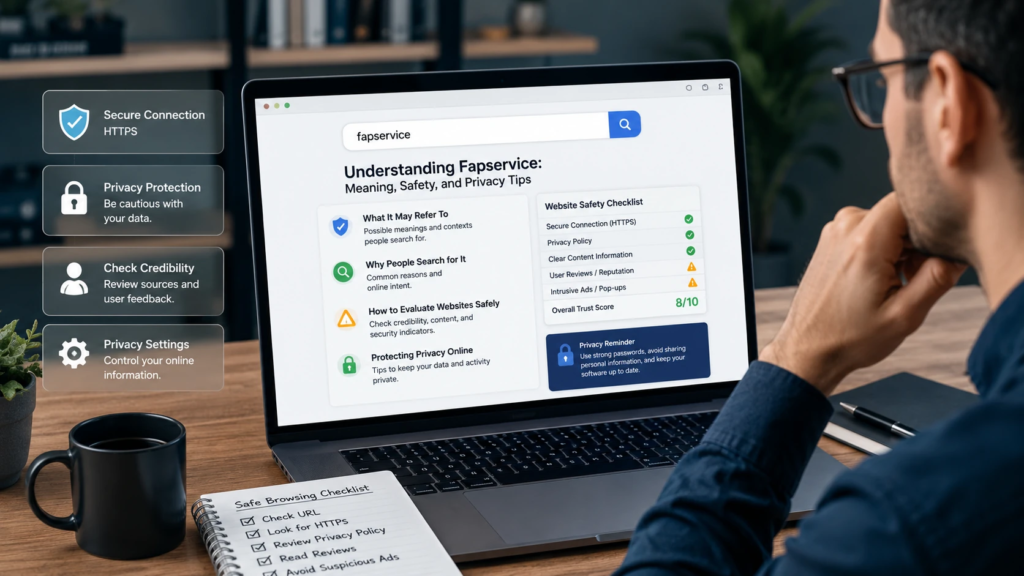
How to Classify Fapservice Search Intent
The table below helps compare the most likely meanings. I use this kind of comparison because it prevents readers from treating a vague keyword as if it had only one possible answer.
| Possible Meaning | Where It May Appear | What the User Probably Wants | Best Next Step |
|---|---|---|---|
| Website or domain keyword | Search engine, browser bar, SEO tool | To visit or evaluate fapservice.com | Check safety, privacy, redirects, and legitimacy before interacting |
| Technical FAPService | Error logs, IBM software, network documentation | To fix a service or database issue | Use official vendor documentation and system logs |
| Femto Access Point Service | Broadband or telecom configuration documents | To understand a network data model | Read technical specifications and device documentation |
| Fan service confusion | Anime, gaming, media, entertainment discussion | To understand fandom-oriented content | Search “fan service” instead of fapservice |
| Typo or unknown term | Casual search, copied text, unclear phrase | To identify what the word means | Compare surrounding context before clicking results |
The most important takeaway is that fapservice needs context before action. I would not recommend clicking the first result simply because the term appears familiar. A safer process is to decide whether the search is navigational, technical, informational, or accidental.
How Fapservice Appears in SEO and Website Research
In my analysis, the keyword fapservice behaves like a navigational search term when users are trying to find a particular site. Semrush’s public result for fapservice.com shows the domain in website traffic data and lists “fapservice” as a top organic keyword with U.S. search activity.
That information can be useful for SEO writers, but it should be handled carefully. Third-party SEO platforms estimate traffic and keyword visibility using their own data methods. These estimates can help identify search interest, but they do not verify whether a website is safe, legal, high quality, appropriate for all audiences, or suitable for a particular reader.
For example, a marketer may see that a keyword has search volume and immediately want to create content. I think that is incomplete analysis. The better question is: what problem does the searcher have, and what kind of page can answer it responsibly? For fapservice, the responsible article is not one that blindly promotes a site. It is one that explains the keyword, clarifies possible meanings, and teaches safe browsing habits.
Privacy and Safety Questions Around Fapservice
Any unfamiliar website search should raise basic privacy questions. I am not saying every unfamiliar site is unsafe. I am saying that readers should apply the same safety checklist to any domain they do not fully trust. This includes checking the URL spelling, looking for HTTPS, reviewing browser warnings, avoiding unexpected downloads, and not entering personal or payment information unless there is a clear reason and a trusted context.
Google describes Safe Browsing as a service built to identify unsafe websites and notify users and website owners of possible harm. Google also says Safe Browsing “helps protect over five billion devices every day.”
That quote matters because browser warnings are not decorative. If a browser or Safe Browsing tool flags a site, I would pause immediately. A warning may relate to malware, phishing, deceptive downloads, compromised pages, or another risk. The safest response is to leave the page, check the domain through trusted tools, and avoid entering information.
FTC guidance is also relevant whenever a website asks for sensitive details, payment information, account credentials, or identity data. The FTC warns:
“Don’t give your personal or financial information in response to a request that you didn’t expect.”
Federal Trade Commission
I interpret that advice broadly. If a page connected with fapservice or any unfamiliar keyword suddenly asks for card details, login credentials, app installation, browser permissions, or identity verification, the user should stop and verify the request through a known trusted route.
Practical Examples of Fapservice Search Scenarios
A realistic example can make the search intent clearer. Imagine a user types fapservice because they saw the word in their browser history. They may want to know whether someone visited a specific website. In that situation, the best response is not to make assumptions about the visitor. The better response is to check browser history details, installed extensions, downloads, redirects, and account security.
Another scenario involves a system administrator who sees “FAPService” in an IBM-related error. IBM’s result describes a message where the service is not running or where FAPDb started or restarted after FAPService. In that case, the user should treat the term as a software service issue. They should check whether the service is installed, whether it started properly, whether environment variables are correct, and whether database startup order caused the message.
A third scenario involves someone researching media terminology. They may have meant “fan service,” which Cambridge defines as content added to please fans. In that case, searching fapservice will produce noisy results. The user should correct the query to “fan service meaning,” “fanservice anime,” or “fan service in media.”
A fourth scenario involves someone evaluating a domain before visiting. This reader should check the URL, scan for warnings, avoid downloads, use strong browser settings, and never assume that traffic data equals trustworthiness. I consider this the most important general-use case because it protects people from accidental exposure to risky pages.
Step-by-Step Guide to Evaluating Fapservice Safely
The safest way to handle fapservice is to evaluate the context before interacting. I recommend the following process for any unfamiliar domain or ambiguous keyword.
Step 1: Identify the Source of the Word
Start by asking where the word appeared. Did it appear in a search suggestion, browser history, error message, SEO report, social media post, email, or technical document? This first step often reveals the correct intent.
If the word appears in an error message, treat it as technical. If it appears in a browser bar, treat it as navigational. If it appears in entertainment writing, check whether the intended phrase was fan service. If it appears in an SEO report, treat it as a keyword that needs further research.
Step 2: Check the Exact Spelling
Spelling matters online. A small change can lead to a different website, a typo domain, or an unrelated result. I would compare fapservice, fapservice.com, FAPService, and fan service separately. These are not interchangeable terms.
This step is especially important because cybercriminals sometimes use similar-looking domains or typos to capture traffic from people who mistype a known site. Even when no scam is involved, a typo can still send a user to irrelevant or inappropriate content.
Step 3: Use Search Results Before Visiting Directly
When I do not trust a domain, I prefer searching the term first rather than typing it directly into the address bar. Search results can reveal whether the term is associated with a company, technical documentation, outage reports, security warnings, or unrelated content.
This does not make search results perfect. Search pages can still show low-quality or unsafe sites. But they give more context than a direct visit. A search results page may also show official documentation, dictionary entries, or third-party safety tools that help clarify the term.
Step 4: Check Browser and Safe Browsing Warnings
If a browser warning appears, take it seriously. Google’s Safe Browsing site status tool is designed to show whether a site has been flagged for unsafe activity. I would not bypass warnings unless there is a strong professional reason and the user understands the risk.
A safe-looking page can still contain questionable ads, redirects, tracking scripts, pop-ups, or downloads. That is why warnings, browser protections, and updated security tools matter.
Step 5: Avoid Sharing Personal Information
Do not enter email addresses, passwords, payment data, ID details, or personal files on an unfamiliar site unless the purpose is clear and the site is trusted. FTC guidance says honest organizations will not unexpectedly contact users to ask for sensitive details such as Social Security, bank account, or credit card numbers.
This step is simple but powerful. Many online risks become serious only after a user provides information, downloads a file, grants permissions, or follows a payment prompt.
Step 6: Look for Unwanted Downloads or Redirects
Unexpected downloads are a warning sign. If a page automatically downloads a file, opens new tabs, redirects repeatedly, or asks for browser notification permissions without a clear reason, I would leave. These behaviors do not always prove malicious intent, but they are enough to justify caution.
A practical example is a page that asks users to install a video player, browser extension, codec, or “security update.” Unless the software comes from a verified official source, I would avoid it.
Step 7: Decide Whether You Need the Site at All
The final step is the most overlooked. Ask whether visiting the site is necessary. If the goal is to understand the keyword, search summaries, dictionaries, documentation, and safety tools may answer the question without visiting the domain. If the goal is technical troubleshooting, official vendor documentation is safer than general web browsing.
Common Mistakes People Make With Fapservice Searches
The first mistake is assuming that search popularity equals safety. Semrush data can show that people search for a domain or keyword, but it cannot guarantee a positive user experience, safe content, or trustworthy data handling.
The second mistake is ignoring capitalization and context. FAPService with capital letters may refer to technical services or telecom data models, while fapservice as a lowercase keyword may point to a domain search. That difference can completely change the answer.
The third mistake is clicking without checking the URL. CISA advises users to check website URLs for slight spelling differences to avoid phishing attempts. I believe this is one of the simplest habits that prevents unnecessary risk.
The fourth mistake is granting browser permissions too quickly. A page may ask for notifications, location, camera, microphone, or file access. CISA’s web safety guidance warns against giving websites access to location, camera, or microphone unless required.
The fifth mistake is treating all similar terms as one topic. Fan service, FAPService, and fapservice may belong to different contexts. A good article, help page, or troubleshooting guide should separate those meanings instead of mixing them.
Fapservice Safety Checklist for Readers
The table below turns the safety advice into practical decisions. I use a checklist because it helps readers act quickly when they are uncertain.
| Safety Check | Why It Matters | What I Would Do |
| URL spelling | Similar domains can lead to unrelated or risky pages | Compare the exact spelling before clicking |
| HTTPS connection | It helps protect data in transit, though it does not prove trust | Avoid entering information on pages without HTTPS |
| Browser warning | It may indicate malware, phishing, or unsafe content | Leave the page and verify through a trusted tool |
| Unexpected downloads | Files may contain unwanted software or risky installers | Cancel downloads from unfamiliar sources |
| Notification prompts | Notifications can be abused for spam or deceptive alerts | Block prompts unless the site is trusted |
| Payment requests | Sensitive data can be misused if the site is not trustworthy | Do not pay unless identity and purpose are verified |
| Login forms | Fake pages can steal credentials | Use unique passwords and avoid reusing credentials |
| Technical error context | A support term may need official documentation | Check IBM, vendor, or device documentation first |
The key takeaway is that safe browsing is not one action. It is a sequence of small checks. When several warning signs appear together, I would treat the page as high risk.
Technical Meaning of FAPService
In technical contexts, FAPService may refer to a service, object, or data model connected with software or network systems. IBM support documentation uses the phrase in an error message about FAPService not running or FAPDb starting or restarting after FAPService. Broadband Forum documentation describes “FAPService” as a Femto Access Point Service object in a data model.
This technical meaning is important because some readers may find the term in enterprise environments. If a technical user searches only “fapservice,” they may get unrelated domain results. A better query would include the product name, error message, vendor, database, operating system, or device model.
For example, a better technical query might be “IBM FAPService not running FAPDb started after FAPService” or “Broadband Forum FAPService Femto Access Point data model.” Those searches are more precise and more likely to lead to official documentation.
In my view, technical users should avoid downloading random “fix tools” from third-party sites. Service errors should be solved through logs, configuration files, environment variables, service managers, database status checks, and official support notes.
Content and Brand Considerations for the Fapservice Keyword
If a publisher wants to write about fapservice, I believe the safest editorial angle is informational rather than promotional. The keyword is ambiguous, and some possible meanings may involve mature or restricted content. A responsible article should not encourage risky browsing or make unsupported claims about a domain.
A good content strategy would focus on meaning, search intent, privacy, website verification, and term confusion. This serves readers who are trying to understand the keyword without pushing them into unnecessary clicks. It also helps search engines understand that the page is a safety and explanation guide rather than a doorway page.
For example, a responsible title might be “Fapservice Meaning and Safety Guide” rather than a title that promises downloads, access, accounts, or explicit content. The article should also avoid pretending to be affiliated with any website unless that relationship is real.
How to Write About Fapservice Without Keyword Stuffing
Keyword stuffing makes content less trustworthy. I would use fapservice naturally in headings, the introduction, the definition section, the safety checklist, the FAQ, and the conclusion. Beyond that, close variations such as “the term,” “the keyword,” “the domain,” “FAPService,” and “related search intent” keep the article readable.
A practical rule is to use the exact keyword when it helps clarity, not every time the topic is mentioned. For example, “fapservice may refer to a domain or technical term” is useful. Repeating “fapservice website fapservice guide fapservice meaning” in one sentence is not useful.
Searchers want answers. They do not want a page that repeats the same word without adding insight. In my experience, the strongest SEO writing is clear enough for readers and structured enough for search engines.
Expert Recommendations for Handling Ambiguous Keywords
My first recommendation is to separate meanings before writing or clicking. Ambiguous keywords are risky because they invite assumptions. Fapservice may be a domain query, a technical term, a typo, or a media-term confusion. Each meaning deserves a different response.
My second recommendation is to use official sources for technical issues. If the term appears in IBM software, use IBM support. If it appears in telecom data models, use Broadband Forum or device documentation. Official sources reduce the chance of downloading irrelevant or unsafe tools.
My third recommendation is to use browser safety tools before visiting unfamiliar sites. Google Safe Browsing, browser warnings, HTTPS checks, antivirus tools, and privacy settings can reduce exposure to unsafe pages.
My fourth recommendation is to avoid entering sensitive information unless there is a verified reason. This aligns with FTC guidance on unexpected requests for personal or financial information.
My final recommendation is to keep the article neutral. A writer should not claim that a site is safe, unsafe, legal, illegal, official, or fraudulent without evidence. When evidence is limited, the honest answer is to explain what can be verified and what remains uncertain.
How Fapservice Fits Into Broader Online Safety
Fapservice is only one example of a broader browsing problem: people often search unclear terms and click quickly. That habit can expose users to phishing pages, redirects, deceptive downloads, unwanted notifications, or privacy-invasive pages. I believe the larger lesson is to slow down before interacting with unknown domains.
CISA’s browsing guidance recommends safer browser settings and warns against granting websites access to sensitive device features unless needed. CISA also advises checking URLs for slight spelling differences to avoid phishing attempts.
These recommendations apply to fapservice, but they also apply to any unfamiliar keyword. Whether a user is checking a streaming site, a file-hosting page, a support forum, a shopping domain, or a login portal, the same principles matter: verify the URL, avoid rushed decisions, protect personal information, and respect browser warnings.
Conclusion
I believe the most practical way to understand fapservice is to treat it as an ambiguous keyword that needs context before action. It may refer to a domain, a technical “FAPService” term, or a mistaken version of another phrase such as fan service. Because those meanings lead to very different outcomes, the reader should first identify where the word appeared, check the spelling, and decide whether the goal is website evaluation, technical troubleshooting, or basic definition research.
The central lesson is safety through context. A search term with traffic is not automatically trustworthy, and a website that appears in search results is not automatically safe. At the same time, a technical term should not be confused with a public website. My recommended next action is simple: before clicking or entering information, verify the exact term, use trusted sources, check browser warnings, and avoid unexpected downloads or personal-data requests. That approach keeps fapservice research useful without turning a vague keyword into unnecessary risk.
Frequently Asked Questions
What Does Fapservice Mean?
Fapservice is an ambiguous keyword that may refer to a specific domain, a search query, or a technical term written as FAPService. The meaning depends on where the word appears. If it appears in browser search results, it may be navigational. If it appears in IBM or telecom documentation, it may be technical. I recommend checking the surrounding context before assuming one definition.
Is Fapservice the Same as Fan Service?
Fapservice is not the same as fan service. Fan service is a media term for content added to please fans, especially in films, games, comics, anime, or entertainment. Cambridge Dictionary defines fan service in that media-related way. If someone is discussing anime, gaming, or pop culture, “fan service” is probably the correct term, not fapservice.
Is Fapservice.com Safe to Visit?
I cannot confirm that fapservice.com is safe just from the keyword. Third-party SEO results show that the domain has search visibility, but traffic data does not prove safety, legitimacy, or quality. Before visiting any unfamiliar site, I would check the URL, browser warnings, HTTPS status, redirects, downloads, and privacy prompts. I would also avoid entering personal or payment information unless the site is fully trusted.
Why Does FAPService Appear in Technical Errors?
FAPService may appear in technical errors because some software and network systems use that term as a service or data model reference. IBM documentation includes an error message involving FAPService and FAPDb startup order, while Broadband Forum documentation references FAPService as a Femto Access Point Service object. Technical users should search the exact product and error message instead of relying on general keyword results.
How Should I Search for Fapservice Safely?
Search for fapservice safely by using a search engine first, reading snippets, checking whether the result is a domain or technical document, and avoiding direct clicks when the intent is unclear. If you choose to visit a site, watch for browser warnings, redirects, unexpected downloads, and permission prompts. I also recommend using updated browsers and security tools.
What Should I Do If a Fapservice-Related Page Asks for Personal Information?
Do not provide personal information unless you can verify the site and the reason for the request. FTC guidance warns against giving personal or financial information in response to unexpected requests. If a page asks for payment details, passwords, identity documents, or browser permissions without a clear trusted purpose, I would leave the page and review account security.
Can I Use Fapservice as an SEO Keyword?
You can use fapservice as an SEO keyword, but I would handle it with caution because the search intent is ambiguous. The best content angle is an informational guide that explains possible meanings, safety checks, and term confusion. Avoid unsupported claims, explicit promotion, or keyword stuffing. A responsible page should help readers understand the term before clicking unfamiliar results.
What Category Fits an Article About Fapservice?
The best category for an article about fapservice is Internet Safety if the article focuses on meaning, search intent, privacy, and safe browsing. If the article focuses on IBM or telecom usage, the better category is Technology or IT Troubleshooting. If the user actually meant fan service, then Entertainment or Media Studies would fit better.
Sources and References
Semrush public search results were used to identify fapservice.com as a domain with U.S. keyword visibility and to understand that “fapservice” appears as an organic keyword.
IBM support documentation was used to verify that “FAPService” appears in technical troubleshooting language related to a service and FAPDb startup sequence.
Broadband Forum documentation was used to verify that “FAPService” also appears as a Femto Access Point Service data model object.
Cambridge Dictionary was used to distinguish “fan service” from fapservice and to provide a verified definition for the media-related term.
Google Safe Browsing sources were used for website safety context and browser-warning relevance.
The Federal Trade Commission was used for consumer safety guidance about unexpected requests for personal or financial information.
CISA web safety guidance was used for recommendations on browser settings, URL checking, and avoiding unnecessary device permissions.
Disclaimer
This article is for educational and informational purposes only. I am not affiliated with fapservice.com, IBM, Broadband Forum, Google, the FTC, CISA, Cambridge Dictionary, or any website mentioned here. I do not verify, endorse, promote, or condemn any specific domain unless directly supported by cited evidence. Readers should use their own judgment, follow browser warnings, avoid unexpected downloads, and consult qualified technical, legal, cybersecurity, or professional support when needed.