
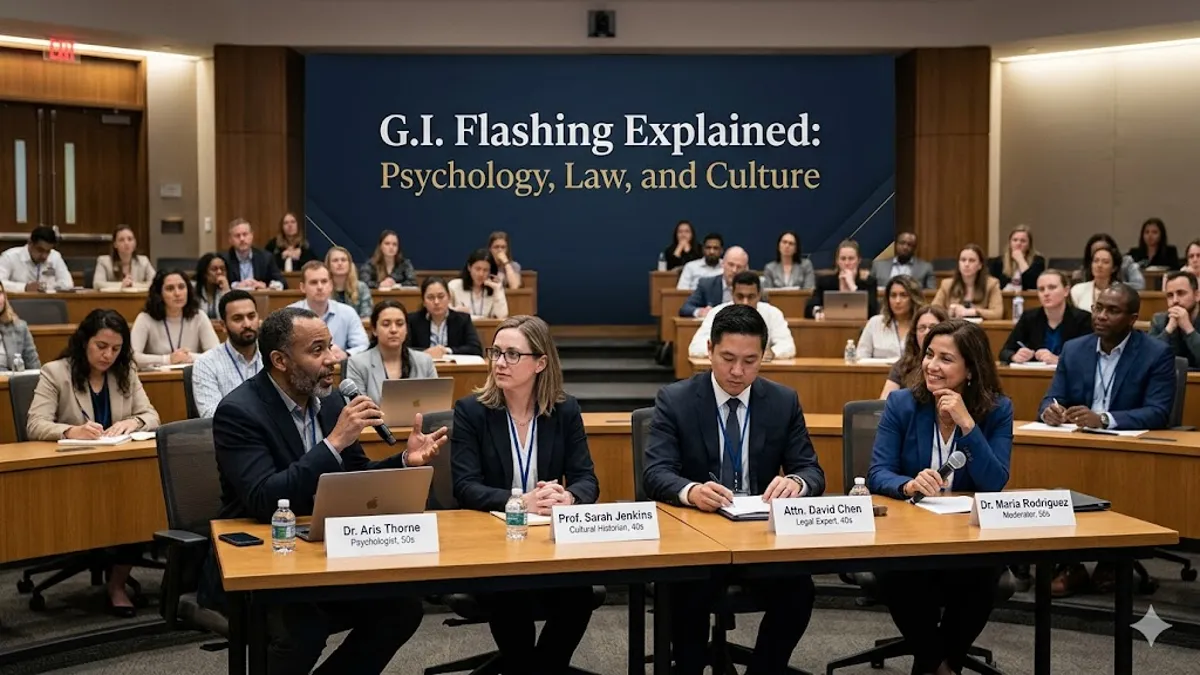
I first encountered the phrase “G.I flashing” while researching unusual behavioral patterns discussed in criminology and psychology literature. In simple terms, the phrase generally refers to incidents of public flashing or intentional exposure, sometimes associated historically with soldiers or individuals engaging in exhibitionistic behavior in public settings. While the terminology is not widely used in modern academic research, the behavior it describes falls within a broader category known as indecent exposure or exhibitionism, which has been studied extensively by psychologists, sociologists, and law-enforcement agencies.
For readers searching to understand what G.I flashing means, the concept typically relates to the act of deliberately exposing one’s body in public places to strangers, often for shock value, attention, or psychological gratification. The phenomenon has appeared periodically in media reports, urban folklore, and criminal justice discussions, especially in contexts involving public disturbances, nightlife environments, or prank culture.
Yet beneath the surface of these incidents lies a more complex story. Public flashing intersects with questions of mental health, social norms, criminal law, and even digital culture. In some cases, it is treated as a prank or juvenile act. In others, it is considered a criminal offense tied to exhibitionistic disorder, a recognized psychological condition.
Understanding the topic requires moving beyond sensational headlines. By examining research from criminology, psychology, and legal studies, it becomes clear that behaviors grouped under labels like “G.I. flashing” reveal deeper insights into how societies define boundaries between private and public behavior. The discussion also highlights how legal systems and mental health professionals respond to acts that challenge those boundaries.
Defining the Behavior Behind the Term
Although the phrase “G.I flashing” appears in informal discussions and online forums, academic literature generally uses the term indecent exposure or exhibitionism.
Exhibitionism refers to a pattern in which a person intentionally exposes their body to unsuspecting individuals, usually strangers, often in public spaces. According to the Diagnostic and Statistical Manual of Mental Disorders (DSM-5), exhibitionistic disorder involves recurrent urges or behaviors of exposing oneself to non-consenting observers (American Psychiatric Association, 2013).
Importantly, not every incident of public exposure qualifies as a clinical disorder. Some cases involve pranks, intoxication, or impulsive acts rather than persistent psychological conditions.
Criminologists often classify flashing incidents into several categories:
| Category | Description | Typical Context |
|---|---|---|
| Impulsive exposure | Spontaneous behavior without long-term pattern | Parties, nightlife environments |
| Exhibitionistic disorder | Repeated exposure driven by psychological urges | Public parks, transit areas |
| Prank-style flashing | Intended to shock or amuse peers | Festivals, college campuses |
| Online-inspired stunts | Behavior recorded or shared online | Social media trends |
Understanding the distinction between these categories helps law enforcement and mental health professionals determine appropriate responses.
Read: Alice Beck Dubow and Pennsylvania’s Superior Court
Historical Roots of Public Flashing
Public exposure has appeared in historical records long before modern terminology emerged.
In ancient Rome, public morality laws addressed indecent exposure as part of broader regulations governing behavior in shared civic spaces. Similar legal frameworks appeared in medieval European cities, where public morality was tied closely to religious norms.
By the nineteenth century, criminologists began documenting exposure incidents in emerging urban centers. These cases were sometimes described as “outrages against public decency.”
The early twentieth century saw the development of psychological explanations for exhibitionistic behavior. Sigmund Freud and later psychoanalytic thinkers suggested that exhibitionism could stem from unresolved developmental conflicts or attention-seeking impulses.
Modern research takes a more nuanced approach. Psychologists emphasize that exhibitionistic behavior can involve a combination of factors including impulse control difficulties, social isolation, and the pursuit of psychological stimulation.
Dr. Gene Abel, a psychiatrist known for his research on problematic sexual behaviors, once noted that exhibitionistic behavior often emerges from “a complex mix of compulsive urges and social learning patterns” (Abel & Osborn, 1992).
Legal Consequences Around the World
Most countries treat public flashing as a criminal offense under laws related to indecent exposure.
The specific legal definitions vary widely, but they generally involve intentionally exposing private parts in public places where others may be offended or alarmed.
| Country | Legal Classification | Typical Penalties |
|---|---|---|
| United States | Indecent exposure | Fines, probation, or jail time |
| United Kingdom | Exposure offense under Sexual Offences Act | Up to 2 years imprisonment |
| Canada | Indecent act in public | Criminal charges or fines |
| Australia | Offensive behavior or exposure | Fines or short jail terms |
Legal responses often depend on context. Courts may consider factors such as intent, prior offenses, and whether minors were present.
Professor Wayne LaFave, a prominent criminal law scholar, has written that indecent exposure laws exist primarily to protect public order and personal dignity in shared spaces (LaFave, 2017).
In many jurisdictions, repeat offenders may also face mandatory counseling or psychological evaluation.
Psychological Perspectives on Exhibitionism
Psychologists who study exhibitionistic behavior emphasize that motivations vary widely.
Some individuals engage in flashing because they seek shock reactions. Others experience a sense of power or excitement from violating social norms.
Research published in the Archives of Sexual Behavior indicates that exhibitionistic behaviors often emerge during adolescence or early adulthood (Kafka, 2010).
Key psychological factors linked to repeated exposure incidents include:
- Impulse control challenges
- Social isolation
- Sensation-seeking personality traits
- Desire for attention or recognition
Clinical psychologist Dr. Fred Berlin, founder of the Johns Hopkins Sexual Behaviors Consultation Unit, has emphasized that many exhibitionistic behaviors are treatable through therapy and behavioral interventions.
“These behaviors are often part of broader impulse control problems rather than simply criminal intent,” Berlin explained in clinical discussions on treatment strategies (Berlin, 2008).
This perspective has influenced how some courts incorporate counseling into sentencing decisions.
Cultural Narratives and Media Portrayals
Public flashing has also appeared frequently in popular culture.
Films, television shows, and comedy routines sometimes depict exposure incidents as humorous pranks rather than criminal acts. College campus folklore and urban legends have contributed to the perception of flashing as a mischievous stunt.
Sociologists warn that such portrayals can obscure the real impact of exposure incidents on victims.
Dr. Nicola Gavey, a sociologist studying gender and public harassment, has argued that unwanted exposure can produce genuine distress.
“What may appear trivial in comedy can feel threatening or violating in real life,” she wrote in research examining harassment in public spaces (Gavey, 2019).
Media coverage also tends to sensationalize unusual incidents, which can distort public understanding of how common the behavior actually is.
Technology and the Changing Landscape
Digital technology has changed the way exposure incidents occur and are documented.
In earlier decades, flashing incidents typically happened in parks, public transportation areas, or busy city streets. Today, smartphones and social media have introduced new dynamics.
Some individuals record or livestream exposure stunts to gain online attention. Law enforcement agencies report that viral trends occasionally encourage risky behavior in public settings.
At the same time, surveillance cameras and mobile phone recordings have made it easier for authorities to identify offenders.
Researchers studying digital culture suggest that the internet amplifies attention-seeking behavior.
Media scholar Zeynep Tufekci has argued that social platforms reward content that provokes strong reactions, which can sometimes encourage boundary-pushing acts in public spaces (Tufekci, 2017).
Prevention and Community Responses
Communities and law enforcement agencies use several strategies to reduce exposure incidents.
Public awareness campaigns often focus on encouraging people to report suspicious behavior quickly.
Urban design can also play a role. Well-lit public spaces, increased surveillance, and visible police presence tend to reduce opportunities for disruptive acts.
| Prevention Strategy | Description | Impact |
|---|---|---|
| Public awareness | Encouraging reporting of incidents | Faster response |
| Environmental design | Improved lighting and visibility | Reduced opportunities |
| Counseling programs | Therapy for repeat offenders | Behavioral change |
| Legal deterrence | Fines and penalties | Public safety reinforcement |
Many jurisdictions now combine enforcement with treatment options, recognizing that psychological intervention can reduce repeat offenses.
Key Takeaways
- “G.I. flashing” generally refers to public exposure incidents associated with exhibitionistic behavior.
- Most legal systems classify flashing as indecent exposure or offensive conduct.
- Psychological research links repeated exposure behavior to impulse control challenges and attention-seeking tendencies.
- Media portrayals sometimes trivialize flashing, but victims may experience genuine distress.
- Technology and social media have changed how exposure incidents occur and are documented.
- Prevention strategies combine law enforcement, urban design, and mental health interventions.
Conclusion
Public flashing remains a complicated social issue that sits at the intersection of law, psychology, and cultural norms.
While sensational stories about exposure incidents occasionally dominate headlines, the behavior itself reflects deeper questions about boundaries in shared spaces. Societies define public decency not only through laws but also through collective expectations about respect and privacy.
Understanding behaviors described by terms like “G.I. flashing” requires separating myth from evidence. Research shows that some incidents stem from impulsive pranks, while others are linked to persistent psychological patterns that benefit from treatment.
Legal systems increasingly recognize this distinction. Many jurisdictions combine penalties with counseling programs designed to address underlying causes and prevent repeat offenses.
Ultimately, the topic highlights a broader truth about social behavior: actions that challenge public norms often reveal how communities negotiate the balance between personal freedom and collective comfort. Examining these behaviors through research rather than sensationalism allows for more thoughtful responses grounded in public safety, psychology, and social understanding.
FAQs
What does G.I. flashing mean?
The phrase generally refers to public flashing incidents involving intentional exposure. It is not a widely used academic term but relates to the broader concept of indecent exposure or exhibitionistic behavior.
Is flashing illegal?
In most countries, intentionally exposing oneself in public where others may be offended is considered a criminal offense, often classified as indecent exposure.
Is flashing considered a psychological disorder?
Repeated exhibitionistic behavior may be diagnosed as exhibitionistic disorder under psychiatric guidelines if it involves persistent urges and causes harm or distress.
Responses vary but may include fines, arrest, court proceedings, and in some cases psychological counseling or treatment programs.
Are flashing incidents common?
They are relatively uncommon compared with other public order offenses, though they receive disproportionate media attention due to their shocking nature.