
i see homecz as a practical search term for people who want to understand digital home services, connected living, internet access, CCTV installation, and smart home planning in one clear place. The term is closely tied to CV. Home Connection Z Group, also presented as HomeCZ, which describes itself as an internet resale services provider offering fast internet, professional CCTV installation, and integrated applications for homes and businesses. In my view, the real value of this topic is not only the name itself. It is the bigger question behind it: how do we build a home or small business setup that is connected, secure, useful, and easy to manage without turning everyday life into a confusing pile of devices, apps, cables, passwords, and cameras?
Key Takeaways About Homecz
Homecz is most directly connected with HomeCZ or CV. Home Connection Z Group, a service provider that publicly describes its offerings around internet connectivity, CCTV installation, and application development. That means the keyword should not be treated only as a vague smart-home lifestyle phrase. It also has a service-provider context, especially for readers searching from Indonesia or looking for local digital installation support.
The broader meaning of homecz can still be useful for readers interested in modern connected homes. A good home setup today usually depends on three layers: stable internet, security devices such as CCTV, and software or applications that make the system easier to manage. When these layers work together, a home becomes more convenient. When they are installed carelessly, the same tools can become frustrating or unsafe.
From my perspective, the strongest homecz approach begins with needs, not gadgets. A homeowner should first ask what problem must be solved. Is the goal better Wi-Fi for work and study, safer monitoring for a shop, remote camera access, better device organization, or a custom app for a business process? The answer shapes the right service plan.
The most practical lesson is simple: digital living works best when speed, security, privacy, and maintenance are planned together. Fast internet without secure passwords creates risk. CCTV without thoughtful placement creates blind spots or privacy concerns. Apps without regular updates can become unreliable. We should think about homecz as an integrated system rather than a single purchase.
What Homecz Means in a Digital Home Context
Homecz can be understood in two connected ways. First, it refers to HomeCZ, the public name used by CV. Home Connection Z Group. The official website presents the company around fast internet, CCTV installation, and integrated applications. Second, the keyword also fits a broader content theme: modern home connectivity and practical smart living.
In my analysis, this dual meaning is important for search intent. Some readers may be looking for a company. Others may be looking for a guide to smart homes. Some may have seen the word on a website and want to know what services it represents. Others may use the term as a shortcut for home connectivity, CCTV, and digital security.
A useful example is a small shop owner who searches “homecz internet CCTV.” That person probably wants a service provider or a setup guide, not a theoretical explanation of smart homes. Another reader searching “homecz smart living” may want design, device planning, and cybersecurity advice. A complete article should serve both needs by explaining the company context and the practical system behind the keyword.
The term also reminds us that smart living does not have to mean luxury. Many people simply want reliable internet, a safer property, video calls that do not freeze, cameras they can monitor remotely, and a clear installation process. In that sense, homecz is best treated as a practical digital-living topic.
Why Homecz Matters for Connected Homes and Small Businesses
Homecz matters because homes and small businesses now depend on digital infrastructure every day. A family may need internet for remote work, online classes, streaming, banking, messaging, and smart TVs. A small business may need internet for payments, stock records, customer communication, CCTV, and employee coordination. When the connection fails, daily routines quickly slow down.
CCTV also plays a growing role. Cameras can help homeowners monitor entrances, shops review activity, warehouses improve oversight, and office owners check basic security conditions. Yet cameras are only useful when installation is planned well. Poor placement, weak passwords, low-quality wiring, unstable internet, and lack of maintenance can reduce the value of any system.
Apps and software add another layer. A business may need a simple custom application for data collection, customer records, bookings, inventory, or internal workflow. A home user may need a connected app to monitor cameras, manage devices, or access service accounts. The HomeCZ site presents application development as one of its services, which makes the keyword broader than internet alone.
In my view, the most important point is integration. Internet, CCTV, and applications should not be planned separately if they need to work together. A CCTV system needs enough bandwidth. Remote monitoring needs secure access. A business app needs reliable hosting or local connectivity. A router setup affects everything connected to it. When planning is integrated, the system becomes easier to use.
Homecz Services and Practical Uses
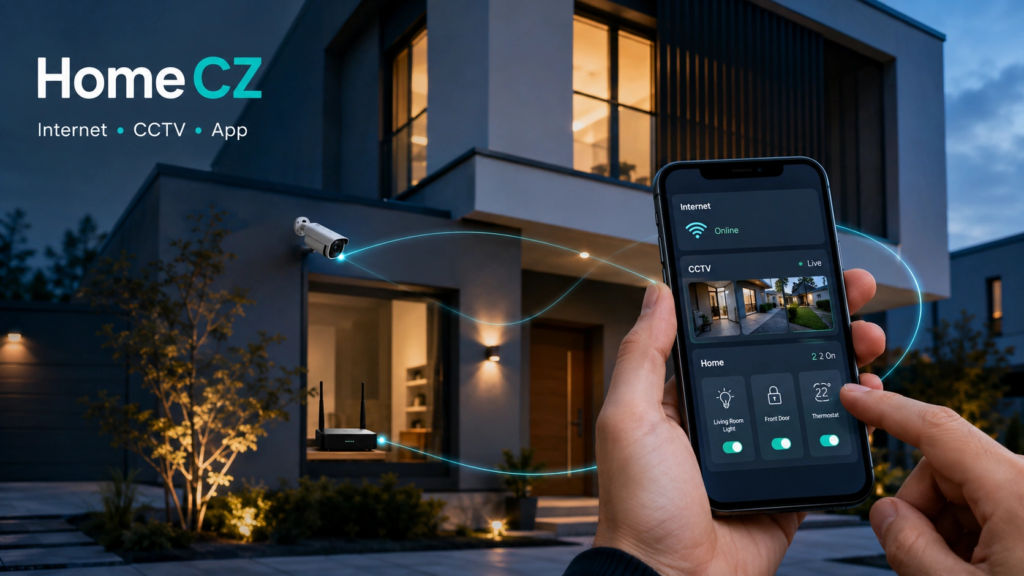
The official HomeCZ site presents three central service areas: fast internet service, professional CCTV installation, and modern application development. I would describe these as the foundation of a practical connected property because they cover connection, visibility, and workflow.
Internet service is the first layer. Without reliable connectivity, smart TVs buffer, video meetings fail, payment systems stall, and cloud-connected cameras become inconsistent. A good internet plan should match the number of users, the type of work being done, the property layout, and the number of connected devices.
CCTV installation is the second layer. A camera system can support security, monitoring, and accountability, but only when it is installed with care. Outdoor cameras may need weather protection. Indoor cameras should respect private spaces. Storage settings should match the owner’s needs. Remote access should use strong security.
Application development is the third layer. This is especially relevant for businesses. A shop might need a simple order-management app. A rental property owner might need a booking or maintenance request tool. A small office might need a basic internal reporting system. A custom application can reduce manual work, but it should be scoped properly before development begins.
The following table explains how these services can work together in realistic situations.
| Homecz Service Area | Practical Use | Best-Fit User | Planning Question |
|---|---|---|---|
| Internet service | Supports work, study, streaming, payments, and connected devices | Homes, shops, small offices, renters, remote workers | How many users and devices need stable access every day? |
| CCTV installation | Helps monitor entrances, stores, parking areas, storage rooms, and public-facing spaces | Homeowners, shop owners, warehouses, offices | Which areas need monitoring without violating privacy? |
| Application development | Creates digital tools for records, bookings, customer activity, or internal workflows | Small businesses, service providers, property managers | What repeated task should the app simplify? |
| Integrated setup | Combines internet, cameras, and apps into one planned digital environment | Users who want a complete solution | How will the system be maintained after installation? |
The key takeaway is that homecz works best as a system. Internet supports CCTV. CCTV may depend on apps. Apps depend on connectivity. A user gets better results when these parts are planned together instead of chosen randomly.
How Homecz Connects Internet, CCTV, and Applications
A connected property has several moving parts. The modem or router brings internet access into the building. Wi-Fi distributes that access across rooms. Wired connections may support cameras, computers, or network video recorders. CCTV devices capture video. Storage systems save footage. Apps allow monitoring, notifications, or business functions.
From my perspective, the strongest homecz setup begins with a simple map. Before buying devices or requesting installation, a user should map the property. Where is the internet entry point? Where are thick walls? Where are power outlets? Where are blind spots? Where do people actually work, study, or operate the business? These details affect the final result.
A home example makes this clear. Imagine a two-floor house where the router is placed in the front room. The family complains that the upstairs bedroom has weak Wi-Fi. At the same time, they want a camera near the gate. If the installer only adds a camera without solving Wi-Fi coverage, remote monitoring may still feel unreliable. A better plan may include router placement, access points, cable routing, and camera location together.
A business example is similar. A small grocery shop may need Wi-Fi for a cashier system, a camera facing the entrance, another camera covering shelves, and a simple app to record daily inventory. If the internet plan is too weak or the router is overloaded, both the payment system and cameras may suffer. Integrated planning prevents this.
Homecz and Smart Home Standards
Homecz is not the same thing as the Matter smart home standard, but any modern digital home conversation benefits from understanding standards. Matter is a smart-home connectivity standard managed by the Connectivity Standards Alliance. The CSA describes Matter as an IP-based protocol designed to help smart devices work together in reliable and secure IoT ecosystems.
A short official statement from the CSA explains why this matters:
“Matter is built around a shared belief that smart home devices should be secure, reliable, and seamless to use.”
Connectivity Standards Alliance
That quote matters because it names the three qualities every connected home should pursue. Secure means devices should not expose the home to easy digital risks. Reliable means devices should work consistently. Seamless means the user should not need five different confusing systems for basic control.
In my view, a homecz-style setup should borrow that same logic even when it does not use Matter devices. The internet should be reliable. CCTV access should be secure. Apps should be easy to use. The system should reduce daily friction rather than create new chores.
Standards also help buyers avoid being trapped by incompatible products. When a user buys random devices from different brands, they may discover that one app controls the camera, another controls lights, another controls plugs, and another controls sensors. A planned setup reduces that problem. Even if a user only starts with internet and CCTV, they should think ahead about future smart devices.
Practical Examples of Homecz in Everyday Life
A remote worker may use homecz principles to build a stable work environment. The priority is not flashy automation. The priority is reliable video calls, strong Wi-Fi in the workspace, backup mobile data when needed, and secure router settings. A camera at the front entrance may add convenience, but the internet plan is the main foundation.
A family with children may use the same idea differently. They may need coverage for online classes, safe device access, content controls, and security cameras outside the home. In this scenario, privacy becomes important. Cameras should not be placed in bedrooms or bathrooms, and family members should understand who can view footage.
A small café may need internet for customer payments, staff communication, music streaming, guest Wi-Fi, and cameras near the cashier and entrance. The owner should separate guest Wi-Fi from business devices. This helps reduce security risk and keeps customers from accessing internal systems.
A warehouse may need a stronger CCTV plan. Cameras should cover entry points, storage zones, loading areas, and high-value inventory spaces. The internet connection should support remote review if the owner needs off-site monitoring. Storage should be planned based on how many days of footage are needed.
These examples show that homecz is not one fixed setup. It is a planning mindset. The right solution depends on property type, user behavior, security needs, budget, and maintenance capacity.
Step-by-Step Guide to Planning a Homecz Setup
The first step is to define the main goal. A user should write down the top three problems they want to solve. For example: weak Wi-Fi in the back room, no camera at the gate, and no simple way to monitor the shop after closing. Clear goals prevent unnecessary spending.
The second step is to count devices and users. A household with two phones and one smart TV has different needs from a home office with laptops, printers, cameras, tablets, and streaming devices. A business with payment systems and CCTV needs more careful planning than a casual home user.
The third step is to inspect the building layout. Wall thickness, distance, power access, cable paths, outdoor exposure, and router placement all matter. A strong plan should match the physical property, not just the internet package name.
The fourth step is to choose secure equipment. Routers, cameras, and apps should allow password changes, software updates, and secure access. Devices that cannot be updated may become a risk over time.
The fifth step is to plan camera placement. Cameras should cover entrances, gates, cashier areas, parking spots, or storage zones when appropriate. They should avoid private spaces and should not create unnecessary surveillance.
The sixth step is to configure the network properly. The default Wi-Fi name and password should be changed. Guest Wi-Fi should be separated from business or family devices when possible. Router admin access should be protected.
The seventh step is to test the system after installation. A user should check internet speed in important rooms, camera angles during day and night, remote access, footage playback, and app login security.
The eighth step is to schedule maintenance. Passwords, device updates, camera cleaning, cable checks, storage review, and internet performance should be reviewed regularly. A connected system is not finished on installation day.
Homecz Security and Privacy Checklist
Security is one of the most important parts of any connected setup. A fast connection is useful, but it can also expose weak devices if the network is poorly configured. CCTV is useful, but camera access must be protected. Apps are useful, but accounts need strong authentication.
The FTC gives direct advice that applies well here:
“Change the default username and password.”
Federal Trade Commission
That sentence is short, but I believe it is one of the most important rules for connected homes. Default usernames and passwords may be known, guessed, reused, or exposed. Changing them is a basic but powerful step.
NIST gives another practical warning:
“Do not reuse your passwords!”
National Institute of Standards and Technology
This matters because many smart home attacks do not require advanced hacking. If a user repeats the same password across many services, one leaked account can create risk elsewhere. A camera account, router login, cloud account, or app dashboard should not share the same password.
The following checklist can help homeowners and small businesses organize safer decisions.
| Risk Area | What Can Go Wrong | Better Homecz Practice |
| Default passwords | Attackers or unauthorized users may guess access credentials | Change router, camera, and app passwords during setup |
| Reused passwords | One breach can expose multiple accounts | Use unique passwords for each important account |
| Weak Wi-Fi setup | Guests or outsiders may reach private devices | Use strong encryption and a separate guest network |
| Poor camera placement | Privacy may be violated or key areas may be missed | Monitor entrances and business zones, not private rooms |
| No software updates | Devices may keep known vulnerabilities | Check firmware and app updates regularly |
| Unclear account access | Former staff or installers may retain access | Review user permissions after installation |
| No maintenance plan | Cameras, storage, and internet quality may degrade | Schedule regular checks for devices and settings |
The most important takeaway is that security is not one setting. It is a habit. A homecz setup should be reviewed over time because users, devices, apps, passwords, and risks change.
Common Mistakes People Make With Homecz-Style Setups
One common mistake is buying the cheapest device without checking support. A low-cost camera may look attractive, but if it has poor night vision, weak app security, no updates, or unreliable storage, it may cost more in frustration later.
Another mistake is placing the router wherever installation is easiest. Router placement affects Wi-Fi quality. A router hidden behind furniture, inside a cabinet, or at one edge of a large building may create dead zones. In many homes, better placement or additional access points can improve everyday performance.
A third mistake is installing too many cameras without a purpose. More cameras do not automatically mean better security. A smaller number of well-positioned cameras can be more useful than many poorly placed ones.
A fourth mistake is forgetting upload speed. Many users focus only on download speed because streaming and browsing depend on it. CCTV remote access, cloud backup, video calls, and file uploads also depend on upload performance. A business user should ask about both.
A fifth mistake is ignoring privacy. CCTV should protect people, not make them feel constantly watched in inappropriate spaces. A thoughtful setup respects family members, employees, customers, and visitors.
A sixth mistake is failing to document the setup. Users should keep records of device names, warranty details, installation dates, admin accounts, service contacts, and renewal dates. Without documentation, future troubleshooting becomes harder.
Expert Recommendations for a Better Homecz Experience
My first recommendation is to start with a needs assessment. Do not begin with a device list. Begin with problems, rooms, users, and workflows. This prevents overbuying and helps the installer design a better solution.
My second recommendation is to prioritize network stability. Everything depends on the network. CCTV, smart TVs, laptops, payment systems, printers, and mobile devices all perform better when the internet and Wi-Fi design are strong.
My third recommendation is to treat CCTV as a security and privacy tool at the same time. The camera should capture useful evidence while respecting boundaries. Business owners should also consider local rules and customer expectations when installing cameras.
My fourth recommendation is to use unique passwords and multi-factor authentication whenever available. This simple habit protects routers, camera apps, email accounts, business dashboards, and cloud services.
My fifth recommendation is to plan for growth. A home may later add smart locks, sensors, lighting, or energy devices. A shop may later add more cameras or a better inventory app. A good homecz setup should leave room for expansion.
My sixth recommendation is to ask service providers clear questions. What is included in the installation? Who owns the equipment? How is support handled? What happens when a camera fails? How are passwords transferred? Is there a warranty? These questions reduce misunderstandings.
How to Compare Homecz With Other Digital Service Options
A reader comparing homecz with another provider should avoid looking only at price. Price matters, but service quality, reliability, installation skill, support, and security practices can matter more over time.
For internet service, compare coverage, speed, stability, customer support, installation quality, and real-world performance. A package that looks fast on paper may not solve a weak signal problem inside the property.
For CCTV, compare camera quality, storage method, night performance, app usability, cabling, mounting, weather resistance, and after-sales support. A camera system should produce usable footage when it matters, not just look good during a demonstration.
For application development, compare scope, timeline, ownership, maintenance, security, and future updates. A simple app can be valuable if it solves a real workflow problem. A complicated app can become a burden if the business does not need it.
In my view, the best provider is the one that asks good questions before recommending a solution. A provider who immediately sells devices without inspecting needs may miss important details.
Homecz for Homes, Shops, and Offices
A home user should focus on comfort, coverage, safety, and privacy. The goal may be strong Wi-Fi in bedrooms and living areas, secure access for cameras, and simple management through a phone app. The setup should be easy enough for non-technical family members to use.
A shop owner should focus on uptime, visibility, and transaction support. Internet may support payments, messaging, and customer service. CCTV may cover the entrance, cashier, shelves, and storage. The owner should separate customer Wi-Fi from business systems.
An office user should focus on productivity and access control. Staff may need reliable Wi-Fi, meeting support, shared printers, cloud apps, and entry monitoring. The setup should support work without creating unnecessary digital risk.
A rental property owner may focus on common areas, service reliability, and tenant convenience. Cameras should be placed only where appropriate, such as entrances or parking areas, not private living spaces. Internet service should be planned based on tenant density and usage.
These different scenarios show why homecz should be adapted. There is no universal package that fits every property. A thoughtful plan begins with the environment and the people using it.
Future of Homecz and Connected Living
Connected living will continue to grow because homes and small businesses now depend on digital tools. More devices will connect to networks. More cameras will support smarter detection. More apps will manage business processes. More standards will try to make devices work together.
I believe the future of homecz-style services will depend on simplicity. Users do not want complicated systems that require constant technical knowledge. They want stable internet, clear camera access, safe accounts, useful apps, and support when something breaks.
Security will also become more important. As more devices connect to the internet, weak passwords and unsupported equipment become larger problems. Buyers will need to ask whether devices receive updates, whether access can be controlled, and whether old accounts can be removed.
Privacy expectations will become stronger too. People may accept cameras at entrances, shops, and storage areas, but they still expect respect in personal spaces. A good digital setup should protect property without creating unnecessary surveillance.
The best future version of homecz is not a home full of gadgets. It is a home or business where technology quietly supports daily life. The connection works. Cameras are placed with purpose. Apps save time. Security settings are maintained. The user feels more in control, not more overwhelmed.
Conclusion
Homecz is useful because it brings together the real foundations of modern digital living: internet access, CCTV installation, and integrated applications. In my view, the keyword should be understood through both its direct connection to HomeCZ or CV. Home Connection Z Group and its broader meaning as a practical approach to connected homes and small businesses. The central lesson is that technology works best when it is planned as a system, not purchased as scattered devices.
A good homecz setup starts with clear goals, stable connectivity, thoughtful camera placement, secure passwords, regular updates, and realistic maintenance. We should not chase smart-home trends just because they look modern. We should choose tools that solve daily problems, protect privacy, and remain easy to use after installation. The next action is simple: map your property, list your needs, check your current internet and security gaps, and then choose services that match the way you actually live or work.
Frequently Asked Questions
What Is Homecz?
Homecz most directly refers to HomeCZ or CV. Home Connection Z Group, a provider that publicly presents services around fast internet, CCTV installation, and integrated applications. The keyword can also be used more broadly for connected home planning, especially when readers are looking for digital solutions that combine connectivity, security, and software. I would understand it as both a service-related term and a practical smart-living concept.
What Services Are Connected With Homecz?
Homecz is connected with internet service, CCTV installation, and application development. In practical terms, that means it can support homes, shops, offices, and small businesses that need stable connectivity, monitoring, and digital workflow tools. The strongest setup depends on the user’s actual needs. A home may need better Wi-Fi and entrance cameras, while a shop may need payment support, customer Wi-Fi, and CCTV coverage near the cashier.
Is Homecz Only for Smart Homes?
Homecz is not only for smart homes. It can also apply to small businesses, offices, shops, rental properties, and other places that need internet access, CCTV, or simple applications. A smart home is one possible use case, but the broader value is digital infrastructure. From my perspective, the most useful homecz setup is one that solves real problems, such as weak connectivity, poor visibility, or manual business processes.
How Should I Plan a Homecz Setup?
You should plan a homecz setup by starting with your needs, not with devices. List the rooms, users, internet problems, camera locations, business workflows, and security concerns. Then check whether your router placement, Wi-Fi coverage, camera angles, storage, and passwords are suitable. A clear plan prevents overspending and helps you build a system that is stable, secure, and easier to maintain.
Is CCTV Important in a Homecz System?
CCTV can be important in a homecz system when it is installed for a clear purpose. Cameras can help monitor entrances, shops, parking areas, storage spaces, and public business zones. However, CCTV should be placed thoughtfully. It should not invade private spaces, and access should be protected with strong passwords. In my view, a smaller number of well-positioned cameras is often better than many poorly planned ones.
How Can I Keep a Homecz Setup Secure?
You can keep a homecz setup secure by changing default passwords, using unique passwords, enabling two-factor authentication when available, updating devices, separating guest Wi-Fi from private devices, and reviewing who has access to camera apps or admin panels. Security should be part of the installation process and the maintenance routine. A connected system becomes safer when users treat protection as an ongoing habit.
Sources or References
CV. Home Connection Z Group official website.
HomeCZ official About page.
Connectivity Standards Alliance, Matter smart home standard information.
Federal Trade Commission, guidance on securing internet-connected devices at home.
National Institute of Standards and Technology, smart home cybersecurity guidance.
Uploaded editorial brief provided for this article.
Disclaimer
This article is for informational and editorial purposes only. Service availability, internet packages, CCTV options, app development scope, contact details, security features, and pricing can change over time. Readers should verify current details directly with the relevant provider before purchasing, installing, or relying on any digital home or business system. This article does not replace professional technical advice, legal advice, cybersecurity consulting, or a site-specific installation assessment.