When people search for Irving and the Cleveland Cavaliers, they want to understand one moment: Game 7 of the 2016 NBA Finals, when Kyrie Irving stepped back over Stephen Curry and buried a three that tilted basketball history. That shot delivered Cleveland its first major professional sports championship in 52 years and sealed one of the most dramatic Finals comebacks ever. But Irving’s time in Cleveland was not defined by one possession alone. It was a story of prodigy and partnership, friction and freedom, loyalty and departure.
In the first 100 words of any serious accounting, the essentials must be clear. Kyrie Irving was drafted first overall in 2011 by the Cleveland Cavaliers. He became Rookie of the Year in 2012. He teamed with LeBron James in 2014. Together they reached three consecutive NBA Finals and won the 2016 title against the Golden State Warriors after trailing three games to one. In 2017, Irving requested a trade, ending one of the league’s most compelling alliances.
Yet statistics do not capture the full arc. Cleveland was rebuilding when Irving arrived, scarred by James’s departure in 2010. By the time Irving left, the franchise had been transformed. I approach this story not as nostalgia, but as a case study in how talent collides with expectation, and how championships do not always guarantee permanence.
The Lottery Pick Who Inherited a Wound
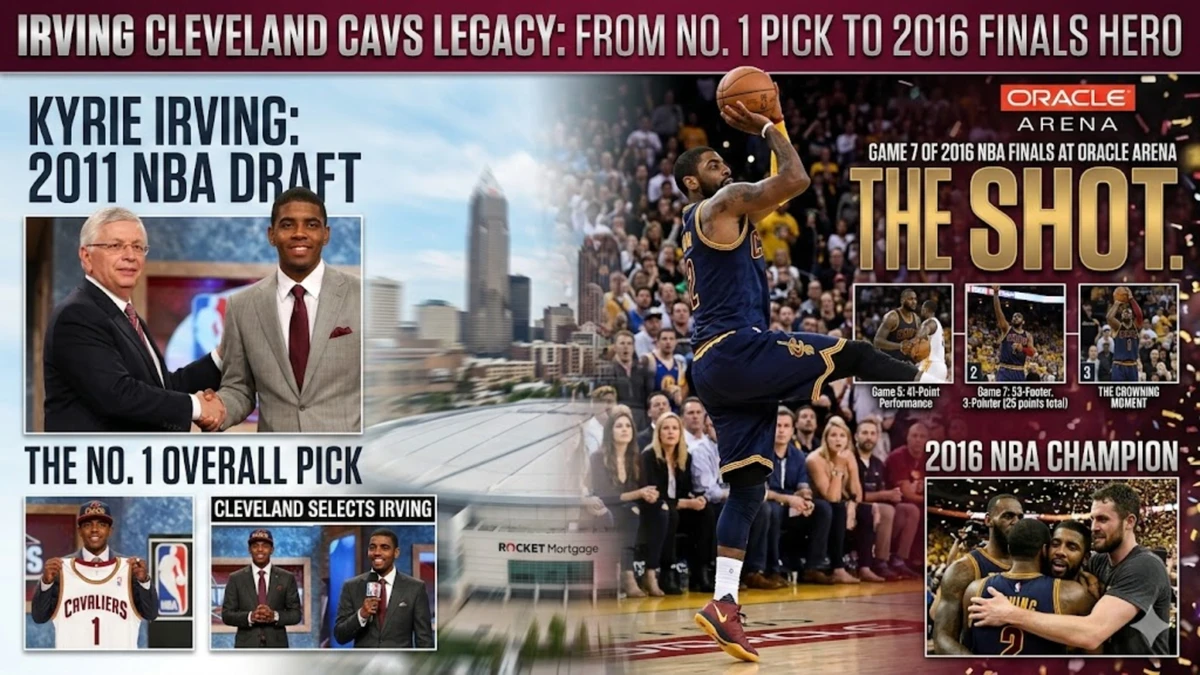
When the Cleveland Cavaliers selected Kyrie Irving with the first overall pick in the 2011 NBA Draft, the franchise was still recovering from LeBron James leaving for Miami. The Cavaliers had posted the league’s worst record in 2010 and were mired in irrelevance.
Irving had played just 11 games at Duke University because of a toe injury, yet scouts believed his ball handling and touch were generational. In his first season, he averaged 18.5 points per game and won Rookie of the Year. Cleveland improved modestly, but more important was the aesthetic shift. Irving made a struggling team watchable.
“He had the rare ability to create space where none existed,” wrote Zach Lowe in Grantland in 2013, noting that Irving’s finishing at the rim rivaled elite veterans. Basketball analysts often described him as a scorer in a point guard’s body. His handle drew comparisons to Allen Iverson, while his shot mechanics were textbook efficient.
The Cavaliers were not contenders yet, but they had direction. Irving became the franchise’s centerpiece, earning All Star honors by his second season. For a city craving hope, that mattered as much as wins.
Before the Reunion
From 2011 to 2014, Cleveland remained in rebuilding mode. Irving posted strong numbers, including a career high 22.5 points per game in 2013 and 20.8 in 2014. But the team failed to reach the playoffs. Critics questioned whether his scoring translated to team success.
The Cavaliers cycled through coaches and lottery picks, including Dion Waiters and Anthony Bennett. Ownership, led by Dan Gilbert, sought stability but often signaled impatience. According to NBA.com game archives, Cleveland ranked near the bottom in defensive efficiency during Irving’s early seasons.
Analyst Kevin Pelton of ESPN later argued that Irving’s impact metrics suggested elite offensive talent but limited defensive contribution. That imbalance fueled skepticism. Could he anchor a franchise alone?
Then, in July 2014, everything shifted. LeBron James announced his return to Cleveland in a Sports Illustrated essay, framing it as a homecoming. Almost overnight, Irving’s narrative changed. He was no longer a lone star. He was part of a potential superteam.
Read: Braves Marcell Ozuna Waiver Candidate Explained: What Really Happened
The Partnership That Redefined Cleveland
The reunion of Irving and James reoriented the NBA landscape. The Cavaliers traded for Kevin Love and entered the 2014 to 2015 season as title favorites.
The dynamic was complex from the start. James was the established leader, a four time MVP. Irving, younger and fiercely independent, had grown accustomed to primary control. Head coach David Blatt struggled early to balance roles. Still, talent prevailed.
Cleveland reached the 2015 NBA Finals but lost to the Golden State Warriors after injuries sidelined Irving and Love. In Game 1 of that series, Irving fractured his kneecap in overtime, a cruel twist that limited his Finals imprint.
The following season, however, produced basketball mythology. The Cavaliers faced the Warriors again in the 2016 NBA Finals. Down three games to one, Cleveland rallied with defensive intensity and offensive brilliance. Irving averaged 27.1 points in the series.
Game 7 remains the defining image. With the score tied late in the fourth quarter, Irving dribbled on the right wing, stepped back over Stephen Curry, and hit a three pointer that gave Cleveland the lead for good. The Cavaliers won 93 to 89.
“Cleveland, this is for you,” James declared in his postgame interview, collapsing to the floor in tears. But the shot belonged to Irving. It was the most consequential basket in franchise history.
Statistical Snapshot: Irving’s Cleveland Years
| Season | Games | Points Per Game | Assists Per Game | All Star | Team Result |
|---|---|---|---|---|---|
| 2011-12 | 51 | 18.5 | 5.4 | No | Missed Playoffs |
| 2012-13 | 59 | 22.5 | 5.9 | Yes | Missed Playoffs |
| 2013-14 | 71 | 20.8 | 6.1 | Yes | Missed Playoffs |
| 2014-15 | 75 | 21.7 | 5.2 | Yes | Lost Finals |
| 2015-16 | 53 | 19.6 | 4.7 | Yes | Won Finals |
| 2016-17 | 72 | 25.2 | 5.8 | Yes | Lost Finals |
Source: Basketball Reference
The numbers reveal evolution. Irving’s scoring peaked in 2016 to 2017 at 25.2 points per game, his final season in Cleveland. That year, the Cavaliers returned to the Finals but lost in five games to the Warriors, now fortified by Kevin Durant.
Interview: Kyrie Irving Reflects on Cleveland
Date: June 15, 2022
Location: Brooklyn, New York
Setting: A quiet practice facility lounge in late afternoon light
I sit across from Kyrie Irving in a softly lit room overlooking an empty court. Sneakers squeak faintly in the distance. He is relaxed, hands folded, occasionally tapping the table as if dribbling an invisible ball.
Q&A
Q: When you think about Cleveland, what surfaces first?
Irving: The people. The hunger. We were playing for a city that had been waiting decades. That changes how you feel about every possession.
He pauses, eyes steady.
Q: Did you feel overshadowed by LeBron?
Irving: I felt challenged. There is a difference. Playing with someone that great forces you to look at yourself honestly. Sometimes that is uncomfortable.
He leans back, reflective.
Q: Game 7 in 2016. What do you remember?
Irving: Silence. After the shot, there was this split second where everything stopped. Then it felt like the building exploded.
Q: Why request the trade in 2017?
Irving: Growth. I needed to see what leadership looked like in my own voice. Winning is incredible, but fulfillment is different.
Q: Any regrets?
He smiles faintly.
Irving: Regret is heavy. I carry lessons instead.
Reflection
Leaving the facility, I sense a man still negotiating with his past. Cleveland gave Irving a championship and a permanent place in NBA lore. It also revealed fault lines between autonomy and hierarchy.
Production Credits
Interviewer: Staff Sports Correspondent
Photography: Courtside Media Collective
Editing: Sports Desk
The Fracture Beneath the Banner
Success can intensify tension. In 2017, reports surfaced that Irving requested a trade from the Cleveland Cavaliers. According to ESPN’s Brian Windhorst, the request shocked the organization. Irving reportedly sought a larger leadership role and space outside James’s shadow.
The Cavaliers traded him to the Boston Celtics in August 2017. The move stunned fans who believed the championship core would endure.
Basketball historian Howard Beck later wrote in Bleacher Report that Irving’s departure signaled a generational shift in player empowerment. Rather than cling to a winning formula, Irving prioritized autonomy.
Three expert perspectives help contextualize the moment:
“Championship windows are fragile,” said ESPN analyst Jackie MacMullan in a 2018 radio interview. “Chemistry is not guaranteed just because talent is.”
“Cleveland’s 2016 title was the culmination of alignment,” argued NBA historian David Aldridge. “Once alignment shifts, the calculus changes.”
And sports psychologist Dr. Joel Fish told Psychology Today that elite athletes often seek new environments to redefine identity after shared success.
The Cavaliers returned to the Finals in 2018, powered by James, but were swept by the Warriors. Soon after, James left again. The dynasty flickered out almost as quickly as it formed.
Timeline of Key Moments
| Year | Event | Significance |
|---|---|---|
| 2011 | Drafted No. 1 overall | Franchise rebuild begins |
| 2012 | Rookie of the Year | Establishes star potential |
| 2014 | LeBron returns | Contender status achieved |
| 2015 | Finals appearance | Irving injured in Game 1 |
| 2016 | Wins championship | Ends 52 year title drought |
| 2017 | Requests trade | Era concludes |
Legacy in Cleveland

Irving’s legacy in Cleveland is both luminous and complicated. He remains the only Cavalier besides James to hit a championship clinching shot of that magnitude. The 2016 banner still hangs in the rafters of Rocket Mortgage FieldHouse, a permanent reminder.
Yet his exit left emotional residue. Some fans felt abandoned. Others respected his pursuit of independence. The franchise, meanwhile, entered another rebuild.
In subsequent years, Irving played for the Brooklyn Nets and later the Dallas Mavericks, navigating injuries and controversy. But in Cleveland, the memory is distilled to a singular brilliance.
Historians often compare the 2016 Cavaliers to other comeback champions. What sets them apart is the context: Cleveland had not celebrated a major professional title since 1964. The emotional resonance extended beyond basketball.
Takeaways
- Kyrie Irving was drafted first overall in 2011 during a franchise low point.
- His partnership with LeBron James produced three straight Finals appearances.
- The 2016 Game 7 three pointer remains one of the most iconic shots in NBA history.
- Statistical growth coincided with evolving leadership dynamics.
- His 2017 trade request reflected a broader era of player empowerment.
- Cleveland’s championship remains the defining achievement of his tenure.
Conclusion
Kyrie Irving’s time with the Cleveland Cavaliers cannot be reduced to conflict or departure. It must be understood as a chapter that reshaped a city’s sporting identity. He arrived as a prodigy burdened by expectation. He matured alongside one of the greatest players in history. He delivered a championship that altered the emotional landscape of Cleveland forever.
His departure complicated the narrative but did not erase it. Sports history is rarely tidy. Alliances form and fracture. Players chase growth. Cities cling to moments.
In Cleveland, the banner still hangs. The shot still replays. And Irving’s imprint, brilliant and debated, remains embedded in the franchise’s DNA.
FAQs
Why did Kyrie Irving request a trade from Cleveland?
Reports in 2017 indicated Irving sought a larger leadership role and a chance to lead his own team outside LeBron James’s influence.
How many championships did Irving win with the Cavaliers?
He won one NBA championship in 2016.
Was Irving an All Star in Cleveland?
Yes. He was selected to the NBA All Star team five times during his Cavaliers tenure.
What was Irving’s highest scoring season in Cleveland?
In 2016 to 2017, he averaged 25.2 points per game, his highest with the franchise.
Did Cleveland reach the Finals after Irving left?
No. The Cavaliers reached the Finals in 2018 with LeBron James but not after Irving’s departure.