
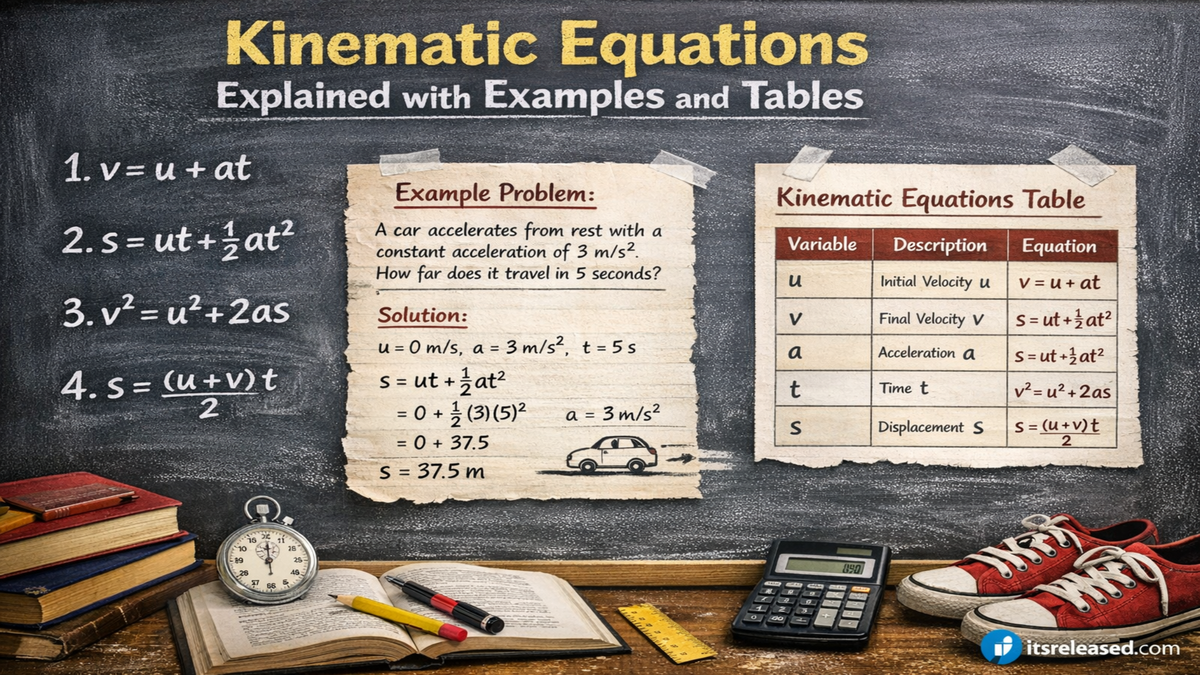
When I first began studying motion in physics, I realized that understanding how objects move is not just about watching them travel from one place to another. It is about describing that motion with clarity, precision, and mathematical relationships. Kinematic equations form the foundation of motion analysis in classical mechanics. They allow us to calculate displacement, velocity, time, and acceleration without worrying about the forces that cause motion. In this detailed guide, I will explain kinematic equations from the ground up, explore their derivations, applications, limitations, and provide structured tables to help you master them confidently.
What Is Kinematics?
Kinematics is a branch of mechanics that focuses on describing motion without considering the forces responsible for it. It answers questions such as:
- How far did the object travel?
- How fast is it moving?
- How long did it take?
- How quickly is its velocity changing?
Kinematics does not analyze why motion happens. That responsibility belongs to dynamics. Instead, it provides the mathematical framework to describe motion clearly and accurately.
Fundamental Quantities in Kinematics
Before exploring kinematic equations, we must understand the core quantities involved.
Displacement
Displacement refers to the change in position of an object. It is a vector quantity, meaning it has both magnitude and direction. Unlike distance, displacement considers direction.Displacement=Final Position−Initial Position
Velocity
Velocity describes how quickly displacement changes with time. It is also a vector quantity.Velocity=TimeDisplacement
There are two main types:
- Average velocity
- Instantaneous velocity
Acceleration
Acceleration measures how quickly velocity changes over time.Acceleration=TimeChange in Velocity
Acceleration can occur when speed increases, decreases, or direction changes.
Time
Time is a scalar quantity that measures duration. It connects displacement, velocity, and acceleration.
Conditions for Using Kinematic Equations
Kinematic equations apply only under specific conditions:
- Motion occurs in a straight line.
- Acceleration remains constant.
- Motion is analyzed in one dimension.
If acceleration changes or motion occurs in two or three dimensions with varying acceleration, more advanced calculus based approaches are required.
The Four Main Kinematic Equations
For constant acceleration motion in one dimension, we use four primary equations.
Equation 1: Final Velocity Formula
v=u+at
Where:
| Symbol | Meaning |
|---|---|
| v | Final velocity |
| u | Initial velocity |
| a | Acceleration |
| t | Time |
This equation helps determine final velocity when acceleration and time are known.
Equation 2: Displacement Using Time
s=ut+21at2
Where:
| Symbol | Meaning |
|---|---|
| s | Displacement |
| u | Initial velocity |
| a | Acceleration |
| t | Time |
This formula calculates how far an object travels in a given time under constant acceleration.
Equation 3: Displacement Using Average Velocity
s=2(u+v)t
This equation uses the concept of average velocity under constant acceleration.
Equation 4: Velocity Without Time
v2=u2+2as
This formula is extremely useful when time is not given.
Summary Table of Kinematic Equations
| Equation | Use Case | When to Use |
|---|---|---|
| v = u + at | Find final velocity | Time is known |
| s = ut + ½at² | Find displacement | Time is known |
| s = (u+v)/2 × t | Displacement with velocities | Both velocities known |
| v² = u² + 2as | Find velocity or displacement | Time not given |
Derivation of Kinematic Equations
Understanding derivations strengthens conceptual clarity.
Deriving v = u + at
Acceleration is defined as:a=tv−u
Rearranging:v−u=atv=u+at
Deriving s = ut + ½at²
Velocity is displacement over time:v=ts
Since average velocity under constant acceleration equals:2u+v
Substitute v = u + at:Average velocity=2u+(u+at)=u+2at
Multiply by time:s=ut+21at2
Types of Motion Covered by Kinematic Equations
Uniform Motion
When acceleration is zero:
- Velocity remains constant.
- Displacement formula simplifies to:
s=ut
Uniformly Accelerated Motion
Acceleration remains constant.
Examples:
- Free falling object
- Car accelerating at steady rate
- Object sliding down incline without friction change
Free Fall Motion
When objects fall under gravity alone:
Acceleration becomes:a=g
On Earth:g≈9.8 m/s²
Kinematic equations remain the same but replace a with g.
Real Life Applications of Kinematic Equations
Automotive Industry
Engineers calculate braking distances using:v2=u2+2as
This determines safe stopping distances.
Sports Science
Coaches analyze sprint acceleration and deceleration.
Aerospace Engineering
Rocket launch trajectories initially rely on kinematic motion equations.
Civil Engineering
Designing highways requires understanding acceleration lanes and stopping distances.
Graphical Interpretation of Motion
Position Time Graph
- Slope represents velocity.
- Curve indicates acceleration.
Velocity Time Graph
- Slope equals acceleration.
- Area under curve equals displacement.
Acceleration Time Graph
- Area under curve equals change in velocity.
Solving Numerical Problems Step by Step
Example 1: Car Acceleration
A car starts from rest and accelerates at 3 m/s² for 5 seconds.
Find final velocity and displacement.
Given:
u = 0
a = 3
t = 5
Final velocity:v=0+3×5=15 m/s
Displacement:s=0+21(3)(52)s=37.5 m
Example 2: Braking Car
A car moving at 20 m/s stops over 40 meters. Find acceleration.02=202+2a(40)0=400+80aa=−5 m/s²
Negative sign indicates deceleration.
Common Mistakes in Using Kinematic Equations
- Ignoring direction signs.
- Mixing units.
- Using wrong equation for unknown variable.
- Applying equations when acceleration is not constant.
Dimensional Consistency of Kinematic Equations
Each equation must maintain unit consistency.
Example:v=u+at
Units:
m/s = m/s + (m/s² × s)
Units match correctly.
Comparison Between Distance and Displacement
| Distance | Displacement |
|---|---|
| Scalar | Vector |
| Always positive | Can be positive or negative |
| Total path covered | Straight line change in position |
Limitations of Kinematic Equations
- Cannot handle variable acceleration directly.
- Not suitable for rotational motion.
- Limited to inertial frames of reference.
- Does not include force analysis.
Extension to Two Dimensional Motion
Projectile motion uses kinematic equations separately for horizontal and vertical directions.
Horizontal:
Acceleration = 0
Vertical:
Acceleration = g
Importance in Academic Curriculum
Kinematic equations build the base for:
- Newton laws of motion
- Work energy theorem
- Circular motion
- Advanced mechanics
Students who master these equations find later physics topics easier.
Practical Strategy to Choose Correct Equation
| Known Variables | Missing Variable | Recommended Equation |
|---|---|---|
| u, a, t | v | v = u + at |
| u, a, t | s | s = ut + ½at² |
| u, v, t | s | s = (u+v)/2 × t |
| u, a, s | v | v² = u² + 2as |
Why Kinematic Equations Matter
Kinematic equations transform motion into predictable mathematical relationships. They allow engineers, scientists, and students to analyze real world motion without directly observing every detail. From calculating falling time of an object to estimating vehicle stopping distance, these equations are essential tools in physics.
Understanding them deeply strengthens logical thinking, analytical skills, and problem solving ability.
Conclusion
When I reflect on the importance of kinematic equations, I see them as the language of motion in classical physics. They allow us to quantify how objects move and predict future motion accurately. By mastering the relationships between displacement, velocity, acceleration, and time, one builds a powerful foundation in physics. Whether solving classroom problems or designing advanced mechanical systems, these equations remain indispensable tools in understanding the mechanics of our universe.
Click Here For More Blog Posts!
FAQs
1. What are kinematic equations used for?
They describe motion under constant acceleration without analyzing forces.
2. Can kinematic equations be used for circular motion?
No, they apply primarily to straight line motion with constant acceleration.
3. What happens if acceleration is zero?
Motion becomes uniform, and displacement equals velocity multiplied by time.
4. Why is acceleration negative in braking problems?
Negative acceleration indicates deceleration or motion opposite to chosen direction.
5. Are kinematic equations valid in space?
Yes, as long as acceleration remains constant and motion is in an inertial frame.