
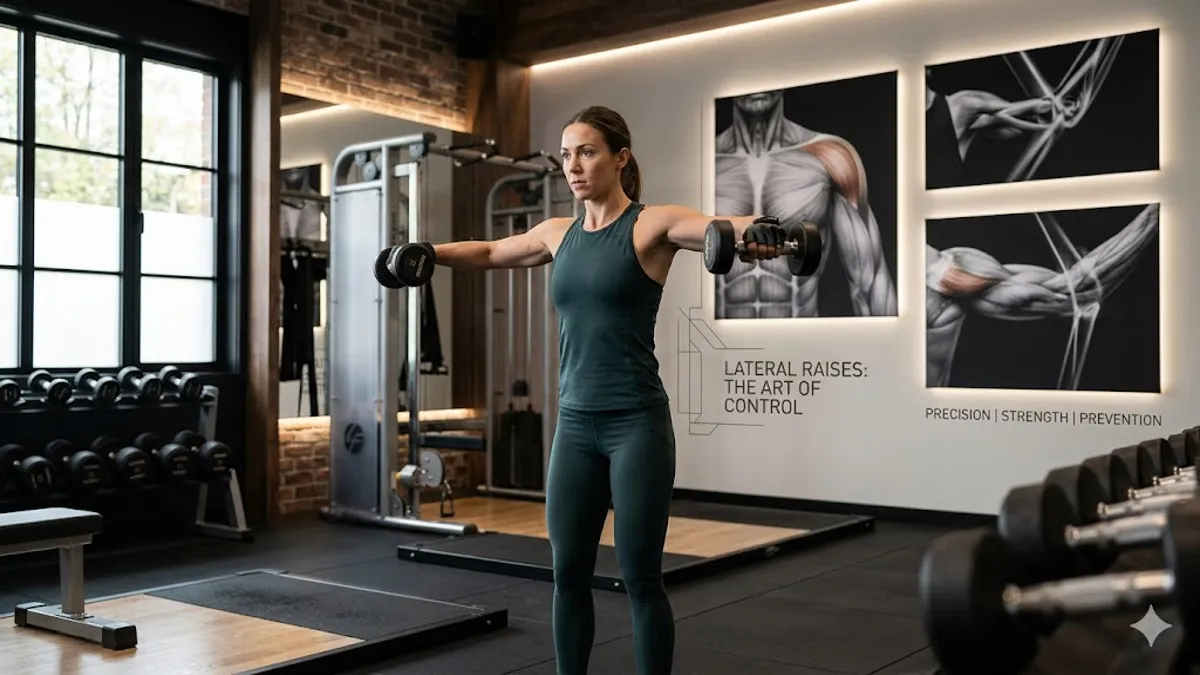
I have watched countless people in gyms reach for dumbbells and swing their arms outward, chasing broader shoulders without quite understanding what they are doing. Lateral raises, one of the most recognizable strength exercises, promise a sculpted silhouette and stronger upper body, but their real value lies deeper. They are not just about aesthetics. They are about control, joint health, and the quiet mastery of movement.
At their core, lateral raises target the deltoid muscles, especially the medial head, which contributes to shoulder width and stability. When performed correctly, they improve posture, enhance athletic performance, and reduce injury risk. When done poorly, they become one of the most misused exercises in the gym, often leading to strain rather than strength.
The appeal is understandable. The movement is simple to learn, requires minimal equipment, and fits into almost any routine. Yet simplicity can be deceptive. Beneath the surface, lateral raises involve biomechanics, muscle coordination, and careful attention to form.
This article explores the exercise from multiple angles: anatomy, technique, science, and cultural relevance. It examines why this modest movement has endured across decades of training philosophies, and how mastering it can reshape not only the shoulders, but the way we think about strength itself.
READ: Provascin: Benefits, Ingredients, and Safety Explained
The Anatomy of a Raise
Lateral raises primarily engage the deltoid muscle, a three-part structure consisting of anterior, medial, and posterior fibers. The medial deltoid is the star of this movement, responsible for lifting the arm away from the body. However, the exercise is not isolated. The trapezius, rotator cuff, and even core muscles contribute to stability and control.
Biomechanically, the movement is known as shoulder abduction. It occurs in the frontal plane and requires coordination between the glenohumeral joint and the scapula. This coordination is often referred to as the scapulohumeral rhythm, a concept widely discussed in kinesiology literature.
Dr. Brad Schoenfeld, a leading researcher in resistance training, has noted that “proper shoulder mechanics are essential not only for hypertrophy but for long-term joint health” (Schoenfeld, 2010). His research emphasizes that exercises like lateral raises must be performed with precision to avoid excessive stress on the shoulder joint.
What makes lateral raises particularly interesting is their sensitivity to small changes. A slight bend in the elbow, a minor shift in torso angle, or a subtle adjustment in grip can alter muscle activation significantly. This sensitivity transforms the exercise into a test of body awareness rather than brute strength.
Technique: Where Simplicity Meets Discipline
The most effective lateral raises are often the least dramatic. The lifter stands upright, holds a pair of dumbbells at their sides, and raises their arms until they reach shoulder height. The motion is controlled, deliberate, and free of momentum.
Yet in practice, many people rush through the movement. They swing weights, shrug their shoulders, or lean backward to lift heavier loads. These compensations reduce the effectiveness of the exercise and increase the risk of injury.
A well-executed lateral raise involves:
- A slight bend in the elbows
- Neutral wrists
- Controlled tempo
- Stable torso
- Minimal involvement of the trapezius
According to the American Council on Exercise, “lifting lighter weights with proper form is far more effective than heavier weights with poor technique” (ACE, 2014). This principle is especially relevant for lateral raises, where the target muscle is relatively small and easily overshadowed by stronger surrounding muscles.
Common Technique Errors
| Error | Impact | Correction |
|---|---|---|
| Using momentum | Reduces muscle activation | Slow down the movement |
| Lifting too high | Strains shoulder joint | Stop at shoulder level |
| Shrugging shoulders | Engages traps instead of deltoids | Keep shoulders relaxed |
| Excessive weight | Compromises form | Reduce load |
| Locked elbows | Increases joint stress | Maintain slight bend |
These corrections may seem minor, but they define the difference between progress and stagnation.
Variations That Change the Game
While the classic dumbbell lateral raise remains the standard, several variations offer unique benefits. Each variation adjusts resistance, stability, or range of motion, allowing individuals to tailor the exercise to their goals.
Cable lateral raises provide constant tension throughout the movement, making them particularly effective for muscle activation. Resistance bands offer portability and joint-friendly resistance. Machine-based lateral raises guide the movement path, reducing the likelihood of error.
Arnold Schwarzenegger, in his training guides, famously emphasized variety in shoulder training, noting that “the body adapts quickly, and variety keeps muscles growing” (Schwarzenegger, 1998).
Comparison of Lateral Raise Variations
| Variation | Key Benefit | Best For |
|---|---|---|
| Dumbbell | Versatility | General training |
| Cable | Constant tension | Hypertrophy focus |
| Resistance band | Joint-friendly | Beginners, rehab |
| Machine | Stability | Isolation training |
| Lean-away | Increased range | Advanced lifters |
Each variation serves a purpose, but none replaces the need for proper execution.
The Science of Shoulder Growth
Muscle hypertrophy depends on mechanical tension, metabolic stress, and muscle damage. Lateral raises contribute primarily through mechanical tension, especially when performed with controlled tempo and sufficient volume.
Research published in the Journal of Strength and Conditioning Research highlights that moderate loads combined with higher repetitions can effectively stimulate muscle growth in smaller muscle groups like the deltoids (Schoenfeld, 2016). This aligns with practical observations in gyms, where lateral raises are often performed in the 10 to 15 repetition range.
Dr. Stuart McGill, a spine biomechanics expert, has also emphasized the importance of stability in upper-body movements. “Stability creates the foundation for strength,” he explains, underscoring the role of core engagement during exercises like lateral raises (McGill, 2007).
Interestingly, studies using electromyography have shown that slight forward leaning can increase medial deltoid activation. This finding illustrates how small adjustments can produce measurable differences in muscle engagement.
Injury Prevention and Longevity
The shoulder is one of the most mobile joints in the body, but this mobility comes at a cost. It is also one of the most injury-prone joints, particularly in individuals who train without proper technique.
Lateral raises, when performed correctly, can strengthen the stabilizing muscles of the shoulder, reducing the risk of injury. However, improper form can lead to impingement, especially when the arms are raised too high or rotated incorrectly.
The National Academy of Sports Medicine emphasizes that “controlled movement and proper alignment are critical for shoulder health” (NASM, 2018). This guidance reflects a broader shift in fitness culture toward injury prevention and longevity rather than short-term gains.
For older adults, lateral raises can play a crucial role in maintaining functional strength. Everyday activities such as lifting objects, reaching overhead, or carrying groceries rely on shoulder stability. In this context, the exercise becomes less about aesthetics and more about independence.
Cultural Significance in Modern Fitness
Lateral raises have endured not because they are flashy, but because they are reliable. They appear in bodybuilding routines, athletic training programs, and rehabilitation protocols alike.
In the age of social media, where complex exercises often dominate attention, lateral raises remain a quiet constant. They do not lend themselves to viral videos or dramatic transformations, yet they are present in nearly every well-designed training program.
Fitness coach Jeff Cavaliere has remarked that “the exercises that look the simplest are often the ones people get wrong the most.” His observation captures the paradox of lateral raises. They are easy to learn but difficult to master.
This enduring relevance speaks to a broader truth about fitness. Progress is rarely about novelty. It is about consistency, discipline, and attention to detail.
Programming Lateral Raises Effectively
Incorporating lateral raises into a workout routine requires more than simply adding them at the end of a session. Their placement, volume, and intensity all influence their effectiveness.
They are often included in upper-body or shoulder-focused workouts, typically after compound movements like overhead presses. This sequencing ensures that the deltoids are not fatigued before heavier lifts.
Sample Programming Guidelines
| Goal | Sets | Reps | Frequency |
|---|---|---|---|
| Muscle growth | 3–4 | 10–15 | 2–3 times/week |
| Endurance | 2–3 | 15–20 | 3–4 times/week |
| Rehabilitation | 2 | 12–15 | As prescribed |
| Strength support | 3 | 8–12 | 2 times/week |
Rest periods are usually short, ranging from 30 to 60 seconds, to maintain metabolic stress.
Progression can be achieved through increased repetitions, improved form, or slight increases in weight. However, the emphasis should always remain on control rather than load.
Expert Perspectives
“Isolation exercises like lateral raises are essential for balanced development,” says Dr. Brad Schoenfeld. “They complement compound movements and address specific muscle groups that might otherwise be neglected.”
Physical therapist Kelly Starrett emphasizes movement quality: “If you cannot control a light weight, you have no business lifting a heavy one. The body keeps the score.”
Strength coach Eric Cressey adds another layer: “Shoulder health depends on what you do outside the main lifts. Small exercises like lateral raises make a big difference over time.”
These perspectives converge on a single idea: precision matters.
Takeaways
- Lateral raises primarily target the medial deltoid but involve multiple stabilizing muscles
- Proper technique is more important than lifting heavy weights
- Variations can enhance effectiveness and prevent plateaus
- Controlled movement reduces injury risk and improves joint health
- Consistency and discipline are key to long-term results
- The exercise supports both aesthetic and functional goals
Conclusion
I have come to see lateral raises not as a minor accessory exercise, but as a reflection of how we approach training itself. They reward patience, punish carelessness, and demand attention to detail. In a world that often celebrates intensity and spectacle, they offer a quieter path to progress.
The movement may appear simple, but its impact is profound. It strengthens the shoulders, supports daily function, and teaches control. It reminds us that strength is not just about how much we can lift, but how well we can move.
For those willing to slow down and focus, lateral raises become more than an exercise. They become a practice in discipline, awareness, and long-term thinking. And in that sense, they represent something larger than fitness. They represent a way of working with the body, rather than against it.
FAQs
What muscles do lateral raises work?
They primarily target the medial deltoid, with support from the trapezius, rotator cuff, and core muscles for stability.
How heavy should I go for lateral raises?
Use a weight that allows controlled movement for 10 to 15 repetitions without swinging or losing form.
Are lateral raises safe for beginners?
Yes, when performed with light weights and proper technique, they are safe and effective for beginners.
Can lateral raises prevent shoulder injuries?
They can strengthen stabilizing muscles, which may reduce injury risk when performed correctly.
How often should I do lateral raises?
Typically 2 to 3 times per week, depending on your training program and recovery capacity.