
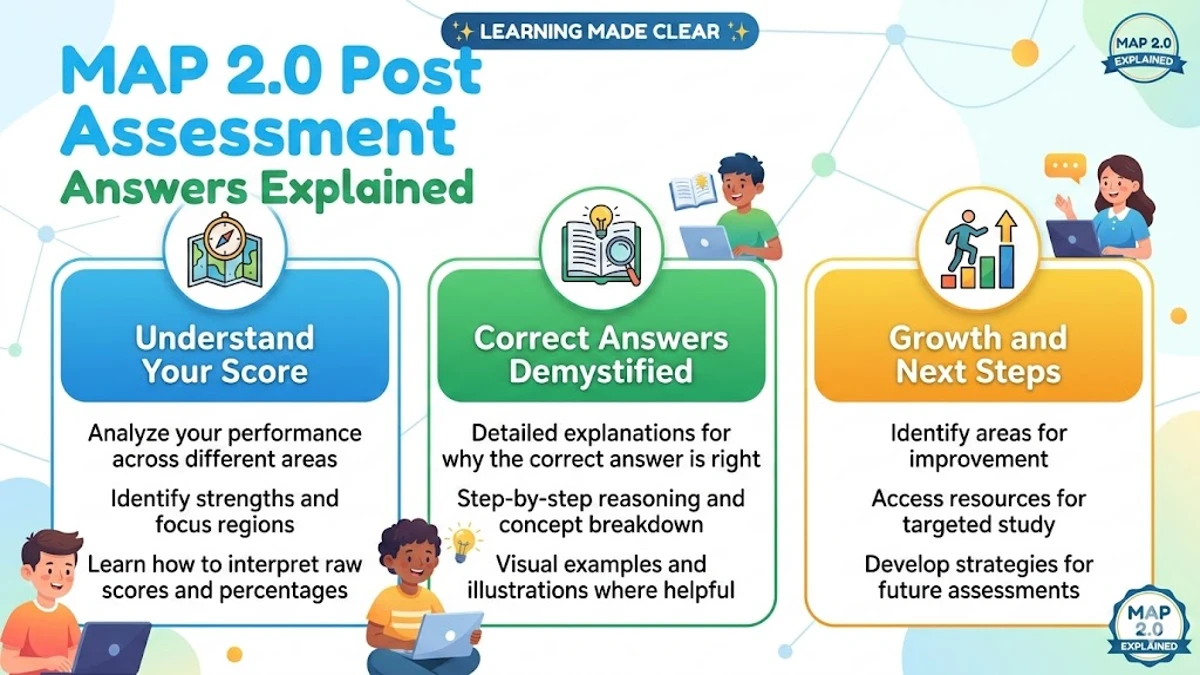
I often see students and parents searching online for “MAP 2.0 post-assessment answers,” hoping to find a straightforward list of correct responses. In reality, such answer keys rarely exist in a public or fixed form. MAP 2.0 assessments, developed by the nonprofit organization NWEA, use adaptive testing technology that changes questions based on each student’s performance. That means every student receives a different sequence of questions, making a universal answer sheet impossible.
Instead of focusing on memorizing answers, the MAP system evaluates student progress through a measurement scale known as the RIT score. The post-assessment phase, which typically follows a learning module or growth cycle, helps teachers determine how much a student’s knowledge has expanded. Educators use the results to adjust lesson plans, identify learning gaps, and track academic development across time.
Understanding how MAP 2.0 assessments function can reduce the frustration many students experience when searching for answers online. These assessments measure learning rather than reward memorization, and their design intentionally prevents simple answer-sharing.
The MAP Growth framework has become one of the most widely used adaptive testing systems in American schools. According to the Northwest Evaluation Association, millions of students across thousands of school districts take MAP assessments each year. The post-assessment component plays a critical role in measuring student progress between instructional cycles.
In this article I explore how MAP 2.0 post-assessments work, why answer lists rarely exist, how educators interpret results, and what students should focus on instead of searching for shortcuts.
The Origins of the MAP Assessment System
When I look back at the history of the MAP assessment system, I see a broader shift in education toward adaptive learning technologies. The system was created by the Northwest Evaluation Association (NWEA), an educational nonprofit founded in 1977. The goal was to design assessments that measure academic growth rather than simply ranking students against one another.
Traditional standardized tests typically present every student with the same questions. MAP assessments introduced a different model. Using computer-adaptive testing, the exam adjusts its difficulty level based on how a student answers each question.
For example, if a student answers a math question correctly, the system presents a more challenging one next. If the student struggles, the following question becomes slightly easier. Over time, this process helps identify a student’s precise instructional level.
Education researcher Susan Brookhart explains that adaptive testing allows educators to measure learning growth more accurately than fixed exams. “Computer-adaptive assessments provide a more precise estimate of student achievement across a wide range of ability levels,” she notes in research on assessment design.
MAP 2.0 represents a newer generation of this system, integrating updated learning standards and digital testing platforms.
Read: 6.5′ Truck Bed for a2011gmc3500hd: Dimensions, Specs, and Replacement Guide
What “Post-Assessment” Means in MAP 2.0
The phrase “MAP 2.0 post-assessment” often confuses students. I think of it as the final checkpoint in a learning cycle rather than a standalone test.
In many classrooms, teachers administer MAP assessments multiple times during the academic year. The most common schedule includes a fall baseline test, a winter progress test, and a spring post-assessment.
The post-assessment serves several purposes. It measures how much a student has grown academically since the beginning of the year. It also helps teachers evaluate whether instructional strategies have been effective.
Unlike traditional exams, the MAP post-assessment does not measure a fixed curriculum unit. Instead, it evaluates broader skills such as reading comprehension, mathematical reasoning, and language usage.
Because the questions change dynamically, two students sitting side by side during the test may see completely different problems.
That design explains why answer keys cannot be shared in the traditional sense.
How Adaptive Testing Changes the Search for Answers
Students searching for MAP 2.0 post-assessment answers often expect a typical quiz format. Yet adaptive testing transforms the structure of assessment entirely.
The system draws from a large question bank aligned with learning standards. Each question has a difficulty rating calibrated using statistical models.
When a student answers a question correctly, the testing algorithm increases the difficulty level. When the student answers incorrectly, the system adjusts downward.
This approach narrows in on the student’s academic level.
| Feature | Traditional Test | MAP Adaptive Test |
|---|---|---|
| Question sequence | Same for all students | Different for each student |
| Difficulty level | Fixed | Adjusts based on performance |
| Answer keys | Single correct list | No universal answer key |
| Score type | Percentage or letter grade | RIT scale score |
Because every student receives a different pathway through the question bank, sharing answers becomes ineffective.
Instead, the assessment measures skill development across time.
Understanding the RIT Score System
The most important result from a MAP assessment is the RIT score, which stands for Rasch Unit. This scale measures student achievement on a continuous numeric range.
Unlike grade-based scoring systems, RIT scores track progress regardless of grade level.
| Grade Level | Typical RIT Reading Range | Typical RIT Math Range |
|---|---|---|
| Grade 3 | 188–203 | 190–204 |
| Grade 5 | 203–218 | 208–222 |
| Grade 8 | 215–230 | 220–235 |
| Grade 10 | 221–236 | 230–245 |
These ranges vary slightly each year depending on national testing trends.
A student who increases their RIT score between assessments demonstrates measurable academic growth. Teachers often celebrate even small improvements because the scale represents precise learning progress.
Assessment expert James Popham emphasizes that growth measures are essential for understanding student learning. “The most meaningful educational measurement is evidence of improvement over time,” he writes in research on educational assessment.
In other words, MAP assessments evaluate progress rather than simply judging performance.
Why Public Answer Lists Rarely Exist
When I examine why students struggle to find MAP post-assessment answers online, the explanation becomes clear: the system was designed to prevent it.
Several factors make answer lists impractical.
First, the question bank contains thousands of items. Students see only a small fraction of these during any test session.
Second, the algorithm selects questions based on real-time performance. That means the next question depends on the student’s previous answer.
Third, test security protocols limit the public release of assessment questions.
Educational testing organizations maintain strict policies to preserve exam validity. If answer keys were widely available, the results would no longer measure true learning.
Testing researcher Daniel Koretz explains that protecting test integrity is essential. “If students gain advance knowledge of items, the test ceases to measure what it is intended to measure,” he writes in research on standardized testing.
This principle applies strongly to adaptive assessments like MAP.
What Teachers Actually Look for in Post-Assessment Results
Teachers rarely focus on individual question answers when reviewing MAP results. Instead, they analyze patterns within the RIT score data.
After the post-assessment, educators receive detailed reports showing student growth and skill breakdowns.
These reports often include:
- growth percentiles
- instructional areas needing improvement
- comparative national averages
Teachers use these insights to plan lessons for the following academic year.
Education strategist John Hattie has argued that data-driven instruction improves student outcomes when used carefully. “Effective feedback and assessment help teachers adapt instruction to meet student needs,” he wrote in research on visible learning strategies.
In practice, the MAP post-assessment acts as a diagnostic tool rather than a traditional exam.
Strategies Students Should Use Instead of Searching for Answers
Rather than looking for answer keys, students benefit more from focusing on the skills the assessment measures.
Reading MAP assessments emphasize comprehension, vocabulary, and inference skills. Math assessments measure reasoning, problem solving, and numerical fluency.
Preparation strategies include:
- reviewing class notes
- practicing reading comprehension exercises
- solving multi-step math problems
- identifying weaknesses in previous assessments
Because MAP tests adapt dynamically, the best preparation involves strengthening core skills rather than memorizing specific questions.
Students who build strong conceptual understanding often perform better because they can handle questions across multiple difficulty levels.
Technology’s Growing Role in Modern Assessments
The MAP system reflects a broader transformation in educational testing. Over the past two decades, digital platforms have enabled more sophisticated forms of assessment.
Computer-adaptive testing now appears in numerous exams, including professional certification tests and college placement assessments.
These systems rely on statistical models to estimate ability with fewer questions than traditional exams.
According to the National Center for Education Statistics, digital assessments are increasingly used to evaluate student progress across the United States.
Adaptive testing also allows educators to track learning growth more frequently throughout the academic year.
For many educators, this shift represents a move toward more personalized learning.
Common Misconceptions About MAP Post-Assessments
Students sometimes misunderstand what the MAP post-assessment measures.
Some assume it determines final grades. In most schools, however, MAP results supplement classroom evaluation rather than replacing it.
Others believe that failing the test has academic consequences. In reality, the assessment primarily measures growth.
Another misconception involves the search for answer keys online. Many websites claim to provide MAP answers, but these lists often contain inaccurate or outdated information.
Educators emphasize that relying on such resources rarely helps students improve their scores.
Instead, the most reliable path to success involves strengthening academic skills and understanding core concepts.
Takeaways
- MAP 2.0 post-assessments measure learning growth rather than memorized knowledge.
- Adaptive testing means each student receives a different sequence of questions.
- Universal answer keys do not exist because the test draws from a large question bank.
- RIT scores track academic progress across multiple assessments.
- Teachers analyze growth data to adjust instruction and identify learning gaps.
- Students perform best when they focus on skill development rather than searching for answers.
Conclusion
When I consider the widespread search for MAP 2.0 post-assessment answers, I see a reflection of how students often approach testing. Many hope for shortcuts, believing that success depends on discovering the right responses in advance. Yet adaptive assessments like MAP are designed specifically to prevent that approach.
The real purpose of the MAP post-assessment lies in measuring learning growth. By adjusting question difficulty in real time, the system identifies a student’s academic level with remarkable precision. Teachers use those insights to guide instruction, identify gaps, and celebrate progress.
Rather than serving as a traditional exam with a fixed answer key, the MAP assessment functions more like a diagnostic tool. It helps educators understand how students learn and how instruction can improve.
For students, the lesson is clear. The path to better MAP results does not involve hunting for answer lists. It involves developing the reading, reasoning, and problem-solving skills that the assessment is designed to measure.
In the long run, that focus on genuine learning benefits students far more than any shortcut ever could.
FAQs
What are MAP 2.0 post-assessment answers?
There is no universal answer list. MAP assessments are adaptive tests that present different questions to each student.
Why can’t students find MAP answer keys online?
The test draws from a large secure question bank and changes questions based on each student’s responses.
What does a MAP post-assessment measure?
It measures academic growth using RIT scores, showing how much a student has improved during the school year.
Do MAP post-assessment scores affect grades?
In most schools, MAP results support instructional planning rather than determining final course grades.
How should students prepare for MAP assessments?
Students should strengthen reading comprehension, vocabulary, and mathematical reasoning rather than memorizing specific questions.