
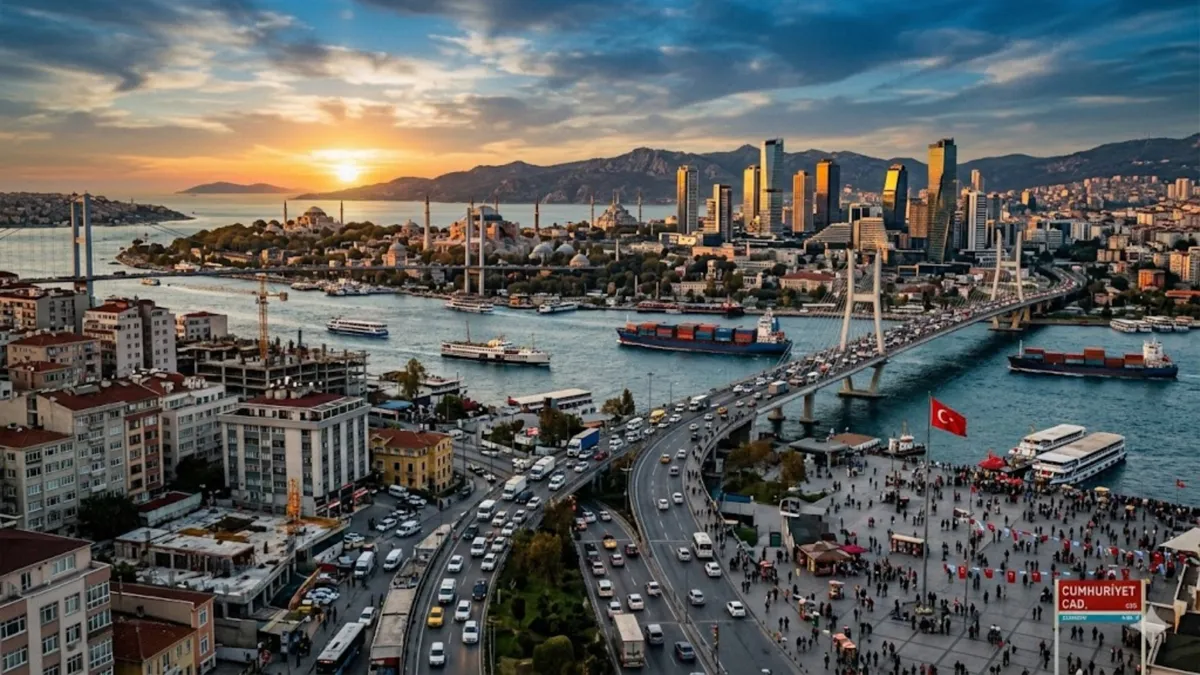
I begin with a simple observation: the word “merfez,” often understood as a linguistic variation or misspelling of the Turkish word merkez meaning “center,” opens a window into something much larger than vocabulary. It points to how nations organize power, how cities rise and fall, and how identity is negotiated through geography and institutions. In Turkey, the concept of the “center” has never been static. It has moved from imperial courts to republican institutions, from bureaucratic Ankara to globalized Istanbul, and now into digital and financial networks that transcend borders.
Within the first glance, readers searching for “merfez” are often seeking clarity: what does it mean, and why does it matter? The answer lies in Turkey’s layered transformation. The “center” is not just a place. It is a system of governance, an economic hub, and a cultural anchor. From the founding of the Republic in 1923 to contemporary debates over central banking independence, the idea of the center has shaped the country’s trajectory.
Over the past two decades, this concept has become even more contested. Political centralization, economic volatility, and urban expansion have redefined what it means to be at the center. The result is a dynamic tension between tradition and modernity, authority and decentralization, stability and flux.
The Historical Roots of the Center
The origins of Turkey’s “center” stretch back to the Ottoman Empire, where power radiated outward from Istanbul. The imperial court, known as the Sublime Porte, functioned as both administrative and symbolic authority. Decisions made in the capital shaped provinces across three continents. Historian İlber Ortaylı once noted, “The Ottoman state was built on a strong center that controlled its periphery through a delicate balance of autonomy and authority.”
When the Republic of Turkey was founded in 1923, Mustafa Kemal Atatürk deliberately relocated the political center to Ankara. This move was both strategic and ideological. Ankara represented a break from imperial tradition and a step toward modernization. It was geographically central and symbolically neutral, a place to build a new national identity.
Yet Istanbul never lost its gravitational pull. As Turkey industrialized, the economic center gradually shifted back toward the historic city. By the late 20th century, Istanbul had become the country’s financial and cultural hub, even as Ankara retained political authority. This dual-center dynamic continues to define Turkey today.
Centralization and Political Power
In recent years, Turkey has experienced a renewed emphasis on centralization, particularly under the leadership of President Recep Tayyip Erdoğan. Constitutional changes in 2017 transformed the country from a parliamentary system to a presidential one, consolidating executive power.
Political scientist Berk Esen has observed, “The shift to a presidential system marked a significant centralization of authority, reducing the role of intermediary institutions” (Esen & Gumuscu, 2016). This restructuring has redefined the “center” as not just a geographic location but a concentration of decision-making power.
Critics argue that this centralization has weakened checks and balances, while supporters contend it has increased efficiency and stability. The debate reflects a broader question: should the center be strong and unified, or distributed and pluralistic?
The implications extend beyond politics. Centralization influences economic policy, media freedom, and regional governance. It shapes how resources are allocated and how citizens interact with the state.
Economic Centers and Financial Authority
Turkey’s economic “center” is perhaps most visible in its financial institutions, particularly the Central Bank of the Republic of Turkey (CBRT). The bank’s policies have significant implications for inflation, currency stability, and investor confidence.
In recent years, the CBRT has faced intense scrutiny. Frequent changes in leadership and unconventional monetary policies have raised concerns among economists. According to the World Bank, Turkey’s inflation rate surged above 60 percent in 2022, highlighting the challenges of maintaining economic stability.
Economist Dani Rodrik has remarked, “Turkey’s economic management reflects a tension between political priorities and institutional independence” (Rodrik, 2021). This tension underscores the importance of a credible and autonomous center in financial governance.
READ: Messeregge Explained Structured Communication Trend
Table: Key Economic Indicators in Turkey (2015–2023)
| Year | Inflation Rate (%) | GDP Growth (%) | Currency Trend (TRY/USD) |
|---|---|---|---|
| 2015 | 7.7 | 6.1 | Stable |
| 2018 | 20.3 | 2.8 | Sharp depreciation |
| 2020 | 14.6 | 1.8 | Volatile |
| 2022 | 64.3 | 5.5 | Severe depreciation |
| 2023 | ~50+ | 4.0 (est.) | Continued volatility |
The table illustrates how economic instability has increasingly defined Turkey’s financial center. The question remains whether reforms can restore confidence and balance.
Istanbul vs. Ankara: A Dual-Center Reality
Turkey’s unique structure is defined by two competing centers: Ankara, the political capital, and Istanbul, the economic powerhouse. This duality creates both opportunities and tensions.
Ankara embodies state authority. Ministries, embassies, and legislative bodies are concentrated there. It is the administrative heart of the nation. Istanbul, by contrast, is outward-facing. It connects Turkey to global markets, culture, and tourism.
Urban planner Murat Güvenç explains, “Istanbul’s role as a global city challenges the traditional notion of a single national center” (Güvenç, 2013). The city’s population, now exceeding 15 million, reflects its dominance.
Table: Comparison of Turkey’s Two Centers
| Feature | Ankara | Istanbul |
|---|---|---|
| Role | Political capital | Economic hub |
| Population | ~5.7 million | ~15.5 million |
| Key Institutions | Parliament, ministries | Banks, corporations |
| Global Influence | Limited | High |
| Historical Identity | Republican foundation | Ottoman legacy |
This dual-center model complicates governance but also enriches Turkey’s national character.
Urbanization and the Expanding Center
As Turkey urbanizes, the concept of the center continues to evolve. Cities like Izmir, Bursa, and Gaziantep are emerging as regional hubs, challenging the dominance of Istanbul and Ankara.
Urbanization has accelerated dramatically. In 1950, only about 25 percent of Turkey’s population lived in cities. Today, that figure exceeds 75 percent. This shift has created new centers of economic activity and cultural influence.
Sociologist Çağlar Keyder notes, “Urban growth in Turkey has decentralized economic activity while reinforcing national integration” (Keyder, 2010). The rise of secondary cities suggests that the center is no longer singular.
This decentralization has practical implications. It affects infrastructure investment, migration patterns, and regional inequality. It also raises questions about how to balance growth across different مناطق.
Digital Transformation and the New Center
In the digital age, the idea of the center is becoming less tied to geography. Technology is reshaping how power and information are distributed.
Turkey has invested heavily in digital infrastructure. E-government services, fintech platforms, and online التجارة are expanding rapidly. These developments are creating a new kind of center, one that exists in networks rather than physical spaces.
According to the OECD, digitalization can “enhance productivity and reduce regional disparities if implemented effectively” (OECD, 2021). In Turkey, this potential is still being realized.
The rise of remote work and digital entrepreneurship further blurs the boundaries of the center. Individuals can now participate in the economy without being physically located in Istanbul or Ankara.
Cultural Identity and the Meaning of Center
Beyond politics and economics, the concept of the center carries cultural significance. It reflects how people see themselves and their place in the nation.
In Turkey, debates about the center often intersect with questions of identity. Is the center secular or religious? Western or Eastern? Modern or traditional? These questions have shaped public discourse for decades.
Anthropologist Jenny White has written, “The struggle over Turkey’s center is ultimately a struggle over its identity” (White, 2013). This struggle is visible in everything from education policy to urban design.
Cultural institutions, media, and الفن play a role in defining the center. They influence how narratives are constructed and who gets to shape them.
Takeaways
- The concept of “merfez” reflects a broader understanding of Turkey’s evolving center of power and identity.
- Turkey’s center has shifted from imperial Istanbul to republican Ankara and back toward a dual-center model.
- Political centralization has redefined authority, particularly after constitutional changes in 2017.
- Economic instability highlights the importance of institutional independence in financial governance.
- Urbanization and digital transformation are creating multiple, decentralized centers across the country.
- Cultural debates about identity continue to shape how the center is understood and contested.
Conclusion
I find that the idea of “merfez,” while seemingly simple, captures the complexity of a nation in motion. Turkey’s center is not fixed. It is negotiated, contested, and continually reimagined. From the corridors of power in Ankara to the الأسواق and skyscrapers of Istanbul, the center exists in multiple forms.
The future of this center will depend on how Turkey balances centralization with pluralism, stability with innovation, and tradition with change. As new cities rise and digital networks expand, the meaning of the center will continue to evolve. – merfez.
In the end, the story of Turkey’s “merfez” is a story of transformation. It is about how a nation defines itself, organizes its power, and navigates the challenges of a rapidly changing world.
FAQs
What does “merfez” mean?
“Merfez” is often interpreted as a variation of the Turkish word merkez, meaning “center.” It refers broadly to central authority, geography, or importance.
Why is Ankara the capital of Turkey?
Ankara became the capital in 1923 to symbolize a break from Ottoman rule and to establish a modern, centralized republic.
Is Istanbul still important politically?
While not the political capital, Istanbul remains highly influential economically and culturally, shaping national and international perceptions.
What role does the Central Bank play?
The Central Bank of Turkey manages monetary policy, inflation, and currency stability, making it a key economic institution.
How is digitalization changing Turkey’s center?
Digital technologies are decentralizing economic activity, allowing new hubs to emerge beyond traditional cities.