
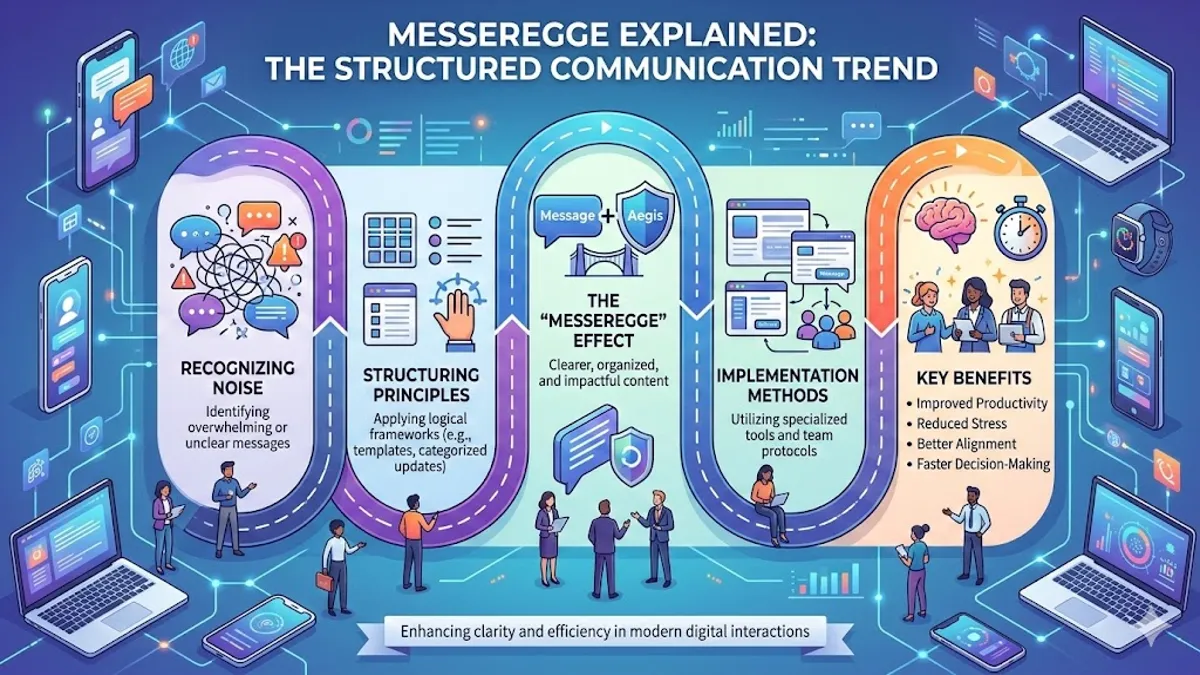
I have come to realize that most communication problems today are not caused by a lack of information, but by an excess of it. Messeregge, a newly emerging concept gaining attention in 2026, attempts to solve this problem by promoting structured, precise, and intentional messaging. At its core, messeregge is a communication philosophy designed to reduce ambiguity, streamline interactions, and improve clarity across digital and professional environments.
For those searching what messeregge means, the answer lies in its practical application: it is a method of organizing messages so that purpose, context, and action are immediately clear. Whether in emails, workplace chats, or social media, messeregge encourages users to state objectives upfront, structure content logically, and minimize cognitive overload.
The concept arrives at a moment when communication channels are saturated. Slack threads multiply, inboxes overflow, and misunderstandings arise from tone-less text exchanges. Messeregge responds by offering a framework that prioritizes clarity over speed and intention over volume.
Though still evolving, the idea reflects a broader cultural shift toward mindful communication. It draws from cognitive science, workplace efficiency strategies, and design principles, positioning itself as both a philosophy and a practical toolkit.
Understanding messeregge means understanding how communication itself is changing in the digital age.
The Birth of a Modern Communication Philosophy
Messeregge does not have ancient roots or a long intellectual lineage. Instead, it appears as a modern construct, emerging in early 2026 discussions around productivity, digital communication, and workplace efficiency.
Its name suggests a fusion of “message” and “edge” or “structure,” implying communication that is both sharp and organized. Unlike traditional communication theories, messeregge is less concerned with rhetoric or persuasion and more focused on clarity and usability.
This reflects the conditions of its origin. Digital communication has transformed how people interact, often prioritizing speed over comprehension. Messages are sent quickly, but not always effectively.
“Information overload is one of the defining challenges of our time,” says Clay Shirky, a scholar of digital media. “The problem is not information, it’s filtering.”
Messeregge can be understood as a response to this challenge. By imposing structure on communication, it seeks to improve how information is processed and understood.
Its emergence also aligns with the rise of AI tools that assist in drafting and refining messages, suggesting that structured communication may become increasingly automated.
READ: Grospal Review: How This Workflow Platform Helps Teams Work Smarter
Core Principles of Messeregge
At the heart of messeregge are several guiding principles that define its approach to communication. These principles are simple in theory but powerful in application.
Clarity is the first priority. Messages should clearly state their purpose at the beginning, eliminating the need for interpretation. Context follows, providing the necessary background to understand the message without additional clarification.
Structure is equally important. Information should be organized logically, often using bullet points or segmented sections to improve readability. This reduces cognitive load, making it easier for recipients to process information quickly.
Finally, intentionality ensures that every message serves a purpose. Redundant or unnecessary information is minimized, allowing communication to remain focused and efficient.
“Cognitive load theory shows that structured information is easier to process and retain,” explains John Sweller, an educational psychologist. “When information is organized, it reduces mental effort.”
These principles form the foundation of messeregge, guiding its application across different contexts.
Messeregge in Workplace Communication
The workplace is one of the primary environments where messeregge has gained traction. In offices and remote teams alike, communication inefficiencies can lead to delays, misunderstandings, and reduced productivity.
Messeregge addresses these issues by standardizing how messages are constructed. Emails, for example, begin with a clear subject and purpose statement. Action items are listed explicitly, often with deadlines attached.
This approach transforms communication from a passive exchange into a structured workflow tool. Teams can quickly identify priorities, responsibilities, and timelines without sifting through lengthy messages.
Traditional vs Messeregge Communication
| Aspect | Traditional Messaging | Messeregge Approach |
|---|---|---|
| Structure | Unstructured text | Bullet points, sections |
| Purpose | Often implied | Clearly stated upfront |
| Action Items | Embedded in text | Explicit and highlighted |
| Efficiency | Variable | Consistently high |
Early adopters report significant improvements in efficiency. Some teams have observed reductions in email chains and faster decision-making processes.
“Clear communication is directly linked to organizational performance,” notes Harvard Business Review research. “Ambiguity creates friction.”
Messeregge seeks to eliminate that friction.
Digital Platforms and the Challenge of Tone
One of the most persistent issues in digital communication is tone. Without vocal cues or body language, messages can be easily misinterpreted. This is particularly true in fast-paced environments like chat platforms.
Messeregge introduces the concept of context indicators to address this challenge. These may include tone markers, clarifying statements, or summaries that reinforce intent.
For example, a message might include a brief note indicating urgency or a reminder that feedback is constructive. These small additions can significantly reduce misunderstandings.
The philosophy also encourages reflective phrasing. Instead of making assumptions, communicators are encouraged to confirm understanding, creating a feedback loop that enhances clarity.
“Miscommunication often stems from assumptions,” says linguist Deborah Tannen. “Explicit context can bridge those gaps.”
By integrating these techniques, messeregge adapts to the limitations of digital communication while enhancing its effectiveness.
Conflict Resolution Through Structured Dialogue
Messeregge extends beyond efficiency into the realm of conflict resolution. In professional and personal settings, disagreements often escalate due to unclear or emotionally charged communication.
The philosophy promotes a structured approach to addressing conflicts. This includes stating concerns objectively, summarizing opposing viewpoints, and avoiding accusatory language.
By focusing on clarity and neutrality, messeregge reduces emotional escalation. It encourages participants to engage with the content of the message rather than its perceived tone.
This method aligns with established conflict resolution strategies, which emphasize active listening and clear articulation of concerns.
Structured communication can transform conflicts into productive discussions, allowing participants to reach resolutions more effectively.
Messeregge Beyond Communication: Retail and Design
Interestingly, the principles of messeregge have found applications beyond digital communication. In retail environments, they influence how products are displayed and information is presented.
Messeregge-inspired display shelves use clear labeling, logical organization, and visual hierarchy to guide consumer behavior. Products are arranged in a way that reduces decision fatigue, making it easier for shoppers to find what they need.
Retail Application of Messeregge
| Element | Traditional Display | Messeregge Display |
|---|---|---|
| Layout | Dense, cluttered | Structured, tiered |
| Information | Minimal or scattered | Clear labels, highlights |
| Navigation | Trial and error | Guided flow |
| Impact | Moderate engagement | Higher conversion rates |
Studies in retail psychology suggest that clear product presentation can significantly influence purchasing decisions. By applying messeregge principles, retailers aim to improve both efficiency and customer satisfaction.
Unexpected Interpretations: Culinary and Cultural Uses
While messeregge is primarily associated with communication, it has also appeared in less conventional contexts. Some culinary discussions describe it as an herb or ingredient used to enhance flavor.
In this interpretation, messeregge represents balance and subtlety, aligning with the broader philosophy of precision and intentionality. Chefs use it to add depth without overwhelming a dish.
Although these uses are less consistent, they reflect the flexibility of the concept. Messeregge, as a term, is still evolving, and its meaning may continue to expand.
This fluidity is characteristic of modern neologisms, which often adapt to different contexts before settling into a defined role.
The Role of AI in Shaping Messeregge
Artificial intelligence is likely to play a significant role in the evolution of messeregge. Tools that assist with writing and communication can incorporate its principles, offering suggestions for clarity and structure.
AI systems can analyze messages, identify ambiguity, and recommend improvements. This aligns with the goals of messeregge, making it easier for users to adopt its practices.
As these tools become more advanced, structured communication may become the default rather than the exception.
“AI has the potential to standardize communication quality,” says Ethan Mollick, a professor at the Wharton School. “It can guide users toward clearer expression.”
This integration could accelerate the adoption of messeregge, embedding it into everyday communication practices.
Challenges and Criticism
Despite its promise, messeregge is not without criticism. Some argue that overly structured communication can feel rigid or impersonal. Others question whether it can be applied universally across different cultural contexts.
There is also the risk of over-standardization. Communication is inherently human, and excessive structure may limit creativity or nuance.
Additionally, the concept’s lack of formal definition can lead to inconsistent interpretations. As a relatively new idea, messeregge has yet to establish a clear framework or set of guidelines.
These challenges highlight the need for balance. Structure should enhance communication, not constrain it.
Takeaways
- Messeregge is a modern philosophy focused on structured, intentional communication
- It aims to reduce information overload and improve clarity
- The concept is widely applied in workplaces and digital platforms
- It incorporates principles from cognitive science and communication theory
- Applications extend to retail design and even culinary discussions
- AI tools may accelerate its adoption and refinement
Conclusion
I find messeregge compelling not because it offers a radical new idea, but because it reframes something fundamental. Communication, in its simplest form, is about understanding. Yet in a world saturated with messages, understanding has become increasingly difficult.
Messeregge reminds us that clarity is not automatic. It must be designed, structured, and maintained. Its emphasis on intentionality reflects a broader cultural shift toward mindfulness in how we communicate.
Whether it becomes a lasting framework or fades as a passing trend will depend on its ability to adapt. For now, it offers a useful lens through which to examine our communication habits.
In an age defined by noise, messeregge proposes something deceptively simple: say less, but say it better.
FAQs
What does messeregge mean?
Messeregge refers to a structured communication approach that emphasizes clarity, context, and logical organization in messages.
Where is messeregge used?
It is used in workplaces, digital communication platforms, retail design, and emerging applications like AI-assisted writing.
Is messeregge a proven method?
While still evolving, it draws on established principles from cognitive science and communication theory.
Can messeregge improve productivity?
Yes, structured messaging can reduce misunderstandings and streamline workflows, improving efficiency.
Is messeregge widely adopted?
It is an emerging concept in 2026, gaining attention but not yet universally adopted.