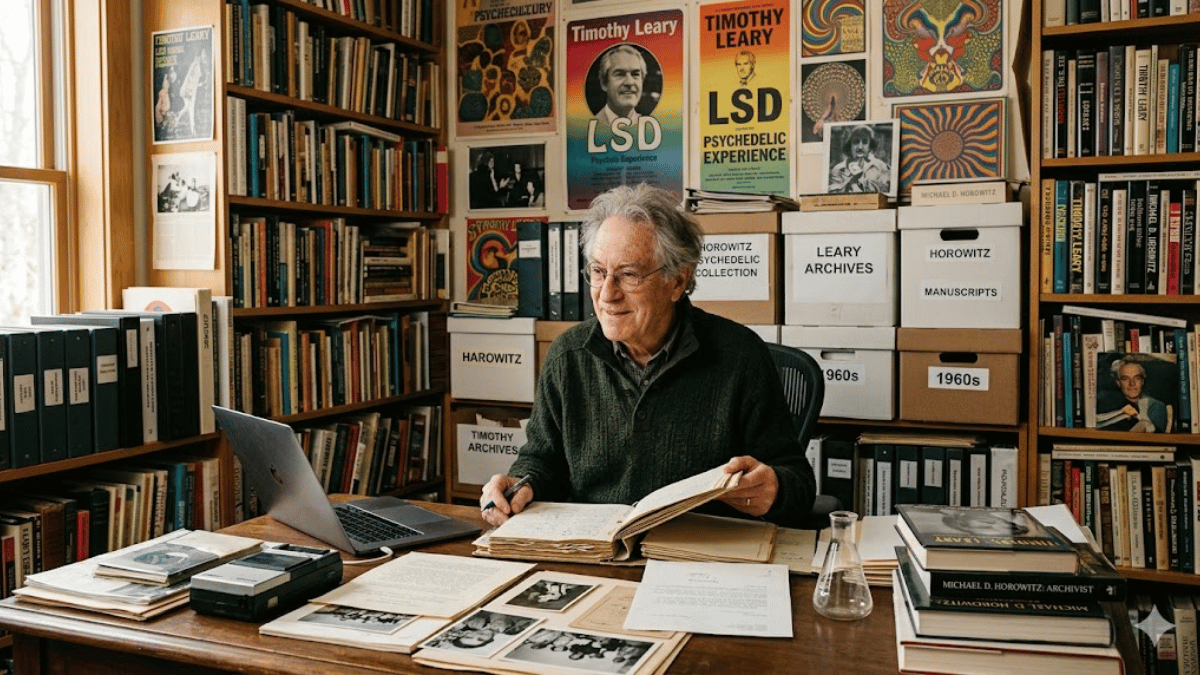
I first encountered the name Michael D. Horowitz not through a bestseller list or a televised interview, but buried inside archival catalogues and bibliographies that scholars quietly circulate among themselves. Within the first moments of searching, the essential fact becomes clear: michael d. horowitz is one of the most influential archivists of America’s psychedelic era, a figure who quietly preserved a contested intellectual tradition that many institutions once avoided.
Born in Brooklyn in 1938, Horowitz would become an author, historian, bookseller, and archivist whose work centered on the literature and cultural history of psychoactive substances. His career intersected with the controversial psychologist and counterculture icon Timothy Leary, whose personal papers Horowitz helped safeguard during a period when government scrutiny of psychedelic research was intense.
Yet Horowitz’s significance extends far beyond one famous association. Over decades, he built and curated one of the world’s most extensive collections of literature related to mind-altering substances, eventually helping establish the Fitz Hugh Ludlow Memorial Library in San Francisco, an archive dedicated entirely to the study of psychoactive drugs and their cultural influence.
In an era when psychedelic research was widely stigmatized, Horowitz operated with a belief that historical documentation must remain neutral and accessible, regardless of the subject’s political or cultural controversy. That philosophy shaped his response when federal agents seized Leary’s archive in 1975, prompting Horowitz to publicly defend the independence of archivists.
Today, historians increasingly recognize his work as a foundation for modern scholarship on psychedelic culture, countercultural movements, and the politics of archival preservation.
A Brooklyn Childhood and the Seeds of Intellectual Curiosity
Michael d. horowitz was born on December 11, 1938, in Brooklyn, New York, into a Jewish immigrant family whose intellectual curiosity would shape his early worldview. His father, Sol Horowitz, descended from Eastern European immigrants who had arrived in the United States amid waves of early twentieth-century migration.
Growing up in postwar New York, Horowitz encountered a city rich in literary experimentation, radical politics, and artistic subcultures. The 1950s and 1960s were a period of profound cultural transformation in the United States. Beat poetry, psychedelic experimentation, and new philosophical movements were reshaping American intellectual life.
Horowitz gravitated toward rare books and unconventional literature rather than traditional academic paths. His interest in rare printed materials soon expanded into collecting works related to consciousness, psychology, and psychoactive substances.
By the late 1960s, Horowitz moved west to San Francisco, a city rapidly becoming the epicenter of the American counterculture.
This move would prove decisive. San Francisco was not merely a geographic relocation but a gateway into the intellectual ecosystem of the psychedelic movement.
Historian Erika Dyck, who studies the history of psychedelic research, once observed:
“Archives shape what future historians can know. Without collectors and archivists who preserve controversial material, entire intellectual movements risk disappearing from the historical record.”
Horowitz would become one of those archivists.
Read: Alice Beck Dubow and Pennsylvania’s Superior Court
The Counterculture Moment and the Turn Toward Archives
By 1967, San Francisco had become synonymous with the “Summer of Love,” a cultural phenomenon that fused music, politics, spiritual experimentation, and psychedelic exploration.
Horowitz arrived at a moment when the movement was transitioning from experimental optimism to political scrutiny.
Psychedelic substances like LSD had moved from academic laboratories into public discourse, attracting both fascination and alarm. Government agencies increasingly viewed the movement with suspicion.
Horowitz’s approach to this environment was neither ideological advocacy nor moral condemnation. Instead, he pursued documentation.
He began collecting books, pamphlets, research papers, underground newspapers, and personal correspondence related to psychedelic culture.
His goal was historical preservation.
Timeline of Key Moments in Horowitz’s Career
| Year | Event | Significance |
|---|---|---|
| 1938 | Born in Brooklyn, New York | Beginning of future archivist and author |
| 1967 | Moves to San Francisco | Enters center of psychedelic counterculture |
| 1970 | Co-founds Fitz Hugh Ludlow Memorial Library | Creates major archive of drug literature |
| 1970s | Serves as Timothy Leary’s archivist | Safeguards key psychedelic historical materials |
| 1988 | Publishes annotated bibliography of Leary | Provides scholarly resource for researchers |
By collecting primary documents rather than commentary alone, Horowitz preserved evidence of a movement whose intellectual legacy might otherwise have been lost.
The Fitz Hugh Ludlow Memorial Library
One of Horowitz’s most enduring achievements was the creation of the Fitz Hugh Ludlow Memorial Library.
Founded in 1970 with fellow collector Robert Barker, the library combined their extensive collections of books, manuscripts, and ephemera related to psychoactive substances.
Named after nineteenth-century writer Fitz Hugh Ludlow, whose book The Hasheesh Eater documented early American experiences with cannabis extracts, the library became the largest archive of drug-related literature in the world.
The library’s holdings eventually included:
- Scientific research papers
- Underground publications
- Cultural artifacts
- Correspondence from psychedelic researchers
- Rare books dating back centuries
Scholar and psychedelic historian Rick Doblin once described the archive’s significance:
“The Ludlow Library became a vital repository for the intellectual history of psychedelics. Without it, much of the early literature would simply have disappeared.”
The library was eventually incorporated into the Ludlow-Santo Domingo Library, one of the most comprehensive private collections of drug literature in existence.
Timothy Leary and the Archivist’s Responsibility
Perhaps the most widely known chapter of Horowitz’s life involves his relationship with psychologist Timothy Leary.
Leary, once a Harvard researcher studying psychedelic substances, became one of the most controversial figures of the 1960s counterculture.
In 1970, after Leary was imprisoned in California, his wife contacted Horowitz and Barker with a request: protect Leary’s personal papers.
The documents were stored in filing cabinets in the family garage. Concerned that they might be seized or destroyed, Leary’s family entrusted them to Horowitz for safekeeping.
The archive included:
- Personal correspondence
- Research notes
- Draft manuscripts
- Letters from fellow thinkers such as Allen Ginsberg
Horowitz accepted the role of archivist.
For him, the responsibility was not political but professional.
He believed the archive represented an intellectual record that future historians would need.
When the Government Seized the Archive
The neutrality of archival work became a central issue in 1975.
That year, federal authorities seized Leary’s archive from Horowitz’s home as part of an investigation connected to Leary’s activities.
For Horowitz, the event raised profound questions about the independence of archivists.
In response, he created the Archival Reality Committee Advocating the Neutrality of Archivists, often abbreviated as ARCANA.
He also drafted what he called the Archivist’s Bill of Rights, a document asserting that archivists must remain independent from political pressure and legal intimidation.
Archivist Terry Cook later wrote in archival theory scholarship:
“The archivist’s obligation is to preserve evidence, not to judge it.”
Horowitz’s experience helped illustrate the tensions archivists sometimes face when preserving politically sensitive records.
Eventually, the government returned the Leary archive.
Horowitz resumed his role as its steward.
Publications and Scholarly Contributions
Though best known as an archivist, Horowitz also contributed to scholarship and publishing.
His most widely cited works include:
| Publication | Type | Year | Contribution |
|---|---|---|---|
| The High Times Encyclopedia of Recreational Drugs | Reference book | 1978 | Comprehensive guide to psychoactive substances |
| An Annotated Bibliography of Timothy Leary | Bibliography | 1988 | Scholarly documentation of Leary’s writings |
| Sisters of the Extreme | Edited anthology | 2000 | Women’s perspectives on drug experiences |
| Moksha: Writings on Psychedelics | Edited volume | 1999 | Aldous Huxley essays on psychedelic philosophy |
Many of these works were produced in collaboration with Cynthia Palmer, his wife and fellow editor.
Together, they curated collections exploring the intersection of literature, psychology, and psychedelic experience.
Publishing executive Michael W. Whalen once remarked:
“Horowitz’s bibliographies and edited collections provided scholars with a roadmap to a fragmented intellectual landscape.”
The Bookseller and Cultural Historian
Beyond archives and publications, Horowitz also operated as a rare-book dealer specializing in psychoactive literature.
His bookstore, Flashback Books, became an online hub for collectors and researchers seeking rare publications on psychedelic history.
Through this work, Horowitz continued a tradition of bibliographic scholarship that predates modern universities.
Many early historians were book collectors first.
In this sense, Horowitz belongs to a lineage of cultural historians who documented intellectual movements through printed artifacts.
His career also reflects a broader transformation in how academic research approaches controversial subjects.
Where earlier generations treated psychedelic culture as marginal or disreputable, contemporary scholars increasingly examine it as a legitimate field of historical inquiry.
Archival Philosophy and Cultural Impact
Horowitz’s influence is perhaps most visible in his philosophy of archival neutrality.
Rather than advocating for or against psychedelic culture, he insisted that historians should have access to primary evidence.
His approach reflects a fundamental principle of archival science: documentation precedes interpretation.
Modern archival studies frequently emphasize this point.
Historian and archivist Verne Harris has written:
“Archives are not neutral spaces, but archivists can defend the integrity of records.”
Horowitz’s work anticipated these debates decades earlier.
By preserving controversial materials, he ensured that historians could examine the psychedelic movement with evidence rather than myth.
The Broader Historical Context
To understand Horowitz’s legacy, it helps to place his work within the broader timeline of psychedelic research.
Psychedelic Research Timeline
| Period | Key Developments |
|---|---|
| 1940s–1950s | Scientific research into LSD and psychedelics begins |
| 1960s | Counterculture popularizes psychedelic experiences |
| 1970s | Government restrictions halt most research |
| 1990s–present | Renewed scientific interest in therapeutic uses |
Horowitz’s archives preserved documentation from the crucial middle phase of this history.
Without those records, much of the intellectual dialogue of the 1960s and 1970s would have been scattered or lost.
Takeaways
- Michael d. horowitz is an American archivist, author, and historian born in 1938.
- He became the archivist for psychedelic researcher Timothy Leary during the 1970s.
- Horowitz co-founded the Fitz Hugh Ludlow Memorial Library, one of the world’s largest collections of drug-related literature.
- His work emphasized archival neutrality and the protection of controversial historical records.
- He contributed major bibliographies and edited volumes documenting psychedelic thought.
- His archives remain essential sources for scholars studying counterculture and drug policy history.
Conclusion
Looking back across the past half-century, michael d. horowitz represents a particular kind of intellectual figure rarely celebrated in public discourse.
He was not a celebrity author or academic theorist.
Instead, he belonged to a quieter tradition: the archivist who ensures that future generations can reconstruct the past accurately.
His work preserving the papers of Timothy Leary and the literature of psychedelic culture provided scholars with the raw materials needed to understand one of the most controversial movements of the twentieth century.
In doing so, Horowitz helped transform the historical study of psychedelics from anecdote and rumor into documented history.
Today, as scientific research into psychedelic medicine experiences a revival, historians increasingly rely on archives that Horowitz helped safeguard decades earlier.
The lesson of his career is simple but profound: history survives only when someone chooses to preserve it.
FAQs
Who is Michael D. Horowitz?
Michael d. horowitz is an American archivist, author, historian, and bookseller born in 1938. He is best known for preserving the papers of Timothy Leary and building one of the world’s largest archives of psychedelic literature.
What is the Fitz Hugh Ludlow Memorial Library?
The Fitz Hugh Ludlow Memorial Library is an archive founded in 1970 dedicated to literature about psychoactive substances and psychedelic culture. Horowitz helped establish it with fellow collector Robert Barker.
Why is Michael D. Horowitz important to psychedelic history?
Horowitz preserved key documents, correspondence, and research materials related to psychedelic culture, enabling historians to study the movement using primary evidence.
Did Michael D. Horowitz write books?
Yes. He co-authored and edited several works, including The High Times Encyclopedia of Recreational Drugs and An Annotated Bibliography of Timothy Leary.
Is Michael D. Horowitz the same person as Michael E. Horowitz?
No. Michael E. Horowitz is a lawyer and government official who served as Inspector General of the U.S. Department of Justice. michael d. horowitz is an archivist and author.