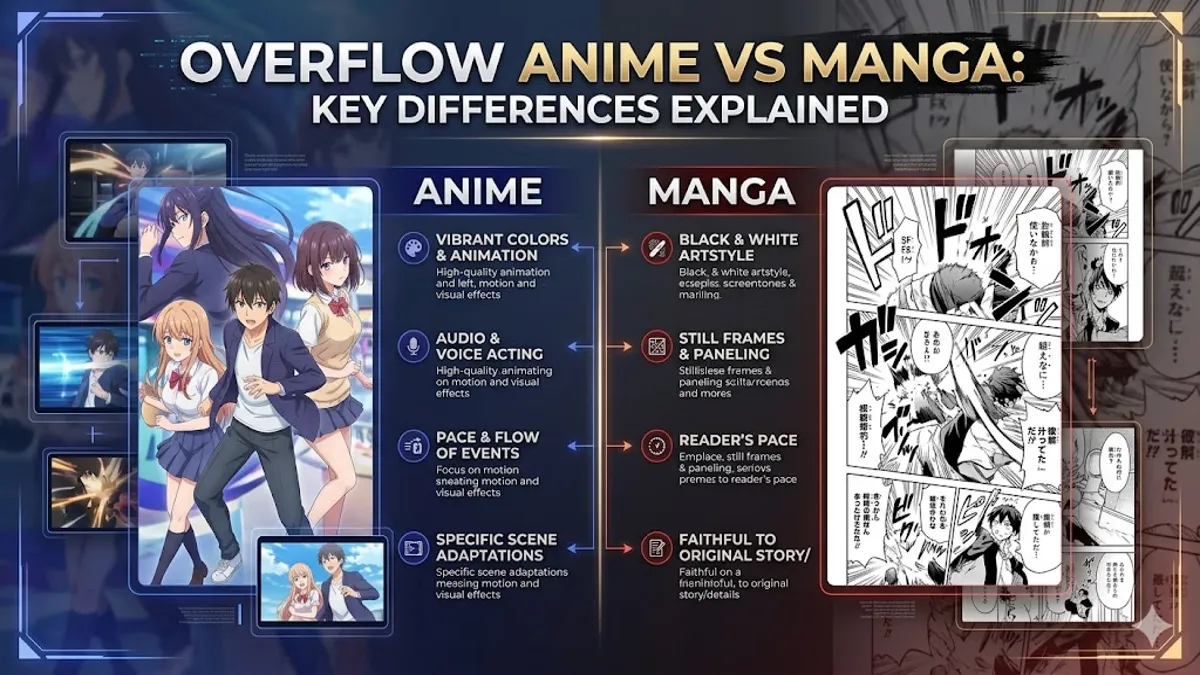
Overflow Anime vs Manga: Every Key Difference Explained (2026)
| The Overflow anime and Kaiduka’s original manga tell the same story — but not in the same way. From a significant character relationship change to pacing, content, and what the manga reveals that the anime never shows, here is every difference broken down clearly. |
When Overflow premiered on Tokyo MX on January 6, 2020, most viewers had no idea it was based on a manga that predated it by over a year. Kaiduka’s original manga — published under the full title Overflow: Iretara Ofureru Kyoudai no Kimochi — was serialised on the ComicFesta digital platform and compiled into a single volume by Suiseisha in October 2018. The anime adaptation followed in early 2020, directed by Rei Ishikura at Studio Hokiboshi with a script by Eeyo Kurosaki.
Most people who watched Overflow did so without ever reading the manga. And if you are curious whether the manga is worth reading after the anime — or whether you are missing anything important by only watching — this guide gives you a straight answer to both questions.
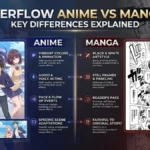
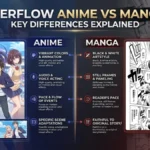
Quick Comparison: Anime vs Manga at a Glance
| ANIME | MANGA |
| 8 episodes, 7–8 min each (complete version) | 1 compiled volume, approx 8–10 chapters |
| Released January–February 2020 | Serialised 2018, compiled volume October 2018 |
| Studio Hokiboshi / Director: Rei Ishikura | Author and artist: Kaiduka |
| Kazushi and the sisters are childhood FRIENDS | Kazushi is the sisters’ cousin — a blood relative |
| Script adapted by Eeyo Kurosaki | Original story by Kaiduka |
| Colour animation with voice acting and music | Black and white static panels |
| More content added in anime-original scenes | More internal character monologue and backstory |
| Exists in censored and uncensored versions | Single explicit adult version |
| Available on Amazon Prime, AnimeFesta, HiAnime | Available on BookWalker, ComicFesta, Coolmic |
Difference 1: The Relationship Between Kazushi and the Sisters
This is the most significant and most discussed difference between the manga and the anime — and it changes the entire framing of the story.
In the Manga
In Kaiduka’s original manga, Kazushi Sudou is the cousin of Ayane and Kotone Shirakawa. They are related by blood. The sisters lost their parents when they were young and were taken in and raised by Kazushi’s family, making him effectively their guardian as well as their cousin. This relationship dynamic is central to the manga’s tone — the closeness between the characters has a specific weight that comes from genuine family bonds, and the crossing of those boundaries carries a particular emotional charge that the manga does not shy away from.
In the Anime
The anime changes this relationship entirely. Kazushi and the Shirakawa sisters are childhood friends rather than cousins. They grew up together but are not blood relatives, and there is no familial guardianship element to their relationship. The sisters simply visit Kazushi’s apartment as friends, which is why the bath incident that kicks off the story feels plausible — they treat his home with the casual familiarity of old friends rather than family members.
| Why was this changed? The anime was broadcast on Tokyo MX — a standard television channel. The cousin/guardian relationship in the manga was considered too close to taboo territory for a broadcast adaptation. Changing the relationship to childhood friends allowed the anime to keep the core emotional dynamic while removing the element most likely to cause controversy with broadcasters and mainstream audiences. The uncensored AnimeFesta version of the anime still uses the childhood friends framing rather than restoring the manga’s cousin relationship. |
Difference 2: Story Pacing and Scene Order
The manga and anime follow the same broad story arc — the accidental bath encounter, the gradual escalation of intimacy between Kazushi and both sisters, and the emotional resolution of their three-way relationship. However, the pacing and scene ordering differ in several places.
The Manga Moves Slowly
Because manga is a static medium where the reader controls the pace, Kaiduka uses more panels to develop each scene. Internal monologue plays a larger role — particularly Kazushi’s guilt-driven inner commentary as he tries to make sense of what is happening. You spend more time inside his head, which gives his emotional arc more texture than the anime can provide in 7-minute episodes.
The Anime Compresses and Rearranges
The anime condenses some scenes and reorders others to fit the episodic format. Screenwriter Eeyo Kurosaki also wrote a number of anime-original scenes that do not appear in the manga at all — these fill the runtime and add moments of character interaction that the compiled manga volume does not contain. The NamuWiki analysis of the series notes specifically that the anime includes original episode content beyond the first compiled volume of the manga.
Episode Endings vs Chapter Endings
Each of the eight anime episodes ends at a dramatically effective point designed to encourage watching the next episode immediately. The manga’s chapter breaks fall at different points, sometimes mid-scene, which gives the reading experience a different rhythm. If you read the manga after watching the anime, the chapter breaks will feel unfamiliar even when the content is similar.
Difference 3: Content and Explicitness
Both the manga and the complete uncensored anime version contain explicit adult content. However, the nature of that explicitness differs between the two mediums in ways that affect the overall experience.
The Manga
Kaiduka’s manga is illustrated in black and white, as is standard for manga format. The explicit scenes are drawn in detail but are static — they rely on the reader’s imagination to fill in movement and sound. The manga also integrates its explicit content more directly into the story’s emotional beats, often using the intimate scenes to advance character development rather than as standalone set pieces. The manga is also the only version of the story where the cousin/guardian relationship framing applies, which adds a different emotional weight to the explicit content.
The Anime Complete Version
The uncensored complete version of the anime, available on AnimeFesta, brings the scenes to life with full animation, voice acting from Tomoe Tamiyasu (Ayane), Mitsu Anzu (Kotone), and Sadai Tsukuda (Kazushi), and a full soundtrack. The animated format makes the explicit content more immediate and visceral than the static manga panels. Many fans who read the manga after watching the anime note that the voice acting in particular gives the characters a distinctly different feel from how they imagined them while reading.
The Censored Anime Version
The censored broadcast version — available on Amazon Prime Video — removes all explicit content entirely. Episodes run approximately 3 to 4 minutes each rather than the full 7 to 8 minutes of the complete version. The story is still coherent but feels significantly compressed. This is the version furthest from both the manga and the complete anime, and is primarily useful for viewers who want to understand the story without adult content.
| Three versions, one story — summary: Manga: Black and white static panels, explicit, cousin relationship framing, more inner monologue Anime Complete Version: Full animation, voice acting, explicit, childhood friends framing Anime Censored Version: Compressed episodes, no explicit content, childhood friends framing |
Difference 4: Character Portrayal and Inner Life
Kazushi Sudou
In the manga, Kazushi’s internal monologue is extensive. You understand exactly what he is thinking at each stage of the story — his guilt about what is happening, his confusion about his feelings for both sisters, and his gradual emotional acceptance of the situation. The anime, constrained by its runtime, cannot replicate this level of internal narration. Anime Kazushi comes across as more passive and reactive because the medium cannot convey his inner voice as effectively. Viewers who read the manga often report finding Kazushi more sympathetic on the page than on screen precisely because of this difference.
Ayane Shirakawa
Ayane’s tsundere personality comes through clearly in both versions — she is assertive, sometimes sharp, and uses humour to mask vulnerability. The manga gives her more space for the vulnerability part. Small panels showing her expression when she thinks Kazushi is not watching convey emotional beats that the anime’s runtime does not always have space for. The voice performance by Tomoe Tamiyasu compensates for this in the anime by adding tonal nuance that the static panels cannot replicate.
Kotone Shirakawa
Both versions treat Kotone as the emotional core of the story, but the manga makes this more explicit. She is the character illustrated on the cover of the compiled volume, and the manga’s final chapter centres on her relationship with Kazushi in a way that confirms her status as the primary heroine. The anime’s final episode similarly centres on Kotone — this is one of the areas where the adaptation closely mirrors the source material’s intent.
Difference 5: What the Manga Has That the Anime Does Not
Beyond the relationship framing change, several specific elements of the manga did not make it into the anime adaptation.
More Backstory on the Sisters’ Childhood
The manga devotes more space to the sisters’ background — specifically the loss of their parents and how Kazushi’s family became their guardians. In the anime, this backstory is either absent or reduced to brief references. The emotional weight of the sisters’ dependence on Kazushi is therefore much stronger in the manga than in the anime, where they simply appear as childhood friends with no particular reason for their deep attachment beyond shared history.
Additional Scenes Not Adapted
The compiled manga volume contains scenes and moments that the eight-episode anime adaptation did not include. Some of these are character interactions that provide additional context for the relationships; others are standalone moments that add texture without advancing the main plot. Readers who go from the anime to the manga will encounter content they have not seen before, even though the core story arc is the same.
Title Difference Between Volumes
An interesting detail noted in NamuWiki’s analysis: the first compiled volume of the manga carries the title Overflow: Iretara Ofureru Kyoudai no Kimochi (Overflow: The Feeling of a Sister Overflowing When Inserted). From the second volume onward, the series title changes to Overafter, with a changing subtitle for each subsequent volume. The anime adaptation used only the first volume as its primary source, which is why Season 2 speculation often references whether a second anime season would need to adapt the Overafter volumes.
Difference 6: Visual Style and Art
Manga Art Style
Kaiduka’s art in the manga is detailed and expressive, with character designs that emphasise the emotional states of the characters through facial expression and body language. Like virtually all manga, it is published in black and white. The panel layouts vary in size and arrangement to control pacing — larger panels for emotionally significant moments, smaller panels for dialogue-heavy exchanges. The art style is fairly typical of the ComicFesta manga platform’s adult romance genre, with an emphasis on character expressiveness over detailed backgrounds.
Anime Character Design
The anime’s character designs were handled by Yoshihiro Watanabe, whose previous credits include Haganai and Heaven’s Lost Property. Watanabe’s adaptation of Kaiduka’s character designs brings them into full colour and gives them a slightly cleaner, more polished look appropriate for animation. The fundamental designs — Ayane’s more assertive visual language, Kotone’s softer and more reserved appearance — are faithfully carried over from the manga. Most viewers find the anime designs to be a natural and faithful translation of the manga’s character art rather than a significant departure.
Which Should You Read or Watch — and in What Order?
If You Have Only Watched the Anime
The manga is worth reading if you want more of the story’s emotional depth, particularly Kazushi’s inner perspective, and if you are curious about the cousin relationship framing that was changed for the broadcast adaptation. You will also encounter content that was not adapted into the anime. Reading the manga after watching the anime is a common path for fans who want more of the world after finishing all eight episodes.
If You Have Only Read the Manga
The anime is worth watching primarily for the voice acting, which adds a dimension that the static black and white panels cannot provide. Tomoe Tamiyasu’s performance as Ayane and Mitsu Anzu’s as Kotone are cited frequently by fans as genuinely adding to the characters rather than simply illustrating the manga’s existing characterisation. The full animation and soundtrack also make the complete uncensored version a meaningfully different experience from the manga even when the scenes are narratively identical.
Recommended Order for New Fans
Most fans recommend watching the complete anime version first, then reading the manga for additional depth and the different relationship framing. The anime is the more accessible entry point — it can be watched in under an hour — and provides enough narrative context to make the manga’s slower pacing feel rewarding rather than redundant.
Where to Read the Overflow Manga
The Overflow manga is available through the following official and legitimate platforms:
- BookWalker — Digital manga platform with a large library of Japanese titles. The manga is available for purchase in Japanese with regional availability depending on your country.
- ComicFesta / AnimeFesta — The original serialisation platform where the manga was published. The most direct official source.
- Coolmic and OceanVeil — International adult manga and anime platforms that carry officially licensed WWWave Corporation content including Overflow for international readers.
- Amazon Kindle — The compiled volume may be available through Amazon’s Kindle manga library depending on your region.
For the anime, see our full guide: Where to Watch Overflow Online: Every Streaming Option in 2026 for a complete breakdown of every legal platform.
Summary: The 5 Most Important Differences
| # | Anime | Manga |
| 1 | Kazushi and sisters are childhood friends | Kazushi is the sisters’ cousin and guardian |
| 2 | 8 episodes, ~7 mins each | 1 compiled volume (8–10 chapters), more content |
| 3 | Anime-original scenes added | More inner monologue and character backstory |
| 4 | Colour animation with voice acting | Black and white static panels |
| 5 | Relationship backstory is minimal | Sisters lost parents, raised by Kazushi’s family |
Frequently Asked Questions
Is the Overflow manga different from the anime?
Yes, in several important ways. The most significant difference is the relationship between the characters: in the manga, Kazushi is the cousin and guardian of the Shirakawa sisters, while in the anime they are simply childhood friends. The manga also contains more internal character monologue and backstory that was not adapted into the anime’s compressed eight-episode format.
Does the manga have more content than the anime?
Yes. The manga contains scenes and character moments that were not adapted into the anime. It also devotes more space to the sisters’ backstory — specifically the loss of their parents and Kazushi’s role as their guardian — which is largely absent from the anime. The series also continued beyond the first compiled volume under the title Overafter, providing additional story content beyond the eight anime episodes.
Is the Overflow manga explicit?
Yes. Kaiduka’s manga is an adult title published on the ComicFesta platform, which specialises in explicit adult romance manga. It contains the same type of content as the uncensored complete version of the anime, presented in black and white static panel form rather than animation.
Which is better — the anime or the manga?
This depends on what you are looking for. The manga provides more story depth, more character backstory, and the original relationship framing between the characters. The anime provides voice acting, colour animation, and a soundtrack that the manga cannot replicate. Most fans recommend experiencing both — watching the complete anime version first for accessibility, then reading the manga for additional depth.
Can I read the Overflow manga in English?
Official English translations of the manga have limited availability. The compiled volume is available in Japanese on platforms like BookWalker and ComicFesta. For international readers, Coolmic and OceanVeil carry officially licensed content from WWWave Corporation, which may include translated versions. Check both platforms for current availability in your region.
Why did the anime change Kazushi from a cousin to a childhood friend?
The change was made to allow the story to be broadcast on Tokyo MX, a standard Japanese television channel. The cousin and guardian relationship in the original manga was considered too close to taboo content for a broadcast adaptation. Changing the relationship to childhood friends allowed the anime to preserve the emotional dynamics of the original story while making it acceptable for television broadcast.
Final Verdict
The Overflow anime is an adaptation that is largely faithful to the spirit and story of Kaiduka’s manga but makes one significant structural change — the relationship between the characters — and necessarily compresses content to fit its runtime. It adds something the manga cannot provide: voice acting, animation, colour, and music. The manga adds something the anime cannot provide: inner character depth, backstory, and the original relationship framing.
Neither is a substitute for the other. If you have only watched the anime and want more of the story, the manga is worth reading. If you have only read the manga and want to hear the characters brought to life, the complete anime version delivers that. For anyone approaching Overflow for the first time, the complete anime version remains the better starting point — it is faster, more accessible, and provides enough of the story to understand why the series generated the response it did.