
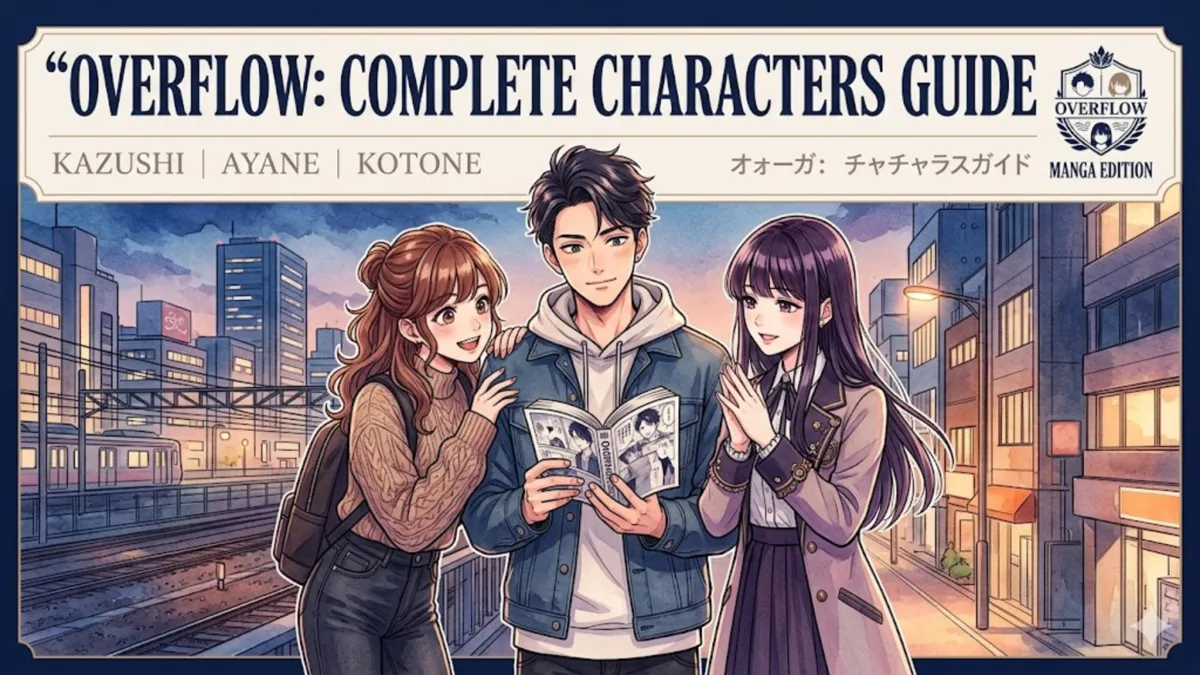
When Overflow premiered on Tokyo MX on January 6, 2020, it arrived with almost no fanfare — a short-form anime adaptation of Kaiduka’s adult manga, produced under the ComicFesta banner by Studio Hōkiboshi. Each episode ran barely seven minutes. The premise seemed straightforward: a college student named Kazushi Sudō reconnects with his childhood friends, the Shirakawa sisters, and domestic proximity leads to romantic and sexual entanglement. Within weeks, the series had become a viral phenomenon, discussed far beyond the niche audience its creators likely anticipated. The reason was not spectacle or budget. It was characters.
Kazushi Sudō, Ayane Shirakawa, and Kotone Shirakawa form a triangular dynamic that, despite its explicit framing, taps into recognizable narrative traditions — the passive male protagonist caught between assertive and demure archetypes, the tsundere older sister, the quiet younger sibling whose gentleness conceals determination. These are not new constructions. What made Overflow distinctive was the economy with which it deployed them. In a format offering roughly fifty-six total minutes of story across eight episodes, Kaiduka and director Rei Ishikura had almost no room for exposition. Every scene had to function simultaneously as character development and plot progression. The result was a trio of characters who, for better or worse, became shorthand for an entire subgenre. This guide examines each of them in detail — their design, their narrative function, their relationship to broader anime archetypes, and the cultural discourse they provoked.
READ: Overflow Season 2: Release Date, Updates & Everything You Need to Know (2026)
The ComicFesta Model and Its Character Requirements
To understand Kazushi, Ayane, and Kotone, it helps to understand the production ecosystem that created them. ComicFesta — later rebranded AnimeFesta — is a platform operated by WWWave Corporation that has been producing short-form anime adaptations of adult manga since 2017, beginning with Sōryo to Majiwaru Shikiyoku no Yoru ni… that April. The model is consistent: each series receives a censored broadcast version for Tokyo MX television and an explicit “complete version” for online streaming. As Anime News Network reported when announcing the adaptation, Overflow was unusual among ComicFesta productions in that it retained the same voice cast across both versions, rather than employing separate actors for the broadcast and premium editions.
This dual-version structure places specific demands on character writing. Characters must be legible and engaging in a censored cut that strips away explicit content, which means their personalities, motivations, and emotional arcs must carry narrative weight independent of sexual scenes. Kaiduka’s original manga, published by Suiseisha with a compiled volume released in October 2018, provided the template. But the anime’s screenwriter, Eeyo Kurosaki, and character designer Yoshihiro Watanabe — whose credits include Haganai and Heaven’s Lost Property — refined the trio into something more streamlined. The result was a set of characters whose appeal transcended their genre classification.
Kazushi Sudō: The Reluctant Center
Kazushi Sudō is, on the surface, the least distinctive member of the triangle. He is a university student living alone. He is characterized as passive, somewhat indecisive, and perpetually caught off guard by the actions of the women around him. In the taxonomy of anime protagonists, he belongs to the “lucky pervert” tradition — a male character whose sexual encounters arise from circumstance rather than agency. His first intimate encounter with Kotone occurs, quite literally, by accident in a bathtub. His encounter with Ayane follows from a case of mistaken identity in the dark.
Yet dismissing Kazushi as a blank-slate audience surrogate misses the structural role he plays. In a series this compressed, Kazushi functions as the narrative’s moral compass — however wobbly that compass may be. His recurring guilt after each encounter, his awkward attempts at apology, and his gradual acceptance of reciprocal feelings provide the closest thing Overflow has to dramatic tension. He is the character through whom the series asks its central question: what happens when childhood bonds cross irreversible thresholds?
Kazushi’s relationship with the Shirakawa sisters predates the events of the series by many years. In the anime adaptation, the three are childhood friends who grew up in close proximity, with Kazushi serving as an older-brother figure. This is a notable departure from the original manga, where the Shirakawa sisters lost their parents young and were raised by Kazushi as a cousin, creating a dynamic closer to pseudo-incest. The anime’s decision to reframe the relationship as one between unrelated childhood friends was a deliberate softening, likely aimed at the broader broadcast audience.
| Attribute | Kazushi Sudō |
|---|---|
| Role | Male Protagonist |
| Occupation | University Student |
| Voice Actor | Sadei Tsukuda |
| Key Trait | Passive, guilt-prone, emotionally conflicted |
| Relationship to Sisters | Childhood friend (anime) / Cousin (manga) |
| Narrative Function | Moral anchor; audience surrogate |
| Character Arc | From avoidance to acceptance of a polyamorous dynamic |
Ayane Shirakawa: Tsundere as Structural Engine
Ayane Shirakawa, the elder of the two sisters, is the character most responsible for setting the plot of Overflow in motion. It is Ayane who, angered by Kazushi’s unauthorized use of her expensive bath salts, decides to join him in the bathtub alongside Kotone. It is Ayane’s departure from the bath that creates the opportunity for Kazushi and Kotone’s first encounter. And it is Ayane’s eventual discovery of — and complicated reaction to — these events that drives the emotional stakes of subsequent episodes.
Voiced by Tomoe Tamiyasu, Ayane is a textbook tsundere: outwardly abrasive, quick to scold, prone to physical retaliation, but fundamentally motivated by deep romantic feelings she struggles to articulate. Her attachment to Kazushi is symbolized, with disarming simplicity, by pudding. As a child, Kazushi once gave Ayane pudding as a gift, and she has remained devoted to the dessert — and, by extension, to him — ever since. This detail, small as it is, exemplifies the kind of efficient characterization Overflow relies on. In a series where screen time is measured in seconds rather than minutes, a single recurring motif replaces pages of backstory.
Ayane’s arc across the series involves moving from defensive hostility to honest emotional expression. She is beauty-conscious, spending her allowance on skincare products and bath salts. She maintains high academic standards. She is, in many ways, the “responsible” sibling. But her tsundere exterior is also a defense mechanism against vulnerability, and the series charts — with surprising care, given its genre — her gradual willingness to be direct about what she wants. By the conclusion of the eight-episode run, Ayane has agreed to share Kazushi’s affections with her younger sister, accepting a non-traditional relationship structure. This resolution is played neither for comedy nor for titillation. It is presented as an emotionally logical endpoint for a character whose entire arc has been about learning to stop competing and start communicating.
“The tsundere archetype endures in anime because it externalizes a universal emotional conflict,” anime critic and scholar Jonathan Clements has observed in his writing on character archetypes. “The gap between what characters feel and what they are willing to say is the engine of dramatic tension.” Ayane Shirakawa is a concentrated example of this principle, compressed into a format that leaves no room for ambiguity.
Kotone Shirakawa: Quiet Determination and the Imouto Archetype
If Ayane is the loud half of the Shirakawa dynamic, Kotone is its quieter counterpart — but quieter does not mean passive. Voiced by Anzu Mitsu, Kotone is the younger sister, characterized by a gentle demeanor, domestic competence, and an outward innocence that belies considerable strategic thinking. She is the first of the two sisters to become physically intimate with Kazushi, and the series’ final episode centers on her. The cover illustration of Kaiduka’s original manga volume features Kotone, not Ayane, suggesting that the creator always viewed her as the primary heroine despite the narrative weight Ayane carries.
Kotone occupies the “imouto” (little sister) archetype, one of the most debated character types in anime discourse. She addresses Kazushi as “Onii-chan” (big brother), positions herself as a domestic caretaker in his apartment, and presents a deliberately wife-like persona. Her character design reinforces this duality — she has shorter black hair compared to Ayane’s longer brown waves, projects a softer physical presence, and communicates through observation rather than confrontation.
Her arc is deceptively simple: Kotone wants to be recognized by Kazushi as a woman rather than as a younger-sister figure. This desire, articulated through action rather than dialogue, drives many of the series’ key scenes. Where Ayane’s feelings are hidden behind hostility, Kotone’s are hidden behind compliance. She mediates between Ayane and Kazushi, ensures domestic harmony, and positions herself as indispensable — all while quietly ensuring she is not excluded from the growing intimacy between Kazushi and her older sister. By the series’ conclusion, she has successfully integrated herself into a three-way relationship, achieving through patience what Ayane achieves through confrontation.
“Kotone represents a character type that anime has explored for decades but rarely with this degree of self-awareness,” notes media analyst Sarah Engel, writing on the evolution of imouto characters in contemporary anime. “She knows exactly what she is doing, and the series knows that she knows.” This meta-awareness — the sense that Kotone is performing innocence as a strategy rather than embodying it as a trait — is what separates her from more straightforward iterations of the archetype.
| Character | Ayane Shirakawa | Kotone Shirakawa |
|---|---|---|
| Position | Older Sister | Younger Sister |
| Voice Actor | Tomoe Tamiyasu | Anzu Mitsu |
| Hair | Brown, waist-length | Black, neck-length |
| Archetype | Tsundere | Imouto |
| Key Trait | Assertive, beauty-conscious | Gentle, domestically skilled |
| Emotional Strategy | Hostility masking affection | Compliance masking determination |
| Signature Detail | Pudding obsession | “Onii-chan” address |
| Resolution | Accepts shared relationship | Integrates into shared relationship |
Cultural Discourse and the Viral Moment
Overflow did not remain a quiet niche production. When it premiered in January 2020, its unusually high production quality — Studio Hōkiboshi’s animation rivaled that of mainstream seasonal anime — combined with the ambiguity of its censored broadcast version to create a “bait-and-switch” phenomenon. Clips circulated on YouTube and social media, often without context, reaching viewers who assumed they were watching a standard romantic comedy or ecchi series. The realization that this was, in fact, a full hentai production sparked a wave of memes, warnings, and discourse. Database sites like MyAnimeList debated how to categorize the show, eventually settling on an “Rx – Hentai” rating.
The characters were at the center of this discourse. Kazushi’s passivity was criticized as emblematic of a male protagonist archetype that enables problematic narratives by removing male agency from sexual encounters. Ayane and Kotone’s “pseudo-sibling” dynamic with Kazushi — especially in the original manga’s cousin framing — triggered discussions about the imouto trope’s proximity to incest-adjacent fantasy. Defenders argued that the anime’s revised “childhood friends” framing neutralized these concerns; critics countered that the domestic cohabitation setup and the sisters’ “Onii-chan” address preserved the troubling undertones regardless of the stated backstory.
Anime studies researcher Dr. Patrick Galbraith, whose work on otaku culture has examined the boundary between fiction and social norms, has noted that characters like those in Overflow function as “limit cases” for genre conventions. They push familiar archetypes to their logical extremes, forcing audiences to articulate what they find acceptable and why. Whether viewers engaged with Kazushi, Ayane, and Kotone as entertaining fiction, as objects of critique, or as both simultaneously, the characters served as catalysts for a broader reckoning with adult anime’s relationship to mainstream culture.
Production and Adaptation Choices
The transition from Kaiduka’s manga to Rei Ishikura’s anime involved several meaningful decisions that reshaped the characters. The most significant was the backstory revision: changing the Shirakawa sisters from Kazushi’s cousins to his childhood friends. This alteration, small in terms of screen time, fundamentally recontextualized every interaction. It also allowed the anime to air on Tokyo MX without triggering broadcast regulations that might have applied to content depicting familial sexual relationships.
Yoshihiro Watanabe’s character designs translated Kaiduka’s manga art into a style that balanced accessibility with the series’ adult content. Ayane was given a taller, slimmer build to visually contrast with Kotone’s shorter, softer frame. Color choices — Ayane’s brown hair against Kotone’s black — reinforced the sisters’ complementary opposition. These are standard techniques in anime character design, but their execution in Overflow was notably precise for a short-form production. Chief animation directors Kazuya Kuroda, Kakuto Gai, and Hisashi Nakamoto maintained consistent character models across all eight episodes, an achievement that lent the series a visual polish unusual for its format and genre.
Legacy and Continued Relevance
Five years after its debut, Overflow remains one of the most-viewed adult anime on tracking sites. Its characters have been widely reproduced in fan art, discussion threads, and AI character platforms. The series demonstrated that short-form adult anime could generate mainstream cultural conversation — not despite its characters’ simplicity, but because of it. Kazushi, Ayane, and Kotone are legible enough to be understood in a seven-minute episode and complex enough to sustain years of discourse. That balance is their most significant achievement.
The ComicFesta model has continued producing similar series, but none have replicated Overflow‘s crossover moment. This suggests that the characters’ success was not merely a product of format or marketing, but of specific creative choices — Kaiduka’s economical storytelling, Kurosaki’s scriptwriting, Watanabe’s designs — that aligned at the right cultural moment. The early months of 2020, just before the global pandemic restructured media consumption habits, proved to be a uniquely receptive window for a series that could be consumed in under an hour and discussed for far longer.
Key Takeaways
- Kazushi Sudō functions as more than a passive protagonist; his guilt and gradual emotional acceptance provide Overflow‘s only sustained dramatic arc across its eight compressed episodes.
- Ayane Shirakawa is the series’ narrative engine, whose tsundere archetype drives plot momentum while her pudding-linked backstory provides efficient emotional shorthand.
- Kotone Shirakawa subverts the imouto archetype through strategic self-awareness, performing innocence as a deliberate tactic rather than embodying it as a character limitation.
- The anime’s decision to rewrite the characters as childhood friends rather than cousins fundamentally recontextualized their dynamic for broadcast viability.
- Overflow‘s viral crossover moment was driven by the characters’ legibility — they could be understood, debated, and memed without requiring deep genre knowledge.
- Studio Hōkiboshi’s production quality elevated the characters beyond genre expectations, giving them visual polish that invited mainstream attention.
- The series remains a case study in how archetype-driven character design can generate cultural discourse disproportionate to a production’s scale.
Conclusion
The characters of Overflow are not, by any traditional measure, groundbreaking. Kazushi Sudō is a recognizable type. Ayane and Kotone Shirakawa map onto archetypes that anime has deployed for decades. What distinguishes them is context — the extreme compression of the short-form format, the dual-version production model that required them to function with and without explicit content, and the cultural moment in which they arrived. These constraints produced characters who are, paradoxically, both simpler and more efficient than their counterparts in longer, more prestigious productions.
Whether one views Overflow as a well-crafted piece of genre entertainment, as a problematic artifact of anime’s more controversial tendencies, or as both, the three characters at its center reward examination. They are a reminder that character design in anime is, at its core, an exercise in compression — in communicating personality, desire, and conflict through the fewest possible gestures. Kaiduka, Ishikura, and their collaborators achieved that compression with a precision that made Kazushi, Ayane, and Kotone impossible to ignore. The conversation they started has not yet ended.
Frequently Asked Questions
What is the relationship between Kazushi and the Shirakawa sisters? In the anime adaptation, Kazushi and the sisters are childhood friends who grew up in close proximity, functioning like siblings without being blood-related. The original manga depicted them as cousins, a detail the anime altered for broadcast.
How many episodes does Overflow have? The first season consists of eight episodes, each approximately seven minutes long. It aired on Tokyo MX from January to April 2020, with both censored broadcast and explicit streaming versions produced by Studio Hōkiboshi.
Who created the original Overflow manga? The manga was created by Kaiduka and published by Suiseisha, with a compiled volume released in October 2018. The anime adaptation was announced in November 2019 and directed by Rei Ishikura.
Is Ayane or Kotone the main heroine of Overflow? The series treats both as co-leads, though evidence suggests Kotone holds a slight edge. She is featured on the manga’s cover, has the first and final intimate scenes, and the narrative’s conclusion centers on her integration into the relationship.
What is ComicFesta / AnimeFesta? ComicFesta, now rebranded as AnimeFesta, is a platform operated by WWWave Corporation that produces short-form anime adaptations of adult manga. It launched in 2017 and releases each series in censored broadcast and explicit online versions.
References
- Anime News Network. (2019, November 20). Kaiduka’s Overflow adult manga gets TV anime. https://www.animenewsnetwork.com/news/2019-11-20/kaiduka-overflow-adult-manga-gets-tv-anime/.153493
- Anime News Network. (2020, January 6). Overflow anime listed with 8 episodes. https://www.animenewsnetwork.com/daily-briefs/2020-01-06/overflow-anime-listed-with-8-episodes/.155088
- Anime News Network. (n.d.). AnimeFesta. https://www.animenewsnetwork.com/encyclopedia/anime.php?id=23049
- Otaku USA Magazine. (2019, November 20). Adult manga Overflow gets anime adaptation. https://otakuusamagazine.com/adult-manga-overflow-gets-anime-adaptation/
- Anime Characters Database. (n.d.). Ayane Shirakawa from Overflow. https://www.animecharactersdatabase.com/characters.php?id=106498
- Anime Characters Database. (n.d.). Kotone Shirakawa from Overflow. https://www.animecharactersdatabase.com/characters.php?id=106500
- IMDb. (n.d.). Overflow (TV Mini Series 2020). https://www.imdb.com/title/tt14962432/
- aniSearch. (n.d.). Overflow. https://www.anisearch.com/anime/14792,overflow