
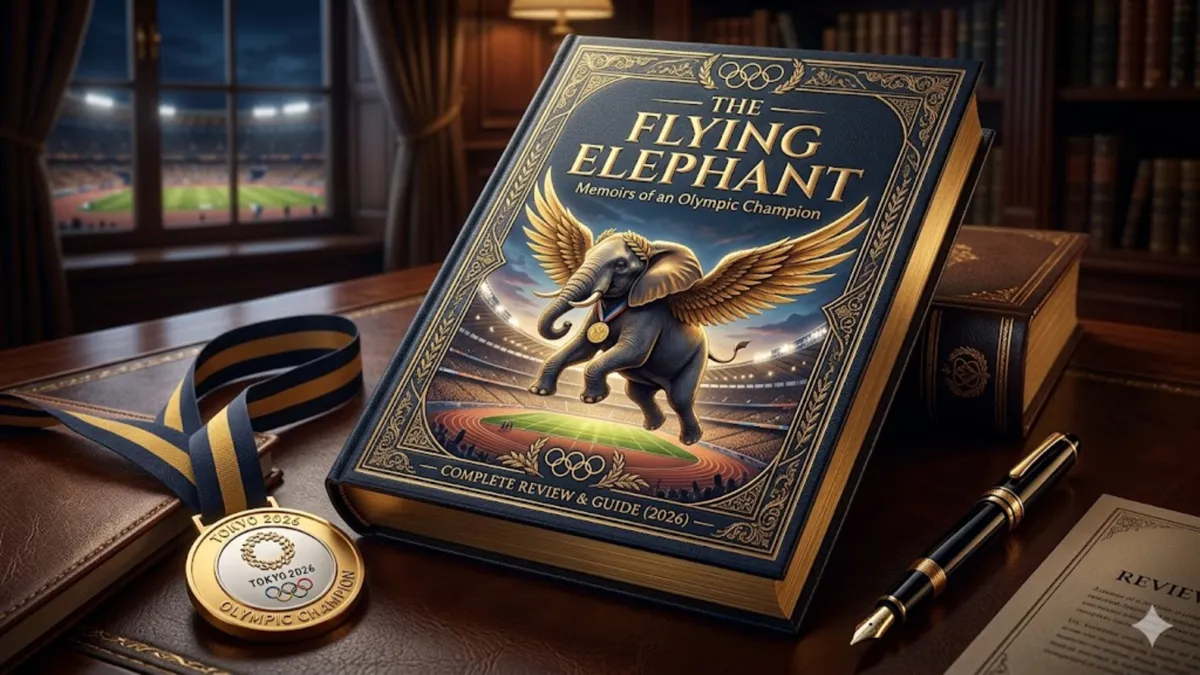
Alexander Savin won silver in Montreal and gold in Moscow. He was the Soviet Union’s most powerful middle blocker during volleyball’s most politically charged decade. Now, in his own words and over 514 pages, he tells the story no one outside Russia has ever had access to — until now.
Sports biographies tend to follow a familiar arc: prodigy emerges, obstacles arise, champion wins gold, champion reflects gratefully. The Flying Elephant: Memoirs of an Olympic Champion, published as a Kindle edition in October 2025, is not that book.
Written by Alexander Savin — a central figure in Soviet volleyball’s extraordinary run of dominance through the late 1970s and 1980s — this memoir spends more time on the teammates history forgot than on the medals he personally collected. That unusual editorial decision is also what makes this one of the most rewarding sports memoirs published in English in years.
At a Glance: The Flying Elephant Memoir
📖 Book Details
| Field | Detail |
|---|---|
| Full Title | The Flying Elephant: Memoirs of an Olympic Champion |
| Author | Alexander Savin |
| Published | October 26, 2025 |
| Format | Kindle Edition (digital only) |
| Pages | 514 pages |
| Photographs | 240+ rare photographs |
| Translators | Andrei Savine, Julia Savine, Peter Murphy, Alfredo Cabero |
| File Size | 68.8 MB (due to embedded photographs) |
| Where to Buy | Amazon Kindle (globally available) |
| Best Read On | Kindle app on tablet (for full-color photos) |
Who Is Alexander Savin? The Man Behind the Nickname
Alexander Savin was born on July 1, 1957, in Taganrog, in the Rostov region of Russia. His family moved to Obninsk in the Kaluga region when he was a child, and it was there that his athletic potential was first identified and developed through the Soviet sports system.
He became a middle blocker for CSKA Moscow and the Soviet national team during one of the most dominant periods any team has enjoyed in international volleyball history. His career record reads like a catalog of excellence:
| Competition | Result | Year(s) |
|---|---|---|
| Olympic Games — Montreal | 🥈 Silver Medal | 1976 |
| Olympic Games — Moscow | 🥇 Gold Medal | 1980 |
| World Championship | 🥇 Gold Medal | 1978 (Italy), 1982 (Argentina) |
| European Championship | 🥇 Gold Medal | 1975, 1977, 1979, 1981, 1983, 1985 |
| World Cup | 🥇 Gold Medal | 1977, 1981 |
Six European Championship golds. Two World Championship golds. Two World Cup golds. An Olympic silver and an Olympic gold. By any measure, Savin was a central figure in one of the most decorated runs in international volleyball history.
So why the nickname “The Flying Elephant”? According to La Gazzetta dello Sport, the nickname emerged from a simple but striking contradiction: Savin was large and powerful — the build of a middle blocker built to dominate at the net — but he moved and jumped with a speed and vertical elevation that seemed physically inconsistent with his size. An elephant, by conventional understanding, does not fly. Savin, by conventional understanding, should not have been able to jump that high. He did anyway. The nickname stuck.
“A flying elephant suggests the impossible made real through discipline, training, and the refusal to accept physical constraints as permanent.”
What the Memoir Covers: A Chapter-by-Chapter Overview
Early Life and Soviet Sports System
Savin opens with his childhood and the experience of growing up in a Soviet society where sports were not merely recreation but an expression of national identity and political strength. The Soviet sports system was built to produce champions systematically, and young athletes identified as promising were funneled into elite programs from an early age.
These early chapters are some of the most valuable in the memoir for readers unfamiliar with how Soviet athletics functioned from the inside. Savin describes training camps where coaches were exacting and performance standards uncompromising — environments that instilled the discipline and accountability that would define his entire career.
Rise Through National Competition
The memoir traces Savin’s progression through domestic competition and his eventual selection for the Soviet national team — a milestone he describes as representing both personal triumph and immense responsibility. To be selected was an honor. It was also a statement about who you were expected to be on behalf of an entire nation.
The 1976 Montreal Olympics — Silver and the Shock of Defeat
The 1976 Montreal Olympics were supposed to be a coronation. The Soviet team entered as the heavy favorite. Poland defeated them 3-2 in the final in one of the great upsets of Olympic volleyball history. Savin played in all five matches. His account of that defeat — and what the team did with it afterward — is one of the memoir’s most compelling sections.
The 1980 Moscow Olympics — Gold on Home Soil
Four years after Montreal, Savin and the Soviet team stood on home ground at Moscow 1980. The political context was extraordinary: the United States and 65 other countries had boycotted the Games in protest of the Soviet invasion of Afghanistan. The Soviet team defeated Bulgaria in the final, dropping just two sets across six matches.
Savin’s recollections of the 1980 Games are not triumphalist. He is candid about what it meant to win gold at a politically compromised Olympics, and how athletes navigated the intersection of personal achievement and national expectation in that environment. These chapters function as historical testimony as much as memoir.
Cold War Context Throughout
What runs through the entire memoir, and what elevates it well beyond the standard sports biography, is the Cold War context Savin lived rather than merely observed. Soviet athletes were not separate from the political tensions of their era — they were an expression of them. Every international tournament carried geopolitical weight. Every match against a Western team was implicitly about more than volleyball.
Savin writes about this reality with the perspective of someone who has spent decades reflecting on what it meant. His account of navigating that environment — the weight of expectation, the structure of elite Soviet training, the experience of competing against political adversaries in Olympic venues — is the material that makes this more than a sports story.
Post-Playing Career and Coaching
The memoir devotes significant attention to Savin’s life after his playing career ended — his transition into coaching, his observations of how the sport evolved, and his reflections on what he contributed to players who came after him. For readers curious about what champions do when the spotlight moves on, this section delivers thoughtful, honest answers.
The 240+ Photographs: A Visual Archive Unlike Any Other
At 68.8MB, the Kindle file is large for a text-based book. The reason is immediately obvious: the memoir contains over 240 photographs spanning five full decades of volleyball history.
These include training camp photographs from the Soviet era, competition images from the 1976 Montreal and 1980 Moscow Olympics, European and World Championship moments, and portraits of teammates and coaches. Many of these photographs have never been published in English-language media before. They were sourced from Savin’s personal family collection and Soviet-era public archives.
On a standard Kindle e-ink device they render in greyscale — adequate but losing color information. On the Kindle app on a tablet or large smartphone screen, they appear in full color, which is the recommended way to experience the book’s visual dimension.
Why This Memoir Matters Beyond Volleyball
Soviet volleyball’s golden era is significantly underdocumented in English. The teams that dominated the 1970s and 1980s — that went 1-2 at Moscow 1980, that swept World Championships across a twelve-year span — produced almost no memoir literature accessible to non-Russian readers. The Cold War isolation of Soviet sport meant the internal experience of those programs remained largely internal. What reached the West was results, not stories.
The Flying Elephant is the exception. A first-person account written in English by a central participant, covering the full arc from youth sport to Olympic gold to coaching. For sports historians, this alone makes it invaluable. For general readers, the themes it explores — mental resilience, collective achievement, the weight of national expectation, legacy — are universal.
Who Should Read This Book?
- Volleyball players and coaches at any level, who will find a master class in dedication, team dynamics, and competitive preparation
- Olympic history enthusiasts who want an insider’s account of Cold War-era competition at its most politically charged
- Sports biography readers who appreciate honest storytelling over triumphalist narratives
- Cold War history students — the memoir illuminates how sport functioned as a proxy battlefield during those decades
- Anyone interested in performance psychology — Savin’s mental preparation methods are detailed and relevant long before sports psychology became mainstream
Familiarity with volleyball is helpful but not required. Savin writes as an insider explaining to an engaged outsider, and the memoir’s core themes are accessible regardless of sport-specific knowledge.
Our Verdict
A rare thing in sports memoir literature: a champion who is more interested in truth than in celebration. Alexander Savin’s account of Soviet volleyball’s golden era is historically important, personally honest, and visually extraordinary thanks to its 240+ photograph archive.
If you have any interest in Olympic history, Cold War sport, or what it actually takes to operate at the highest level of international competition across a decade, this memoir earns its 514 pages.
Available exclusively on Amazon Kindle. Recommended reading device: Kindle app on tablet for full-color photo experience.
Frequently Asked Questions
Who wrote The Flying Elephant: Memoirs of an Olympic Champion?
The memoir was written by Alexander Savin, the Soviet Olympic volleyball champion who won silver at Montreal 1976 and gold at Moscow 1980. It was translated into English by Andrei Savine, Julia Savine, Peter Murphy, and Alfredo Cabero.
Why is Alexander Savin called “The Flying Elephant”?
The nickname describes the contradiction at the heart of his playing style: Savin was a large, powerful middle blocker who moved and jumped with speed and elevation that seemed impossible for his physical size. The combination of mass and vertical athleticism earned him the paradoxical nickname early in his career.
Where can I buy The Flying Elephant Kindle edition?
The book is available exclusively as a Kindle edition on Amazon, accessible globally. It can be read on any Kindle device or via the Kindle app on smartphones, tablets, and computers.
How many pages is the memoir?
514 pages, with over 240 rare photographs embedded throughout, sourced from private family collections and Soviet-era public archives.
Do I need to know about volleyball to enjoy this book?
No. Savin writes as an insider explaining to an engaged outsider. The memoir’s core themes — Cold War pressure, mental resilience, collective performance, the pursuit of excellence — are accessible to anyone regardless of sport-specific knowledge.
What Olympic medals did Alexander Savin win?
Savin won a silver medal at the 1976 Montreal Olympics and a gold medal at the 1980 Moscow Olympics. Beyond the Olympics, he won six European Championship golds, two World Championship golds (1978 and 1982), and two World Cup golds (1977 and 1981).