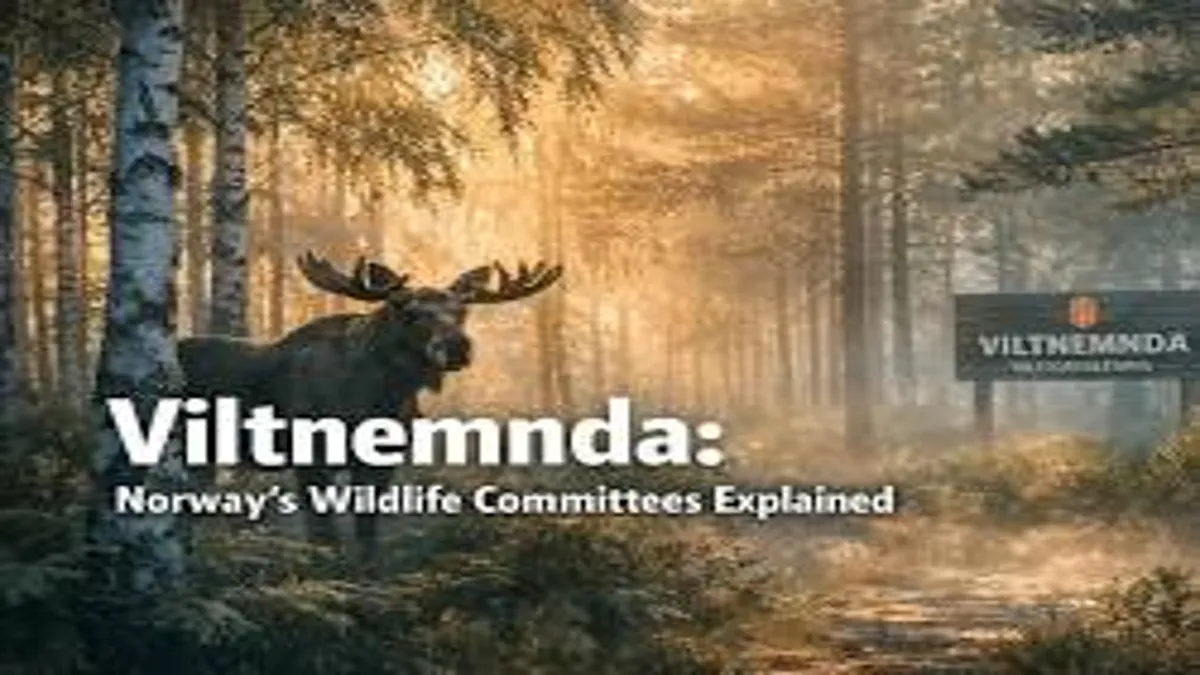
I often find that understanding a country’s relationship with nature requires looking beyond national policies and into the local institutions that quietly shape daily decisions. In Norway, one such institution is the viltnemnda, or wildlife committee. For readers searching for clarity, the term refers to municipal-level bodies responsible for managing wildlife populations, implementing hunting regulations, and ensuring ecological balance within their jurisdictions. These committees sit at the intersection of conservation science, rural traditions, and local democracy.
In practical terms, viltnemnda operates as a decision-making body within Norwegian municipalities, overseeing issues such as moose quotas, deer population control, and predator management. Their authority is grounded in national legislation, particularly the Wildlife Act of 1981, yet their decisions reflect local ecological conditions and community values. This decentralized approach allows Norway to adapt wildlife management to diverse landscapes, from dense forests to Arctic tundra.
The importance of viltnemnda has grown in recent decades as Norway faces new environmental pressures. Climate change, expanding infrastructure, and debates over large predators like wolves and bears have intensified scrutiny of how wildlife is governed. These committees must balance competing interests: protecting biodiversity, supporting hunting traditions, and addressing public safety concerns.
What emerges is a nuanced system where local knowledge and national policy converge. The story of viltnemnda is not just about wildlife. It is about governance, identity, and the evolving relationship between humans and the natural world.
READ: Betanden Meaning: How Behavior Turns Into Success
The Legal Foundations of Viltnemnda
The structure of viltnemnda is rooted in Norway’s Wildlife Act (Viltloven) of 1981, which established a framework for sustainable wildlife management. The law emphasizes that wildlife is a national resource, but its stewardship is shared with local authorities.
Municipalities are required to establish wildlife committees composed of locally elected representatives. These committees operate under guidelines from the Norwegian Environment Agency, yet retain significant autonomy in decision-making. This balance reflects Norway’s broader political philosophy of decentralization.
Legal scholar Hans Christian Bugge has noted, “Norwegian environmental law integrates national objectives with strong local implementation mechanisms” (Bugge, 2011). Viltnemnda exemplifies this approach.
The committees are responsible for setting hunting quotas, managing habitats, and addressing conflicts between wildlife and human activity. Their decisions must align with scientific data, but they also consider local economic and cultural factors.
This legal framework ensures that wildlife management is both standardized and adaptable, allowing Norway to maintain ecological integrity while respecting regional diversity.
Local Governance and Decision-Making
Viltnemnda operates at the municipal level, making it one of the most localized forms of environmental governance in Europe. Members are typically drawn from local councils, ensuring democratic accountability.
Decisions are often made through consultation with landowners, hunters, and environmental experts. This collaborative approach reflects Norway’s tradition of participatory governance.
Sociologist Ottar Brox observed, “Local knowledge plays a crucial role in resource management, particularly in rural communities” (Brox, 2006). This insight is evident in how viltnemnda functions.
Meetings often involve detailed discussions about population data, seasonal patterns, and land use. The committees must balance scientific recommendations with practical realities on the ground.
This localized decision-making process allows for flexibility. For example, hunting quotas for moose may vary significantly between regions based on population density and ecological conditions.
The result is a system that is responsive and context-specific, rather than rigidly centralized.
Wildlife Management in Practice
The core responsibility of viltnemnda is managing wildlife populations. This includes setting quotas for species such as moose (elg), red deer (hjort), and roe deer (rådyr).
Table: Key Wildlife Species Managed by Viltnemnda
| Species | Primary Concern | Management Approach |
|---|---|---|
| Moose | Overpopulation, traffic risk | Regulated hunting quotas |
| Red Deer | Agricultural impact | Seasonal hunting |
| Roe Deer | Ecosystem balance | Population monitoring |
| Wolves | Predator-prey conflict | Controlled culling debates |
| Bears | Conservation vs safety | National oversight + local input |
Moose management is particularly significant. Norway has one of the highest moose densities in Europe, leading to frequent road accidents. Viltnemnda plays a key role in reducing these risks through controlled hunting.
Ecologist Atle Mysterud explains, “Adaptive management of ungulates is essential to balance ecological and societal needs” (Mysterud, 2011). This principle guides committee decisions.
The challenge lies in maintaining sustainable populations while addressing human concerns. Each decision reflects a careful negotiation between competing priorities.
The Role of Hunting Culture
Hunting is deeply embedded in Norwegian culture, and viltnemnda must navigate this tradition carefully. Hunting is not only a recreational activity but also an important source of food and income in rural areas.
The committees regulate hunting seasons, issue permits, and ensure compliance with national laws. Their decisions directly affect local communities, making transparency and fairness essential.
Historian Peder Anker notes, “Norwegian environmental policy often integrates traditional practices with modern conservation principles” (Anker, 2018). This integration is evident in wildlife management.
Hunters often participate in data collection, providing valuable information about animal populations. This collaboration strengthens the relationship between authorities and communities.
However, tensions can arise. Debates over predator control, particularly wolves, highlight differing perspectives on conservation and tradition.
Viltnemnda must balance these interests, ensuring that hunting remains sustainable while protecting biodiversity.
Predator Management and Public Debate
Few issues generate as much controversy as the management of large predators. Wolves, bears, and lynx are protected species, yet they also pose challenges for livestock farmers and rural communities.
Viltnemnda plays a role in implementing national predator policies at the local level. This includes responding to incidents and participating in discussions about culling.
Table: Predator Management Framework in Norway
| Predator | Protection Status | Key Issue | Local Role |
|---|---|---|---|
| Wolf | Protected | Livestock predation | Input on culling decisions |
| Bear | Protected | Human safety concerns | Monitoring and reporting |
| Lynx | Protected | Population control | Regional quota input |
| Wolverine | Protected | Reindeer conflicts | Coordination with Sami |
These debates often reflect broader societal divisions. Urban populations may prioritize conservation, while rural communities emphasize safety and livelihoods.
Political scientist Peter Skogen has argued, “Conflicts over large carnivores are as much about social values as ecological facts” (Skogen, 2015).
Viltnemnda operates within this complex landscape, attempting to mediate between competing interests.
Climate Change and Emerging Challenges
Climate change is reshaping Norway’s ecosystems, creating new challenges for wildlife management. Warmer temperatures affect migration patterns, breeding cycles, and habitat availability.
Viltnemnda must adapt to these changes, often with limited resources. Monitoring systems are evolving, incorporating new technologies such as GPS tracking and data analytics.
The Norwegian Environment Agency has emphasized the need for adaptive management strategies to address climate impacts (Norwegian Environment Agency, 2020).
Changes in vegetation and snow cover influence animal behavior, requiring adjustments in hunting quotas and conservation measures.
This evolving context underscores the importance of flexibility. Static policies are no longer sufficient in a rapidly changing environment.
Viltnemnda’s ability to adapt will be crucial in maintaining ecological balance in the years ahead.
Takeaways
- Viltnemnda is a municipal wildlife committee central to Norway’s decentralized environmental governance.
- It operates under the Wildlife Act of 1981, balancing national policy with local decision-making.
- The committees manage species populations, particularly moose and deer, through regulated hunting.
- Hunting culture plays a significant role, shaping both policy and community engagement.
- Predator management remains a contentious issue involving ecological and social considerations.
- Climate change is introducing new challenges that require adaptive strategies.
Conclusion
I come away from examining viltnemnda with a sense of how deeply governance can be rooted in place. These committees are not abstract institutions. They are embedded in landscapes, communities, and traditions. They reflect a uniquely Norwegian approach to managing nature one that values local knowledge as much as scientific expertise.
The system is not without tension. Conflicts over predators, debates about hunting, and the pressures of climate change all test its resilience. Yet these challenges also highlight its strengths. By decentralizing authority, Norway allows decisions to be shaped by those most affected.
In an era where environmental issues are increasingly global, viltnemnda offers a model of localized responsibility. It shows that effective governance does not always require centralization. Sometimes, it depends on trusting communities to care for their own environments.
The future of wildlife management in Norway will likely continue to evolve. But the principles underlying viltnemnda cooperation, adaptability, and balance will remain essential.
FAQs
What is viltnemnda?
Viltnemnda is a municipal wildlife committee in Norway responsible for managing local wildlife populations and hunting regulations.
What laws govern viltnemnda?
It operates under Norway’s Wildlife Act of 1981, which outlines sustainable wildlife management principles.
What species does viltnemnda manage?
It manages species like moose, deer, and contributes to predator management involving wolves and bears.
Why is hunting important in Norway?
Hunting is both a cultural tradition and a practical tool for managing wildlife populations sustainably.
How does climate change affect viltnemnda?
Climate change alters ecosystems, requiring adaptive management strategies and updated monitoring systems.