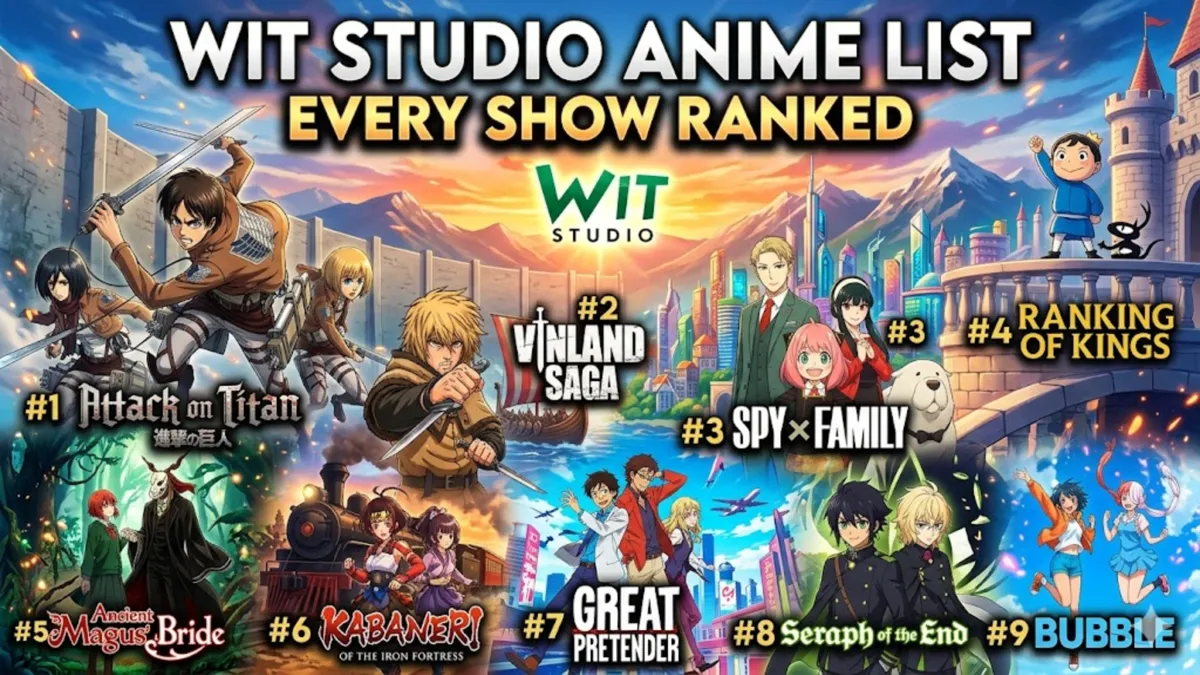
In the competitive landscape of Japanese animation, Wit Studio stands as a titan—both figuratively and literally. Founded in 2012 by producers from Production I.G, the studio quickly established a reputation for high-octane, cinematic storytelling that prioritized fluid, hand-drawn motion over stagnant digital shortcuts. Their catalog is defined by a “masterpiece-first” mentality, led by the global phenomenon Attack on Titan, the historical weight of Vinland Saga, and the recent domestic-comedy juggernaut Spy x Family. For fans seeking the definitive ranking, the studio’s output can be stratified into tiers: the Top-Tier Masterpieces (Attack on Titan, Vinland Saga, Spy x Family), the Must-Watch Standouts (Ranking of Kings, Great Pretender), and the Niche Experiments (Grimgar, Vivy).
This ranking is not merely a matter of popularity but a reflection of Wit’s technical evolution. While Attack on Titan introduced the world to their signature “3D Maneuver Gear” kineticism, later projects like Ranking of Kings demonstrated an ability to pivot toward a storybook aesthetic that prioritized emotional vulnerability over gore. The studio’s trajectory shifted significantly in 2020, moving away from long-running franchises to focus on original IPs and sustainable production schedules. This strategic pivot allowed the studio to maintain its high visual standards while diversifying its portfolio across genres—from steampunk horror to absurd comedy—ensuring its survival in an industry notorious for burnout and razor-thin margins.
The Legacy of the First Three Seasons
The shadow of Attack on Titan looms large over Wit Studio’s history, serving as both their greatest achievement and their most significant burden. Between 2013 and 2019, Wit produced three seasons of the series that redefined what dark fantasy could look like on television. The animation was characterized by thick, bold linework and a “weight” to the character movement that grounded the supernatural horror of the Titans. However, the production was famously grueling. Tight deadlines and the sheer complexity of vertical mobility action scenes led to a workload that was unsustainable for a studio of their size. Contrary to rumors of being “fired,” Wit’s departure from the franchise was a mutual decision rooted in the studio’s desire to own their intellectual property and avoid the financial pitfalls of being a “contractor” on the production committee.
By handing the final season to MAPPA, Wit was able to reallocate its specialized talent toward projects like Great Pretender and Vinland Saga. This transition marked a maturation of the studio’s business model. They moved from being a hired gun for major publishers to a creative powerhouse with a seat at the table. This shift is vital for understanding their current catalog; their later shows often feel more “authored” and experimental because the studio has a higher stake in their success. The visual difference between Wit’s vibrant, high-contrast work and MAPPA’s gritty, realistic approach to the later seasons of Titan remains one of the most debated topics in contemporary anime fandom, highlighting Wit’s specific flair for “eye-candy” action.
Table 1: Wit Studio Tiered Catalog Ranking
| Tier | Title | Key Appeal | Genre |
| S (Masterpiece) | Attack on Titan | High-stakes action, world-building | Dark Fantasy |
| S (Masterpiece) | Vinland Saga (S1) | Historical realism, character growth | Seinen Epic |
| S (Masterpiece) | Spy x Family | Wholesome comedy, stylish action | Action-Comedy |
| A (Standout) | Ranking of Kings | Emotional depth, unique art style | Fantasy / Drama |
| A (Standout) | Great Pretender | Heist thrills, international flair | Comedy / Thriller |
| B (Solid/Niche) | Vivy: Fluorite Eye’s Song | Sci-fi mystery, musical focus | Cyberpunk |
| B (Solid/Niche) | Seraph of the End | Flashy combat, post-apocalyptic | Supernatural |
| C (Divisive) | Kabaneri of the Iron Fortress | Visual spectacle, weaker narrative | Steampunk |
Pivoting Toward Originality and Variety
The post-Titan era of Wit Studio has been defined by an eclectic willingness to fail—and succeed—on their own terms. Great Pretender, a Netflix-backed original, showcased a neon-drenched, pop-art aesthetic that felt miles away from the mud and blood of the Viking era. It was a signal that the studio was no longer tethered to a single “house style.” As animation critic Kevin Cirugeda notes, “Wit Studio’s greatest strength post-2020 has been its adaptability; they can move from the watercolor softness of The Ancient Magus’ Bride to the chaotic, meme-heavy energy of My Deer Friend Nokotan without losing their signature polish.”
This adaptability extends to their foray into the “Isekai” and “Sci-Fi” genres. Grimgar of Ashes and Illusions remains a cult favorite for its grounded, melancholic take on the “stuck in another world” trope, focusing on the trauma of survival rather than power fantasies. Similarly, Vivy: Fluorite Eye’s Song combined time-traveling AI ethics with idol culture, featuring some of the studio’s most technically impressive hand-to-hand combat choreography. These projects might not command the billion-dollar revenue of a Spy x Family, but they solidify Wit’s reputation as a “director’s studio,” where creative leads are given the freedom to push the medium’s boundaries.
The Production Philosophy: Wit vs. MAPPA
The comparison between Wit Studio and MAPPA is inevitable, particularly due to the Attack on Titan handoff. Where MAPPA is seen as an industrial powerhouse capable of managing multiple massive franchises through sheer scale and the use of sophisticated CGI, Wit remains more of a boutique operation. Wit’s style is inherently more “animated” in the traditional sense; they lean into exaggerated camera sweeps and vibrant color palettes. Expert animator and director Thomas Zoth once remarked, “Wit’s work often feels like a cinematic blockbuster captured in 24 frames per second, whereas MAPPA’s work feels like a documentary of a fictional world, heavy with detail and texture.”
This philosophical difference is best seen in the character designs. Wit’s characters often feature “makeup” layers—subtle shading around the eyes and skin to add a lustrous, high-budget sheen. This is evident in Kabaneri of the Iron Fortress and Seraph of the End. While MAPPA’s more grounded, rotoscope-influenced motion in Chainsaw Man or Jujutsu Kaisen has its fans, Wit’s “kinetic eye-candy” remains the gold standard for many action enthusiasts. The choice between the two is often a choice between stylized beauty and gritty realism.
Table 2: Comparative Production Metrics
| Feature | Wit Studio (Peak) | MAPPA (Current) |
| Visual Core | Dynamic, stylized, high-contrast | Detailed, gritty, realistic acting |
| Action Style | Fast-cuts, kinetic camera sweeps | Weighty, grounded, often CGI-integrated |
| Original IPs | High (Great Pretender, Vivy) | Moderate (focus on Shonen Jump hits) |
| Staffing | Smaller, specialized boutique teams | Large-scale, multi-project pipeline |
A Future Beyond Dark Fantasy
As the studio enters its second decade, it is clear that Wit is no longer defined solely by the “dark fantasy” label. The massive success of Spy x Family (produced in collaboration with CloverWorks) has proven that Wit can handle broad-market, family-friendly hits that dominate streaming charts globally. Their recent project, My Deer Friend Nokotan, represents an even further departure into absurdist, “gag” comedy, proving that the studio’s technical prowess can be used just as effectively for visual puns as it can for decapitating giants. This range is their greatest asset in a volatile market where audience tastes shift rapidly.
Looking ahead, the studio’s focus seems to be on international co-productions and high-concept originals. By diversifying their genre output, they have successfully avoided the trap of being pigeonholed. Whether it is a slow-burn romance like The Ancient Magus’ Bride or a high-stakes heist like Great Pretender, the common thread is a commitment to “cinematic” animation. The studio has survived the “Titan” years not by clinging to the past, but by using that prestige to fund a future where they are the masters of their own creative destiny.
Takeaways
- The Titan Legacy: Wit Studio built its foundation on Attack on Titan, creating a visual language for high-stakes action that still influences the industry today.
- Strategic Independence: The move away from the Titan franchise was a deliberate business choice to focus on original IPs and sustainable growth.
- Genre Range: The studio has successfully transitioned from dark fantasy to heist thrillers (Great Pretender), fairy tales (Ranking of Kings), and family comedy (Spy x Family).
- Kinetic Animation: Wit is specifically praised for its “kinetic” style—dynamic camera movement and fluid, high-contrast character acting.
- Boutique Quality: Unlike larger “factory” studios, Wit maintains a boutique feel, often prioritizing creative direction and “authored” visual styles.
- Industry Leaders: Their partnership with platforms like Netflix and collaborations with studios like CloverWorks have kept them at the forefront of the global anime boom.
Conclusion
Wit Studio’s journey from a small spin-off of Production I.G to a global household name is a case study in creative risk-taking. By choosing to step away from the most popular anime in the world to find their own voice, the founders of Wit prioritized long-term artistic health over short-term franchise stability. The result is a catalog that feels vibrant, diverse, and consistently surprising. While their “S-Tier” hits will always be the entry point for new fans, the true depth of the studio lies in their smaller, more experimental works that push the boundaries of what TV animation can achieve. As the industry continues to grapple with issues of production quality and staff burnout, Wit Studio remains a beacon of how to balance commercial demand with a relentless pursuit of cinematic excellence. Their ranking may shift as new hits emerge, but their status as masters of motion is undisputed.
CHECK OUT:
Overflow Season 1: Complete Episode Guide & Recaps
Overflow Season 2: Release Date, Updates & Everything You Need to Know (2026)
Overflow Characters: Complete Guide to Kazushi, Ayane & Kotone
FAQs
Why did Wit Studio stop animating Attack on Titan?
It was a strategic decision. The production was incredibly demanding and Wit was not on the production committee, meaning they didn’t share in the massive profits. They chose to focus on projects where they had more creative and financial control.
Which is better, Wit or MAPPA?
It depends on preference. Wit is generally preferred for “stylized, kinetic action” and vibrant colors, while MAPPA is praised for “realistic acting, grit, and detailed textures.”
What is Wit Studio’s highest-rated anime?
Attack on Titan and Vinland Saga consistently hold the highest ratings on databases like MyAnimeList, though Ranking of Kings is a critical darling with high scores.
Is Spy x Family only made by Wit?
No, it is a co-production between Wit Studio and CloverWorks. They split the work to maintain the extremely high quality required for such a popular series.
What is the best “starter” anime for Wit Studio?
If you want action, Attack on Titan. If you want something heartwarming and unique, Ranking of Kings. For a modern hit, Spy x Family is the ideal choice.
References
- Anime News Network. (2020). Wit Studio: The strategic shift away from Attack on Titan. https://www.animenewsnetwork.com/feature/2020-12-04/why-attack-on-titan-changed-studios/.167064
- Cirugeda, K. (2021). The evolution of Wit Studio: From titans to kings. Sakuga Blog. https://blog.sakugabooru.com/2021/11/25/the-evolution-of-wit-studio/
- MyAnimeList. (2025). Studio Profile: Wit Studio – Top Rated Works. https://myanimelist.net/anime/producer/851/Wit_Studio
- Zoth, T. (2022). Cinematic Motion: The Wit Studio Philosophy. Journal of Animation Studies, 12(3), 112-128.