
I regard beton celular autoclavizat as one of the most practical modern masonry materials, but only when the product is selected and installed according to the building design. Known internationally as autoclaved aerated concrete, or AAC, and commonly called BCA in Romania, the material combines low weight, thermal performance, dimensional accuracy, and relatively simple processing.
These qualities make AAC attractive for houses, apartment buildings, commercial properties, interior partitions, and infill walls within reinforced-concrete structures. Large blocks can cover wall surfaces quickly, while their cellular structure helps limit heat transfer. The material is also mineral and non-combustible, which can support fire-safe wall construction when the complete assembly follows tested specifications.
The apparent simplicity of BCA can nevertheless be misleading. Not every block has the same density, compressive strength, thermal conductivity, dimensions, or approved use. A lightweight block designed for thermal performance should not automatically replace a denser structural product. A thin partition block should not be treated as an exterior load-bearing unit simply because both products carry the same general BCA name.
In my analysis, the most common failures are rarely caused by the basic material alone. Problems usually begin with an unsuitable product, an uneven first course, missing damp protection, excessively thick joints, unplanned service channels, incompatible renders, or untreated thermal bridges around concrete columns and beams.
This guide explains what beton celular autoclavizat is, how manufacturers produce it, which technical values matter, and where it can be used. I will also examine its advantages, limitations, installation process, current Romanian price examples, and its practical differences from ceramic masonry blocks.
Key Takeaways About Beton Celular Autoclavizat
- Beton celular autoclavizat is the Romanian term for autoclaved aerated concrete, usually abbreviated as AAC internationally and BCA in Romania.
- It is a lightweight, porous, steam-cured mineral building material.
- Its principal ingredients normally include sand, cement, lime, water, gypsum or anhydrite, and a small amount of aluminium as a pore-forming agent.
- The material is cured in pressurised autoclaves rather than being left to harden only under normal atmospheric conditions.
- EN 771-4 covers performance requirements for AAC masonry units placed on the European market.
- AAC products can be intended for load-bearing walls, non-load-bearing walls, external enclosures, internal partitions, thermal protection, or fire-resistant assemblies.
- Product properties vary significantly between manufacturers and product ranges.
- Lower density normally improves thermal resistance, but it may also be associated with lower compressive strength.
- AAC is non-combustible when classified as reaction-to-fire class A1, but the fire-resistance period of a wall depends on its complete tested construction.
- Thin-bed mortar helps maintain dimensional accuracy and reduces thermal discontinuities through the joints.
- The first course normally requires a levelling mortar because it must correct imperfections in the foundation or slab.
- AAC absorbs moisture and must be protected from rising damp, prolonged rain exposure, and direct ground contact unless a specifically designed system permits such use.
- Heavy objects require fixings designed for cellular concrete.
- Retail prices should be compared per cubic metre, not only per block or pallet.
- The structural engineer and architect must approve wall type, thickness, reinforcement, connections, and opening details.
What Is Beton Celular Autoclavizat?
Beton celular autoclavizat is a precast lightweight concrete product containing a controlled network of small air-filled pores. Those pores reduce the quantity of solid material in each block, lowering its density and improving its resistance to heat flow.
The English abbreviation AAC comes from “autoclaved aerated concrete.” Romanian builders and retailers generally use BCA, which represents the Romanian name. Although the terms are often used interchangeably in everyday conversation, the precise product should always be identified by its manufacturer, dimensions, declared properties, and intended application.
The harmonised European product standard provides an important starting point for understanding AAC:
“This European Standard specifies the characteristics and performance requirements of autoclaved aerated concrete masonry units.”
NEN, summary of EN 771-4:2011+A1:2015 [1]
This statement matters because it shows that AAC is a regulated family of masonry products rather than a single universal block. EN 771-4 addresses characteristics that manufacturers must declare, but the standard does not mean that every compliant product performs identically.
The standard covers units used in several types of masonry, including load-bearing and non-load-bearing walls. Potential applications include single-leaf walls, cavity walls, partitions, retaining structures, basement construction, thermal insulation, sound insulation, and fire-protection walls, subject to national rules and the manufacturer’s declared application.
I believe buyers should treat the declaration of performance as seriously as the product name. Two white blocks with similar dimensions can have different densities, strengths, thermal values, and surface profiles. Selecting them only by appearance or price can undermine the designer’s intended wall performance.
AAC should not be confused with ordinary dense concrete. Structural concrete used for foundations, columns, beams, and slabs usually contains coarse aggregate and has a much higher density. BCA has a cellular structure and is generally used as a masonry unit rather than as a direct replacement for reinforced structural concrete. – beton celular autoclavizat.
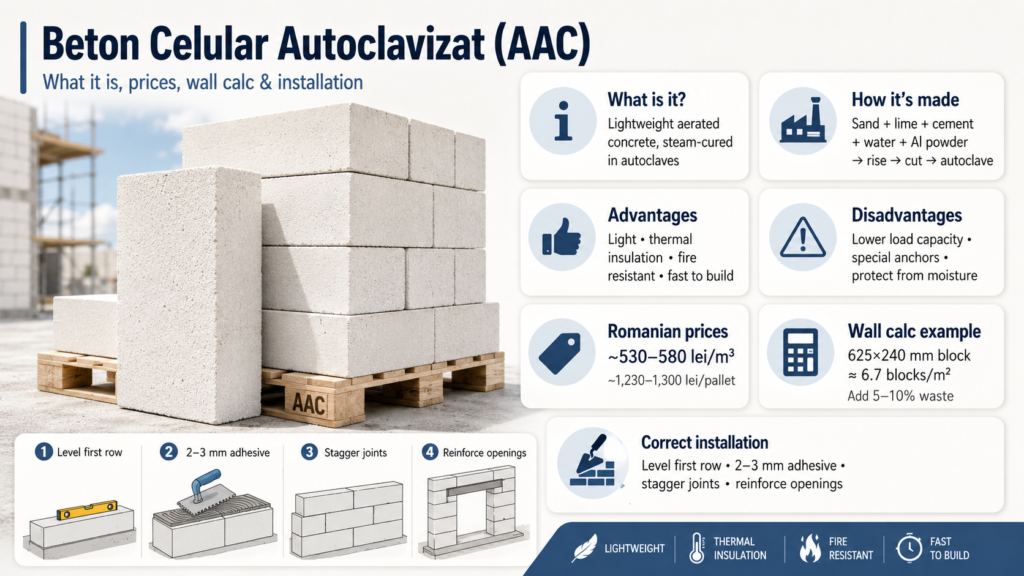
How Autoclaved Aerated Concrete Is Manufactured
AAC production begins with carefully measured mineral ingredients. A typical formula contains ground quartz sand, cement, unhydrated lime, anhydrite or gypsum, water, and a very small quantity of aluminium powder or paste. Some plants also return crushed production waste to the mixture.
An independently verified environmental declaration for Ytong AAC lists typical material proportions of 50 to 70 percent sand, 15 to 30 percent cement, 10 to 20 percent unhydrated lime, 2 to 5 percent anhydrite or gypsum, and 0.05 to 0.1 percent aluminium by mass. These values describe that product declaration and should not be applied blindly to every manufacturer. [2]
Mixing and Expansion
The ground materials are combined with water to create a fluid mixture. Aluminium reacts within the alkaline environment and produces hydrogen gas. This gas forms the small pores that give AAC its characteristic cellular structure.
The hydrogen escapes after expansion, leaving the pores filled with air. According to the Xella declaration, pores in the referenced product commonly measure approximately 0.5 to 1.5 millimetres in diameter.
The mixture expands inside a mould, often compared with dough rising. This comparison is useful for visualisation, although industrial AAC production involves precisely controlled chemical and thermal processes rather than ordinary fermentation.
Cutting the Green Cake
After the mixture develops enough initial strength, manufacturers remove the semi-solid mass from the mould. At this stage, it is often called a green cake.
Thin wires or automated cutting equipment divide the mass into blocks or panels. Cutting before final hardening allows manufacturers to achieve accurate dimensions without sawing fully cured concrete.
The process may also create hand grips, tongue-and-groove profiles, or other product features. Dimensional accuracy is one reason many AAC systems can use thin-bed mortar rather than thick conventional joints.
Autoclave Curing
The cut elements enter large pressure vessels known as autoclaves. Steam, elevated temperature, and pressure cause the raw ingredients to form stable calcium silicate hydrates.
The referenced Xella declaration describes a curing period of approximately 5 to 12 hours at about 190°C and approximately 12 bar. Different factories may use adjusted production cycles, so these figures should be treated as a documented example rather than a universal rule. [2]
Autoclaving gives the material its final strength, dimensional stability, and mineral structure. This controlled treatment distinguishes AAC from non-autoclaved foam concrete and other lightweight cellular products that harden through different processes.
Technical Properties That Matter When Choosing AAC
I would not select beton celular autoclavizat from the brand name alone. The most useful values are density, compressive strength, thermal conductivity, dimensional tolerances, moisture behaviour, vapour permeability, fire classification, and declared application.
The following table shows broad technical ranges documented for one large AAC product family. Individual Romanian products can have narrower or different values, so the declaration of performance for the exact unit remains the controlling document.
Typical AAC Properties and Their Practical Meaning
| Property | Documented general range or classification | Practical importance |
|---|---|---|
| Gross density | Approximately 250 to 800 kg/m³ | Influences weight, strength, thermal behaviour, and acoustic mass |
| Compressive strength | Approximately 1.6 to 10 N/mm² | Helps determine suitability for structural or non-structural use |
| Thermal conductivity | Approximately 0.07 to 0.18 W/mK | Lower values generally improve resistance to heat transfer |
| Water-vapour resistance factor | Commonly around 5/10 in cited documentation | Influences vapour movement through the wall |
| Drying shrinkage | Less than 0.2 mm/m in cited documentation | Relevant to dimensional stability and cracking risk |
| Reaction to fire | Commonly A1 for declared mineral AAC products | Indicates non-combustibility of the material |
| Typical block widths | Approximately 50 to 480 mm across product systems | Determines whether the block suits lining, partitions, or exterior walls |
| Sound reduction | Varies with surface mass, thickness, and finishes | Important for bedrooms, service rooms, and separating walls |
The central lesson is that no single value defines a good block. A thermally efficient low-density unit may not provide the same compressive strength or acoustic mass as a denser product. The correct choice depends on the complete wall requirement.
Density
Density measures the mass contained in one cubic metre of material. AAC is considerably lighter than ordinary structural concrete because much of its volume consists of air-filled pores.
Lower density can reduce the permanent load placed on slabs, beams, columns, and foundations. It also makes blocks easier to handle than dense concrete elements of comparable size.
A lower figure does not automatically mean better quality. Density interacts with strength, thermal conductivity, sound performance, and fixing capacity. A project may deliberately specify a denser AAC unit where mechanical performance or acoustic mass matters more than obtaining the lowest possible conductivity.
Compressive Strength
Compressive strength describes the material’s ability to resist compression under a standardised test. It is normally stated in newtons per square millimetre.
The value is essential, but it does not independently prove that a wall is safe to carry floors or a roof. Structural performance also depends on wall height, thickness, eccentricity, openings, restraint, foundation movement, mortar, reinforcement, connections, and seismic loads.
Romania’s seismic conditions make structural design especially important. I would never recommend changing a specified block strength or wall thickness without approval from the structural engineer.
Thermal Conductivity
Thermal conductivity, represented by the lambda symbol, describes how readily heat passes through a material. A lower value generally indicates better insulating performance.
AAC’s many air-filled cells limit heat transfer, giving the material a thermal advantage over dense concrete. The European industry association summarises the intended combination of functions:
“AAC stands for highly efficient thermal insulation, optimal fire protection, and masonry with excellent load-bearing abilities.”
European Autoclaved Aerated Concrete Association [3]
This quotation describes the material family’s potential, not the guaranteed performance of every block. The building’s actual energy efficiency also depends on wall thickness, mortar joints, concrete thermal bridges, external insulation, windows, roof insulation, airtightness, ventilation, and workmanship.
Moisture is equally important. Water conducts heat more effectively than dry air, so wet masonry generally performs worse thermally than dry masonry. Published declared values must therefore be interpreted using the calculation conditions stated by the manufacturer and designer.
Vapour Permeability
AAC allows water vapour to move through its pore structure. This quality is sometimes described informally by saying that the wall “breathes,” but that expression can cause confusion.
A vapour-open wall does not replace ventilation. Occupants still produce moisture through cooking, bathing, drying clothes, and breathing. Kitchens, bathrooms, and living spaces require planned ventilation regardless of the masonry material.
Vapour movement must also be considered across the entire wall. Exterior insulation, adhesives, renders, paints, interior finishes, and vapour-control layers all affect moisture behaviour.
Fire Performance
AAC is mineral and can achieve reaction-to-fire class A1. It does not provide fuel in the way that combustible materials can.
The reaction-to-fire classification of the material is not the same as the fire-resistance rating of a completed wall. A wall’s EI or REI period depends on thickness, structural role, joints, render, openings, penetrations, load, and the tested or assessed construction.
Fire performance must therefore be checked using documentation for the complete wall assembly. A cable opening, service box, unprotected joint, or unsuitable penetration seal can reduce the practical protection offered by an otherwise fire-resistant wall.
Where Beton Celular Autoclavizat Can Be Used
AAC appears in residential, commercial, industrial, and public construction. Its appropriate use depends on the exact product and the structural system.
Exterior Infill Walls
In buildings with reinforced-concrete frames, AAC is frequently used to close the spaces between columns and beams. The concrete structure carries the main building loads, while the blockwork creates the exterior envelope.
This application requires careful treatment at the junction between masonry and concrete. The two materials can move differently as temperature, moisture, and structural loads change. Reinforcement, connection details, flexible joints, render mesh, and exterior insulation may be required by the project.
Load-Bearing Masonry
Some AAC units are declared for load-bearing walls. Such products can be used in appropriately designed masonry structures.
The existence of a load-bearing product does not mean that an owner or contractor can decide independently to build a load-bearing AAC house. The structural engineer must calculate the wall system, foundations, floor support, openings, reinforcement, ties, lintels, and seismic detailing.
Internal Partitions
Thinner AAC units are commonly used for room partitions. They are relatively easy to cut around openings and can provide a solid surface for plaster or compatible finishing systems.
Partition thickness should account for wall height, unsupported length, door openings, service routes, acoustic expectations, and attached objects. The thinnest available block is not automatically the most economical choice if it later requires additional sound lining or reinforcement.
Fire-Separating Walls
AAC can contribute to fire-resistant walls because the material is non-combustible and limits heat transfer. The selected system must have documentation supporting the required fire period.
A wall should not be described as fire-rated only because its blocks are A1. The completed construction, including all joints and penetrations, must match the tested or assessed system.
Renovation and Infill Work
AAC can be useful when filling former openings, building service enclosures, modifying room layouts, or completing local masonry repairs.
The new material must remain compatible with the surrounding construction. Joining AAC rigidly to older brickwork without considering differential movement can create cracks at the interface.
Advantages of Beton Celular Autoclavizat
Low Weight
AAC’s cellular structure gives it a lower density than dense concrete and many solid masonry products. Lower wall weight can reduce structural loading and simplify manual handling.
Large blocks cover more wall area per unit, potentially improving installation speed. However, dimensions and weight must still be considered ergonomically. Mechanical lifting may be required for large panels or units that exceed safe manual-handling limits.
Strong Thermal Performance
Air trapped in the pores reduces heat transmission. This helps AAC contribute to the thermal resistance of exterior walls.
A thermally efficient block can reduce the thickness of additional insulation required in some designs, although compliance must be demonstrated through a complete energy calculation. Concrete columns, beams, slab edges, lintels, and window junctions still need careful thermal treatment.
Easy Cutting and Shaping
AAC can be cut with dedicated hand saws, band saws, or other tools recommended by the manufacturer. Installers can create accurate end blocks and adjust units around openings.
This workability also helps with electrical and plumbing routes. It does not justify cutting deep horizontal channels wherever convenient. Excessive chasing may weaken partitions, interfere with structural behaviour, or produce cracks.
Dimensional Accuracy
Factory-cut units can have precise dimensions and flat surfaces. This supports thin-bed mortar joints and helps installers maintain alignment.
Accurate blocks cannot compensate for a poorly levelled base. The first course must establish a level, straight reference for every subsequent row.
Fast Wall Construction
A typical AAC unit has a larger face area than a traditional small-format brick. Fewer individual units may therefore be needed for the same wall area.
Construction speed depends on site logistics, worker training, weather, material placement, cutting organisation, and mortar preparation. A disorganised site can erase much of the productivity advantage.
Non-Combustible Mineral Composition
AAC does not normally contribute combustible fuel to a fire. It can form part of walls designed for high fire resistance.
This property is particularly useful in stair enclosures, plant rooms, separating walls, and other areas where fire compartmentation matters. The final rating must still be verified for the chosen wall construction.
Resistance to Rot and Insects
AAC does not rot like untreated organic materials and does not provide food for insects.
Mould can still grow on surface dust, wallpaper, paint, or other organic contamination when moisture remains present. Mineral masonry does not remove the need to control condensation, leaks, and ventilation.
Disadvantages and Limitations of AAC Blocks
Moisture Absorption
The same pore structure that improves thermal performance can absorb water. Unprotected blocks can become wet during storage, construction, flooding, or long-term exposure.
The Xella environmental declaration includes a clear design caution:
“Direct contact with water is avoided for technical structural reasons.”
Xella environmental product declaration for Ytong AAC [2]
I interpret this as a reminder that AAC belongs within a planned moisture-management system. It needs appropriate damp-proof courses, plinth details, external finishes, roof protection, flashings, and drainage.
Blocks should be stored on stable pallets and protected from rain while allowing ventilation. Trapping already wet blocks under completely sealed coverings can slow drying.
Special Fixings for Heavy Loads
Ordinary short plastic plugs may not hold heavy cabinets, boilers, sanitary equipment, awnings, or mechanical units securely in AAC.
Manufacturers offer spiral plugs, long expansion anchors, frame fixings, chemical anchors, and other systems specifically tested for cellular concrete. The correct choice depends on load type, edge distance, block density, embedment depth, and installation method.
For very high loads, the design may require a load-distribution plate, built-in reinforcement, or attachment to a concrete structural element.
Lower Impact Resistance Than Dense Concrete
AAC is relatively easy to cut, which also means its edges and surfaces can be damaged by hard impacts. Corners may chip during transport or careless handling.
Minor edge damage can sometimes be repaired using a compatible mortar. Severely cracked or broken blocks should not be placed in critical positions merely to avoid waste.
Acoustic Performance Requires Careful Selection
A lightweight wall does not necessarily block airborne sound as effectively as a heavier wall of similar thickness. Acoustic performance depends strongly on surface mass, thickness, plaster layers, junctions, flanking paths, and service penetrations.
A thin partition that appears adequate for visual separation may perform poorly between a bedroom and bathroom. Additional thickness, denser units, resilient linings, or a different wall system may be justified.
Thermal Bridges Remain Possible
AAC’s good conductivity value does not eliminate heat loss through concrete columns, beams, ring beams, slab edges, lintels, and poorly insulated window reveals.
Exterior insulation is often continued over both the blockwork and concrete structure to create a more uniform thermal layer. Discontinuities can cause local cold surfaces, condensation risk, and visible staining.
Workmanship Still Determines the Result
Because AAC is easy to cut and position, inexperienced installers may assume that precise masonry techniques are unnecessary.
Uneven joints, dust-covered bonding surfaces, missing vertical-joint mortar where required, poorly tied intersections, and random foam filling can weaken the wall or create cracks and air leakage.
Beton Celular Autoclavizat Versus Ceramic Brick
Both AAC and modern ceramic blocks can produce durable, energy-efficient walls. I do not believe one material wins in every category.
The correct comparison examines complete wall systems with equivalent structural, thermal, fire, acoustic, and finishing requirements.
AAC and Ceramic Block Comparison
| Criterion | Beton celular autoclavizat | Modern ceramic block |
| Typical weight | Usually lighter | Commonly heavier, depending on void pattern |
| Cutting | Straightforward with AAC saws | Usually requires ceramic cutting equipment |
| Thermal conductivity | Very low in lightweight AAC products | Can be low in thermally optimised hollow blocks |
| Compressive strength | Varies by density and product class | Varies by clay body, geometry, and product class |
| Acoustic mass | Lower-density units may need additional design measures | Heavier products can offer an advantage in some assemblies |
| Joint system | Thin-bed mortar commonly used with accurate units | Thin-bed mortar or foam may be used with rectified systems |
| Fixings | Dedicated AAC anchors normally required | Fixings must suit hollow ceramic structure |
| Fire behaviour | Mineral and generally non-combustible | Fired clay is also non-combustible |
| Service chasing | Relatively easy | Can be slower and may fracture webs if done carelessly |
| Moisture protection | Requires damp protection and suitable finishes | Also requires appropriate moisture detailing |
| Handling | Large but relatively light units | Weight depends on dimensions and cavity geometry |
| Site waste | Offcuts can be shaped or recycled where systems exist | Broken units may be harder to reuse accurately |
The most important takeaway is that price per block does not reveal the less expensive wall. A complete comparison should include quantity, mortar, reinforcement, lintels, insulation, cutting time, transport, wastage, labour, plaster thickness, and long-term energy performance.
For example, one product might cost more per cubic metre but require less installation time and thinner levelling coats. Another might provide greater acoustic mass but need more complicated cutting around services.
How to Choose the Correct AAC Product
Define the Wall’s Function
The first step is to establish whether the wall is load-bearing, non-load-bearing, external, internal, separating, fire-rated, or part of a framed structure.
This decision should come from the architectural and structural plans. A salesperson or installation team should not redefine the wall’s structural role during construction.
Check the Declaration of Performance
Find the declaration for the exact product code and dimensions. Do not rely only on a general brochure covering an entire brand.
Review compressive strength, density, dimensional tolerance, thermal conductivity, reaction to fire, moisture-related values, and intended use.
Select Thickness Through Design
Exterior-wall thickness must satisfy structural, thermal, acoustic, moisture, and detailing requirements. The block alone may not achieve the required energy target without additional insulation.
Partition thickness should consider height, door openings, impact, sound, service channels, and suspended loads. Saving a small amount on thin units can create higher finishing or acoustic costs later.
Confirm Compatible Mortar and Accessories
AAC manufacturers normally specify levelling mortar for the first course and thin-bed adhesive mortar for later courses. Some systems include lintels, U-blocks, reinforcement, repair mortars, and compatible renders.
Combining unrelated products without checking compatibility can affect bond strength, shrinkage, water behaviour, and warranty conditions.
Review Fixing Requirements Early
Kitchen cabinets, boilers, radiators, railings, façade components, and mechanical systems should be identified before walls are completed.
Where possible, the designer can include reinforced zones or structural fixing points. This is safer than improvising after finishes have been applied.
Current BCA Prices in Romania
Romanian prices vary by brand, density, dimensions, store, delivery region, quantity, and promotional conditions. A pallet price can also be misleading because pallets contain different volumes.
Representative listings checked in June 2026 included approximately 489 RON per cubic metre for certain Soceram units, around 491 RON per cubic metre for selected Elpreco Izopor products, approximately 533 to 568 RON per cubic metre for several Macon products, about 545 RON per cubic metre for a listed CELCO unit, and approximately 748 to 771 RON per cubic metre for selected Ytong products purchased in stated quantities. [6][7]
These examples are not universal market averages. Stock and pricing can differ between individual stores, cities, and delivery addresses.
A complete budget should include:
- AAC blocks
- First-course levelling mortar
- Thin-bed mortar
- Lintels or lintel systems
- Reinforcement and wall ties
- Delivery and unloading
- Pallet deposits or return arrangements
- Cutting equipment
- Waste and damaged units
- Labour
- Interior and exterior finishes
- Thermal insulation
- Special fixings
- Scaffolding and site protection
Sample Wall-Quantity Calculation
Consider a hypothetical exterior wall with a gross area of 100 square metres and 15 square metres of windows and doors.
The net masonry area is:
100 m² minus 15 m² = 85 m²
For a 300-millimetre-thick wall:
85 m² × 0.30 m = 25.5 m³
Adding 5 percent for cuts and reasonable waste:
25.5 m³ × 1.05 = 26.775 m³
The project would therefore require approximately 26.8 cubic metres of blocks, subject to the manufacturer’s pallet quantities and the designer’s opening details.
At an illustrative block price of 500 RON per cubic metre, the blocks would cost approximately 13,388 RON. At 770 RON per cubic metre, the same calculated volume would cost approximately 20,617 RON.
This example excludes mortar, lintels, reinforcement, transport, labour, insulation, finishes, taxes not already included in the listing, and unexpected waste.
Block-Count Calculation
Suppose a block has a visible wall face measuring 599 millimetres by 199 millimetres.
Converted to metres, the face area is:
0.599 m × 0.199 m = approximately 0.1192 m²
For 85 square metres:
85 m² ÷ 0.1192 m² = approximately 713 blocks
Adding 5 percent:
713 × 1.05 = approximately 749 blocks
The final order must be rounded to full packs or pallets. The supplier’s published consumption rate should also be checked because profiles, joint details, special cuts, and product dimensions can affect the actual quantity.
Step-by-Step AAC Wall Installation
The following sequence describes general good practice. The structural drawings and manufacturer’s instructions take priority.
1. Inspect the Supporting Surface
The slab, foundation, or supporting wall must have adequate strength, correct dimensions, and suitable level.
Remove loose material, mud, ice, standing water, and debris. Significant dimensional errors should be corrected before blockwork begins.
2. Install Damp Protection
Where the wall could receive moisture from the foundation or slab, install the specified damp-proof membrane or waterproofing layer.
The detail should remain continuous and connect correctly with floor, wall, and plinth waterproofing. Punctures or gaps can allow moisture to rise into the masonry.
3. Set Out the Wall
Mark wall lines, openings, corners, intersections, and service zones. Verify dimensions against the drawings before placing mortar.
Small setting-out errors can create major problems at windows, doors, stairs, roofs, and structural columns.
4. Lay the First Course
Place the first course on a levelling mortar thick enough to correct minor irregularities in the base.
Begin at the highest point of the support. Set corner blocks accurately, then use a string line or laser to align the intermediate units.
The first course controls the entire wall. Time spent achieving level and alignment here usually saves considerably more time later.
5. Prepare Bonding Surfaces
Remove dust and loose particles before applying thin-bed mortar. Follow the manufacturer’s requirements regarding surface moisture and weather conditions.
Dry, dusty surfaces can reduce bond quality. Excessively wet blocks may also interfere with the intended mortar behaviour.
6. Mix Thin-Bed Mortar Correctly
Use clean water, the prescribed powder-to-water ratio, and appropriate mixing equipment. Allow any stated resting time before remixing.
Do not add extra cement, sand, gypsum, or water to change the consistency unless the manufacturer explicitly permits it.
7. Apply a Uniform Mortar Layer
Use the recommended notched scoop, trowel, or carriage to spread a consistent thin layer.
Thick, uneven joints reduce dimensional precision and create local thermal bridges. Missing mortar can weaken contact and allow air leakage.
8. Maintain the Required Bond
Offset vertical joints between courses according to the system requirements. Avoid continuous vertical joints unless a designed detail specifically permits them.
Cut end blocks accurately rather than filling large gaps with arbitrary pieces or expanding foam.
9. Connect Walls and Structural Elements
Install ties, reinforcement, anchors, movement joints, or separation strips as shown in the project.
Connections must accommodate structural support while controlling differential movement. Rigidly packing every junction may increase cracking risk.
10. Form Openings Correctly
Use approved lintels, reinforced U-block systems, or structural elements specified above windows and doors.
Do not assume that a row of ordinary blocks can bridge an opening without support. Temporary propping may be required until the lintel system reaches adequate strength.
11. Install Reinforcement Where Specified
Horizontal reinforcement may be required under windows, at long wall sections, near openings, or in other stress zones.
Grooves should have the specified dimensions, be cleaned, and be filled with the approved material before reinforcement is embedded.
12. Cut Service Channels Responsibly
Coordinate electrical and plumbing routes before chasing walls. Use suitable groove cutters or tools that control dimensions and dust.
Avoid deep horizontal channels, back-to-back chases, or cuts near critical supports without approval. Repair the channels with compatible materials.
13. Protect Unfinished Masonry
Cover the top of incomplete walls at the end of the working day. Prevent rainwater from entering the cellular structure from above.
Allow the walls to dry adequately before applying vapour-resistant finishes or insulation systems.
14. Apply Compatible Finishes
Use plasters, base coats, reinforcement meshes, primers, paints, and exterior systems suitable for AAC.
Follow specified curing, drying, thickness, and weather conditions. A rigid or poorly bonded finish can crack even when the underlying blockwork remains stable.
Common AAC Construction Mistakes
Choosing Blocks Only by Price
The lowest price per pallet may hide a smaller pallet volume, unsuitable strength, different density, or higher transport cost.
Compare cubic-metre price and technical performance together.
Skipping the Damp-Proof Course
AAC can draw moisture upward when placed directly on a damp support. Finishes may later stain, blister, or develop salts.
Moisture protection must form part of the initial wall detail.
Building an Uneven First Course
Thin-bed mortar is not designed to correct major irregularities in later rows. An uneven base leads to tilted blocks, thick joints, and increased plaster consumption.
Using Ordinary Thick Mortar Everywhere
A thick mortar joint can interrupt the wall’s thermal performance and make alignment more difficult.
Use the mortar system specified for the product.
Filling Large Gaps With Foam
Expanding foam may have a role in specific approved details, but it should not replace masonry units or structural mortar at random.
Large gaps should be corrected with accurately cut AAC pieces and compatible mortar.
Cutting Excessive Service Chases
Deep channels can reduce wall thickness and create weak lines. This is particularly serious around doorways, windows, and structural support zones.
Ignoring Concrete Thermal Bridges
A thermally efficient AAC wall can still perform poorly where uninsulated reinforced concrete crosses the envelope.
The external insulation and junction design must create continuity around columns, beams, lintels, and slab edges.
Using Universal Plugs for Heavy Objects
A fixing that works in solid concrete may not perform correctly in cellular concrete.
Use anchors rated for AAC and verify the design load.
Applying Finishes Before the Wall Dries
Wet masonry trapped behind low-permeability finishes may dry very slowly. This can affect thermal performance and interior humidity.
The contractor should confirm acceptable moisture conditions before finishing.
Expert Recommendations for Better AAC Walls
In my view, the best results come from treating the wall as a coordinated system rather than a stack of individual blocks.
First, keep one verified technical file for the project. It should contain the declaration of performance, installation guide, mortar data, lintel details, fixing recommendations, fire documentation, and finish requirements.
Second, arrange a sample wall or first-course inspection before large-scale work begins. This allows the site manager to verify mortar consistency, joint thickness, alignment, block cutting, and connection details.
Third, coordinate services before the masonry reaches full height. Planned routes reduce destructive chasing and prevent conflicts with reinforcement or lintels.
Fourth, inspect the envelope continuously. Thermal bridges, missing mortar, damaged blocks, wet pallets, and incorrect ties are easier to correct before plaster and insulation conceal them.
Fifth, compare whole-wall costs. A meaningful comparison includes materials, labour, insulation, finishes, waste, transport, and expected energy performance.
Finally, preserve traceability. Record delivery labels, batch details, product codes, photographs, and any approved substitutions. Clear records help resolve later questions about performance or compatibility.
Environmental Considerations and End-of-Life Options
AAC uses mineral raw materials and less solid material per cubic metre than dense concrete because a large proportion of its volume consists of air pores.
This does not make the product environmentally impact-free. Cement and lime production require energy and release greenhouse gases. Autoclaves also consume thermal energy, although manufacturers may recover steam and reuse process water.
Environmental performance varies by factory, energy source, transport distance, block density, building design, and service life. A product-specific environmental product declaration provides more useful information than a broad claim that AAC is simply “green.”
AAC’s thermal performance can reduce operational heating and cooling demand when it forms part of a well-designed building envelope. Those savings depend on climate, insulation, airtightness, heating equipment, occupant behaviour, and the entire building design.
Clean AAC offcuts may be returned, crushed, or reused in certain manufacturer systems. Contaminated demolition waste can be harder to recycle because it may contain plaster, adhesives, paint, insulation, or other materials.
I believe waste reduction should begin during design. Dimensions can be coordinated with block modules, openings can be planned to reduce narrow cuts, and offcuts can be reused where technically appropriate.
Conclusion
Beton celular autoclavizat offers a useful combination of low weight, thermal performance, fire safety, dimensional accuracy, and installation speed. These qualities explain why BCA remains a popular choice for Romanian houses, framed buildings, interior partitions, and other masonry applications.
I believe the central practical lesson is that AAC should be selected as part of a complete wall system. Density, compressive strength, thickness, mortar, reinforcement, moisture protection, insulation, finishes, and fixings must work together. Choosing blocks only by brand or pallet price can create expensive problems later.
The material’s cellular structure supports good thermal performance, but it also makes moisture protection and specialised fixings important. Its accurate dimensions allow thin joints, but only when the first course is level and installers follow the system instructions.
Before placing an order, ask the architect and structural engineer to confirm the exact product requirements. Obtain the declaration of performance, compare prices per cubic metre, calculate net wall quantities, and include all accessories in the budget. That process gives beton celular autoclavizat the best opportunity to deliver the performance promised by its technical documentation.
Frequently Asked Questions
What Does Beton Celular Autoclavizat Mean in English?
Beton celular autoclavizat means autoclaved aerated concrete in English. The international abbreviation is AAC, while the Romanian construction industry usually calls it BCA. It is a lightweight mineral masonry material containing many small air-filled pores. Manufacturers form these pores during production and then cure the cut blocks with pressurised steam inside an autoclave.
Is AAC the Same as Ordinary Concrete?
No, AAC is not the same as ordinary structural concrete. Dense concrete normally contains coarse aggregates and is commonly used for foundations, columns, beams, and slabs. AAC has a cellular structure, much lower density, and different mechanical and thermal properties. It is normally supplied as masonry blocks or panels and must be used according to its declared purpose.
Can Beton Celular Autoclavizat Be Used for Load-Bearing Walls?
Yes, certain beton celular autoclavizat products can be used for load-bearing walls when their declared performance and the building design permit it. Not every AAC block is structural. The engineer must specify strength, density, thickness, mortar, reinforcement, connections, lintels, and seismic detailing. A contractor should not substitute a partition block for a load-bearing unit.
Does an AAC Wall Need Exterior Insulation?
It depends on the block’s thermal conductivity, wall thickness, local energy requirements, thermal bridges, and the building’s overall energy calculation. Some thick, low-density AAC products can provide substantial thermal resistance, but many projects still use continuous exterior insulation. The architect or energy assessor should calculate the complete wall, including concrete columns, beams, renders, and insulation.
Is AAC Waterproof?
No, AAC is not inherently waterproof. Its pores can absorb moisture from rain, foundations, leaks, or direct ground contact. Walls require damp-proof courses, suitable plinth details, flashings, roofing protection, compatible renders, and proper drainage. Wet masonry should be allowed to dry before it is covered with finishes that significantly restrict vapour movement.
Does AAC Crack Easily?
AAC walls can crack when the base moves, the first course is uneven, joints are incorrect, walls lack required reinforcement, or masonry is rigidly connected to structural elements that move differently. Cracks can also develop around openings and service channels. Correct design, reinforcement, movement details, compatible finishes, and careful workmanship reduce the risk.
Is Beton Celular Autoclavizat Better Than Brick?
Beton celular autoclavizat is not universally better than ceramic brick. AAC is usually lighter, easier to cut, and highly effective thermally. Ceramic blocks may provide greater mass and different strength or acoustic characteristics. The best choice depends on structural design, thermal requirements, sound control, labour, insulation, transport, availability, and complete wall cost.
What Mortar Should Be Used for AAC Blocks?
The first course is generally placed on a levelling mortar that corrects small irregularities in the supporting surface. Later courses commonly use a compatible thin-bed mortar recommended by the AAC manufacturer. Installers should follow the specified water ratio, joint thickness, working time, temperature limits, and surface-preparation requirements.
Can Kitchen Cabinets Be Fixed to AAC Walls?
Yes, kitchen cabinets can be fixed to AAC walls using anchors designed and rated for cellular concrete. The required system depends on cabinet weight, contents, block density, wall thickness, and loading direction. Heavy cabinets may need long anchors, chemical systems, mounting rails, reinforcement plates, or connections to structural elements.
How Much Does BCA Cost in Romania?
Prices vary by brand, dimensions, density, quantity, store, and delivery location. Representative listings checked in June 2026 ranged from about 489 RON per cubic metre for selected economy products to roughly 770 RON per cubic metre for certain premium AAC units. Buyers should confirm current local prices and add mortar, delivery, lintels, reinforcement, waste, labour, insulation, and finishes.
How Much Waste Should Be Added to an AAC Order?
A preliminary allowance of approximately 3 to 7 percent may be reasonable for a simple project, but the correct amount depends on openings, wall geometry, block module, cutting quality, handling, and reuse of offcuts. Five percent is commonly used for early calculations. Final quantities should be rounded to full packs or pallets and checked against the supplier’s consumption data.
Can AAC Be Used in Bathrooms?
AAC can be used for bathroom walls when the construction includes suitable waterproofing, adhesives, tiles, ventilation, and service details. The blocks themselves should not be expected to stop water. Wet zones around showers and baths require a continuous waterproofing system installed according to the product manufacturer’s instructions.
Sources and References
- NEN, EN 771-4:2011+A1:2015, specification for autoclaved aerated concrete masonry units.
- Institut Bauen und Umwelt and Xella Baustoffe GmbH, Environmental Product Declaration for Ytong Autoclaved Aerated Concrete, issued December 2021.
- European Autoclaved Aerated Concrete Association, AAC Products and Applications.
- European Autoclaved Aerated Concrete Association, Fire Resistance and Material Characteristics.
- CELCO, technical documentation for Romanian BCA products.
- Hornbach Romania, current AAC product listings and cubic-metre prices, checked June 2026.
- Leroy Merlin Romania, current AAC product listings and cubic-metre prices, checked June 2026.
- Xella, Ytong product and manufacturing documentation.
Disclaimer
This article provides general construction information and does not replace architectural, structural, fire-safety, energy, acoustic, or moisture-control design. Product properties, standards, regulations, prices, and availability can change. Always use the declaration of performance and installation instructions for the exact product purchased. A qualified architect, structural engineer, energy assessor, and authorised contractor should verify the wall system before construction begins.