
I have found that the name Peitner raises a simple question with a deeper answer: is it only a rare family name, or does it point toward a larger story of place, language, migration, and identity? In my view, the most useful way to understand Peitner is to treat it first as a surname with Central European roots, then examine how spelling variations, family records, and regional history may help explain where a particular Peitner family line came from.
Many people search for Peitner because they have seen it in a family document, a genealogy database, an old record, a social profile, or a name list. The challenge is that rare surnames can be confusing. A common surname may appear in thousands of obvious records, but a rare surname often appears with variant spellings, transcription mistakes, and regional language shifts. That means we should not rush to one fixed answer. We should look at the strongest evidence, compare related spellings, and understand what the name might have meant in the world where it developed.
Key Takeaways About Peitner
The most important point is that Peitner appears to be a rare surname, not a widely established modern brand, product, or universal concept. Based on available surname sources, I would approach Peitner as a family name connected to Germanic and Alpine naming traditions, especially because similar forms are associated with Bavaria, Austria, South Tyrol, and Jewish Ashkenazic history.
Peitner may be connected with topographic naming. A topographic surname usually described a person by the landscape around them, such as a hill, valley, stream, bridge, forest, or slope. This matters because many old European surnames were not originally chosen as fixed family brands. They were practical labels that helped distinguish one person from another in a local community.
Another important point is spelling. When we research Peitner, we should also consider forms such as Peintner, Peithner, Leitner, Pointner, Paintner, and similar names. These spellings do not automatically prove the same family origin, but they can become useful research paths when records are handwritten, translated, indexed, or preserved across different countries.
What Peitner Means in Surname Research
Peitner is best understood as a surname that may have developed from older Germanic or related regional language patterns. The key clue is its structure. Many surnames ending in “-ner” point to someone connected with a place, occupation, or characteristic. In Alpine and German-speaking regions, this kind of ending often worked like a label meaning “person from” or “person associated with.”
A useful verified explanation from FamilySearch describes Peitner as a topographic name. The short quotation matters because it shows that the name is not merely a modern online invention.
“topographic name for someone who lived by a mountain spur”
Source: FamilySearch, Peitner Family History
I read that quotation as a practical clue rather than a complete family history. It tells us what the surname may mean linguistically, but it does not prove where every modern Peitner family came from. A surname meaning is a starting point. A family tree still needs records, dates, places, and links between generations.
For example, a person named Peitner in a modern record from the United States might have ancestors from Austria, Bavaria, South Tyrol, another German-speaking region, or a Jewish Ashkenazic community. The surname meaning can guide the search, but the actual family line must be proven through documents such as civil registrations, church books, immigration records, census entries, marriage certificates, naturalization papers, and cemetery records.
Why Peitner Is Not Always Easy to Interpret
Peitner is not like a surname with one famous public origin story. It is rare, and rarity creates research problems. A rare surname can be valuable because each appearance may matter, but it can also mislead researchers because a single spelling may hide many variations.
In my analysis, the biggest mistake is assuming that Peitner has one universal meaning in every context. Surnames often developed in local dialects, then changed as families moved, officials wrote names phonetically, and databases later digitized old handwriting. A clerk might have heard one pronunciation and written another spelling. A migrant family might have simplified a name. A record indexer might have misread old script. Over time, Peitner could appear close to Peintner, Peithner, or another related form.
A realistic example helps explain the issue. Imagine a family whose ancestor arrived in America in the late nineteenth century. On a passenger list, the name might appear as Peintner because that spelling was used in the place of origin. In a census record, the same family might appear as Peitner because the census taker wrote what they heard. On a marriage certificate, the name might become Pitner or Paintner because the official did not know the original spelling. None of these changes proves that the family changed its identity on purpose. It may simply show how names move through languages and record systems.
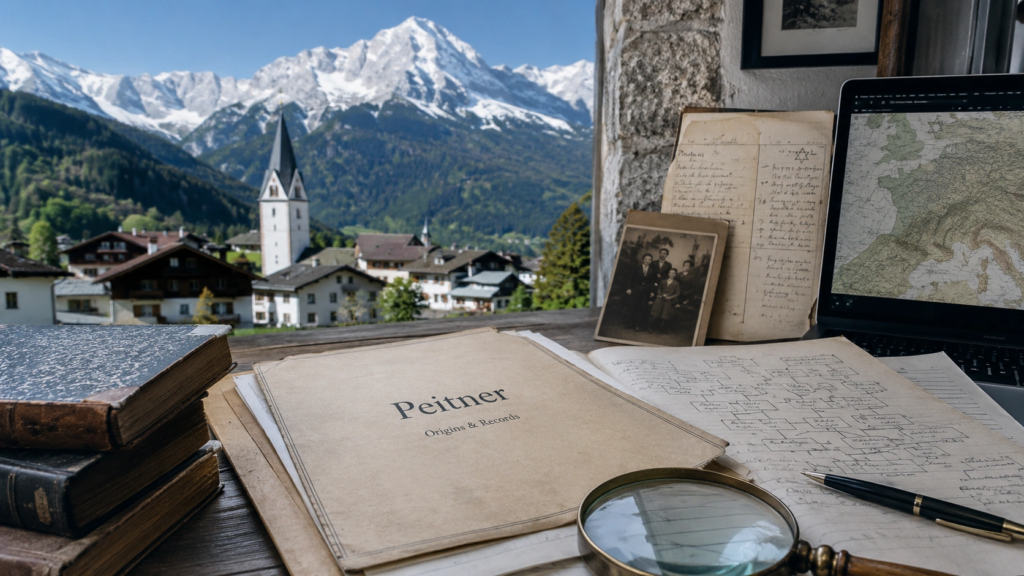
Peitner Origin and Historical Context
The origin of Peitner appears most strongly tied to German-speaking Central Europe, especially Alpine regions. The landscape connection is important. In older rural communities, people were often identified by the places where they lived. A person near a slope, spur, hill, farmstead, mill, bridge, or meadow could be described through that local feature. Over time, such descriptions became inherited surnames.
From my perspective, this makes Peitner a useful example of how geography shaped identity. A surname connected to a mountain spur or slope reflects a world where place was not background scenery. It was part of work, travel, farming, family distinction, and community memory. Mountain and hillside communities often had repeated given names, so a descriptive surname helped clarify who someone was.
This does not mean every Peitner ancestor lived on the same slope or in one exact village. It means the word pattern likely belongs to a naming tradition where local geography mattered. For family researchers, that is a signal to examine Alpine records carefully, especially in regions where German, Austrian, South Tyrolean, and Jewish Ashkenazic histories overlap.
Peitner as a Topographic Surname
A topographic surname describes a person through the physical environment. Names of this type are common across Europe. English examples include Hill, Wood, Brook, and Field. Germanic examples often describe mountains, clearings, forests, streams, settlements, and slopes. Peitner fits naturally into that kind of naming system if the topographic interpretation is correct.
FamilySearch gives another general explanation that helps place Peitner in a wider surname context.
“Surnames can provide insights into a person’s ancestry, cultural background, or geographic origin.”
Source: FamilySearch, Find Your Last Name’s Meaning and Origin
I believe that sentence is especially relevant here because Peitner is not only a word to define. It is a clue that may point toward language, region, migration, and social setting. A surname can never replace documentary proof, but it can help us choose better places to search.
Let us consider a practical scenario. A researcher finds “Maria Peitner” in a marriage record but cannot locate her birth record. Instead of searching only for Peitner, the researcher should also search for Peintner, Peithner, Leitner, and other close spellings in the same region and time period. If the family lived in an Alpine area, the researcher should look at parish boundaries, nearby villages, and civil registration districts. The meaning of the surname suggests where the search might be stronger, but the records decide the final answer.
Possible Jewish Ashkenazic Connection
One important detail is that Peitner may also appear in Jewish Ashkenazic surname context. This does not mean every person with the surname is Jewish, and it does not mean the name has only one religious or ethnic origin. It means the surname can appear in more than one naming pathway, which is common in Central European family history.
Some Jewish surnames were adopted, assigned, translated, adapted from occupations, or shaped by local language rules. In areas where German and Yiddish influenced naming, similar endings and sounds could produce overlapping surname forms. A family name might reflect a place, a trade, a sound-based adaptation, or an official spelling requirement.
In my view, the right approach is careful and respectful. We should not infer religious identity from a surname alone. If a person researching Peitner suspects Jewish ancestry, the better next step is to look for synagogue records, Jewish civil registers, burial records, Holocaust-era documents, community books, naturalization records, and family testimony. The surname can open the question, but evidence must answer it.
Peitner and Similar Spellings to Check
Spelling variations are essential in Peitner research. A researcher who searches only the exact spelling may miss important records. This is especially true when records were handwritten in old German script, copied into indexes, translated across languages, or entered by officials unfamiliar with the family.
| Spelling or Related Form | Why It May Matter | How to Use It in Research |
|---|---|---|
| Peitner | Primary spelling for the target surname | Search exact records first, especially in modern databases and family documents |
| Peintner | Commonly discussed related surname form | Search as a likely variant in Alpine and German-speaking records |
| Peithner | Phonetically close spelling | Use when handwriting or indexing errors may have inserted “h” |
| Leitner | Similar topographic meaning in some surname sources | Treat carefully, because similarity does not always mean the same family |
| Pointner | Related-looking Alpine surname form | Search nearby records only when geography and dates support it |
| Paintner | Possible phonetic or transcription variant | Use in English-language records, passenger lists, and census databases |
| Pitner | Simplified spelling possibility | Check in Americanized or English-language records |
The main takeaway from this table is that variants should be used as research tools, not assumptions. I would not claim that every Peitner is a Peintner or every Peintner is a Peitner. Instead, I would use each spelling as a doorway into records that may have been indexed imperfectly.
Practical Applications for Peitner Family Research
Peitner research becomes easier when we move from abstract meaning to practical steps. The first step is to gather what the family already knows. This includes full names, birth dates, marriage dates, death dates, countries, towns, immigration years, religious affiliations, and old photographs. Even a small clue, such as a village name on a marriage record, can change the entire search.
The second step is to build a timeline. A timeline prevents confusion between people with similar names. For example, if there are two men named Johann Peitner in nearby areas, dates and spouses help separate them. Without a timeline, a researcher might accidentally combine two families into one tree.
The third step is to search records with variant spellings. I have found that rare surnames often reward flexible searching. Use wildcard searches where databases allow them. Try “Petn,” “Pitner,” or “Peint” depending on the platform. Search by first name, spouse name, and place when surname spelling becomes uncertain.
The fourth step is to verify each connection. A family tree should not be built only from other public trees. Public trees can be useful hints, but they often repeat old mistakes. Stronger evidence comes from original records or high-quality indexed records that include names, dates, locations, relationships, and source details.
Example Research Scenario for the Peitner Surname
Let us consider a hypothetical example. Suppose someone finds a great-grandfather named Anton Peitner in a United States census record from 1910. The record says he was born in Austria around 1875 and immigrated around 1898. That is a promising start, but it is not enough to identify his birthplace.
A good researcher would search for Anton Peitner in passenger lists, naturalization records, marriage records, death certificates, and church registers. If no exact result appears, the researcher would try Anton Peintner, Anton Paintner, Anton Pitner, and possibly Anton Leitner if the other details match closely. The researcher would also look for relatives living nearby, because immigrants often traveled with siblings, cousins, or neighbors.
Now imagine a passenger list shows “Anton Peintner” from a village in Tyrol. That does not automatically prove he is the same person from the census record, but it creates a strong lead. If the age, destination, spouse, occupation, and later naturalization record match, the evidence becomes stronger. This is how surname research works in real life: one clue leads to another, and each clue must be tested.
What Records Help Most With Peitner Genealogy?
The best records depend on country, date, religion, and migration path. However, some record types are especially useful for rare surnames. Civil registration records may show births, marriages, deaths, parents, occupations, and residences. Church records may predate civil registration and can include baptisms, confirmations, marriages, burials, sponsors, and witnesses.
Immigration and naturalization records can be especially important if a Peitner family moved from Europe to the United States, Canada, Australia, South America, or another destination. Passenger lists sometimes include last residence, nearest relative, destination contact, occupation, and nationality. Naturalization files can include birthplaces, arrival dates, spouses, children, and name changes.
Cemetery records also matter. A grave inscription may preserve an original spelling, birth village, military service, or family relationship. Obituaries can provide relatives’ names and migration clues, although they must be checked against official documents because newspaper details are not always accurate.
Step-by-Step Guide to Researching Peitner
Start with the most recent known person in the family line. Work backward one generation at a time. This method may feel slow, but it prevents the common mistake of jumping to a distant ancestor only because the surname matches.
Write down every known fact about the person named Peitner. Include exact spellings from each record. If one document says Peitner and another says Peintner, keep both. Do not “correct” records too early, because the spelling difference may become important later.
Search for birth, marriage, and death records first. These are the backbone of family research. Marriage records are often especially useful because they may name parents, witnesses, residences, and religious communities.
Search for census records and residence records next. These help place the family in time and location. They may also reveal siblings, in-laws, boarders, and neighbors who came from the same region.
Add immigration and naturalization records if the family crossed borders. Look for ship manifests, border crossings, passport applications, alien registrations, and citizenship papers. In some cases, the naturalization record is the first document that gives an exact European birthplace.
Compare every record against the timeline. If a result looks promising but the age, spouse, occupation, or place conflicts strongly, do not force it into the tree. A rare surname can still belong to different people.
Common Mistakes When Researching Peitner
The first mistake is treating one spelling as the only correct spelling. Historical records were not standardized the way modern identity documents are. Peitner, Peintner, and other related-looking forms may appear in different records for practical reasons. A flexible search is usually stronger than a rigid one.
The second mistake is trusting online family trees without checking sources. A tree may include a correct ancestor, but it may also include copied mistakes. I believe public trees should be treated like suggestions, not proof.
The third mistake is ignoring geography. If records point to Bavaria, Austria, or South Tyrol, local history matters. Parish borders, language shifts, political boundary changes, and regional naming customs can affect where records are stored and how names appear.
The fourth mistake is assuming identity from surname meaning. If Peitner has a topographic meaning, that does not tell us everything about a person’s ethnicity, religion, class, occupation, or exact origin. A surname meaning is useful, but it is not a complete biography.
Peitner Surname Research Checklist
The following checklist gives a practical research path. I would use it before drawing firm conclusions about any Peitner family line.
| Research Step | What to Look For | Why It Helps |
| Collect family documents | Birth certificates, marriage records, letters, photos, prayer books, old IDs | Builds the foundation from known evidence |
| Record every spelling | Peitner, Peintner, Peithner, Paintner, Pitner | Prevents missed records caused by spelling changes |
| Build a timeline | Dates, places, spouses, children, occupations | Helps separate people with similar names |
| Search civil records | Births, marriages, deaths, residences | Provides official family links |
| Search church records | Baptisms, marriages, burials, sponsors | Extends research before modern civil records |
| Check migration records | Passenger lists, naturalization files, border crossings | May reveal original hometowns |
| Study local geography | Villages, parishes, districts, historical borders | Explains where records may be held |
| Verify with multiple sources | Compare names, dates, places, relationships | Reduces the risk of false matches |
The most important lesson from this checklist is that Peitner research should move from evidence to interpretation, not the other way around. A meaning is helpful, but records create the family story.
Expert Recommendations for Understanding Peitner
My strongest recommendation is to search Peitner with patience and spelling flexibility. Rare surnames can produce fewer results, but each result may carry more weight. A single marriage record or naturalization file may reveal more than dozens of unsourced family tree entries.
I also recommend tracking locations as carefully as names. In Central European research, the place can be more important than the spelling. Once a village or parish is known, records may become much easier to follow. Without a place, even a rare surname can lead to uncertain matches.
The National Archives offers a useful reminder about genealogy research as a process of exploring records and ancestry.
“Learn how you can use the resources at the National Archives to explore your family’s ancestry.”
Source: National Archives, Resources for Genealogists and Family Historians
That quotation matters because it points researchers back to records. In my view, the meaning of Peitner is interesting, but the real family history comes alive only when the name is connected to people, dates, places, documents, and relationships.
How Peitner Compares With Peintner
Peintner is one of the most important related forms to check. Some surname databases show Peintner more clearly than Peitner, and Peintner appears in Alpine contexts such as Italy’s South Tyrol, Austria, and Germany. This does not prove that Peitner and Peintner are always the same, but it does make Peintner a practical variant for research.
From my perspective, the Peitner and Peintner relationship should be handled carefully. If a family record alternates between the two spellings in the same household, the connection may be strong. If two unrelated families appear in different regions centuries apart, the connection may be weak. Evidence decides.
A good research practice is to create a variant log. In that log, write each spelling, the source where it appeared, the date, the location, and the person connected with it. Over time, patterns may appear. Perhaps the European records use Peintner while the American records use Peitner. Perhaps church records use one spelling while civil records use another. Those patterns can help reconstruct the family’s naming history.
Why Online Results for Peitner Can Be Confusing
Recent online results for Peitner are mixed. Some pages describe Peitner as a surname. Others present it as a broad idea connected to creativity, productivity, gaming, design, or innovation. I would be cautious with those modern concept-style explanations unless they provide verifiable evidence.
Search engines sometimes surface newly published pages that target unusual keywords. These pages may use confident language but offer little historical support. When dealing with a rare surname, we should prefer sources that specialize in surnames, genealogy, archives, historical records, or documented family history.
That does not mean every non-genealogy page is useless. It means the reader should ask: does the source explain where its claim comes from? Does it cite historical language evidence? Does it provide records? Does it distinguish between Peitner and Peintner? Does it avoid turning a rare surname into a vague motivational concept? If the answer is no, the source should be treated as weak.
The Cultural Value of Rare Surnames Like Peitner
Rare surnames can carry a special emotional weight. A common surname may connect someone to a broad population, while a rare surname may feel like a narrow thread running through history. I believe that is why people search names like Peitner. They are not only looking for a definition. They are looking for belonging, origin, and continuity.
A rare surname can also help preserve family memory. If only a small number of records contain the name, each document becomes valuable. A baptism entry, a ship manifest, a cemetery stone, or a marriage witness might reveal a connection that would otherwise disappear.
At the same time, rarity requires humility. Not every matching surname belongs to the same family. Not every similar spelling shares the same origin. Not every online claim is reliable. The best approach combines curiosity with discipline.
Conclusion
Peitner is best understood as a rare surname with likely Central European roots, especially within Germanic, Alpine, and possibly Jewish Ashkenazic naming contexts. I believe the most practical lesson is that the meaning of Peitner gives researchers a useful starting point, but it should never replace evidence from real records. A surname can point toward geography, language, and history, yet a family line must be built carefully through dates, places, relationships, and documents.
The strongest approach is to begin with known family information, search exact and variant spellings, pay close attention to geography, and verify every connection before adding it to a family tree. I would especially recommend checking Peintner and other similar forms when Peitner records become difficult to find. For anyone carrying the name, researching Peitner can become more than a definition. It can become a disciplined search for the people, places, and choices that shaped a family story.
Frequently Asked Questions
What Does Peitner Mean?
Peitner most likely functions as a surname with a topographic meaning. In surname research, that means it may have described someone connected with a landscape feature, such as a mountain spur or slope. I would not treat that meaning as a full family history by itself. It is a linguistic clue that should be tested against records, locations, and family documents.
Where Does the Peitner Surname Come From?
The Peitner surname appears most closely connected with Central European and German-speaking naming traditions, especially Bavaria, Austria, and Alpine regions. Some sources also connect the name with Jewish Ashkenazic surname patterns. The exact origin of a specific Peitner family depends on records, because different families can share similar surnames without having the same immediate ancestry.
Is Peitner the Same as Peintner?
Peitner and Peintner may be related spellings in some family lines, but they should not automatically be treated as identical. Peintner is an important variant to search because it appears more visibly in some Alpine surname resources. The safest method is to compare records by person, date, location, spouse, children, and migration details before deciding whether the spellings refer to the same family.
Why Is Peitner Hard to Find in Records?
Peitner can be hard to find because it is rare and may appear under variant spellings. Old handwriting, regional pronunciation, migration, database indexing, and official recordkeeping can all change how a surname appears. A researcher should search exact and flexible forms, including Peintner, Peithner, Paintner, and Pitner, especially in immigration and census records.
How Can I Start Researching My Peitner Family History?
Start researching Peitner family history with the most recent known ancestor and work backward. Gather family documents, build a timeline, record every spelling, and search birth, marriage, death, census, church, immigration, and naturalization records. I would avoid jumping to distant ancestors until each generation is supported by reliable evidence.
Does the Peitner Name Prove German, Austrian, or Jewish Ancestry?
The Peitner name can suggest possible German, Austrian, Alpine, or Jewish Ashkenazic connections, but it does not prove ancestry by itself. Surnames are clues, not final evidence. A person should verify ancestry through documents such as civil registrations, synagogue or church records, immigration files, naturalization papers, and family records.
Sources and References
FamilySearch, Peitner Family History
FamilySearch, Find Your Last Name’s Meaning and Origin
National Archives, Resources for Genealogists and Family Historians
Forebears, Peintner Surname Origin, Meaning and Last Name History
Geneanet, Last Name Peintner: Origin and Meaning
Ancestry, Peintner Family History
Disclaimer
This article is for general informational and genealogy research purposes only. I have summarized available surname evidence and practical research methods, but a surname meaning cannot prove a specific person’s ancestry, ethnicity, religion, nationality, or family line. Anyone researching Peitner should verify conclusions through original records, reliable archives, and documented family evidence.