
I view the Landbouw Economisch Instituut as one of the most important institutions in the development of evidence-based agricultural policy in the Netherlands. Commonly known by its abbreviation LEI, the institute was created to collect reliable information about farming, production costs, prices, incomes, markets, and rural economic conditions. Its research helped governments, agricultural organisations, farmers, and other decision-makers understand a sector that was becoming increasingly complex.
The original Dutch name is often written as Landbouw-Economisch Instituut, with a hyphen, although many people search for landbouw economisch instituut without punctuation. In English, it is generally translated as the Agricultural Economics Research Institute or Agricultural Economic Institute. These names refer to an organisation whose identity changed several times as it became part of the wider Wageningen research system.
The former LEI no longer operates under its historic name. It became part of Wageningen University & Research near the end of the twentieth century, was renamed Wageningen Economic Research in 2016, and became part of Wageningen Social & Economic Research in January 2025. The original purpose remains visible in the modern organisation: gathering evidence, analysing economic and social developments, and helping policymakers and businesses make better decisions about agriculture and food.
In my analysis, understanding the LEI requires more than memorising a sequence of names. Its real significance lies in the research infrastructure it created. Farm accounts, cost calculations, regional studies, agricultural forecasts, trade analysis, market research, and policy evaluations made economic developments measurable. That evidence helped transform agricultural policy from a largely political discussion into a field where claims could be tested against systematically collected data.
This article explains how the institute began, what it researched, how its findings were used, where readers can find its publications, and how its legacy continues in present-day food and agricultural research.
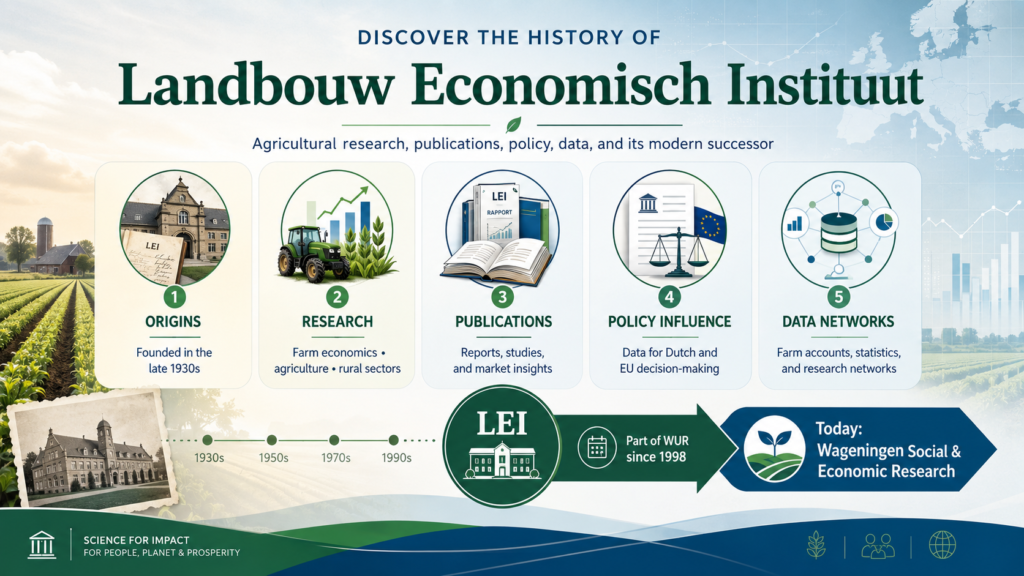
Key Takeaways About the Landbouw Economisch Instituut
The most important facts can be summarised as follows:
- Plans for an agricultural documentation organisation emerged in 1939.
- The institute began its activities on 1 December 1940.
- Its original work focused heavily on production costs, farm accounts, prices, and economic conditions.
- The organisation was supported by both government and organised agriculture.
- Its research covered agriculture, horticulture, fisheries, regional development, statistics, markets, and social conditions.
- The LEI became a ministerial foundation in 1971.
- It joined the Wageningen research structure around 1998 and 1999.
- The name changed to Wageningen Economic Research in 2016.
- In January 2025, Wageningen Economic Research and Wageningen Centre for Development Innovation merged to form Wageningen Social & Economic Research.
- The modern organisation continues to collect economic and sustainability information from a representative sample of Dutch agricultural, horticultural, fishing, and forestry businesses.
- Historical LEI reports remain valuable for studying farm incomes, agricultural policy, land use, trade, rural development, and structural change.
- The abbreviation LEI may appear in government documents and academic references published many years after the organisation joined Wageningen University & Research.
The central lesson is that the LEI should not be viewed only as a former government-linked research institute. I believe it is better understood as the foundation of a continuing Dutch tradition of agricultural economic measurement and applied policy research.
What Was the Landbouw Economisch Instituut?
The Landbouw Economisch Instituut was a Dutch research institution dedicated to the economic and social study of agriculture and related sectors. It gathered information, analysed developments, produced forecasts, and published research intended to support agricultural policy and business decisions.
Its work covered more than the price of crops or the profitability of an individual farm. Researchers examined regional economies, rural communities, agricultural trade, production methods, land use, mechanisation, horticulture, fisheries, forestry, consumer behaviour, environmental policy, and the structure of food supply chains.
The institute occupied an unusual position between science, government, and the agricultural sector. It needed access to detailed farm and market information, but its conclusions also needed to be sufficiently independent to remain credible. The early governance model therefore included both government representatives and organised agricultural interests.
Meaning of the LEI Abbreviation
LEI stands for Landbouw-Economisch Instituut. Historical publications may use several variations of the name, including:
- Landbouw-Economisch Instituut
- Landbouw Economisch Instituut
- LEI
- LEI-DLO
- LEI Wageningen UR
- Agricultural Economics Research Institute
- Agricultural Economic Institute
These variations can complicate research. A report published in 1960 may list the Landbouw-Economisch Instituut in The Hague, while a report from the early twenty-first century may identify LEI Wageningen UR as the publisher. Both can belong to the same institutional tradition.
The abbreviation should also be interpreted in context. Other organisations may use the letters LEI, so researchers should check whether a publication concerns Dutch agriculture, food, rural development, fisheries, or Wageningen University & Research.
Why the Netherlands Needed Agricultural Economic Research
The economic crisis that began in 1929 exposed weaknesses in agricultural markets. Prices could fall sharply, farmers could struggle to cover production costs, and governments could no longer assume that unrestricted supply and demand would always produce acceptable outcomes.
Price intervention created a new problem. A government could not set or influence agricultural prices responsibly without knowing how much it cost to produce milk, grain, vegetables, meat, and other goods. Reliable cost calculations required farm accounts, production records, labour information, land costs, yields, input prices, and consistent analytical methods.
The need was therefore practical. Policymakers required evidence about the economic position of farmers. Agricultural organisations needed credible information when discussing prices and support measures. Farm advisers needed benchmarks for comparing business performance. Researchers needed a central institution capable of collecting and standardising information.
In my view, the LEI emerged because individual bookkeeping records and scattered statistics were no longer sufficient. Agricultural policy had become too consequential and technically demanding to operate without a specialised research organisation.
How the Landbouw Economisch Instituut Was Established
The earliest plans appeared before the institute formally existed. In 1939, the First Division of the Royal Netherlands Agricultural Committee considered establishing a documentation bureau for agriculture. Its proposed purpose was to provide objective information to organisations and individuals who needed it.
The plan was connected to a wider debate about agricultural prices and production costs. Farmers and government officials recognised that economic decisions required better documentation and analysis. They also understood that the new institution would need some independence from individual interest groups.
In November 1940, the committee decided to establish a general documentation bureau for Dutch agriculture. Organisational and legal arrangements delayed the final foundation, but work began on 1 December 1940. Dr J. Horring was appointed as director, initially supported by only one administrative employee.
The modest scale of this beginning is significant. A research institution that would eventually produce a large body of national and international work started with an extremely small staff. Its influence grew because demand for agricultural economic evidence was already substantial.
In January 1941, the director-general responsible for food supply commissioned research into the production costs of arable crops from the 1941 harvest. Government services agreed to assist, and the government financed the investigation. This early assignment illustrates how quickly the institute moved from general planning to policy-relevant research.
By April 1941, government and the principal agricultural organisations had agreed that the organisation should be supported jointly. It was intended to have an objective scientific character rather than promote the position of one particular group. The foundation was formally completed later in 1941 after approval of its legal documents and statutes.
Why Objectivity Was Central to the Institution
Agricultural cost calculations can affect prices, subsidies, rents, regulations, and negotiations. Every interested party may therefore have a reason to prefer one conclusion over another. Farmers might emphasise high costs, governments might seek affordable food, and buyers might prefer lower prices.
The LEI needed methods that could withstand disagreement. Its authority depended on the credibility of the underlying information and on the perception that its researchers were not simply producing results for one interest group.
This does not mean that agricultural research is completely free of assumptions. Researchers must decide which farms belong in a sample, how family labour should be valued, how depreciation should be calculated, and which market developments should be included in a forecast. Objectivity is therefore achieved through transparent methods, consistent data, critical review, and clear explanations of uncertainty.
Timeline of the Landbouw Economisch Instituut
The table below shows the main organisational stages. The transition into the Wageningen structure is sometimes dated differently because organisational integration began in 1998, while archival records identify 1 April 1999 as a formal succession date.
| Year or period | Institutional development | Why it mattered |
|---|---|---|
| 1937 | Earliest surviving preparatory records | Shows that documentation and planning preceded formal establishment |
| 1939 | Proposal for an agricultural documentation bureau | Created the conceptual basis for a central economic research organisation |
| 1 December 1940 | Research activities began | Marks the practical start of the LEI |
| 1941 | Foundation and statutes were formally completed | Established a permanent organisation supported by government and agriculture |
| Post-1945 period | Research expanded and became more central to agricultural policy | Supported reconstruction, price policy, productivity analysis, and structural development |
| 1965 onward | Long-term farm economic data collection developed further | Created a consistent information base for comparing agricultural businesses |
| 1 January 1971 | LEI became a ministerial foundation | Gave it a legal position comparable to other research institutes linked to the agricultural ministry |
| 1998 | LEI joined Wageningen University & Research according to WUR history | Integrated applied economics with the Wageningen social sciences structure |
| 1 April 1999 | National Archives records identify Wageningen University as institutional successor | Represents the formal administrative transition in archival documentation |
| 2016 | LEI became Wageningen Economic Research | Introduced a unified Wageningen research brand |
| January 2025 | Wageningen Economic Research merged with Wageningen Centre for Development Innovation | Created Wageningen Social & Economic Research |
The timeline shows continuity rather than disappearance. The historic name changed, but the research tradition moved into a broader organisation with a wider international, social, environmental, and food-system focus.
The Core Research Functions of the LEI
The institute’s activities developed over time, but several research functions remained central throughout its history.
Production Cost Research
One of the earliest priorities was measuring the cost of producing agricultural goods. Researchers needed to account for seeds, feed, fertiliser, machinery, fuel, labour, land, buildings, depreciation, finance, and output levels.
A cost calculation can appear simple, but agricultural production creates difficult questions. Family members may work without a conventional salary. Machinery can serve several activities. Weather can reduce output without reducing all costs. Land may be owned or rented. A crop may require expenditure in one year but generate income in another.
The LEI developed methods for comparing businesses despite these differences. The resulting information could support price discussions, farm advice, and policy analysis.
Consider a hypothetical dairy farm that produces one million kilograms of milk per year. If total allocated production costs are €450,000, the calculated cost is €0.45 per kilogram. A second farm may report costs of €0.40, but that difference cannot be interpreted properly until we know whether both calculations value family labour, land, depreciation, and finance in the same way.
The LEI’s contribution was not merely collecting numbers. It established common definitions that allowed meaningful comparison.
Farm Business Analysis
Farm accounts provided information about revenues, costs, investments, debt, labour, productivity, and profitability. By examining multiple businesses, researchers could estimate typical results for different farm types and identify the reasons some businesses performed differently from others.
This information helped farmers evaluate their own operations. A farm adviser could compare a client’s feed costs, yield, labour use, or machinery expenses with a relevant benchmark. Policymakers could assess whether a sector-wide income decline resulted from low prices, high costs, weak productivity, or unusual weather.
A hypothetical greenhouse business may experience falling profits even while sales increase. Detailed accounts might show that energy costs rose faster than revenue. That finding points toward a different response than a situation caused by weak consumer demand.
Agricultural Price and Income Analysis
Prices alone do not show whether farmers are economically secure. A higher product price can be offset by increased fertiliser, feed, energy, wage, or financing costs. Researchers therefore analyse both revenue and expenditure.
The LEI studied farm incomes, price formation, market conditions, and profitability across agricultural sectors. Its findings contributed to discussions about support measures, market organisation, investment, taxation, and structural reform.
In my analysis, this was one of the institute’s most politically sensitive functions. Income estimates can influence public perceptions of farmers and affect negotiations between government, producers, and supply-chain businesses. Reliable methodology was essential.
Regional and Rural Research
Agricultural problems are not distributed evenly. Soil, water, infrastructure, land fragmentation, market access, farm size, labour supply, and population change can differ greatly between regions.
The LEI conducted regional studies to understand why certain agricultural areas did not develop as expected. Such research could support land consolidation, rural development, infrastructure planning, and changes in agricultural structure.
For example, a region might contain many small parcels spread across long distances. Farmers would spend more time moving machinery, and inefficient field shapes could raise labour and fuel requirements. An economic study could help quantify the potential benefits of land consolidation.
Regional research also examined social conditions. The wellbeing of a rural area depends on employment, services, population trends, housing, transport, and opportunities outside traditional farming.
Horticulture, Fisheries, and Forestry
The term agriculture was interpreted broadly. The institute developed specialised work on horticulture and fisheries, while later data systems also included forestry businesses.
Horticultural businesses face economic conditions that differ from those of arable or livestock farms. Greenhouse operations may have high energy and capital costs, while flower and vegetable markets can experience rapid price changes.
Fisheries research must account for vessels, fuel, quotas, stocks, landing prices, crew arrangements, ports, and international policy. Forestry involves long production periods, environmental objectives, public benefits, and markets that do not always reward every service a forest provides.
Specialised departments and methods were therefore necessary. A single general farm model could not represent all these sectors accurately.
Statistics and Documentation
The institute collected, organised, interpreted, and published large amounts of information. This documentation function was essential because economic research depends on accessible and consistent records.
The Dutch National Archives summarises this role in a sentence that captures the institution’s working method:
“Onderzoek, het verzamelen, interpreteren en publiceren van gegevens, is dan ook een centraal thema binnen het instituut.”
Nationaal Archief, inventory of the Landbouw Economisch Instituut archive
The quotation means that research and the collection, interpretation, and publication of data formed a central theme within the institute. I believe this description remains the most concise explanation of the LEI’s importance. It did not only produce conclusions. It built the evidence base from which conclusions could be drawn.
How LEI Data Supported Agricultural Decisions
The value of economic information becomes clearer when we follow it from the farm to a policy decision.
Suppose dairy farmers report that environmental requirements will sharply reduce their incomes. A policymaker cannot evaluate that claim using a single farm or a general national average. Researchers may need to divide farms by size, soil type, production intensity, region, debt position, and existing environmental performance.
They could then model several policy scenarios. One scenario might require investment in equipment. Another could limit production. A third might combine environmental payments with technical support. Each scenario would affect farm categories differently.
The research result would not make the political choice automatically. It would show likely costs, benefits, distributional effects, uncertainties, and trade-offs. Government officials could then decide whether a policy should be revised, phased in gradually, or accompanied by compensation.
This distinction matters. Economic research informs decisions but does not replace democratic judgment. Researchers can estimate that one option is cheaper, but society may choose another because it protects biodiversity, employment, animal welfare, food security, or regional communities.
The Role of Representative Samples
Researchers cannot normally collect complete accounts from every farm. They use a carefully selected sample intended to represent the wider sector.
The present-day Wageningen organisation reports that it has collected economic and sustainability information since 1965 from a representative group of nearly 1,800 Dutch agricultural, horticultural, fishing, and forestry businesses. This system is known as the Bedrijveninformatienet, or Farm Sustainability Data Network.
A representative sample is more valuable than a large but biased collection. If participation came mainly from highly profitable farms, the calculated average would overstate sector performance. If mainly struggling businesses participated, the opposite problem would occur.
Researchers therefore classify businesses and apply statistical methods to reflect the structure of the population. From my perspective, this long-running data infrastructure is one of the strongest parts of the LEI legacy.
Major LEI Publications and Research Outputs
The institute produced several types of publications, each designed for a different purpose.
Landbouw-Economisch Bericht
The Landbouw-Economisch Bericht was a major recurring publication presenting the economic condition of Dutch agriculture and agribusiness. Editions discussed international developments, European policy, agricultural trade, rural areas, environmental issues, production structures, profitability, and farm income.
English summaries were often published as the Agricultural Economic Report. These summaries made Dutch findings accessible to international readers.
For a researcher studying Dutch agriculture in a particular year, the Landbouw-Economisch Bericht can provide a useful starting point. It combines sector data with economic and policy context. However, readers should still consult the underlying sources when they need detailed methodology or figures.
Research Reports
LEI reports addressed defined policy or industry questions. Topics included agricultural trade, tenancy rules, food waste, consumer behaviour, climate policy, market competition, international development, rural planning, and sector profitability.
Many of these reports were commissioned by government ministries, European institutions, agricultural organisations, companies, or international bodies. Commissioned research should be evaluated carefully, but funding does not automatically invalidate a study. The important questions concern methodological independence, transparency, data quality, and whether limitations are clearly reported.
Mededelingen, Verslagen, and Internal Notes
Historical catalogues contain publication series described as Mededelingen, Verslagen, Onderzoekverslagen, and Interne Nota’s. These documents can contain valuable information that never appeared in widely distributed books or journals.
A regional study may preserve details about local agricultural structures that cannot be found elsewhere. An internal methodological note may explain how a cost calculation was constructed. A forecasting report may show how researchers understood future markets at a particular moment.
Readers should distinguish between a final public report and an internal working document. The latter may contain preliminary analysis or have a narrower audience.
Statistical Tools and Farm Benchmarks
The LEI also became known for economic classifications, farm-size calculations, benchmark information, and datasets used by planners and authorities. Historical planning documents sometimes required applicants to use LEI calculations when demonstrating the economic size of an agricultural business.
These tools created consistency across decisions, but classifications can become outdated. A unit designed for a previous production structure may not reflect modern technology, prices, or diversified farm activities. Researchers must therefore identify the version and year of every classification they use.
The Modern Successor to the Landbouw Economisch Instituut
The direct institutional tradition now continues through Wageningen Social & Economic Research. The current organisation was formed in January 2025 by merging Wageningen Economic Research with Wageningen Centre for Development Innovation.
The name reflects a broader research agenda than the original institute’s early concentration on cost prices and farm accounts. Modern food and agricultural questions involve consumer choices, international value chains, climate change, biodiversity, social justice, technological transitions, urban food systems, and institutional behaviour.
Wageningen University & Research describes the scale of the challenge directly:
“Food systems need fundamental change.”
Wageningen University & Research, Wageningen Social & Economic Research
This statement shows how far the research agenda has expanded. The original LEI helped policymakers understand production costs and agricultural markets. Its successor must also examine how entire food systems can become environmentally sustainable, economically viable, resilient, inclusive, and fair.
The modern institute specialises in policy analysis, impact evaluation, scenarios, market research, value-chain studies, consumer behaviour, and system transformation. It works with governments, international organisations, research institutes, non-governmental organisations, and agrofood businesses in more than 60 countries.
That international reach is not a rejection of the original mission. It reflects the globalisation of agricultural questions. Dutch farms depend on international feed, fertiliser, labour, energy, technology, finance, and markets. Consumer decisions in one country can influence land use and employment in another. Climate and biodiversity problems cross borders.
A second short statement from WUR explains the practical purpose of this research:
“These insights support informed decision-making.”
Wageningen University & Research, Wageningen Social & Economic Research
In my view, this line connects the historic LEI with its modern successor. Names, methods, and research themes have changed, but the practical objective remains recognisable: produce evidence that improves decisions.
Comparing the Historic LEI With Its Modern Successor
The table below shows how the institution’s scope developed. It should not be read as a complete separation between old and new. The historic LEI also researched social and environmental questions, while the modern organisation continues economic measurement and farm-data work.
| Research dimension | Historic LEI emphasis | Modern Wageningen emphasis |
| Primary policy context | Dutch agricultural and food policy | Dutch, European, and international food-system policy |
| Early analytical priority | Production costs, prices, farm accounts, and sector conditions | System transitions, sustainability, resilience, behaviour, markets, and policy impact |
| Main unit of analysis | Farm, sector, region, and agricultural market | Farm, company, consumer, value chain, region, institution, and food system |
| Data approach | Bookkeeping, surveys, statistics, regional documentation | Long-term farm networks, sustainability indicators, modelling, behavioural research, and digital data |
| Geographic scope | Initially concentrated on the Netherlands | Active in the Netherlands and internationally |
| Environmental analysis | Developed as environmental policy became more important | Integrated with climate, biodiversity, circularity, and nature-positive economics |
| Social analysis | Rural welfare, labour, farm structure, and regional communities | Inclusion, justice, behaviour, governance, livelihoods, and social transformation |
| Typical users | Ministries, agricultural organisations, advisers, and farmers | Governments, international organisations, NGOs, businesses, researchers, and civil society |
| Organisational name | Landbouw-Economisch Instituut | Wageningen Social & Economic Research |
| Continuing principle | Evidence for agricultural decision-making | Evidence for food-system and societal decision-making |
The strongest continuity lies in the use of applied evidence. Both the former LEI and its successor seek to connect research with real choices made by policymakers, producers, businesses, and communities.
How to Find Landbouw Economisch Instituut Publications
Historical research becomes easier when the search process is organised. I recommend the following steps.
Step 1: Define the Research Question
Begin with a specific subject, sector, region, and period. “Dutch farming” is too broad. “Dairy farm income in the Netherlands between 1975 and 1985” is much more useful.
A defined question helps identify the likely publication type. Annual economic conditions may appear in a Landbouw-Economisch Bericht, while a regional land-consolidation issue may appear in a Verslag or internal note.
Step 2: Search Multiple Name Variations
Use the full historic name, the abbreviation, and later institutional names. Useful combinations include:
- Landbouw-Economisch Instituut
- Landbouw Economisch Instituut
- LEI Den Haag
- LEI-DLO
- LEI Wageningen UR
- Wageningen Economic Research
- Wageningen Social & Economic Research
Add the sector, location, author, or year. A search for “LEI tuinbouw 1987” will usually produce more relevant results than “LEI report.”
Step 3: Search Wageningen Repositories
Wageningen University & Research maintains research catalogues and the eDepot, which contain many digitised LEI reports. Publication records may include authors, year, series, report number, abstract, language, and a document file.
Older scans may have imperfect text recognition. Searching for spelling variations can help, particularly when historic Dutch spelling or damaged scans affect indexing.
Step 4: Use the Dutch National Archives
The National Archives holds an extensive LEI archive covering records from 1937 to 1999. The inventory includes annual reports, meeting records, commission files, departmental material, and many publications.
An archive inventory describes groups of records rather than reproducing every document online. Researchers may need to record an inventory number and request consultation or a reproduction.
Step 5: Check Government Archives
Dutch government repositories contain letters, parliamentary documents, commissioned reports, and policy material referring to LEI research. These sources are especially useful when studying how a report influenced an actual decision.
A research report explains the analysis. A ministerial letter may reveal how government interpreted or used it. Reading both provides a more complete picture.
Step 6: Verify the Publication Version
Record the exact title, author, year, report number, series, publisher, and edition. A report may exist in Dutch and English, or an annual publication may have several summaries.
Do not assume that two similarly titled files are identical. One may be a summary, revised edition, annex, or policy response.
Step 7: Read the Methodology Before Using the Figures
Historical statistics must be interpreted using the definitions applied at the time. Farm-size categories, price levels, accounting conventions, currency, and sector boundaries may differ from modern standards.
For example, income measured before valuing family labour cannot be compared directly with a figure that deducts an imputed wage for unpaid family workers. A historical guilder amount also requires more analysis than simply converting it into euros.
Step 8: Distinguish Forecasts From Observed Results
A forecast describes what researchers expected under particular assumptions. It should not be cited as though the predicted event actually occurred.
Later LEI research evaluated forecasts made during the 1960s and found that technological change, European market expansion, consumer preferences, imports, and exports could be difficult to predict. This is a useful reminder that economic models clarify possibilities rather than eliminate uncertainty.
Practical Uses of Historical LEI Research
Historical reports remain relevant for several kinds of reader.
Agricultural Historians
Historians can use LEI material to reconstruct farm structures, production systems, incomes, regional differences, mechanisation, and policy debates.
A report published during a period of rapid tractor adoption may show not only how many machines were used but also how mechanisation affected labour requirements and farm costs.
Farmers and Agricultural Families
Families researching the history of a farm may find regional reports, farm-type studies, or sector statistics that explain the economic environment in which earlier generations made decisions.
A family account book gives one business’s experience. LEI benchmarks can show whether that experience was typical or unusual.
Policy Researchers
Historical research allows analysts to compare past and present interventions. Price supports, land consolidation, production limits, environmental payments, and tenancy rules have long histories.
The purpose is not to copy an old policy without adjustment. It is to understand which mechanisms worked, which created unintended effects, and how conditions have changed.
Economists and Data Researchers
Long-term publications allow researchers to study structural change. They can examine how farm numbers, scale, productivity, labour, profitability, or trade developed over decades.
Combining time series requires careful harmonisation. Definitions may change, and breaks in methodology can create apparent trends that are partly statistical.
Regional Planners
Regional LEI studies can reveal earlier expectations about population, employment, land use, transport, and agricultural development. Comparing those expectations with later outcomes can improve modern planning.
A region once considered dependent on small-scale farming may now rely on tourism, logistics, specialised horticulture, or commuting. Historical reports help explain the transition.
Genealogists and Local Researchers
Although LEI reports are not primarily genealogical records, they can provide context for people who worked in agriculture, fisheries, government, or rural organisations.
An individual’s decision to leave farming may make more sense when regional research shows falling incomes, fragmented land, limited expansion opportunities, or changing labour demand.
Common Misconceptions About the Landbouw Economisch Instituut
The LEI Was Only a Statistics Office
The institute collected statistics, but it also interpreted data, conducted field research, developed models, evaluated policy, produced forecasts, and studied social conditions.
A table showing average income is descriptive. Explaining why income changed and estimating the effect of a proposed policy require economic analysis.
The LEI Still Exists Under the Same Name
The historical name is no longer the current institutional name. Its work continued through Wageningen Economic Research and now Wageningen Social & Economic Research.
Older sources may still be described as LEI publications, and people familiar with the organisation may continue using the abbreviation informally.
Every LEI Estimate Was an Official Government Position
The institute frequently worked for government, but a research finding should not automatically be treated as government policy. Researchers analyse evidence, while ministers and parliaments make political decisions.
A commissioned report may recommend several options without selecting one.
Historic Figures Can Be Compared Directly With Current Data
Prices, farm classifications, accounting systems, sector definitions, and currencies change. A direct comparison can be misleading unless methods are harmonised.
The correct approach is to identify whether a figure is nominal or inflation-adjusted, which costs it includes, what population it represents, and whether the same definition is used in both periods.
Agricultural Economics Is Only About Profit
Agricultural economics examines scarcity, incentives, trade-offs, behaviour, markets, public goods, risk, distribution, and policy. Profitability is important because farms must remain viable, but economic analysis can also address water quality, biodiversity, food access, rural employment, climate impacts, and consumer welfare.
A Model Produces a Certain Prediction
Models depend on assumptions. Unexpected technological, political, environmental, or consumer changes can produce different results.
A responsible forecast should present scenarios, uncertainty, sensitivity, and limitations rather than a single number without context.
Recommendations for Using LEI Research Responsibly
I recommend treating every historical report as both evidence and a product of its time. The data can be extremely valuable, but definitions, institutions, technologies, and policy goals may have changed.
First, identify the intended audience. A technical working paper may assume specialist knowledge, while an annual economic report may summarise results for a broader policy audience.
Second, examine who commissioned the research and how the study was governed. This information helps readers understand the question being asked, though it should not be used as a substitute for evaluating the methods.
Third, locate appendices and methodological notes. The most important qualifications are often found outside the executive summary.
Fourth, compare several sources. A farm-income estimate can be examined alongside government statistics, agricultural organisation reports, market data, and later academic studies.
Fifth, preserve the original terminology when citing a source, then explain it in modern language. Changing a historical category silently can distort the meaning.
Sixth, distinguish between national averages and the distribution of outcomes. An average farm result can conceal major differences between regions, business sizes, production systems, and debt levels.
Finally, avoid presenting a historical recommendation as a solution to a modern problem without evaluating current circumstances. Climate obligations, European law, labour markets, consumer preferences, technology, and international trade may now be substantially different.
Why the Landbouw Economisch Instituut Still Matters
The LEI matters because modern agricultural debates continue to depend on the questions it was created to answer. What does production cost? Which businesses are economically vulnerable? Who bears the cost of a regulation? How do prices move through a supply chain? What happens to rural communities when agriculture changes? Which policy option produces the intended result?
Today, these questions are joined by additional concerns. Researchers must account for greenhouse-gas emissions, water quality, biodiversity, animal welfare, healthy diets, social justice, international development, and resilience to crises.
The analytical challenge has therefore grown. A policy that improves farm income may increase consumer prices. A measure that lowers emissions in the Netherlands may shift production abroad. A more efficient supply chain may concentrate market power. A nature restoration programme may create public benefits while reducing the land available for production.
From my perspective, the enduring lesson of the Landbouw Economisch Instituut is that these trade-offs should be measured openly. Evidence cannot remove political disagreement, but it can expose unrealistic assumptions and clarify who gains, who pays, and where uncertainty remains.
The institute’s legacy also demonstrates the value of long-term data. A survey conducted once can describe a moment. A consistent information network maintained over decades can reveal structural change, identify cycles, and test whether policies achieved their goals.
Conclusion
I see the Landbouw Economisch Instituut as far more than a historic Dutch research name. It helped establish the data, methods, and institutional relationships needed to understand agriculture as an economic and social system. Beginning with a small operation in 1940, the LEI developed research on production costs, farm performance, prices, regions, horticulture, fisheries, trade, and agricultural policy.
Its organisational identity changed through integration with Wageningen University & Research, the adoption of the Wageningen Economic Research name in 2016, and the creation of Wageningen Social & Economic Research in January 2025. The continuing emphasis on evidence-based scenarios, policy analysis, economic data, and informed decisions shows that the original mission remains relevant.
In my view, the practical lesson is simple: use LEI research with historical care, but do not dismiss it as outdated. Readers should verify definitions, methods, years, and publication versions before drawing conclusions. A useful next step is to search the Wageningen repositories and National Archives using the exact topic, period, region, and LEI publication series relevant to the research question.
Frequently Asked Questions
What Was the Landbouw Economisch Instituut?
The landbouw economisch instituut was a Dutch organisation that researched the economic and social conditions of agriculture and related sectors. Known as the LEI, it collected farm data, calculated production costs, studied prices and incomes, analysed regions and markets, and produced information for policymakers, agricultural organisations, advisers, and businesses. Its activities began on 1 December 1940, while the final legal foundation was completed in 1941.
Does the Landbouw Economisch Instituut Still Exist?
The Landbouw Economisch Instituut no longer exists under its historic name. It became part of Wageningen University & Research around 1998 and 1999 and was renamed Wageningen Economic Research in 2016. In January 2025, Wageningen Economic Research merged with Wageningen Centre for Development Innovation to form Wageningen Social & Economic Research, which continues much of the LEI research tradition.
What Does LEI Mean in Dutch Agricultural Research?
LEI means Landbouw-Economisch Instituut. The abbreviation appears on thousands of reports, government documents, academic references, and historical records concerning Dutch agriculture, horticulture, fisheries, rural areas, food markets, and agricultural policy. Later variations include LEI-DLO and LEI Wageningen UR. Researchers should check the publication date and institutional information because the organisation’s formal name and structure changed over time.
When Was the LEI Founded?
The institute began work on 1 December 1940 after proposals developed during 1939 and 1940. Its foundation, statutes, and legal arrangements were formally completed in 1941. Some summaries therefore describe 1940 as the founding year, while more detailed histories distinguish between the start of operations and the final legal establishment.
What Kind of Research Did the LEI Conduct?
The LEI researched farm costs, profitability, prices, income, production, trade, agricultural policy, regional development, mechanisation, rural society, horticulture, fisheries, forestry, food chains, consumers, and environmental issues. Its precise research agenda changed as Dutch agriculture and public policy developed. Early work concentrated strongly on cost prices and farm bookkeeping, while later work included broader food-system and sustainability questions.
Where Can I Find Old LEI Reports?
Old LEI reports can be found through Wageningen University & Research repositories, the WUR eDepot, Research@WUR, Groen Kennisnet catalogues, Dutch government archives, library systems, and the Dutch National Archives. Search with the full name, abbreviation, publication series, report number, author, year, region, and subject. Older digitised documents may require spelling variations because scanned text is not always indexed accurately.
What Was the Landbouw-Economisch Bericht?
The Landbouw-Economisch Bericht was a recurring LEI publication reviewing the economic condition of Dutch agriculture and agribusiness. It discussed international and European developments, agricultural production, trade, rural areas, environmental issues, profitability, and income. English summaries were published under the title Agricultural Economic Report. Different annual editions should be cited separately because economic conditions and methodologies changed.
Is Wageningen Economic Research the Same as the LEI?
Wageningen Economic Research was the later name of the institutional research tradition associated with the LEI. The name was introduced in 2016 as part of Wageningen University & Research’s branding strategy. Since January 2025, the relevant organisation has been called Wageningen Social & Economic Research following a merger with Wageningen Centre for Development Innovation.
Why Are LEI Farm Accounts Important?
LEI farm accounts are important because they provide consistent information about revenue, expenditure, labour, investment, productivity, debt, and profitability. When collected from a representative sample, these records allow researchers to estimate sector conditions and compare farm types. Their value increases over time because long-running datasets reveal structural developments that cannot be seen in a one-year survey.
Can Historical LEI Data Be Compared With Modern Figures?
Historical LEI data can be compared with modern figures only after checking definitions and methods. Researchers must account for inflation, currency changes, farm classifications, sector boundaries, sample design, accounting conventions, and the treatment of family labour, land, depreciation, and finance. A direct comparison without these adjustments may produce a misleading trend.
Sources and References
- Wageningen University & Research, “Wageningen Social & Economic Research”
- Wageningen University & Research, history of Wageningen University & Research
- Dutch National Archives, archive inventory 2.11.65, Landbouw Economisch Instituut, 1937 to 1999
- Dutch National Archives Actor Register, “Landbouw-Economisch Instituut (LNV)”
- Landbouw-Economisch Instituut, Tien Jaren Landbouw-Economisch Instituut: Opbouw van het Economisch Onderzoek in de Landbouw, Tuinbouw en Visserij, 1950
- LEI, historical editions of the Landbouw-Economisch Bericht
- LEI, English editions of the Agricultural Economic Report
- Wageningen University & Research eDepot and Research@WUR publication records
- Dutch government archives containing LEI research and ministerial policy documents
- LEI, Meerjarenvisie van het Landbouw-Economisch Instituut, 1982-1986
Disclaimer
This article is intended for general informational, historical, and educational purposes. It does not represent Wageningen University & Research, Wageningen Social & Economic Research, the Dutch government, the Dutch National Archives, or any former LEI employee. Institutional structures, databases, archive access procedures, publication locations, and organisational descriptions may change. Readers conducting academic, legal, financial, or policy research should consult original reports, verify current information, examine the relevant methodology, and cite the authoritative source documents directly.