
I see the phrase Premier Lotteries used most often as a shortened reference to Premier Lotteries Ireland Designated Activity Company, commonly called PLI. The company operates the Irish National Lottery under a licence granted by the Irish state. It is not a separate lottery game, a system for predicting winning numbers, or an unregulated international betting website.
Understanding that distinction is important because several organisations are involved in Ireland’s lottery system. Premier Lotteries Ireland manages the commercial and operational side of the National Lottery. An independent regulator oversees its compliance with legislation and the licence. Government departments ultimately distribute money raised for Good Causes through approved programmes and funding channels.
In my analysis, the public can understand this structure most easily by separating four functions: operating games, regulating the operator, managing lottery funds, and allocating Good Causes funding. These functions are connected, but one organisation does not control all of them.
Premier Lotteries also sits at the centre of a changing lottery market. Players can still purchase tickets through thousands of retailers, while eligible adults can also use the official website and mobile application. Digital access brings convenience, but it also makes identity checks, account security, spending controls, advertising standards, and reliable ticket verification increasingly important.
This guide explains the company’s identity, history, ownership, licence, games, funding model, player requirements, regulatory oversight, and public responsibilities. I will also examine a recent compliance issue because a balanced company profile should include both positive contributions and documented shortcomings.
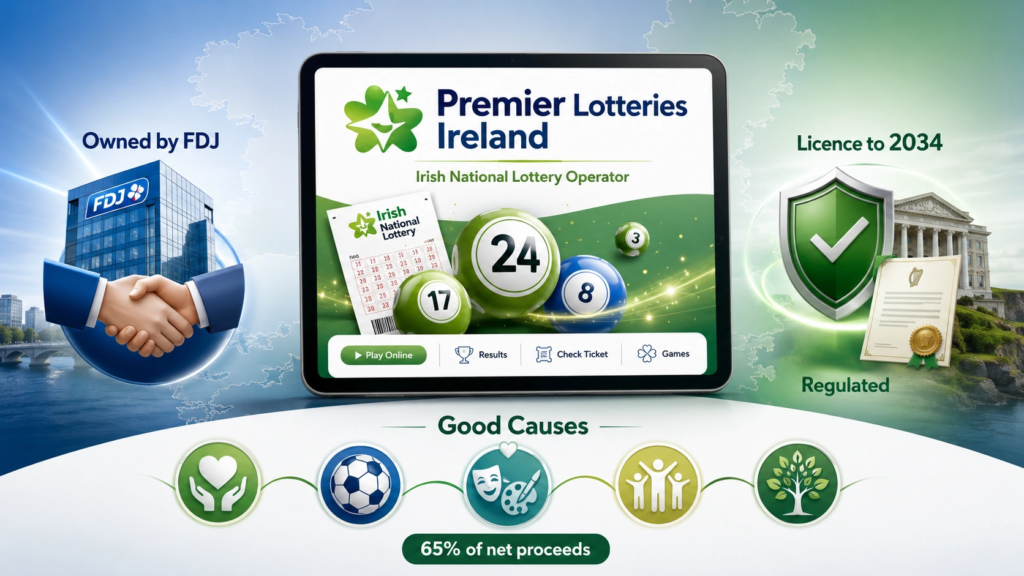
Key Takeaways About Premier Lotteries
The following points provide a quick summary of the most important facts:
- Premier Lotteries Ireland DAC operates the Irish National Lottery.
- The company holds exclusive operating rights under a 20-year licence that began in November 2014 and runs until 2034.
- The Irish National Lottery remains a regulated national institution even though its operator is privately owned.
- FDJ acquired Premier Lotteries Ireland in November 2023 and later adopted the group name FDJ UNITED.
- Premier Lotteries Ireland is currently led by CEO Cian Murphy.
- The Regulator of the National Lottery independently monitors the operator’s compliance with the National Lottery Act 2013 and the operating licence.
- National Lottery products include draw games, scratch cards, instant-win products, retail tickets, and online play.
- Online participants must be at least 18, legally resident in Ireland, and physically located in Ireland when playing.
- Lottery proceeds contribute to prizes, retailer commissions, operating costs, regulation, and funding for Good Causes.
- Lottery participation should be treated as paid entertainment rather than a financial plan or reliable method of generating income.
What Premier Lotteries Is
Premier Lotteries Ireland DAC is the private company authorised to operate Ireland’s National Lottery. Its responsibilities include managing games, processing ticket sales, supporting retailers, operating official digital services, paying valid prizes, marketing the National Lottery, and transferring the required funding for Good Causes.
The company uses the name National Lottery when communicating with players. As a result, many people may use the official lottery website or buy a ticket without encountering the Premier Lotteries corporate name prominently until they read the legal information, company pages, or terms and conditions.
The official description is direct:
“Premier Lotteries Ireland (PLI) operates the Irish National Lottery.”
Premier Lotteries Ireland, official About page
This short statement matters because it defines the relationship correctly. Premier Lotteries Ireland is the operator, while the National Lottery is the state-authorised lottery system and public-facing brand.
From my perspective, the distinction resembles a public transport authority appointing a company to run a service under detailed contractual and regulatory conditions. The operator handles daily activity, but it does not gain unlimited control. Its powers and responsibilities are defined by legislation, licence terms, regulatory approvals, codes of practice, and performance standards.
Premier Lotteries Is Not an Independent Offshore Lottery
Premier Lotteries Ireland should not be confused with websites that sell bets on foreign lottery results or claim to purchase international tickets on a customer’s behalf. The Irish National Lottery operates within a defined national legal and regulatory framework.
Official online play is restricted by age, legal residence, and physical location. These conditions distinguish the authorised service from unrelated international websites that may use Irish lottery names, results, or branding.
A reader searching for Premier Lotteries should therefore verify that information comes from the official Irish National Lottery domain, the Regulator of the National Lottery, an Irish government source, or a clearly identified corporate record.
Why the Corporate Name Matters
Knowing the operator’s legal name helps consumers understand privacy policies, account agreements, complaints procedures, and regulatory decisions. A legal document may refer to Premier Lotteries Ireland DAC rather than simply using the National Lottery brand.
The corporate identity also matters when the media reports on ownership changes, financial results, licence compliance, or management appointments. A headline about Premier Lotteries usually concerns the operator rather than a specific game such as Lotto or EuroMillions.
The History of Premier Lotteries Ireland
Ireland’s National Lottery existed before Premier Lotteries Ireland became its operator. The current operating arrangement emerged from a government decision to award a long-term licence through a competitive process.
Premier Lotteries Ireland was awarded a 20-year licence in 2014. The company began operating the National Lottery on 30 November 2014, meaning the current licence period is scheduled to continue until 2034.
The licence was awarded following an upfront payment of €405 million. Government information published after the award stated that the payment supported public projects, including the development of the National Children’s Hospital.
In my view, this history explains why the National Lottery can be both publicly authorised and privately operated. The state did not simply sell an unrestricted lottery business. It granted a time-limited right to operate the National Lottery under legislation, detailed licence conditions, and independent supervision.
The Move From the Previous Operator
Before the current licensing arrangement, the National Lottery had been operated through a company associated with An Post. Premier Lotteries Ireland took over operations after the new licence came into effect.
Operational transitions of this size involve much more than changing a company name. Retailer relationships, technology systems, game administration, prize processes, staff, contracts, marketing, customer records, and regulatory reporting all need to continue without undermining confidence in the games.
A lottery depends heavily on public trust. Players must believe that tickets are recorded correctly, draws are conducted properly, results are accurate, prizes can be claimed, and financial transfers follow the required rules. The licence therefore includes controls that go beyond ordinary commercial contracts.
Who Owns Premier Lotteries Ireland?
Premier Lotteries Ireland is owned by FDJ UNITED, the European gaming group formerly known as La Française des Jeux or FDJ.
FDJ completed the acquisition of all the share capital of Premier Lotteries Ireland on 3 November 2023 after receiving regulatory approval. The shares were acquired from the Ontario Teachers’ Pension Plan Board, An Post, and the An Post pension plan.
The acquisition was significant because operating Premier Lotteries Ireland became FDJ’s first move into running a national lottery outside France. In March 2025, the wider group changed its name to FDJ UNITED to reflect its expanded European operations.
The official acquisition announcement included this statement:
“The synergies between FDJ and Premier Lotteries Ireland will draw on our respective and acknowledged skills.”
Stéphane Pallez, Chairwoman and CEO of FDJ Group
I interpret this quotation as an indication that the parent company expected to combine experience from the French and Irish lottery markets. However, ownership by an international group does not remove the operator’s Irish legal obligations. Premier Lotteries Ireland must continue complying with its Irish licence and the decisions of the Irish regulator.
Current Leadership
The official Premier Lotteries Ireland website identifies Cian Murphy as CEO. The company is operated by an Irish-based management team from its Dublin headquarters.
Leadership information is relevant because the operator is accountable for customer service, technology, compliance, responsible play, retailer operations, game performance, and its relationship with the regulator.
The independent Regulator of the National Lottery is Carol Boate. Her office is separate from Premier Lotteries Ireland and carries out statutory oversight functions.
How Premier Lotteries Fits Into the National Lottery Structure
The National Lottery structure can seem complicated because several organisations deal with money, regulation, games, and public funding. The table below separates their main roles.
| Organisation or participant | Primary role | What it does not normally control |
|---|---|---|
| Premier Lotteries Ireland | Operates the Irish National Lottery | Does not independently allocate government Good Causes grants |
| Regulator of the National Lottery | Oversees compliance, game integrity, player protection, and the licence | Does not operate or market lottery games |
| Irish Government | Establishes legislation and receives lottery funding for permitted purposes | Does not manage daily ticket sales |
| Government departments and public bodies | Distribute eligible Good Causes funding through programmes | Do not conduct National Lottery draws |
| Retailers | Sell authorised lottery products and validate eligible tickets | Do not set national game rules |
| Players | Purchase tickets and claim valid prizes | Do not influence random draw outcomes |
| FDJ UNITED | Owns Premier Lotteries Ireland | Does not replace the Irish regulator |
The most important takeaway is that operational power, regulatory power, and funding allocation are deliberately separated. This reduces the risk of one organisation controlling every stage without external scrutiny.
Games Operated by Premier Lotteries
Premier Lotteries Ireland operates a portfolio of draw games and instant-win products under the National Lottery brand. The exact range may change as games are approved, introduced, modified, or withdrawn.
Well-known draw games include Lotto, EuroMillions, EuroDreams, and Daily Million. The National Lottery also offers associated products such as Lotto Plus, raffle features, scratch cards, and online instant-win games.
Some games are specific to Ireland, while others form part of international lottery arrangements. EuroMillions, for example, is played across participating European countries, although certain raffle features or supplementary prizes may be designed for Irish players.
Retail Lottery Sales
Retail remains a major part of National Lottery access. Authorised shops sell draw-game tickets and scratch cards, provide information, and may validate or pay certain prizes according to the applicable rules.
Retailers must follow sales and player-protection requirements. These responsibilities include observing age restrictions, completing relevant training, using authorised equipment, and complying with operational codes.
The retail network also gives people who do not use online accounts a way to participate. Physical tickets must be protected carefully because possession and validation requirements can affect a prize claim.
Online and Mobile Services
Eligible adults can use the official National Lottery website or mobile application to purchase entries, check results, manage game activity, and access account tools.
Digital play differs from retail play because the operator can apply identity verification, location requirements, account controls, transaction records, and spending restrictions directly to an individual account.
I believe digital records can reduce some risks associated with losing a physical ticket. At the same time, online access can make repeated participation easier, so effective spending controls and player-awareness tools become more important.
Game Rules and Random Outcomes
Each authorised game has official rules defining ticket prices, entry procedures, closing times, draw processes, prize categories, claim periods, and exceptional circumstances.
No number-picking method can alter the random probability of an independently drawn combination. Historical frequency does not make a number “due,” and a long period without a jackpot win does not guarantee that the next ticket will win.
Consider a hypothetical example. A player notices that the number 12 has not appeared recently and concludes that it must appear soon. Random draws do not have a memory that balances individual numbers according to a person’s expectations. Previous outcomes do not create a promise about the next draw.
How Premier Lotteries Is Regulated
The Office of the Regulator of the National Lottery oversees Premier Lotteries Ireland under the National Lottery Act 2013 and the operating licence.
The regulator’s responsibilities include monitoring the integrity of games, reviewing the operator’s performance, examining controls, protecting participant interests, overseeing advertising, handling regulatory complaints, investigating possible breaches, and managing the National Lottery Fund.
This oversight is independent of the operator. Premier Lotteries Ireland cannot decide for itself whether it has complied with every licence condition.
The regulator describes transparency in clear terms:
“Details of any breaches of the Licence are always published by the Regulator, and in a timely manner.”
Regulator of the National Lottery, Strategy Statement 2025–2027
From my perspective, publication of breaches is essential. Consumers cannot evaluate regulation properly when failures are hidden. Public reporting allows readers to see the nature of an incident, the operator’s response, and the regulator’s enforcement action.
Approval and Monitoring of Games
Premier Lotteries Ireland does not have unrestricted freedom to create or change games. Certain game schemes and significant operational matters require regulatory consideration or approval.
The regulator can examine whether proposed arrangements protect participants, maintain the integrity of the National Lottery, support long-term sustainability, and remain consistent with the licence.
Oversight may involve draw observations, technical reviews, audits, advertising monitoring, mystery-shopping exercises, complaint analysis, and examination of operator reports.
Performance Standards
The operator is assessed against defined standards. These can cover matters such as customer service, complaint resolution, system availability, retailer support, prize processing, responsible play, and financial reporting.
Missing a target does not always constitute a formal breach. A performance target can trigger investigation, corrective action, or closer monitoring even where the regulator does not impose a financial consequence.
This distinction is useful. Performance management focuses on whether the operator is meeting expected service levels, while formal enforcement deals with violations of legislation or licence conditions.
The 2024 Licence Breach and What It Shows
A balanced explanation of Premier Lotteries should acknowledge a licence breach documented in the regulator’s 2024 annual report.
The issue originated from a third-party software release affecting the “Check My Numbers” facility on the National Lottery website during September and October 2022. Some users could access the facility while the latest draw results were still being verified.
This timing problem meant some players could receive a “Ticket Not a Winner” message even though the system did not yet have the final verified draw information needed to provide that conclusion.
The regulator determined that the incident breached the licence. In 2024, €23,000 was withheld from payments due to the operator and transferred to the Exchequer for Good Causes.
The regulator reported that the issue may have contributed to as many as 394 prizes remaining unclaimed, with a maximum combined value of €2,299. The operator was also directed to return the potentially affected amount to players through prizes in other National Lottery games.
Premier Lotteries Ireland stated that it discovered and self-reported the issue, introduced a permanent solution, and had not experienced a recurrence.
In my view, two lessons emerge. First, even a relatively small software timing error can undermine player confidence because ticket checking must be accurate. Second, independent oversight provides a mechanism for investigating the problem, publishing the findings, ordering remedial steps, and imposing a financial consequence.
How Premier Lotteries Supports Good Causes
Raising money for Good Causes is a central public purpose of the Irish National Lottery. Lottery funding supports eligible projects and services in areas established by law and government policy.
Premier Lotteries Ireland generates the relevant proceeds through National Lottery sales and transfers required amounts through the regulated funding structure. It does not personally select every community organisation or project that receives public funding.
Government departments and authorised bodies distribute funding through grants, programmes, and sector-specific processes. Applicants generally apply to the relevant programme rather than asking Premier Lotteries Ireland directly for a donation.
How the Funding Formula Works
The regulator’s current strategy explains that, after prize money is allocated, Good Causes receive the largest proportion of the remaining proceeds. The financial model allocates 65 percent of sales less prizes to Good Causes.
“Sales less prizes” is often described as gross gaming revenue in lottery financial reporting. It is not the same as 65 percent of every euro spent because prize liabilities are deducted first.
Here is a simplified hypothetical example for explanation only:
- Suppose total ticket sales were €100 million.
- Suppose €55 million was allocated to prizes.
- Sales less prizes would equal €45 million.
- At 65 percent, the Good Causes allocation would be €29.25 million.
- Remaining amounts would contribute to retailer commissions, regulation, operations, and other licence-defined costs.
This example does not represent a reported year. Its purpose is to show how the calculation differs from simply taking 65 percent of total sales.
Recent Good Causes Transfers
The Regulator’s 2024 annual report states that €238.3 million was transferred from the National Lottery Fund to the Exchequer to support Good Causes during 2024. The comparable transfer for 2023 was reported as €241 million.
Separately, the Irish Government’s first annual National Lottery Good Causes Report stated that approximately €6 billion had been raised for Good Causes since the National Lottery was established.
These sums can support community facilities, culture, heritage, health, sport, recreation, youth services, and other purposes permitted under Irish law. Actual grant criteria and allocation decisions depend on the relevant government department or programme.
What Good Causes Funding Does Not Mean
The Good Causes contribution does not make buying a lottery ticket equivalent to making a charitable donation. A ticket purchase is primarily a gambling transaction that provides an opportunity to win a prize.
Someone who wants all or most of a payment to reach a particular charity should donate directly to that organisation after checking its credentials. A lottery ticket distributes money among prizes, funding, retail costs, operating expenses, and other required categories.
I believe both ideas can be true at once: the National Lottery raises substantial public funding, and individual players should still regard their spending as entertainment rather than philanthropy or investment.
Eligibility and Responsible Play Requirements
Premier Lotteries Ireland must operate within player-protection requirements. The official online terms state that a player must be at least 18 years old, legally resident in Ireland, and physically located in Ireland when playing online.
Online identity verification may require an eligible passport or driving licence and a smartphone capable of capturing the required image. The process is intended to confirm age and identity.
Retailers also have responsibilities relating to underage sales. Lottery tickets and scratch cards should not be purchased for or given to children.
The National Lottery summarises its intended approach with a brief statement:
“Play responsibly, Play for fun.”
Irish National Lottery
I consider “play for fun” the most important part of that message. Lottery games should not be treated as a way to pay rent, clear debt, replace employment income, or recover earlier losses.
Signs That Lottery Play May Be Becoming Harmful
A person should reconsider their participation when gambling begins affecting essential spending, relationships, sleep, work, or emotional health.
Possible warning signs include:
- Spending more than intended
- Hiding purchases from family members
- Borrowing money to buy tickets
- Increasing spending after a loss
- Believing a win is required to solve financial problems
- Feeling anxious when unable to play
- Repeatedly checking results in a disruptive way
- Using several accounts or payment methods to bypass limits
- Treating near misses as evidence that a win is approaching
A hypothetical example can make the distinction clearer. A person who occasionally buys one ticket from a fixed entertainment budget is behaving differently from someone who uses grocery money to purchase many tickets after losing the previous week.
The second situation requires a firm response, such as stopping play, using account controls, discussing the problem with a trusted person, and contacting an appropriate gambling-support service.
How to Use Official Premier Lotteries Services Safely
The safest approach begins with verifying that a website, application, message, or retailer is genuinely connected to the Irish National Lottery.
Step 1: Use the Official National Lottery Domain
Type the known official address directly or access it through a trusted bookmark. Avoid clicking advertisements or messages that use slightly altered spellings.
A fraudulent site might add a hyphen, change the domain extension, replace one letter, or create a misleading subdomain.
Step 2: Check Eligibility Before Registering
Online players must meet the age, residence, and physical-location requirements. Providing false information could breach account terms and create problems when claiming a prize.
Identity verification should occur only through the official account system. A supposed lottery representative should not request identity documents through an unexpected social-media message.
Step 3: Create a Unique Password
Use a password that is not shared with email, banking, shopping, or social accounts. Account reuse increases the damage that can follow a data breach on another service.
Where additional account security is available, use it. Never disclose verification codes to a caller or message sender.
Step 4: Set a Fixed Entertainment Budget
Choose a spending amount before playing and treat it as a cost, not an investment. The amount should come from discretionary money remaining after housing, food, bills, transport, savings, and debt commitments.
Do not increase the budget because a jackpot has grown or because previous tickets lost.
Step 5: Read the Game Rules
Check ticket prices, closing times, draw dates, prize categories, claim periods, and validation requirements. Rules can differ between games and purchasing channels.
A person who buys a retail ticket should sign it where appropriate and store it securely. Online players should confirm that an entry appears correctly in their account records.
Step 6: Verify Results Through Official Channels
Use the official website, application, retailer terminal, or published draw information. Keep the ticket until the result and any prize claim have been fully verified.
The documented “Check My Numbers” incident reinforces the value of confirming important results through an official validated process, particularly when a result has only just been drawn.
Step 7: Follow the Correct Prize-Claim Process
Prize procedures depend on the amount, game, and purchasing channel. Smaller prizes may be payable through retailers, while larger prizes can require direct contact with National Lottery claims staff.
A genuine lottery does not require a winner to pay a secret release fee, international tax charge, courier deposit, or cryptocurrency payment before receiving a prize.
Step 8: Stop When Play Is No Longer Recreational
Use available limits and breaks before spending becomes harmful. Seeking help early is easier than waiting for a serious financial crisis.
Premier Lotteries Services, Risks, and Appropriate Responses
The table below connects common activities with their benefits, risks, and safer responses.
| Activity | Potential benefit | Main risk | Practical response |
| Buying a retail ticket | Simple access without an online account | Losing or damaging the ticket | Sign and store it securely |
| Playing online | Account record and convenient access | Frequent or impulsive spending | Set strict spending limits |
| Using ticket-checking tools | Quick result information | Acting on an unverified or mistimed result | Retain the ticket and confirm officially |
| Joining a syndicate | Shared cost and more collective entries | Disputes about ownership or prize division | Use a written agreement |
| Giving a lottery product as a gift | Entertainment for an eligible adult | Underage exposure | Never give tickets to anyone under 18 |
| Following jackpot news | Awareness of upcoming draws | Increased spending driven by excitement | Keep the original budget unchanged |
| Claiming a prize | Access to valid winnings | Scams impersonating claims staff | Use official contact details only |
| Reading winner stories | General interest and publicity | Unrealistic expectations about winning | Remember that winners are exceptional |
| Applying for Good Causes funding | Possible support for eligible projects | Applying to the wrong organisation | Use the relevant government programme |
| Checking historical numbers | Entertainment and record review | Believing patterns predict random draws | Treat every valid combination according to its actual odds |
The central lesson is that most risks can be reduced by using official channels, protecting tickets and accounts, maintaining a fixed budget, and refusing to treat past results as predictions.
Common Misconceptions About Premier Lotteries
Premier Lotteries Is the Name of a Lottery Game
Premier Lotteries is the shortened corporate name commonly used for Premier Lotteries Ireland. The games are sold under names such as Lotto, EuroMillions, EuroDreams, and Daily Million.
The Government Directly Runs Every Draw and Retail Sale
The National Lottery is state-authorised, but Premier Lotteries Ireland handles daily operations under licence. The independent regulator monitors compliance and protects the public interest.
Premier Lotteries Chooses All Good Causes Recipients
The operator raises and transfers the required funds. Government departments and public bodies generally decide how funds are distributed through eligible programmes.
Buying More Tickets Creates a Reliable Return
Buying more valid entries increases the number of chances purchased, but it also increases spending. It does not turn a negative-expectation gambling product into a dependable investment.
Frequently Drawn Numbers Are More Likely Next Time
Past frequency does not create certainty about a future random draw. A number that appeared several times remains subject to the same rules as other eligible numbers in the next independent draw.
A Message Saying I Won Must Be Genuine
A scammer can copy logos, names, addresses, and winner language. A person cannot win a draw they did not enter. Genuine claims should be verified using independently obtained official contact information.
A Licence Means Operational Errors Never Occur
Regulation reduces risk and creates accountability, but it does not make errors impossible. The 2022 ticket-checking issue and subsequent enforcement demonstrate why monitoring and transparent corrective action remain necessary.
Expert Recommendations for Evaluating Premier Lotteries
My first recommendation is to distinguish the public-facing National Lottery brand from Premier Lotteries Ireland as the licensed operator. This makes privacy notices, complaints, regulation, and corporate reporting easier to understand.
Second, use the regulator’s website when evaluating compliance. Company marketing can explain games and initiatives, but an independent regulator provides a more appropriate source for licence breaches, investigations, and enforcement decisions.
Third, separate Good Causes funding from personal winning expectations. The public funding contribution is real, but it does not improve an individual ticket’s probability or make repeated gambling financially advisable.
Fourth, verify all claims about “winning systems.” No retailer, influencer, application, prediction service, or number generator can guarantee a random lottery jackpot. Claims of secret access or manipulated outcomes should be treated as warning signs.
Fifth, review account activity regularly. Digital records can help a player see whether spending is increasing. Monthly totals often provide a clearer picture than thinking about each small purchase separately.
Finally, decide in advance what would cause you to stop. A practical rule might be that lottery spending ends immediately if it affects a household bill, requires borrowing, creates secrecy, or causes distress.
Conclusion
I believe the clearest way to understand Premier Lotteries is to view it as the licensed commercial operator within a wider public and regulatory system. Premier Lotteries Ireland manages the Irish National Lottery’s games, retail relationships, digital channels, prize operations, and required financial transfers, but it does not regulate itself or independently choose every Good Causes recipient.
Its licence began in November 2014 and runs until 2034. The company is now owned by FDJ UNITED, while its Irish management team is led by CEO Cian Murphy. Independent oversight is provided by the Regulator of the National Lottery, whose published reports cover performance, funding, player protection, and compliance issues.
The operator has helped generate substantial funding for Good Causes, including €238.3 million transferred during 2024. The documented ticket-checking breach also shows why transparent regulation and reliable technology are essential.
My recommended next step is to use official National Lottery and regulator information whenever checking games, accounts, prizes, company claims, or compliance records. Anyone choosing to participate should set a firm entertainment budget, protect account information, verify results carefully, and remember that lottery play cannot provide guaranteed income.
Frequently Asked Questions
What Is Premier Lotteries?
Premier Lotteries usually refers to Premier Lotteries Ireland DAC, the private company licensed to operate the Irish National Lottery. It manages games, ticket sales, retail systems, digital services, prize processes, marketing, and required financial transfers. The company operates under the National Lottery Act 2013, a detailed licence, regulatory codes, and independent oversight rather than functioning as an unrestricted gambling business.
Is Premier Lotteries the Irish National Lottery?
Premier Lotteries Ireland is the operator of the Irish National Lottery, but the two names describe different parts of the structure. The National Lottery is the state-authorised lottery and public-facing brand. Premier Lotteries Ireland is the company appointed to manage its operations under licence. The Regulator of the National Lottery separately monitors compliance, game integrity, participant protection, and funding obligations.
Who Owns Premier Lotteries Ireland?
Premier Lotteries Ireland is owned by FDJ UNITED. The group, then known as La Française des Jeux or FDJ, completed its acquisition of all PLI shares in November 2023 following regulatory approval. FDJ later changed its corporate name to FDJ UNITED in 2025. The Irish operator continues to be governed by Irish legislation and its National Lottery licence despite being part of a wider European group.
How Long Does the Premier Lotteries Licence Last?
The operating licence lasts for 20 years from 30 November 2014, meaning it is scheduled to continue until 2034. The licence gives Premier Lotteries Ireland exclusive rights to operate the Irish National Lottery during that term, subject to compliance with its conditions. Long-term operating rights do not prevent enforcement, licence amendments, regulatory investigations, or performance monitoring during the licence period.
Who Regulates Premier Lotteries?
The Regulator of the National Lottery independently oversees Premier Lotteries Ireland. The regulator monitors compliance with the National Lottery Act 2013 and the operating licence, examines game integrity, reviews advertising, protects participant interests, investigates complaints and possible breaches, manages the National Lottery Fund, and publishes regulatory decisions. Carol Boate is identified on the regulator’s official website as the Regulator of the National Lottery.
How Much Money Does Premier Lotteries Raise for Good Causes?
The amount varies each year because it depends partly on ticket sales and prizes. The regulator reported that €238.3 million was transferred from the National Lottery Fund to the Exchequer for Good Causes in 2024. The government has also reported that approximately €6 billion has been raised since the Irish National Lottery began. Government programmes, rather than Premier Lotteries alone, determine the final allocation of funding.
Can Anyone Play the Irish National Lottery Online?
No. Official terms state that online players must be at least 18 years old, legally resident in Ireland, and physically located in Ireland while playing. Identity and age verification may be required. These conditions apply to official online participation and should not be confused with unrelated international websites that offer bets based on Irish lottery results.
Is Premier Lotteries Safe?
Premier Lotteries Ireland is a licensed and independently regulated operator, but players should still follow ordinary security and responsible-play precautions. Use only official websites and applications, create a unique password, verify prize messages independently, retain retail tickets, and never pay an unexpected fee to release winnings. Regulation provides oversight and remedies, but it does not eliminate every possibility of technical errors, scams, or harmful spending.
Does Premier Lotteries Contact Winners by Email?
The contact process depends on how an entry was purchased and the type of prize involved. Online accounts may allow the operator to identify certain winners, while holders of retail tickets are normally responsible for checking and claiming their prizes. Any unexpected email should be verified through official contact details. A message requesting advance payment, cryptocurrency, banking passwords, or authentication codes is a strong scam warning.
Can I Improve My Chances of Winning?
Purchasing additional distinct valid entries can increase the number of combinations held, but it also increases the amount spent and does not guarantee a prize. Number histories, lucky dates, prediction software, and “hot number” systems cannot control an independent random draw. In my view, the safest principle is to buy only from a fixed entertainment budget and assume that the full ticket cost may be lost.
How Do I Apply for National Lottery Good Causes Funding?
Applicants generally apply through the government department, public body, or programme responsible for the relevant funding category. Premier Lotteries Ireland raises and transfers funds but does not personally decide every grant recipient. Organisations should identify a suitable official programme, review its eligibility conditions, gather required evidence, and apply through the stated public process rather than sending a general funding request to the lottery operator.
Sources and References
- Premier Lotteries Ireland, official About page.
- Irish National Lottery, online Terms and Conditions.
- Irish National Lottery, Responsible Play and ID Verification information.
- Regulator of the National Lottery, National Lottery Operator information.
- Regulator of the National Lottery, Annual Report 2024.
- Regulator of the National Lottery, Strategy Statement 2025–2027.
- Regulator of the National Lottery, legislation and operating licence records.
- Department of Public Expenditure, National Lottery licence announcement.
- Department of Public Expenditure, National Lottery Good Causes Report 2023 announcement.
- FDJ UNITED, history and acquisition announcements.
- Irish National Lottery, FDJ ownership information.
- Publishing and structural instructions supplied in the article brief.
Disclaimer
This article provides general information about Premier Lotteries Ireland and the Irish National Lottery based on public records available in June 2026. It is not affiliated with, sponsored by, or endorsed by Premier Lotteries Ireland, the Irish National Lottery, FDJ UNITED, the Regulator of the National Lottery, or the Irish Government. Lottery rules, games, ownership details, licence conditions, funding totals, claim procedures, and digital requirements can change. Lottery participation involves financial risk and cannot guarantee winnings or income. Only adults who meet all legal eligibility conditions should participate, and anyone experiencing gambling-related harm should stop playing and seek appropriate professional support.