
I first became interested in Imogen Faith Reid because her arrival as a television lead did not follow the conventional path associated with a breakout performer. Before audiences knew her as Natalia Grace in Good American Family, she had accumulated practical production experience through theatre, doubling, featured performance, stunt-related work, and other supporting assignments. Her story is therefore not simply about a newcomer suddenly becoming famous. It is about how work that often remains invisible can prepare an actor for an unusually demanding opportunity.
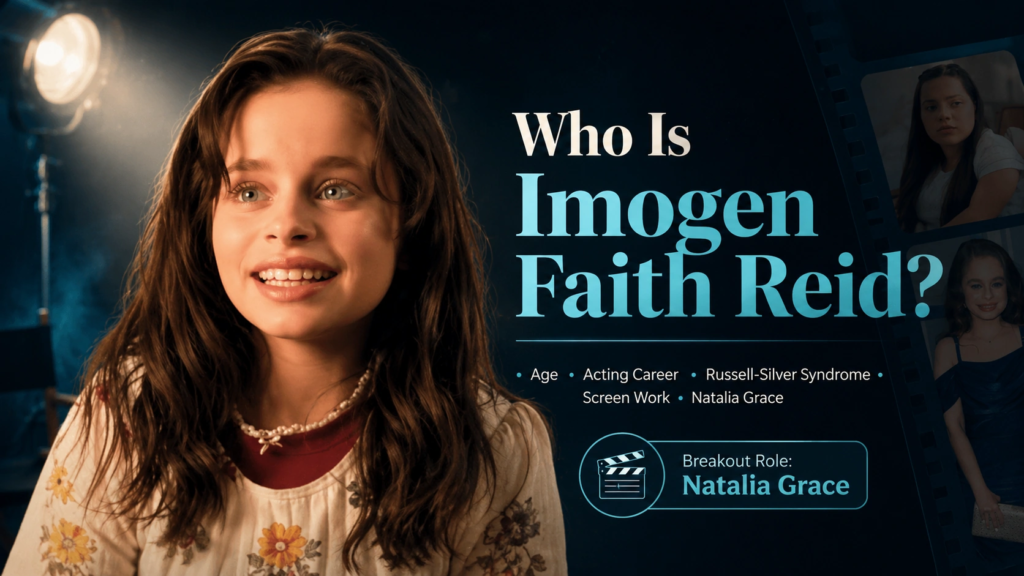
Reid is a British actress born in May 1997. As of June 2026, she is 29 years old. She lives with Russell-Silver syndrome, also called Silver-Russell syndrome, a rare growth condition. Her most prominent role is Natalia Grace in Hulu’s limited drama Good American Family, which premiered in the United States in March 2025 and later became available through Disney+ in international markets.
In my view, Reid’s performance attracted attention for three connected reasons. She entered the production with little previous experience in speaking roles, she had to portray one person through sharply conflicting perspectives, and she was participating in a sensitive dramatization involving adoption, disability, identity, alleged abuse, and public judgment. Understanding her career requires us to consider all three factors rather than reducing her story to her age, height, or medical condition.
Key Takeaways About Imogen Faith Reid
- Imogen Faith Reid is a British actress born in May 1997.
- She was 29 years old as of June 2026.
- She has Russell-Silver syndrome, a rare condition associated with restricted growth before and after birth.
- Reid plays Natalia Grace in Hulu’s limited series Good American Family.
- The role was her first major speaking part and her first leading television performance.
- Before becoming a lead actress, she worked as a body double, picture double, featured performer, stunt performer, and stage entertainer.
- Reid and Natalia Grace have different forms of dwarfism.
- She worked with acting, dialect, and movement coaches while preparing for the role.
- Publicly available profiles do not provide a verified figure for her wealth or earnings.
- Reid discussed an upcoming project in 2025, but its title had not been publicly confirmed through her major professional profiles by June 2026.
The central lesson I draw from her career is that an actor’s preparation may begin long before viewers hear that actor speak on screen. Production experience, movement awareness, live performance, patience, and the ability to observe established performers can all become part of an actor’s training.
Who Is Imogen Faith Reid?
Imogen Faith Reid is an English actress and performer who became internationally recognised for portraying Natalia Grace in Good American Family. Hulu describes her as an emerging actress whose earlier experience crossed film, television, live theatre, doubling, featured performance, and stunt work. [1]
Reid was born in England in May 1997 and is based in London. Public sources sometimes list a specific day in May, but the month and year are the details consistently supported across major professional profiles. Using those verified details, she turned 29 in May 2026.
Her route into acting began with an interest in singing and performance. In an interview with the Casting Society, Reid explained that drama classes at school helped her recognise the sense of creative escape she experienced when embodying another character. She later trained at the Miskin Theatre, part of North Kent College, completing performing arts and production-related study. [1][5]
That education gave her a formal foundation, but her professional development did not begin with conventional dialogue-heavy roles. Reid took jobs that placed her inside large productions while requiring her to contribute in less visible ways. She performed as a featured artist, worked as a double, participated in physical and stunt-related sequences, and gained experience in theatre.
From my perspective, this distinction matters. A body double is not merely someone who resembles another performer. Depending on the production, a double may need to match movement, positioning, costume, rhythm, physical proportions, and camera requirements. The work demands concentration and consistency, particularly when visual continuity is important.
Reid’s experience gave her access to professional sets and showed her how major productions operate. It also allowed her to observe directors, camera crews, actors, stunt teams, costume departments, and other specialists. Although those jobs did not immediately make her a familiar public figure, they formed a practical apprenticeship.
Imogen Faith Reid’s Biography at a Glance
The following table separates established facts from details that are frequently repeated without strong verification.
| Category | Verified information | Relevant context |
|---|---|---|
| Full name | Imogen Faith Reid | Sometimes credited as Imogen Reid |
| Birth date | May 1997 | She was 29 as of June 2026 |
| Nationality | British | Professional interviews describe her as London-based |
| Profession | Actress and performer | She has also worked as a body double, picture double and featured performer |
| Medical condition | Russell-Silver syndrome | The condition is different from Natalia Grace’s diagnosis |
| Breakout role | Natalia Grace in Good American Family | Her first major speaking and leading screen role |
| Training | Miskin Theatre and performing arts programmes | Her studies included performance and production |
| Earlier experience | Film, television, theatre, doubling and stunt-related work | Many earlier credits were not conventional character roles |
| Confirmed relationship status | Not publicly established through reliable professional sources | Private-life speculation should not be presented as biography |
| Verified net worth | Not publicly available | Online estimates should be treated as unconfirmed |
The most important takeaway is that Reid was not entirely new to entertainment when she joined Good American Family. She was new to leading a major television drama, but she already understood the realities of sets, performance schedules, physical preparation, and production teamwork.
How Imogen Faith Reid Began Performing
Reid has said that singing was one of her earliest creative interests. She enjoyed entertaining people and imitating singers before drama became a more serious ambition. Her interest in acting developed more clearly during her teenage years when school drama classes allowed her to explore different characters.
She subsequently trained at the Miskin Theatre for several years. Hulu’s official biography notes that she completed a BTEC Level 3 Performing Arts programme and further performing and production studies. [1] This combination is useful because production education can give an actor a broader understanding of how performance fits into the technical process.
Theatre also became an important part of her development. Reid appeared in productions of Snow White and the Seven Dwarfs, including British pantomime performances. Pantomime can demand singing, dancing, direct audience engagement, comic timing, physical exaggeration, and the ability to react when a live performance changes unexpectedly.
I believe stage work can be particularly valuable for a developing screen actor because it builds stamina and presence. A theatre performer cannot simply stop when an audience reacts differently than expected. The actor must maintain the scene, adjust timing, and continue communicating clearly.
Consider a hypothetical example. An actor may spend weeks preparing a comic exchange, only to discover that one audience laughs for twice as long as another. The performers must delay the next line without losing momentum. That skill does not transfer directly to every television scene, but it strengthens concentration and responsiveness.
The Film and Television Work Reid Did Before Becoming a Lead
Before Good American Family, Reid worked on several well-known productions, although her responsibilities varied considerably. It would be misleading to describe every assignment as a standard acting role because some involved doubling, featured performance, physical work, or production support.
Hulu’s official biography states that she appeared as a tap-dancing member of a circus troupe in Fantastic Beasts: The Crimes of Grindelwald. She later doubled for young Cosette in the television adaptation of Les Misérables, an assignment that included harness-based physical work. [1]
She also worked on HBO’s The Third Day, doubling the child of Jude Law’s character. Reid has identified this as her first professional screen credit and described the pride she felt when she saw it listed. [5]
Other publicly documented work includes assignments connected to The Famous Five, The Lord of the Rings: The Rings of Power, House of the Dragon, The Creator, and The One and Only Ivan. Her responsibilities were not identical on every project. Professional listings distinguish between featured appearances, doubling, picture-double work, small-scale doubling, and stunt-related participation. [1][6]
That distinction protects the accuracy of her biography. It also makes her career more interesting. Reid learned from jobs that many viewers rarely think about, even though those roles help productions maintain continuity and safely complete difficult shots.
A picture double, for example, may replace a principal performer in shots where the face is not clearly visible. A scale double may help create visual relationships between performers, sets, props, or camera angles. A stand-in usually helps the crew prepare lighting and framing before the principal actor steps onto the set.
These jobs require reliability. A performer must reproduce positions, understand instructions quickly, and remain attentive during repeated technical adjustments. In my analysis, Reid’s comfort with physical detail later became especially relevant when she prepared to portray Natalia Grace.
Imogen Faith Reid’s Breakthrough in Good American Family
Good American Family is a Hulu limited series inspired by events surrounding Natalia Grace, a Ukrainian-born adoptee with a rare form of dwarfism. The drama stars Reid alongside Ellen Pompeo and Mark Duplass, who play Kristine and Michael Barnett. The supporting cast includes Dulé Hill, Christina Hendricks, Sarayu Blue, and Jenny O’Hara. [2]
The series uses multiple perspectives to examine how fear, bias, trauma, and conflicting accounts shape the way a person is perceived. This structure placed an unusual burden on the actress playing Natalia.
In certain scenes, Reid needed to present Natalia as the Barnetts believed they saw her. In other scenes, the audience encounters events from Natalia’s own perspective. Changes in framing, performance, context, and emotional emphasis can make the same person appear threatening in one moment and vulnerable in another.
Reid was selected after an international search. Business Insider reported that she submitted a self-taped audition and went through multiple online callbacks before securing the role. The production cast her before several of the better-known performers because finding the right Natalia was central to moving the series forward. [3]
Series creator Katie Robbins described the moment the casting team recognised Reid’s potential:
“It was that kind of moment where you see her and you’re just like, this person is a star.”
Katie Robbins, quoted by Business Insider
This quotation matters because it shows that Reid was not selected merely because she physically fit part of the role. The creative team responded to what she communicated in the audition, including the emotional variations she could bring to a character whose presentation changes with the storyteller’s perspective.
The role became Reid’s first major speaking performance. She was moving from work in which she often supported another performer’s visual presence to a role requiring her to carry long emotional sequences, develop relationships across an entire series, learn a different accent, and become the central figure in an internationally discussed story.
Why the Casting Team Chose an Adult Actress
Natalia is shown at different ages during the series, so some viewers initially assumed that Reid was a child actor. Reid was actually in her twenties during production.
The decision to cast an adult had both creative and ethical dimensions. According to the show’s creators, the role required the performer to move between conflicting representations of Natalia, including scenes involving distressing subject matter. An adult actress could handle the working conditions and emotional demands without placing a child performer in the same position. [3]
Reid’s stature also allowed the production to present Natalia at different stages of her story without changing the central performer. This continuity was important because the audience needed to recognise one character even when the series changed the way it interpreted her behaviour.
In my view, the casting demonstrates why screen age and real age should not automatically be treated as the same thing. Casting depends on the needs of the story, the safety of the performer, visual credibility, emotional ability, and production design.
A useful hypothetical comparison would be a series told partly through a frightened adult’s memory and partly through a child’s recollection. The actor might need to alter posture, vocal energy, facial tension, and movement for each version. An adult performer with the appropriate physical characteristics may offer the production greater control over those demanding transitions.
How Reid Prepared to Play Natalia Grace
Reid approached the role with several forms of professional support. Disney connected her with an acting coach who helped her analyse the script, understand Natalia’s intentions, and break down difficult scenes. She also worked with a dialect coach to develop an American accent. [3][4]
Movement preparation was particularly important. Reid and Natalia Grace both have forms of dwarfism, but they do not share the same diagnosis. Reid has Russell-Silver syndrome, while Natalia has spondyloepiphyseal dysplasia congenita.
Because different conditions can affect the body in different ways, Reid did not want to copy Natalia’s physicality superficially. She worked with a movement coach to find a respectful performance that acknowledged Natalia’s movement while remaining genuine to Reid’s own body. [4]
This is a subtle but significant acting problem. I believe responsible physical characterisation requires more than reproducing visible gestures. The performer must understand what movements are safe, how the character’s physical experience affects daily behaviour, and where imitation could become disrespectful or medically inaccurate.
The preparation process included three main layers:
- Emotional interpretation: Reid worked through Natalia’s objectives, fears, reactions, and relationships.
- Vocal transformation: She developed an American accent while preserving emotional clarity.
- Physical characterisation: She worked with a movement specialist to distinguish Natalia’s physicality from her own without turning disability into an exaggerated performance.
That combination helped Reid construct what she repeatedly called her own version of Natalia. She did not claim to reproduce the real person perfectly. Instead, she created a dramatic interpretation grounded in the scripts, available research, coaching, and her understanding as another little person.
Reid’s Connection With Natalia Grace’s Experiences
Reid had not followed Natalia Grace’s story before auditioning for the series. Once cast, she began researching the events and the competing narratives surrounding them. The production did not arrange direct contact between Reid and Natalia.
This meant Reid had to balance factual research with the requirements of a fictionalised television drama. She could study public information and approach the role sympathetically, but she could not claim to know Natalia’s private thoughts.
That limitation is worth acknowledging. A performance based on a living person is still an interpretation, especially when the production openly uses multiple perspectives and dramatised scenes. Viewers should not treat every line of dialogue as a documentary record.
Reid has nevertheless explained that her own experience as a little person helped her understand the effects of judgment. She could recognise how strangers form assumptions based on appearance and how those assumptions can influence a person’s treatment.
From my perspective, this connection strengthened her performance without making her life identical to Natalia’s. Shared experience can provide emotional insight, but it does not erase differences in diagnosis, upbringing, nationality, family history, or trauma.
How Perspective Shapes Reid’s Performance
One of the most interesting features of Good American Family is its use of unreliable or incomplete perspective. Early scenes may encourage viewers to interpret Natalia through the fears of other characters. Later material changes the emotional context and asks the audience to reconsider what it previously accepted.
For Reid, this meant playing behaviour that could be interpreted in more than one way. A look might appear calculating from one character’s perspective but frightened from another. Silence could seem threatening in one version and protective in another.
This type of performance depends on precision. The actor cannot simply play a villain in one episode and a victim in another. There must be enough continuity for both portrayals to feel connected to the same character.
I have found that the strongest way to understand this challenge is to imagine one event filmed twice. In the first version, the camera stays close to an anxious parent, the music creates suspicion, and the child remains partially hidden. In the second, the camera stays with the child, removes the threatening music, and reveals what happened before the parent entered the room. The actor’s movements may be similar, but the audience’s interpretation changes.
Reid discussed this contrast in interviews, explaining that scenes from Kristine’s point of view allowed Natalia to appear sharper and more unpredictable, while scenes from Natalia’s perspective revealed the child beneath other people’s assumptions. [7]
Her performance therefore supports the series’ broader question: how easily can presentation become mistaken for truth?
Russell-Silver Syndrome and Imogen Faith Reid
Reid was born with Russell-Silver syndrome, which is also commonly called Silver-Russell syndrome. It is a rare disorder associated with slow growth before and after birth. Medical references also describe possible feeding difficulties, differences in body symmetry, short stature, and other features that can vary from person to person. [8]
MedlinePlus estimates that Silver-Russell syndrome may affect approximately one in 30,000 to one in 100,000 people. The genetic causes are complex. Some cases involve changes affecting the regulation of growth-related genes on chromosomes 7 or 11, while a substantial percentage have no identified genetic cause. [8]
A diagnosis does not mean every affected person has the same symptoms or needs. Medical conditions exist across a spectrum, and an individual’s abilities cannot be inferred solely from a diagnostic label.
Russell-Silver Syndrome and Natalia Grace’s Condition Compared
This table clarifies a frequent source of confusion.
| Point of comparison | Imogen Faith Reid | Natalia Grace |
| Condition | Russell-Silver syndrome | Spondyloepiphyseal dysplasia congenita |
| Shared general characteristic | Both may be described within conversations about dwarfism or short stature | Both may be described within conversations about dwarfism or short stature |
| Are the conditions identical? | No | No |
| Why movement coaching mattered | Reid needed to create physicality that respected Natalia’s different condition | Natalia’s movement could not responsibly be represented through simple imitation |
| Appropriate conclusion | Reid brought relevant lived understanding as a little person | Her personal experience did not make her medically or biographically identical to Natalia |
The essential point is that “dwarfism” is a broad term rather than a single diagnosis. Different underlying conditions can affect proportions, joints, growth, mobility, posture, and medical needs in different ways.
This article cannot determine the health status or medical needs of either individual beyond information they or reputable sources have made public. Readers looking for medical guidance should consult qualified clinicians and recognised medical organisations.
Why Reid’s Casting Matters for Disability Representation
Reid’s casting contributed to a continuing discussion about who gets to portray disabled characters. Productions have historically cast non-disabled performers in many disabled roles, sometimes treating disability as a transformation designed to display acting skill.
Good American Family made a different choice. The production sought a little person for Natalia and conducted an international search. Reid’s condition is not identical to Natalia’s, but her lived experience allowed her to understand forms of social judgment that a performer without dwarfism might not recognise as directly.
Authentic casting does not automatically guarantee accurate storytelling. Scripts, direction, editing, marketing, and production culture remain important. However, casting an actor with relevant lived experience can bring knowledge into the creative process that would otherwise be absent.
Reid has also spoken about learning to embrace the qualities that make her distinctive. Her comments resist the idea that success requires an actor to hide physical difference.
One of her clearest observations was:
“Our differences make us who we are, and that’s amazing.”
Imogen Faith Reid, ReVamp Magazine
I interpret this as more than a general statement about confidence. Within the context of her career, it points to a practical industry issue. The same physical difference that may limit access to conventional casting can also make a performer uniquely qualified for roles that require authenticity, scale awareness, movement knowledge, or a particular perspective.
Representation should not confine an actor to stories about disability. The next stage of progress would allow performers such as Reid to play characters whose disability is present but not the entire purpose of the plot.
Learning From Ellen Pompeo and Mark Duplass
Joining a major series opposite experienced actors created an intense learning environment. Reid has described Ellen Pompeo and Mark Duplass as supportive colleagues who took her under their wing.
That guidance mattered because Reid was moving into what the industry calls the “first team,” meaning the group of principal actors rather than the doubles and stand-ins who support them. She already knew the physical environment of a set, but she now had to manage the responsibilities of a lead performer.
These responsibilities include maintaining character continuity across scenes filmed out of sequence, protecting emotional energy, communicating concerns, adjusting quickly to direction, and repeating intense material for different camera setups.
In a later Casting Society interview, Reid reflected on the experience:
“I feel truly grateful for the experience I had.”
Imogen Faith Reid, Casting Society
The quotation is simple, but the surrounding interview gives it weight. Reid described receiving advice from Pompeo and Duplass while adapting to a level of responsibility she had not previously experienced.
A new lead actor may need to learn when to ask a question, how to preserve energy during long days, and how to communicate when a scene becomes physically or emotionally difficult. Experienced colleagues can make that transition less isolating.
Imogen Faith Reid’s Known Screen and Stage Experience
The following table distinguishes her breakout acting role from earlier production assignments.
| Production or area | Type of work associated with Reid | What the experience likely developed |
| Fantastic Beasts: The Crimes of Grindelwald | Featured circus performer and tap dancer | Choreography, timing and large-set experience |
| Les Misérables television production | Young Cosette double with harness-related work | Physical precision and stunt awareness |
| The Third Day | Body double | Continuity, camera positioning and dramatic-set experience |
| House of the Dragon | Featured background performance | Work within a large ensemble production |
| The Creator | Stunt-related work | Physical performance and action-set procedures |
| The Famous Five | Picture-double work | Visual matching and continuity |
| The Lord of the Rings: The Rings of Power | Small-scale doubling | Scale-based visual production techniques |
| Snow White and the Seven Dwarfs | Stage and pantomime performance | Live timing, character work and audience engagement |
| Good American Family | Lead role as Natalia Grace | Dialogue, accent work, emotional performance and series continuity |
The table shows progression rather than a sudden change from no experience to television stardom. Each assignment involved a different form of discipline, and those disciplines converged when Reid became a lead.
How to Explore Imogen Faith Reid’s Work Step by Step
Readers who discover Reid through Good American Family can explore her career more accurately by following a deliberate process.
1. Begin With Good American Family
Watch the series while paying attention to changes in point of view. Notice how Reid adjusts Natalia’s posture, vocal quality, expression, and emotional openness depending on whose version of events is being presented.
Streaming availability differs by country. Hulu carries the programme in the United States, while Disney+ has distributed it in several international markets.
2. Separate Acting Roles From Doubling Credits
When reviewing Reid’s earlier credits, look at the type of assignment rather than assuming every listing represents a named speaking character. Terms such as body double, picture double, scale double, featured artist, and stunt performer describe different responsibilities.
This approach prevents viewers from expecting to find Reid in a prominent dialogue scene when her contribution may have been technical or physical.
3. Read Interviews About Her Preparation
Her interviews with publications such as ReVamp, TresA, Business Insider, and the Casting Society provide valuable explanations of the audition process, movement coaching, dialect preparation, and her transition from doubling to leading.
First-person interviews are particularly useful because they distinguish Reid’s own statements from assumptions made by entertainment websites.
4. Verify Medical Information Separately
Use medical organisations such as MedlinePlus, the National Organization for Rare Disorders, or NHS genomics resources when learning about Russell-Silver syndrome.
An actor’s interview can describe personal experience, but it should not replace clinical information about causes, diagnosis, management, or inheritance.
5. Check Professional Profiles for New Projects
Reid’s agency profile and official production announcements are stronger sources for future work than unsourced celebrity pages. She said in 2025 that she had another project in development, but the title was not yet public.
Until a production company, network, recognised trade publication, or professional representative confirms the title, readers should avoid treating online speculation as established fact.
Common Misconceptions About Imogen Faith Reid
Misconception: Reid Was a Child When Good American Family Was Filmed
Reid was an adult actress in her twenties. Her appearance, stature, costume, performance, and the production’s visual choices allowed her to portray Natalia across younger stages of the story.
Describing Reid as a child actor is inaccurate and may also reinforce the harmful assumption that adults with dwarfism should be treated as children.
Misconception: Reid and Natalia Have the Same Condition
They have different diagnoses. Reid has Russell-Silver syndrome, while Natalia Grace has spondyloepiphyseal dysplasia congenita.
Both conditions may be discussed in relation to dwarfism, but that does not make them medically interchangeable.
Misconception: Good American Family Was Reid’s First Time on a Set
It was her first major speaking role and first television lead, not her first professional production. She had already worked on film and television sets in several capacities.
Her previous experience helped her understand set etiquette, physical continuity, technical repetition, and collaboration.
Misconception: Every Earlier Credit Was a Conventional Acting Role
Some of Reid’s earlier work involved doubling, stunts, featured performance, or production support. Those jobs are legitimate professional credits, but they should be described accurately.
Inflating a doubling credit into a speaking character role does not strengthen her biography. It obscures the distinctive path she actually followed.
Misconception: The Series Is a Documentary
Good American Family is a dramatised limited series inspired by real events. It uses created dialogue, compressed storytelling, structured perspectives, and dramatic interpretation.
Viewers can learn about themes and public events through the programme, but they should consult documentary reporting and primary legal records before treating a scene as historical proof.
Misconception: Reid Has a Verified Public Net Worth
No authoritative public financial filing establishes Reid’s net worth. Celebrity wealth websites may publish estimates, but such numbers often rely on speculation about salaries, contracts, property, or advertising income.
In my view, the responsible answer is that her net worth is not publicly verified.
Misconception: Reid Has Publicly Confirmed Every Detail of Her Private Life
Professional biographies focus primarily on her work, training, condition, interests, and creative ambitions. Relationship rumours or claims about family members should not be repeated unless Reid confirms them in a reliable public source.
A person’s growing visibility does not remove the right to personal privacy.
Recommendations for Watching Reid’s Performance Thoughtfully
I recommend approaching Good American Family as a drama about interpretation rather than a simple mystery about whether one character is good or bad. The programme deliberately shows how camera placement, memory, fear, and authority can influence belief.
First, pay attention to who controls the story in each episode. A character with more social authority may appear automatically credible, even when the audience has not independently verified that character’s claims.
Second, notice how disability affects other characters’ assumptions. Reid’s performance invites viewers to question whether unusual movement, dependence, silence, or emotional distress is being interpreted fairly.
Third, separate sympathy for a performance from certainty about every historical detail. Reid can create an emotionally persuasive character without the fictional series becoming a complete factual record.
Finally, avoid infantilising the actress while praising her ability to portray a child. Reid is an adult professional. Her work should be discussed in terms of acting choices, preparation, emotional control, and collaboration rather than treating her stature as a novelty.
What Makes Imogen Faith Reid’s Performance Stand Out
The strength of Reid’s performance lies in contrast. She can appear guarded in one scene and openly childlike in another without making the character feel disconnected. That contrast supports the show’s changing perspectives.
Her face and voice often carry more information than the dialogue. A moment of hesitation may show that Natalia is calculating how much she can safely reveal. An abrupt change in energy may suggest fear rather than manipulation.
Reid also avoids playing vulnerability as constant helplessness. Her Natalia can be playful, angry, stubborn, observant, confused, affectionate, and defensive. Those variations give the character more humanity than a performance built around a single emotional label.
I believe her previous doubling work may have contributed to this physical precision. A performer accustomed to matching positions and repeating movement can be highly aware of posture, direction, and visual continuity.
Her stage experience may also have helped her commit to clear emotional choices. Live performers learn that an intention must remain readable even when circumstances around the performance change.
None of these factors alone explains her success. Together, they show why career development cannot always be measured by the number of speaking credits on a résumé.
What Is Next for Imogen Faith Reid?
In interviews published during 2025, Reid said that she had another project in progress but could not yet reveal the details. TresA reported that she was working on an unannounced production, and Reid said she was excited to discuss it when permitted. [7]
As of June 2026, the major publicly accessible profiles reviewed for this article did not clearly identify that project by title. Her professional agency profile continued to foreground Good American Family and her established television credits. [6]
The responsible position is therefore to acknowledge her statement without guessing. Film and television projects may remain confidential, change titles, experience delays, or never move into public production.
Her future casting will be particularly interesting because Good American Family demonstrated that she can sustain complex dramatic material. The next question is whether the industry will offer her a wider range of characters.
I would like to see her considered for contemporary drama, comedy, fantasy, musical work, voice performance, and roles in which her stature is not the central conflict. Meaningful inclusion develops when actors with disabilities can participate across genres rather than only when a story specifically requires a disability narrative.
Conclusion
Imogen Faith Reid’s career shows why the work before a breakthrough deserves attention. She did not arrive on Good American Family without preparation. Her theatre training, doubling assignments, featured appearances, physical performance work, and experience on major sets gave her a practical foundation for her first leading role.
I believe the most useful way to understand Imogen Faith Reid is to look beyond simplified labels such as “newcomer” or “the actress who looks like a child.” She is an adult British performer whose personal experience as a little person informed, but did not completely define, her portrayal of Natalia Grace.
Her preparation also demonstrates the value of responsible collaboration. Acting coaching helped her understand the script, dialect training supported the American voice, and movement coaching helped her respect the differences between her condition and Natalia’s.
The practical next step is to watch Good American Family with close attention to perspective. Then compare the performance with Reid’s interviews and verified professional history. Doing so reveals not only a breakout actress, but also the years of less visible work that helped make the breakthrough possible.
Frequently Asked Questions
Who Is Imogen Faith Reid?
Imogen Faith Reid is a British actress best known for playing Natalia Grace in Hulu’s limited series Good American Family. Before receiving the lead role, she worked in theatre, featured performance, doubling, and stunt-related production assignments. Her previous credits are connected to projects such as The Third Day, Les Misérables, The Famous Five, House of the Dragon, and The Lord of the Rings: The Rings of Power.
How Old Is Imogen Faith Reid?
Imogen Faith Reid was born in May 1997, making her 29 years old as of June 2026. She was in her twenties when she portrayed Natalia Grace at several younger ages in Good American Family. She is therefore an adult actress, not a child performer. Her ability to portray younger ages comes from her stature, character work, costume, makeup, movement, and the visual construction of the series.
What Condition Does Imogen Faith Reid Have?
Imogen Faith Reid has Russell-Silver syndrome, also known as Silver-Russell syndrome. It is a rare condition generally associated with restricted growth before and after birth. Features and medical needs vary among individuals. Reid has discussed embracing her difference, but readers should use recognised medical sources rather than entertainment profiles for clinical information.
Does Imogen Faith Reid Have the Same Condition as Natalia Grace?
No. Reid has Russell-Silver syndrome, while Natalia Grace has spondyloepiphyseal dysplasia congenita. Both are associated with short stature or dwarfism, but they are medically different conditions. This difference is one reason Reid worked with a movement coach. She wanted to represent Natalia’s physicality respectfully without simply copying movements that might not be natural or safe for Reid’s own body.
Was Good American Family Imogen Faith Reid’s First Acting Role?
It was her first major speaking role and first television lead, but it was not her first professional entertainment job. Reid had previously worked as a double, featured performer, stage actress, and stunt-related performer. Those assignments allowed her to gain experience on major productions before she became widely known to audiences.
Did Imogen Faith Reid Meet Natalia Grace?
Public interviews indicate that Reid did not speak directly with Natalia Grace while preparing for the series. She researched the publicly documented story, worked with coaches, consulted the scripts and production team, and developed her own dramatic interpretation. Because the series is fictionalised, her portrayal should not be treated as a perfect recreation of Natalia’s private thoughts or experiences.
What Movies and Television Shows Has Imogen Faith Reid Worked On?
Her professional history includes work connected to Fantastic Beasts: The Crimes of Grindelwald, Les Misérables, The Third Day, The One and Only Ivan, House of the Dragon, The Creator, The Famous Five, and The Lord of the Rings: The Rings of Power. The nature of her work varied, and several assignments involved doubling, featured performance, or stunt-related responsibilities rather than conventional speaking roles.
What Is Imogen Faith Reid’s Net Worth?
There is no reliable, publicly verified figure for Imogen Faith Reid’s net worth. Websites that provide exact estimates may be guessing based on presumed salaries or general industry rates. Actor contracts and personal finances are usually private. Without a financial disclosure or a direct statement from Reid or her representatives, presenting a specific number as fact would be misleading.
Is Imogen Faith Reid in a Relationship?
Reid has not made a relationship a central part of her verified professional biography. Reliable sources focus on her training, acting career, condition, interests, and experiences filming Good American Family. Claims about a partner should be treated as unconfirmed unless Reid chooses to discuss the subject publicly through a trustworthy source.
Does Imogen Faith Reid Have a New Project?
Reid stated in 2025 interviews that she had another project in development but could not reveal its title. By June 2026, the public professional profiles consulted for this article did not clearly identify the production. Readers should wait for confirmation from her agency, an official studio announcement, or a recognised entertainment trade publication.
Sources and References
- Hulu Press, “Imogen Faith Reid,” official cast biography, March 2025.
- Hulu Press, “Good American Family,” official series synopsis and cast information.
- Business Insider, “Meet Imogen Faith Reid, Who Won the Role of Natalia Grace After an International Search,” March 2025.
- ReVamp Magazine, interview with Imogen Faith Reid, May 2025.
- Casting Society, “Imogen Faith Reid, Actor of the Month,” November 2025.
- Independent Talent Group, professional profile and selected credits for Imogen Faith Reid.
- TresA Magazine, interview with Imogen Faith Reid, June 2025.
- MedlinePlus Genetics, “Silver-Russell Syndrome,” updated March 2025.
- National Organization for Rare Disorders, “Russell-Silver Syndrome.”
Disclaimer
This article is an informational biography based on publicly available professional profiles, interviews, entertainment reporting, and recognised medical references. It does not provide medical advice or attempt to diagnose any individual. Production credits, streaming availability, personal information, and future projects may change. Private details that have not been reliably confirmed have been excluded or clearly identified as unverified.